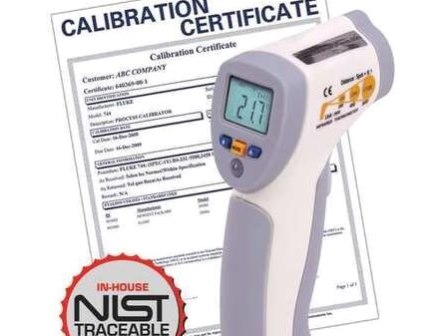
A digital infrared thermometer should always return accurate readings.
Whether you use it for cooking, to measure body temperature, atmospheric temperature, or any other relevant use, a thermometer should always be made to ensure the correct temperature.
From time to time, digital infrared thermometers will require recalibration. It is, thankfully, a very simple task.
Reset digital thermometer: Some digital thermometers do not require any adjustment of the screw or nut. You simply need to find the reset button.
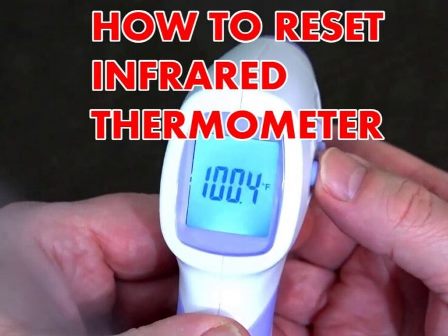
If the infrared thermometer does not work, you simply need to reset the medical device.
“Er” will appear on the display when the unit needs to be restarted. To reset the unit, remove the batteries, wait a few minutes, and then reinstall the batteries.
Check the following article for complete instructions on how to do it:
A digital infrared thermometer should always return accurate readings. Whether you use it for cooking, for measuring body temperature, atmospheric temperature, or any other relevant use, a thermometer should always be made to provide the correct temperature.
How does an infrared thermometer work? An Infrared Thermometer is a handheld device that can display temperature readout on it after scanning portions of an object or area with the built-in laser.
Infrared thermometers are used to measure, surface temperature up to 1500 ºC.
The main use of the infrared thermometer is to read a particular spot on a surface of the human body, food, machinery, or equipment that emits heat.
Infrared Thermometer how it works?
How does an infrared thermometer work?
An infrared thermometer is a non-contact temperature measurement device. Infrared Thermometers detect the infrared energy emitted by all materials, at temperatures above absolute zero, (0°Kelvin)– and convert the energy factor into a temperature reading.
The most basic design consists of a lens to focus the infrared (IR) energy onto a detector, which converts the energy to an electrical signal that can be displayed in units of temperature after being compensated for ambient temperature variation.
How infrared thermometer works?
This configuration facilitates temperature measurement from a distance without contact with the object to be measured. As such, the infrared thermometer is useful for measuring temperature under circumstances where thermocouples or other probe-type sensors cannot be used or do not produce accurate data for a variety of reasons.
Some typical circumstances are where the object to be measured is moving; where the object is surrounded by an EM field, as in induction heating; where the object is contained in a vacuum or other controlled atmosphere; or in applications where a fast response is required.
Digital Infrared Thermometer
What do infrared thermometers measure?
What temperatures do infrared thermometers measure?
Infrared thermometers allow users to measure temperature in applications where conventional sensors cannot be employed.
Why should I use an infrared thermometer to measure temperature in my application?
Specifically, in cases dealing with moving objects (i.e., Rollers, moving machinery, or a conveyor belt), or where non-contact measurements are required because of contamination or hazardous reasons (such as high voltage), where distances are too great, or where the temperatures to be measured are too high for thermocouples or other contact sensors.
What should I consider about my application when selecting an infrared thermometer?
The critical considerations for any infrared pyrometer include a field of view (target size and distance), type of surface being measured (emissivity considerations), spectral response (for atmospheric effects or transmission through surfaces), temperature range, and mounting (handheld portable, or fixed mount).
Other considerations include response time, environment, mounting limitations, viewing port or window applications, and desired signal processing.
Digital Infrared Thermometer
Infrared thermometer range
A most accurate temperature reading. What is meant by Field of View, and why is it important?
The field of view is the angle of vision at which the instrument operates, and is determined by the optics of the unit.
To obtain an accurate temperature reading, the target being measured should completely fill the field of view of the instrument. Since the infrared device determines the average temperature of all surfaces within the field of view, if the background temperature is different from the object temperature, a measurement error can occur.
Digital Infrared Thermometer offers a unique solution to this problem. Many infrared Thermometers feature a laser dot. A single laser dot marks the center of the measurement area.
Infrared thermometer working principle
Applications of digital thermometer: Working with an Infrared Thermometer.
Infrared Thermometers are ideal for investigations because they respond to temperature changes instantly. The key to successfully using an infrared thermometer is to understand exactly what it is that you are measuring.
Most infrared thermometers contain a built-in laser pointer to help the user determine which direction the thermometer is pointed to.
Many people incorrectly assume that when they are using an infrared thermometer, they are measuring the temperature of whatever the dot happens to be touching.
While an infrared thermometer does measure the temperature of the object that it is pointed at, the accuracy of the measurement varies with distance.
If you measure an object’s temperature at point-blank range, then for all practical purposes the temperature that is being displayed is the object’s temperature.
If you measure the same object’s temperature from 20 feet away, you will likely get a very different measurement.
The reason why this occurs is that the size of the cone that is being measured increases with distance.
Therefore, you aren’t just measuring the object that the thermometer is pointed at. The thermopile is also collecting infrared energy from the air between itself and the object. You may also be collecting infrared energy from other nearby objects. In these types of situations, the thermometer may report an average temperature or a dominant temperature.
Infrared thermometer how it works?
When using an infrared thermometer on an investigation, investigators should try to take measurements from as close to the target object as possible in order to ensure accuracy. It is also important to realize that an infrared thermometer is not usually capable of measuring a floating cold spot.
Working of digital thermometer:
Pointing the thermometer at a cold spot will yield the aggregate temperature of the cold spot, it is not actually displaying the cold spot’s temperature, but rather what you are seeing is the cold spot’s influence on the aggregate temperatures of nearby objects.
Holding the meter by its handle, point the IR Sensor toward the object whose temperature is to be measured. The meter automatically compensates for temperature deviations from the ambient temperature.
Keep in mind that it will take up to 30 minutes to adjust to wide ambient temperatures are to be measured followed by high-temperature measurements, some time (several minutes) is required after the low (and before the high) temperature measurements are made.
This is a result of the cooling process, which must take place for the IR sensor.
What does an infrared thermometer measure?
what does an infrared thermometer measure?
Infrared Thermometer Basics: Infrared thermometers measure temperature from a distance. This distance can be many miles or a fraction of an inch. Infrared thermometers are often used in circumstances when other sorts of thermometers are not practical. If an object is very fragile or dangerous to be near, for example, an infrared thermometer is a good way to get a temperature from a safe distance.
What temperature do infrared thermometers measure?
What Infrared Thermometers Do? Infrared thermometers work based on a phenomenon called black body radiation. Anything at a temperature above absolute zero has molecules inside of it moving around. The higher the temperature, the faster the molecules move.
Are infrared thermometers really accurate in detecting fever?
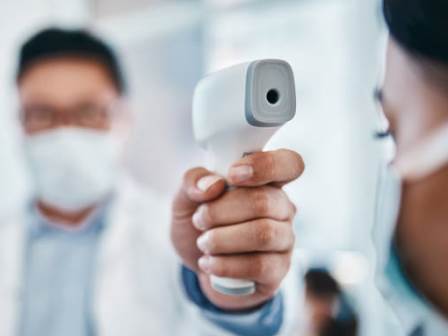
With the rise of the epidemic, many hospitals and businesses have implemented temperature checks for employees, patients, and customers using infrared thermometers.
These devices offer efficiency, safety, and accuracy in detecting fevers in large groups of people.
Research has shown that when used correctly, non-contact or infrared thermometers are just as accurate as oral thermometers.
Non-contact thermometers are popular with pediatricians, as children often fidget when trying to get a temperature reading.
The device offers security to both parties while providing a fast and accurate reading.
Of course, when available, a personal thermometer is the gold standard in healthcare, but due to the epidemic and the need for mass testing quickly, a non-contact thermometer has become the standard.
The operator must follow device protocol and will not detect a fever in someone who has taken fever-reducing medications.
But with many establishments now requiring temperature checks, these portable thermometers are proving to be safe, fast, and accurate while helping to reduce the spread of the epidemic.
Infrared forehead thermometer accuracy
For general home use, forehead thermometers will give you an idea of whether or not a person has a fever.
The environment in which a person uses a forehead thermometer can affect its accuracy, according to the Food and Drug Administration (FDA) trusted source.
The FDA writes that a draft, direct sunlight, or a heat source could affect the temperature reading and make it inaccurate.
The reading could also be inaccurate if a person has been wearing a headband or headband before taking it or if they have sweat or dirt on their forehead.
How to use infrared thermometer?
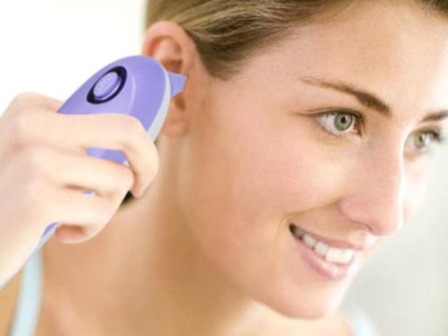
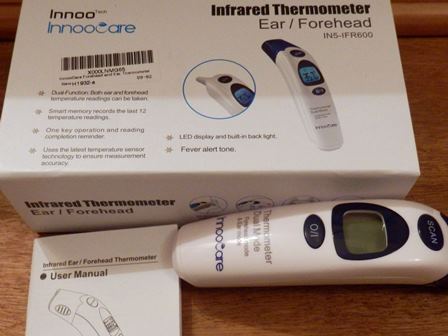
Forehead thermometers use infrared sensors to capture infrared radiation produced by the body. Although infrared radiation is not visible, it can be felt by a person as heat.
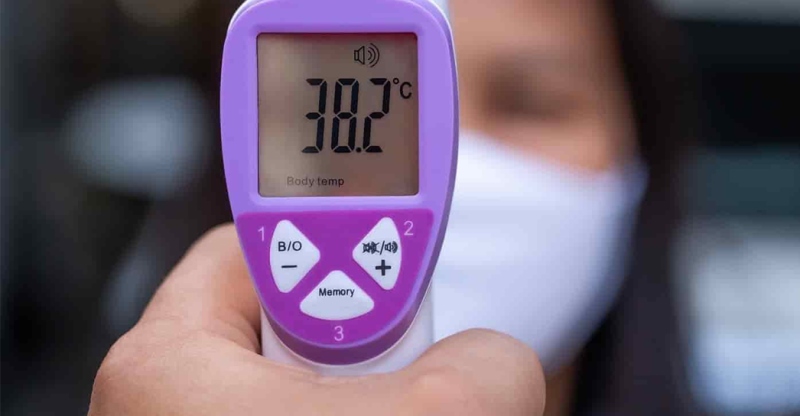
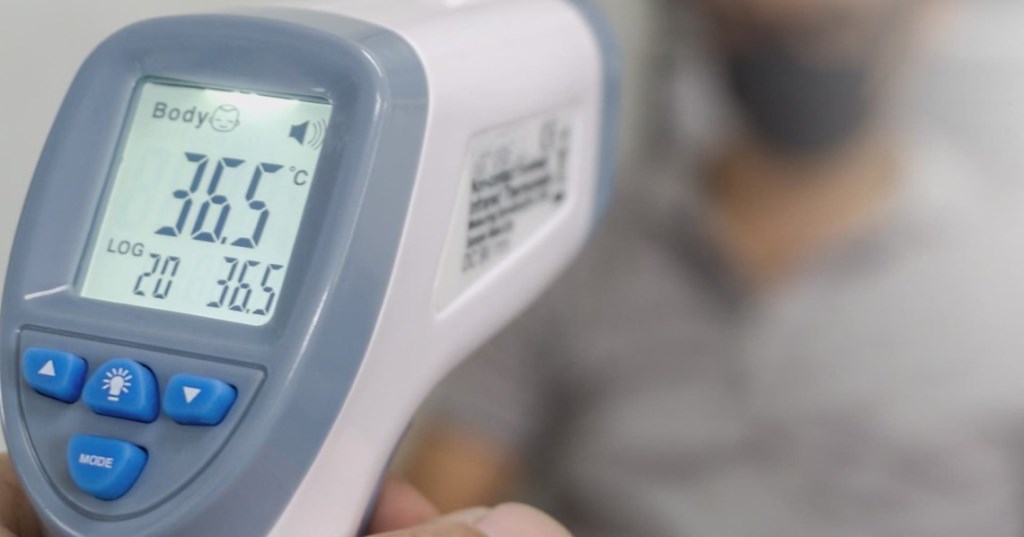
One person can take another person’s temperature with a forehead thermometer by holding the thermometer a few inches from the center of the forehead, just above the eyebrows.
The exact positioning will depend on the manufacturer’s instructions.
A lens inside the thermometer focuses the infrared radiation that the person emits. The thermometer measures this electrical reading and displays the result on the thermometer screen.
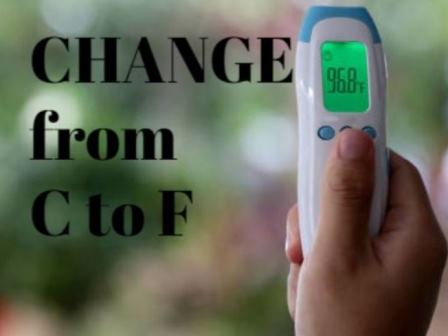
In the United States, thermometers usually show the temperature at °F. In many other countries, thermometers will show the temperature at °C.
It will only take a person a few seconds to take a temperature reading with a forehead thermometer.
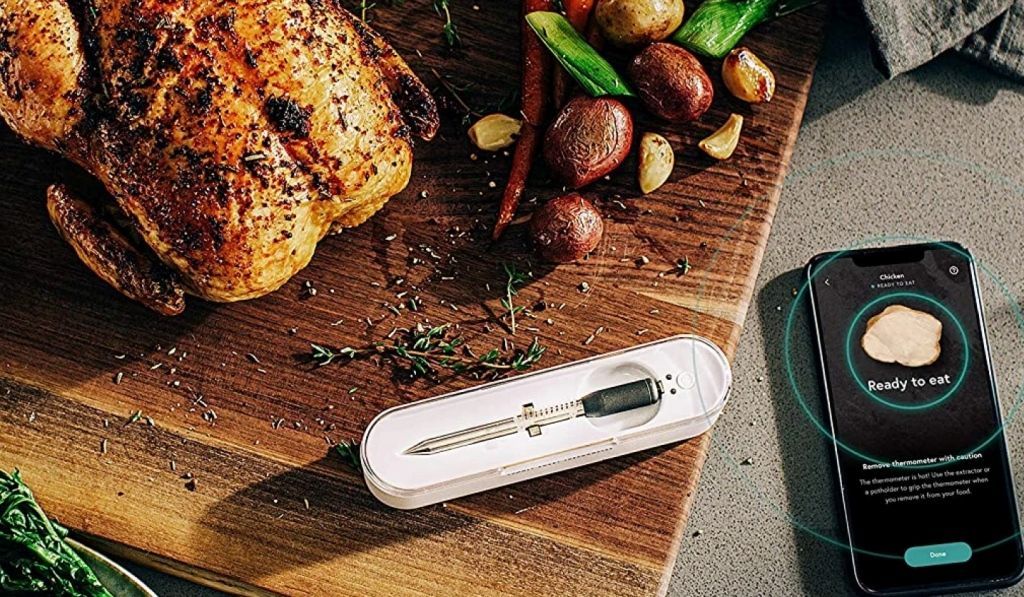
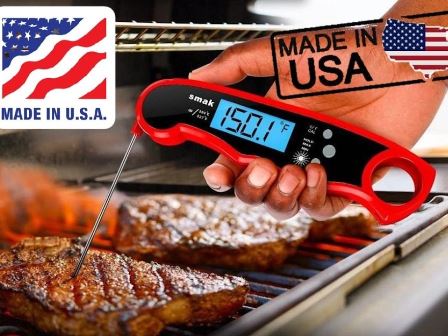
We’ve compiled a list of the best bluetooth thermometers made in the USA and all the pros and cons of a bluetooth meat thermometer.
For most people looking for the best bluetooth experience with a great app, easy pairing and decent range.
If your budget allows, I highly recommend choosing a device that has both Bluetooth and WiFi, as this fixes all the potential issues with limited range and dropped connection that you may experience with the Bluetooth-only options.
We have selected the best bluetooth barbecue thermometers on the market today.
These are our favorite thermometers to keep track of your grill or smoker on your smartphone or tablet.
Bluetooth meat Thermometer Made in USA
Wireless meat thermometer
Maybe you are an aspiring grill master or barbecue enthusiast or maybe you are looking to develop your meat cooking skills.
Whatever the reason you fire up the grill, it’s important to have a good wireless grill thermometer on hand.
As with other ways of cooking, grilling and smoking meat requires precision, especially when it comes to temperature.
A wireless meat thermometer will not only help you get the precise temperature you need to cook your meat evenly, but this device will also allow you to monitor temperatures from afar.
When it comes to choosing a meat thermometer, you’ll want to consider probe length, wireless range, temperature range, and other useful features.
While the basic models will get the job done, maybe you want an app that sends you alerts or tracks the ambient temperature over the course of your grilling session.
There are options in a variety of price ranges and styles for every type of grill, and we tried every option on this list.
Thermopro bluetooth thermometer
The ThermoPro TP25 grilling thermometer equipped with 5.0 Bluetooth technology monitors your food from up to 500ft away by the ThermoPro app.
Comes with 4 color-coded stainless-steel probes that can be used to read 4 types of food at once.
Independently set a timed alarm for each probe, making this device extremely convenient.
With its step-down probe tip design and backlit LCD display, receiving and reading an accurate temperature is simple even in the darkest conditions.
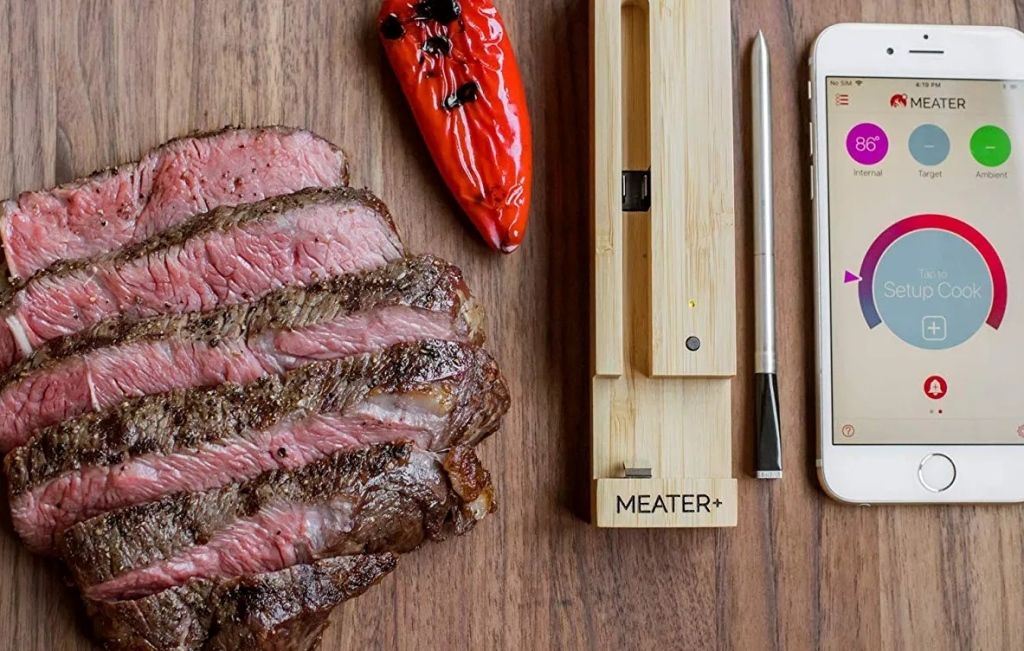
MEATER is the first truly wireless smart meat thermometer. Along with the MEATER app, it will help you cook the juiciest steak, chicken, turkey, fish, or other meats perfectly every time for every occasion.
Apption-Labs (MEATER) is headquartered in Leicester, United Kingdom, and also has offices in Los Angeles, CA, USA.
Product inspirations come from our own experiences and most importantly, from the actual people who need them.
While Bluetooth uses short-range radio waves to transmit signals, wireless can use radio waves, infrared, and internal memory.
Which is better wireless or Bluetooth?
Wi-Fi is better suited for operating full-scale networks because it enables a faster connection, better range from the base station, and better wireless security (if configured properly) than Bluetooth.
A digital thermometer should always return accurate readings. Whether you use it for measuring body temperature, atmospheric temperature, or any other relevant use.
The average home medical kit is not complete without a properly functioning digital thermometer. These useful devices can accurately read a person’s body temperature within a one-degree margin of error. However, sometimes digital thermometers come preset with an unfamiliar unit of temperature.
Fortunately, setting a digital thermometer is easy and can be accomplished by following these simple steps.
How to set Infrared Thermometer?
How to set digital thermometer?
Setup and Operation:
Hold the meter by its handle grip and point it toward the surface to be measured.
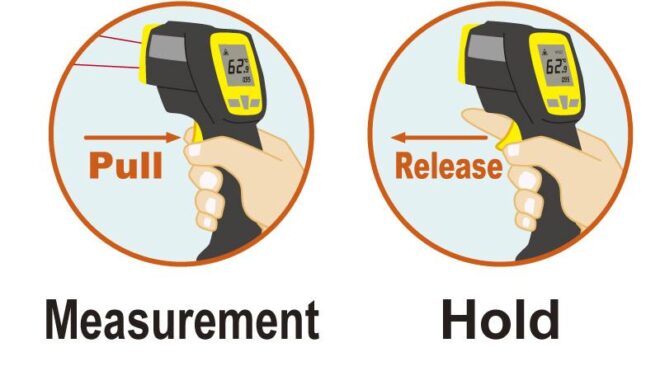
Pull and hold the trigger to turn the meter on and begin testing. The display will light if the battery is good. Replace the battery if the display does not light. Meter automatically powers down after 10 seconds once the trigger is released.
While measuring, the SCAN icon will appear in the upper left-hand corner of the LCD.
Release the trigger and the HOLD icon will appear at the top of the LCD, indicating that the reading is being held.
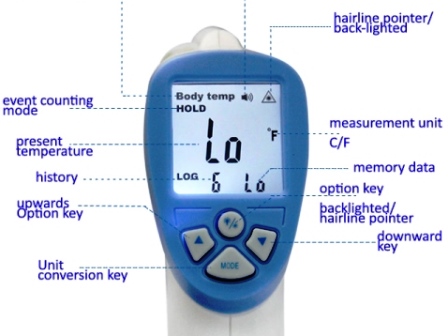
Press the Up ▲/ Laser button to turn on the laser pointer. When the laser is on, the Laser icon will appear at the top of the LCD. Press the Up ▲/ Laser button again to turn the laser off.
While in the HOLD mode, press the MODE button to access and set emissivity (EMS) value, temperature units (°C or °F), Max/Min readings, trigger lock (on/off), high alarm (on/off and set point), and low alarm (on/off and setpoint). Each time you press the MODE button, you advance through each option.
Digital thermometer instructions
Refer to the flow chart to see the sequence of functions in the model cycle.
Emissivity (EMS). When the Emissivity icon is flashing, use the Up ▲ and Down ▼ buttons to adjust from 0.10 to 1. Then press the MODE button again to enter the setting.
Trigger-Lock. Use for continuous monitoring of temperatures. When the Lock icon is flashing, use the Up ▲ or Down ▼ button to turn “on”. Then press the MODE button again to enter the setting. Once you press the measurement trigger, the Lock icon is shown, confirming the lock measurement mode. The meter will continuously display the temperature until the measurement trigger is pressed again.
High Alarm. When the High alarm icon is flashing, use the Up ▲ or Down ▼ button to turn “on”. Then press the MODE button again to enter the setting. The High alarm icon will still be flashing, allowing you to set the alarm trigger temperature setpoint from –31 to 1000°F (–35 to 537°C) using the Up ▲ and Down ▼ buttons. Press the MODE button again to enter the setting.
Low Alarm. When the Low alarm icon is flashing, use the Up ▲ or Down ▼ button to turn “on”. Then press the MODE button again to enter the setting. The Low alarm icon will still be flashing, allowing you to set the alarm trigger temperature setpoint from –31 to 1000°F (–35 to 537°C) using the Up ▲ and Down ▼ buttons. Press the MODE button again to enter the setting.
Infrared thermometer how to use?
Press and continue to hold down the trigger to take temperature readings. The unit will take temperature readings while the trigger is pressed and held (SCAN appearing on the display indicates measurements are being taken).
After the trigger is released, the last temperature measured will be displayed for approximately 15 seconds and the display will turn off automatically. HOLD will appear on the display when the trigger has been released to indicate that the unit is no longer.
How to set up the infrared thermometer?
The infrared thermometer is the most popular thermometer. It is easy to use, has short measurement time, accurate reading, and has voice settings. Even at night, it can be used to know its temperature. However, a factory infrared thermometer is required to be set; otherwise, the measured value is not accurate, so, how to set up the infrared thermometer?
how to set the infrared thermometer to Fahrenheit?
As for the setting of the infrared thermometer, in fact, the machine has been set at the factory and generally does not need to be adjusted. The warning threshold range is 33.0°C – 40.0°C. The factory default setting is 37.5°C.
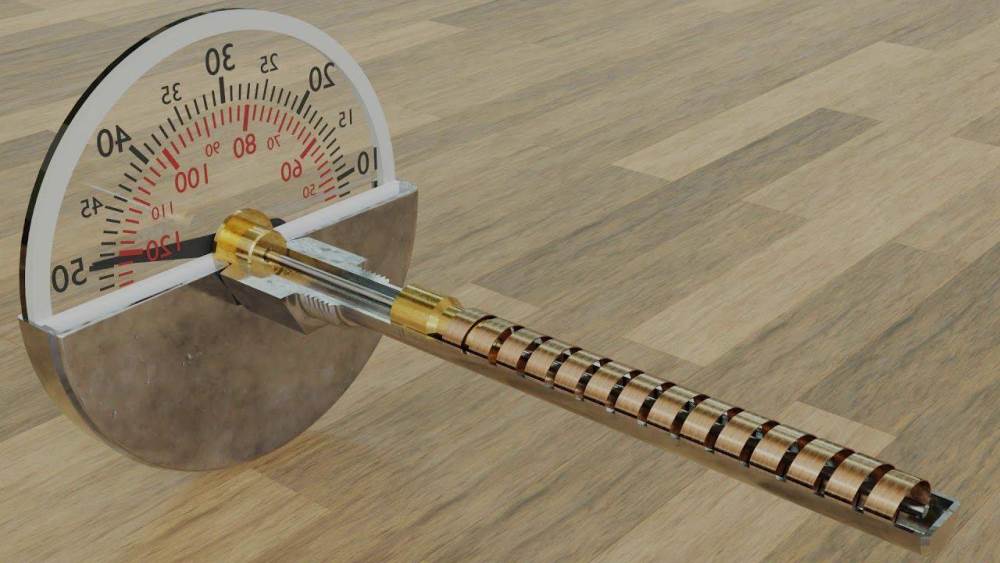
A bimetallic thermometer uses a bimetallic spring as a temperature sensing element. This technology uses a coil spring made from two different types of metals that are welded or clamped together. These metals can include copper, steel, or brass. When should a bimetal thermometer be calibrated?
A bimetallic thermometer is a temperature measurement device.
Converts the temperature of the medium into a mechanical displacement by means of a bimetallic strip.
The bimetallic strip consists of two different metals that have different coefficients of thermal expansion. Bimetallic thermometers are used in residential devices like air conditioners, furnaces, and industrial devices like heaters, hot wires, refineries, etc. They are a simple, durable, and cost-effective way to measure temperature.
When should a bimetal thermometer be calibrated?
When should a bimetallic stemmed or digital thermometer be calibrated?
The calibration method used at your facility will depend on the types of the temperature measuring device, monitoring frequency, and intended use (ex: product receiving, product storage tanks, cold storage areas, pasteurization).
The frequency of calibration depends on the type of thermometer and its intended use.
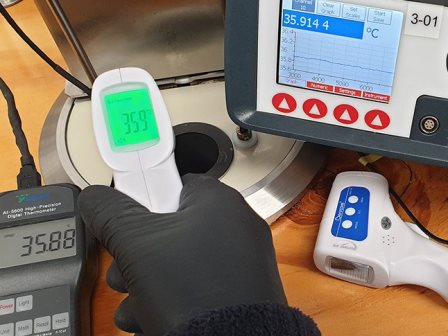
Thermometers should be calibrated: before use; if dropped; when going from one temperature range to another; and after a long storage time.
In most applications, a thermometer should be within ±1°F or ±0.5°C when compared to the reference thermometer used for calibration.
Accurate thermometers can be used as reference thermometers (ex: National Institute of Standards and Technology, NIST). In some critical applications calibration against a certified reference, a calibrated reference thermometer is required.
Bimetallic thermometer calibration
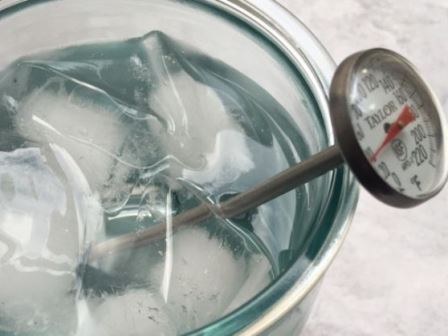
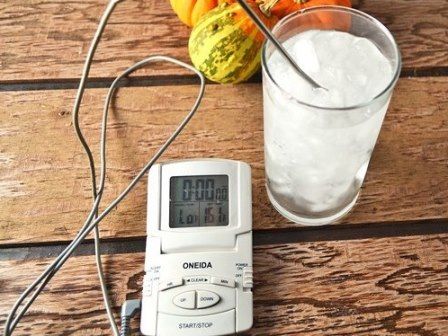
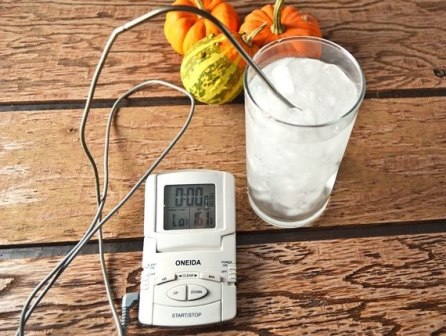
The most accurate method for calibrating the bimetallic thermometer is the ice point method. To calibrate a bimetallic thermometer using this method, fill a glass completely with ice, add cold water, and let it sit for 4 to 5 minutes.
Next, insert the stem of the thermometer into the ice water. Make sure the stem does not touch the bottom or sides of the glass.
Let it sit until the dial stops moving. If the thermometer is accurate, it should measure 0 ° C or 32 ° F. Otherwise, turn the nut located below the dial so that it reads 0 ° C.
Check at regular intervals to ensure accuracy. A weekly or monthly thermometer calibration process should be implemented depending on your application requirements.
A digital thermometer should always return accurate readings. Whether you use it for measuring body temperature, atmospheric temperature, or any other relevant use.
Temperature is a critical measurement for ensuring the safety and quality of many food products. There are a variety of commercial temperature monitoring devices available.