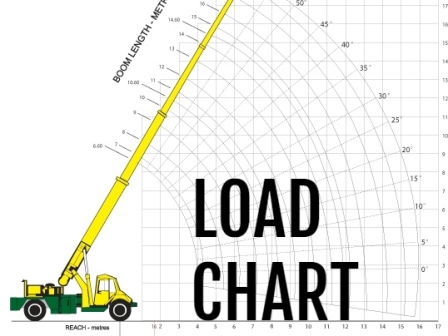
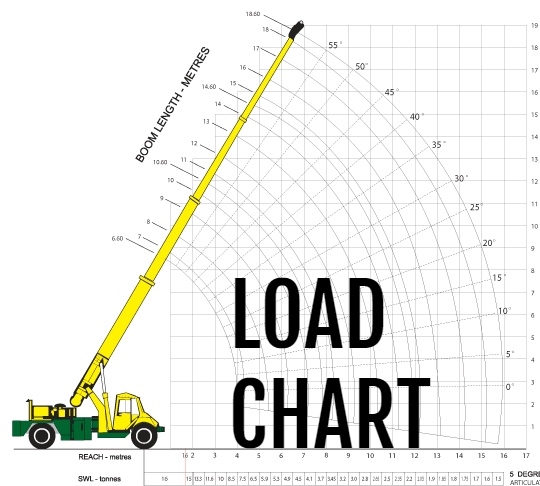
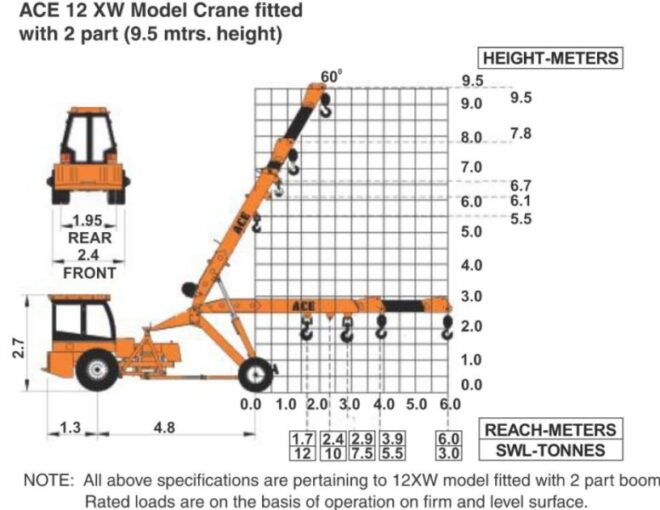
The nominal loads shown in the lift chart are for each machine as originally manufactured and equipment. Modifications to the machine or the use of optional equipment other than specified may result in a reduced capacity.
Construction equipment can be hazardous if improperly operated or maintained. Operation and maintenance of this machine shall be in compliance with the information in the Operator’s and safety handbook, service manual, and parts
The operator and other personnel associated with the machine shall fully acquaint themselves with the latest American National Standards Institute (ANSI) Safety Standards for cranes.
Load Chart and sizes
SETUP:
The machine shall be leveled on a firm supporting surface. Depending on the nature of the supporting surface, it may be necessary to have structural supports under the outrigger floats or tires to spread the load to a larger bearing surface.
For outrigger operation, outriggers shall be properly extended with tires raised free of crane weight before operating the boom or lifting loads.
If the machine is equipped with a front jack cylinder, the front jack cylinder shall be set in accordance with written procedure.
When equipped with an extendable counterweight, the counterweight shall be fully extended before operation.
Tires shall be inflated to the recommended pressure before lifting on rubber.
With the certain boom and hoist tackle combinations, maximum capacities may not be obtainable with standard cable lengths.
Do not travel with crane boom extension or jib erected.
Lifting operations risk assessment example
OPERATION:
Rated loads at rated radius shall not be exceeded. Do not tip the machine to determine allowable loads. For clamshell or concrete bucket operation, the weight of bucket and load must not exceed 80% of rated lifting capacities.
All rated loads have been tested to and meet minimum requirements, and do not exceed 85% of the tipping load on outriggers fully and 50% extended, and 75% of the tipping load on outriggers 0% extended (fully retracted) as determined by Crane Stability Test Code.
Rated loads include the weight of hook block, slings, and auxiliary lifting devices and their weights shall be subtracted from the listed rating to obtain the net load to be lifted. When more than the minimum required hoist reeving is used, the additional rope weight shall be considered part of the load to be handled.
Load chart ratings will differ when
Load ratings are based on freely suspended loads. No attempt shall be made to move a load horizontally on the ground in any direction.
Rated loads do not account for wind on lifted load or boom. It is recommended when wind velocity is above 20 m.p.h (32km/h), rated loads and boom lengths shall be appropriately reduced.
Rated loads are for lift crane service only.
Do not operate at a radius or boom length where capacities are not listed. At these positions, the machine may overturn without any load on the hook.
The maximum load which can be telescoped is not definable because of variations in loadings and crane maintenance, but it is safe to attempt retraction and extension within the limits of the capacity chart.
When either boom length or radius or both are between values listed, the smallest load shown at either the next larger radius or next longer or shorter boom length shall be used.
Crane load chart safety factor
For safe operation, the user shall make due allowances for his particular job conditions, such as soft or uneven ground, out of level conditions, high winds, side loads, pendulum action, jerking or sudden stopping of loads, hazardous conditions, the experience of personnel, two machine lifts, traveling with loads, electric wires, etc. Side pull-on boom or jib is extremely dangerous.
If the machine is equipped with individually controlled powered boom sections, the boom sections must be extended equally at all times.
Never handle personnel with this machine without written approval.
Keep load-handling devices a minimum of 18 inches (45.7 cm) below the boom head at all times.
Boom angle of crane
The boom angle before loading should be greater than the loaded boom angle to account for deflection.
Capacities appearing above the bold line are based on structural strength and tipping should not be relied upon as a capacity limitation.
Capacities for the 35 ft. (10.6 m.) boom length shall be lifted with the boom fully retracted. If the boom is not fully retracted, capacities shall not exceed those shown for the 40 ft. (12.2m) boom length.
When lifting over the front of the machine, radii less than 35 ft (12m.) not recommended.
When operating the machine in the “On Outriggers 50% Extended” mode, the outrigger beam pins must be engaged. When operating the machine in the “On Outriggers 0% Extended” mode, the outrigger beams must be fully retracted. Failure to follow these precautions could result in structural damage or loss of stability of the machine.
Simply put, the only way to know if the load you are lifting with a mobile crane is within the limitations of the crane is to relate the lift to the manufacturer’s load chart and notes.
Mobile crane load chart: Simply put, the only way to know if the load you are lifting with a mobile crane is within the limitations of the crane is to relate the lift to the manufacturer’s load chart and notes.
Persons who are not crane-operators regularly have questions regarding lifting safety. The purpose of this Tech Tip is to help those less familiar with crane load charts better understand the questions to ask and the information that must be followed.
An experienced crane operator enters the cab of an unfamiliar crane expecting to find certain information on the load chart. Just as you may expect to find certain information when you enter an unfamiliar automobile. You locate the speedometer and fuel gauge, then locate windshield wiper, outside mirror, and seat adjustment controls.
You do this because you know these controls must exist to operate safely. Similarly, certain information will always be located within a crane’s load rating chart and notes. You just have to know what you’re looking for.
Mobile Crane Load Chart
Crane load chart
The crane load chart in the mobile crane industry is long past the days of a single page load chart. Load charts have become increasingly complex. There is specific information you must obtain prior to attempting to lift a load.
How is the crane configured? Are the outriggers fully extended and set, partially extended and set, or will the lift be made on rubber tires?
How much counterweight is installed on the crane?
What are the boom and jib/extension configurations? If the lift will be made with an extension or jib you must locate the load chart that provides ratings for these accessory devices.
Mobile crane lifting capacity
Over what operating areas will the load be handled? Working Area charts define specific areas of the crane that relate to loading ratings.
Areas such as Over the Side, Over the Rear, Over the Front, and 360-degree Rotation lead you to specific load charts. Make certain you know the area where the load will be lifted from, the area the load will pass through, and the area the load will be placed.
Base lifting capacities on the area with the least load rating according to the working area chart. The combined information to this point will lead you to one or more pages within a load chart.
How to calculate crane load capacity?
Does the crane have sufficient load hoist reeving? Reeving charts indicate the type of wire rope and the number of parts of wire rope required to lift loads. A reeving chart which indicates 28,000 lbs. capacity for a two-part reeving will require more reeving prior to making a lift that exceeds 28,000 lbs.
To determine how much load the crane can safely handle you must also know the length of the boom (hydraulic cranes show boom lengths in a row at the top of the load chart), and the load radius of the suspended load (hydraulic cranes show radius in a column on the left side of the load chart).
When boom length and/or radius is between the values printed on the load chart you must select the boom length and/or radii with the least load rating.
Keep in mind that a shorter boom length may have a lesser rating. You cannot assume that taking load values from the next longer boom length is safe.
Mobile Crane Load Chart
Crane capacity chart
Equally important to the load ratings shown on the chart are the load chart notes. Load chart notes provide critical information relating to the operation, set up, configuration, and restrictions.
Finally, you must account for all accessory weights. Items such as load blocks, extensions, jibs, and rigging must be added to the weight of the load to determine the total load imposed on the crane.
Don’t hesitate to ask a crane operator for clarification. And, don’t think twice about challenging what you are told. Load charts may have become more complex, but the key information provided has not changed significantly.
Knowing what to look for is a good start to a safer job site. Safety is a team effort that requires both the operator and management working with the same safety objectives. Don’t compromise your job site safety.
Mobile crane load chart calculations
Mobile crane stability:
We’ve looked at how gravity, balance, and leverage work together to keep a crane stable, how the crane is made, what the tipping point is, and what the standards and OSHA say. Now let’s apply what we’ve learned.
We cannot stress the importance enough of taking the time and making the effort to ensure proper setup, knowing your load weight, and having an educated operator–it just might save you a costly mistake.
Mobile crane lifting
Lifting on Rubber: Crane manufacturers that allow “on rubber” lifts will provide a load rating chart specifically for this configuration.
Mobile crane outriggers
Over the Side: Not only are fully set outriggers recommended for the full capacity of the load chart, lifting over the side is the least stable location for most cranes. For this reason, try to position the crane to make the initial lift in the least stable location (such as over the side), and then swing to a more stable location (such as over the end). This may help prevent an accidental overload of the crane during the lift. In other words, any miscalculation of the load weight can be noticed right away.
Mobile crane boom extension
Over the Front: When the boom is positioned over the front of a crane on outriggers, the tipping axis is the forward set of outriggers. Crane manufacturer’s that allow “over the front” lifts will provide a load rating chart specifically for this configuration.
Crane boom angle
Over the Rear: When the boom is positioned over the rear of a crane, the tipping axis is the rear set of outriggers. While this is usually where the most capacity is provided, you must still follow the load chart and know your load weight for your lift to ensure the crane will remain stable and upright.
Crane boom length
Boom Length: Just because a crane has a long reach, doesn’t mean you need to use all of it. Many times tipping is a result of the boom being extended beyond the necessary length.
Mobile Crane Load Chart
Mobile crane safety tips
Hopefully, by now, we can all agree that the loss of stability resulting in a tipping incident or accident shouldn’t be a common occurrence. They are costly and can be avoided. Remember the following key points:
Make sure the operator is a qualified mobile crane operator with the education, knowledge, and experience to operate the machine and make the lift.
There are many crane designs, read the crane manufacturer’s operation manual to make certain the operator fully understands the operating quadrants, superstructure positions and operating characteristics of the crane.
Make sure the operator fully understands the load capacity chart for the crane they are operating.
Make sure the operator fully understands how to use the crane’s load weighing device (LMI, RCI, RCL, etc.).
NEVER lift loads where the load chart does not provide ratings.
NEVER lift more weight than what’s posted in the load chart.
Outriggers are to be fully extended and set at all times when practical.
Never allow the operator to “lift by the seat of their pants” if they can start to feel the crane tipping, then it is already too late, the crane has been overloaded.
How to read crane load chart?
The book, “Mobile Crane Support Handbook” is a comprehensive reference that is focused exclusively on the design and engineering of supports for mobile crane installations.
Written by one of the leading lifting specialist engineers, this book addresses the full range of subjects needed for the engineering of mobile crane support in construction job site situations.
Topics covered include support reactions from crawler and outrigger-supported cranes, soil bearing capacity, analysis of subsurface structures, the strength of crane mats, practical design methods, and industry standards and regulations.
Each crane has a load chart that, in short, specifies the crane’s capabilities—detailing its features and how its lift capacity varies when considering distance and angle. Just like the old saying ‘if you fail to plan, you plan to fail,’ failing to consult a crane load chart before renting or employing a crane for a specific job could leave you with too much or too little capacity for your job.
How to select crane capacity?
Virtually all construction projects require the lifting, hauling or transportation of heavy materials ‘ which is why cranes play a gigantic role in the development of your project. Deciding which crane is right for your objectives can be an overwhelming task, as the range of options available is limitless! There is an enormous variety of cranes ‘ each designed for a specific function or use.
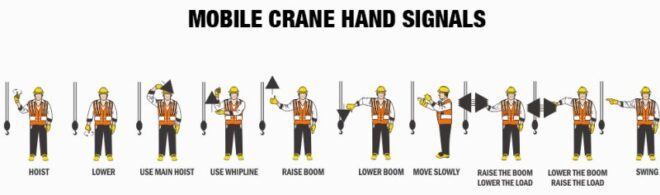
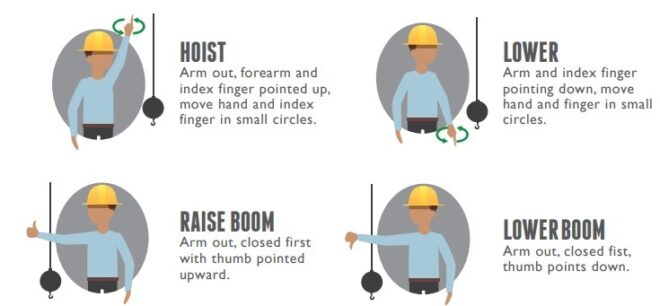
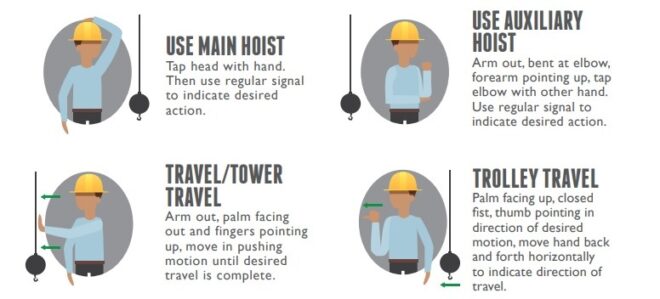
Here is a crane hand signal chart, which provides the standardized hand signals used in crane operations to ensure clear communication between the crane operator and the signal person:
Signal
Description
Hoist
Forearm vertical, forefinger pointing up, move hand in small horizontal circles.
Lower
Forearm vertical, forefinger pointing down, move hand in small horizontal circles.
Use Main Hoist
Tap fists on head, then use regular signals.
Use Whipline
Tap elbow with one hand, then use regular signals.
Raise Boom
Arm extended, fingers closed, thumb pointing upward.
Lower Boom
Arm extended, fingers closed, thumb pointing downward.
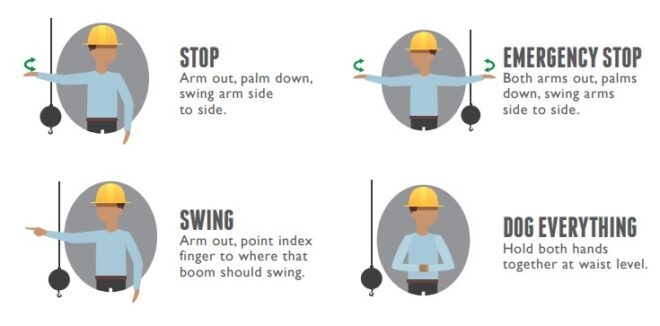
Swing
Arm extended, point with finger in direction of swing.
Stop
Arm extended, palm down, move arm back and forth horizontally.
Emergency Stop
Arm extended, palm down, move arm back and forth horizontally rapidly.
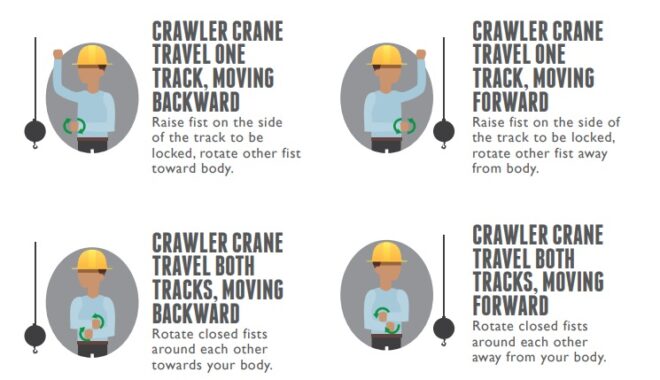
Travel (Both Tracks)
Rotate fists around each other in front of the body.
Travel (One Track)
Point with one finger in direction of travel.
Table of hand signals used in crane operations
These signals are designed to be clear and unambiguous to ensure safe and effective crane operations.
What are the proper hand signals for cranes?
Hand signals used in crane operations are standardized to ensure clear communication between the crane operator and the signal person.
Hoist
Lower
Use Main Hoist
Use Whipline (Auxiliary Hoist)
Raise Boom
Lower Boom
Swing
Stop
Emergency Stop
Travel
Travel (One Track)
These signals are internationally recognized and are crucial for maintaining safety and efficiency on construction sites or any environment where cranes are used.
It’s essential for both the signal person and the crane operator to be thoroughly familiar with these signals and to ensure they are clearly understood before beginning operations.
These signals are standardized to ensure safe and effective communication between the signal person and the crane operator during operations.
Questions about Crane Hand Signal Chart
These FAQs provide a basic understanding of crane hand signal charts and their importance in ensuring safe crane operations. For specific regulations or detailed guidance, refer to local safety standards and crane operation manuals.
Here are some frequently asked questions (FAQs) about crane hand signal charts:
What is a crane hand signal chart used for?
A crane hand signal chart is used to facilitate clear communication between the crane operator and the signal person (or rigger) on the ground. It ensures safe and efficient crane operations by providing standardized gestures that indicate specific actions or commands.
Why are crane hand signals important?
Crane hand signals are crucial for safety on construction sites and other work environments where cranes are used. They provide a reliable means of communication in situations where verbal communication may be difficult or unreliable due to distance, noise, or other factors.
Who typically uses crane hand signals?
Crane operators and signal persons (riggers) primarily use crane hand signals. The signal person is responsible for directing the crane operator using these signals to perform tasks such as lifting, lowering, swinging, and stopping operations.
Are crane hand signals standardized?
Yes, crane hand signals are standardized to ensure consistency and clarity across different construction sites and countries. Standardization helps to prevent misunderstandings and reduces the risk of accidents due to miscommunication.
Where can I find a crane hand signal chart?
Crane hand signal charts are typically included in crane operation manuals provided by equipment manufacturers. They are also available through safety organizations, regulatory bodies, and online resources related to crane operations and safety.
How should crane operators and signal persons learn and practice hand signals?
Both crane operators and signal persons should undergo training that includes learning and practicing crane hand signals. Training programs often include classroom instruction, practical demonstrations, and hands-on practice to ensure proficiency and safety awareness.
What should I do if I encounter unfamiliar crane hand signals?
If you encounter unfamiliar crane hand signals or are unsure of a signal being used, do not proceed with the operation. Instead, seek clarification from the signal person or supervisor before continuing. Safety should always be the top priority.
Can crane hand signals be supplemented with other forms of communication?
Yes, while crane hand signals are the primary method of communication, they can be supplemented by radio communication, visual aids (such as markings on the ground), or other means to enhance safety and accuracy in crane operations.
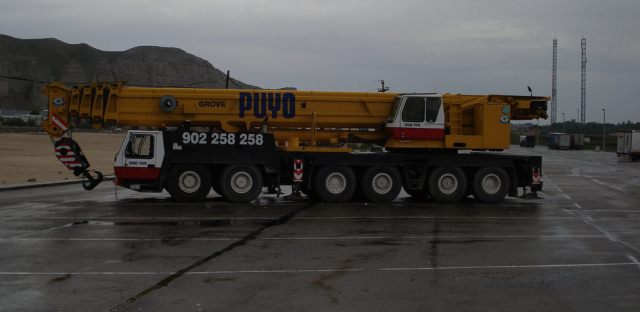
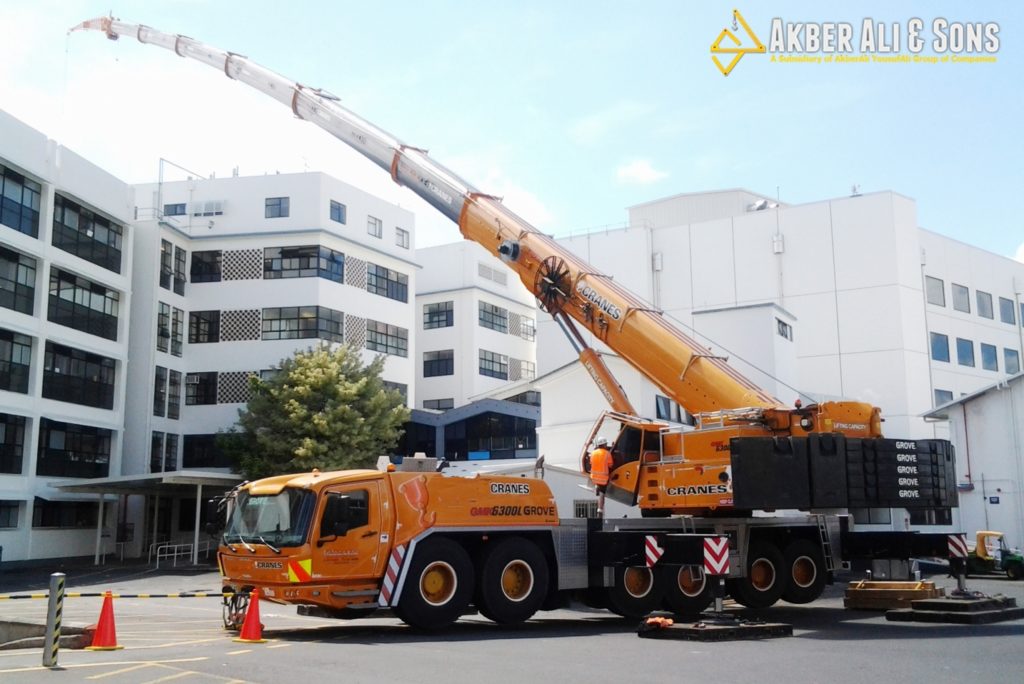
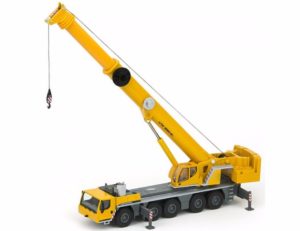
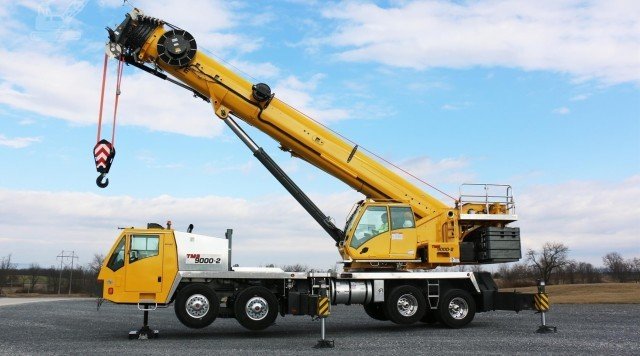
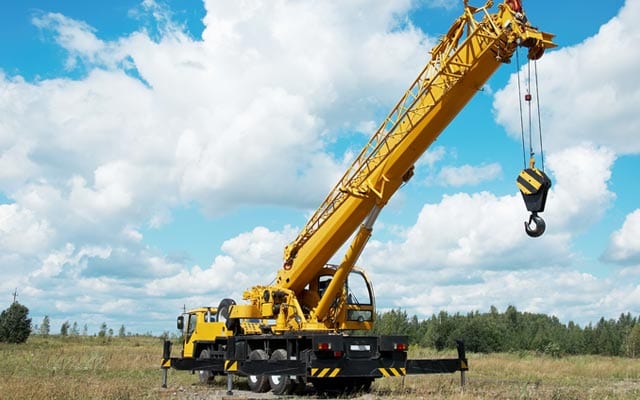
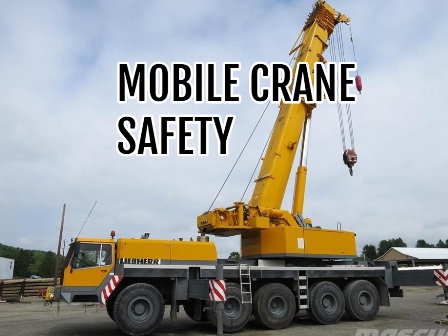
What is a mobile crane? The mobile telescopic cranes, usually have the particularity, what distinguishes them from all others to have a boom telescopic, that carries more than one cylinder, the telescopic boom that carries a usually rectangular shape. This heavy machine is useful in the work of modern construction
what is a mobile crane?
Telescopic crane boom
The telescopic cranes are mobile in the sense that they transport goods and articles in a flexible way.
In addition, as telescopic cranes are also equipped with height adjustments, when it comes to transporting and transferring goods from one place to another, the problems related to height are completely eradicated.
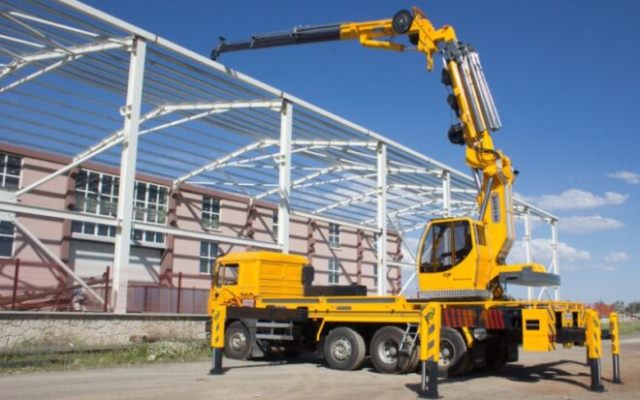
Heavy cranes, such as telescopic cranes, can be mounted on top of a truck and then driven to those places where goods and loads need to be moved.
The main difference between a telescopic crane and other conventional cranes is that the former has a hollow boom that contains several tubes mounted on one side and another. A hydraulic mechanism allows the movement of elongation and refraction of the beam.
Telescopic crane specifications
The telescopic boom that it carries with it has a usually rectangular shape.
Its materials are made of high durability and strength steel.
the regulation of the base or platform that it carries is generally fulfilled automatically.
what is a mobile crane?
How cranes work
The operation of the system can be based on two concepts; the first of these is the total hydraulic, and as a second or remaining system, it is an electric drive, which in case of limitation sends a warning to a control panel, avoiding accidents.
It carries with it a continuous 360 ° rotation based on a planetary reducer with an involuntary disk brake and activated by an orbital hydraulic motor with high torque and low revolutions.
The stabilizers of this crane are operated by four feet with their respective hydraulic system, composed of double brake cylinders, which carry a blocking valve.
At the same time some limit switches are placed in each of the stabilizers that above all the only objective will be to ensure the adherence of these to sleep and prevent them from raising the boom if the stabilizers are not properly fitted, this way they will ensure stability to perfection and therefore safety when working.
I get also a false frame so that in this way can be absorbed those efforts of bending and torsion results of the platform and in the van placed the stabilizers and the superstructure, thus relieving the efforts without the need to the telescopic crane.
This type of crane is equipped with a hydraulic system that is driven by a pump that diverts strength from the crane, engines, tanks, filters, safety, and blocking valves, double-acting control valves, and high-precision pipes.
what is a mobile crane
Cargo crane
Cranes, such as telescopic cranes, are often used in daily hauling operations, but it must also be borne in mind that these heavy cranes are very important when it comes to maneuvering operations in ports as well.
Heavy cranes are very important equipment. And of all the variants of heavy cranes, the telescopic cranes are unique because they not only offer utility but also mobility from side to side.
By recognizing the contribution of telescopic cranes as one of the best-designed devices to help load transfer in today’s times, it is like giving these heavy cranes their deserved recognition and credit.
telescopic crane transporting cargo
Construction crane
In terms of ports, telescopic cranes offer one of the best possible services. This is because a port is a place that is always full of activity.
The loading and unloading of cargo is something that takes place in any port without a break of a second.
This being the case and given the disadvantages of several other types of heavy cranes, telescopic cranes offer superior support for the proper functioning of tasks in a port.
In any port, you can find many of these telescopic cranes that allow easy mobility and transfer of cargo to the appropriate containers, thus providing the utility in the best possible way.
It is also widely used in the following fields
in the construction of buildings
in the construction of bridges
manufacture of prefabricated components
electrical installations, electrical towers
wind fields
hoisting machinery and heavy equipment
crane hoisting load
Port cranes
Considering today’s rapid development, it is natural that the cranes have begun to be widely used.
But in terms of the shipping industry and the transport of goods and cargo through ships, cranes have always been the main technology used.
This is because, when it comes to transporting goods and transferring cargo from one area of a port to another, it is very difficult to use simple shelves for luggage, since the quantity and weight of the cargo in the ports is quite heavy and, therefore, requires the help of such telescopic cranes to carry out the cargo transfer process.
Telescopic cranes are used very often in ports due to the ease of mobility they present and the possibility of adjusting the height they offer. They give flexibility to a new name and also provide exceptional service at the same time. Like heavy cranes, telescopic cranes are very popular and highly demanded and easily visible in most ports around the world.
TELESCOPIC CRANES IN PORT
Telescopic crane parts
Supporting chassis
Truck in charge of transporting the crane depends on each model. Support of the crane, cabin, boom; transports all the weight, in the van placed the stabilizers and the superstructure, thus relieving the efforts.
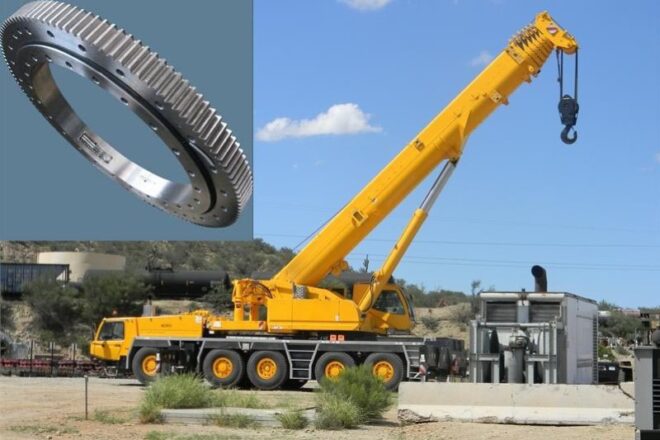
Orientation crown
To maneuver the load, the boom must be able to move to the right and to the left, as well as up and down.
Beneath the operator’s cab is a Rotex gear on a rotating platform bearing that rotates at 2 revolutions per minute (rpm).
It is powered by a bidirectional hydraulic motor mounted in the cab and housed in a metal cover to prevent injury.
The rotation is controlled by a pedal pedal hydraulic in the cabin.
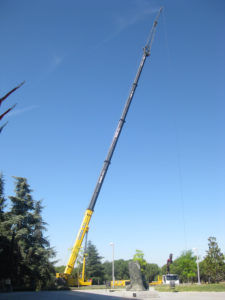
Telescopic boom
The most recognizable part of any crane is the boom. This is the steel arm of the crane that holds the load.
Rising just behind the operator’s cab, the boom is the essential piece of a crane, allowing the machine to lift loads to several dozen feet.
Most hydraulic truck cranes have a boom that has several telescopic sections
Some arms are equipped with a feather, which is the lattice structure attached to the end of the arm.
As the load is lifted, the sections extend to the desired height.
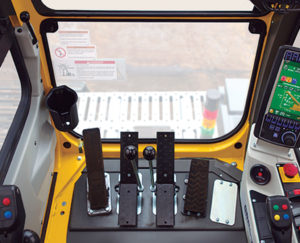
Control cabin
All this equipment is controlled by the operator inside the cabin, which is located at the top of the deck.
Crane operators use various control mechanisms to raise and lower the boom, turn the boom and boom, wind and roll the winch and control other peripheral equipment.
Stabilizers
Hydraulic truck cranes are used to lift heavy loads at high altitudes, and it is important that the truck is completely stable during the lifting operation.
The tires do not offer the necessary stability, so the truck uses stabilizers that act as scales to prevent the crane from leaning too far to one side or the other.
The stabilizers use the hydraulic system to lift the entire truck, the tires and everything from the ground.
The stabilizers are formed by the beam, which is the leg of the stabilizer, and the pad, which is the foot.
Sometimes, “floats” are placed under the platform to dissipate the strength of the crane and the load on the concrete or pavement. Floats are usually wooden boards that line up to create a base that is larger than the pad.
It consists of four extensible feet with its respective hydraulic system. The stabilizers are only one mechanism used to balance the crane during lifting operations.
Counterweights
There are also removable counterweights that can be placed on the back of the crane at the bottom of the cab.
These counterweights prevent the crane from tilting forward during the operation.
The amount of counterweight needed for a particular lift is determined by the weight of the load, the radius of the boom and the angle of the boom during the operation.
Counterweights are only used during lifts; They have to be removed before the truck can be driven.
Steel cable lines
Reinforced steel cable lines run from a winch just behind the operator’s cab, extending up and over the boom and arm.
The lines go up the boom telescopic and adhere to a goalball; It keeps the lines taut when there is no load on the hook.
crane parts
Crane lift
The hydraulic crane has two basic types of controls to maneuver a load:
Joysticks: There are two joysticks in the cabin. One controls the movement from left to right of the arm and the other controls the movement back and forth.
Pedals: These pedals are responsible for retracting and extending the telescopic sections of the boom. They also control the amount of pressure generated by the pump.
Lifting equipment
The joysticks and pedals are connected to hydraulic hoses that connect several hydraulic cylinders to the spool valves.
The spool valve is connected to the hydraulic pump through a third hose that is placed between the two hoses that go from the spool valve to the hydraulic piston.
When a joystick is pushed in one direction, the valve closes one of the hydraulic hoses that lead to the ram and opens the other.
The way the joystick is pushed determines whether the piston in the hydraulic ram slides in or out.
The reel valve system allows the crane operator to control the hydraulic pistons.
Operator crane
Before any survey, the operator enters the data into a computer inside the booth, including the weight of the object to be lifted and the height at which it must be lifted.
This computer serves as a backup for the operator, warning the operator if the crane is being pushed beyond its capacity.
Using a graphics folder in the cabin, the operator also determines the elevation angle and the radius of the boom.
Once all of this is entered, the computer can track the progress of the elevator and warn the driver if the crane is close to its limitations.
If the boom is raised too high for the load amount, a series of lights just above the interior of the front window will begin to light. These lights are the warning lights of the LMI charging moment indicator.
There are at least two other people needed to perform a survey correctly, including the greaser and the signalman.
The oiler is responsible for making sure that all parts of the crane are in place and secured before any lifting.
He or she also acts as an observer during a survey to ensure that the survey is done correctly.
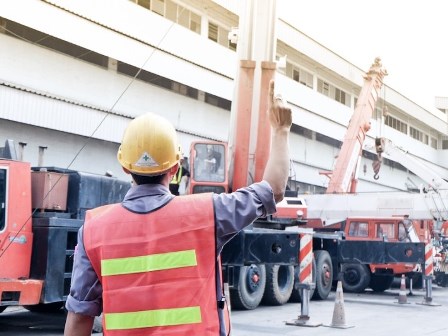
The signalman, as the name implies, gives the operator manual signals during the survey to make sure that the load is being maneuvered correctly.
cockpit
Hydraulic crane
How a hydraulic system works: If you have read How hydraulic machines work, know that the hydraulic crane is based on a simple concept: the transmission of forces from one point to another through a fluid.
Most hydraulic machines use some type of incompressible fluid, a fluid that is at its maximum density.
Oil is the most commonly used incompressible fluid for hydraulic machines, including hydraulic cranes.
In a simple hydraulic system, when a piston pushes down the oil, the oil transmits all the original force to another piston, which is pushed upwards.
A hydraulic pump creates the pressure that moves the pistons. The pressure in a hydraulic system is created by one of two types of hydraulic pumps:
Variable displacement pump
Gear pump
Hydraulic system
Most hydraulic truck cranes use two-gear pumps that have a pair of interconnected gears to pressurize the hydraulic oil.
When it is necessary to increase the pressure, the operator presses the accelerator of the foot to make the pump work faster.
In a gear pump, the only way to get high pressure is to run the engine at full power.
For example, A 70-ton hydraulic crane uses a 12.7-liter diesel engine that generates up to 365 horsepower. The motor is connected to three two-gear pumps, which include:
Main pump: this pump drives the piston rod that raises and lowers the boom, as well as the hydraulic telescopic sections that extend the boom. The main pump can generate 3,500 pounds per square inch (psi) of pressure. It generates more pressure than the other two pumps because it is responsible for moving much more weight.
Pilot pressure counterbalance pump: a hydraulic crane uses counterweights at the rear of the cab to prevent it from tipping over. These are added and eliminated by a hydraulic lift that has its own pump. The counterweight gear pump can generate 1,400 psi.
Steering pump/stabilizer: a pump controls the steering and stabilizers. The stabilizers are used to stabilize the truck during lifting operations. Because the direction and operation of the stabilizer are not performed simultaneously, they work with the same pump. This pump generates 1,600 psi.
telescopic crane
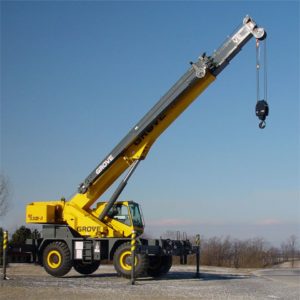
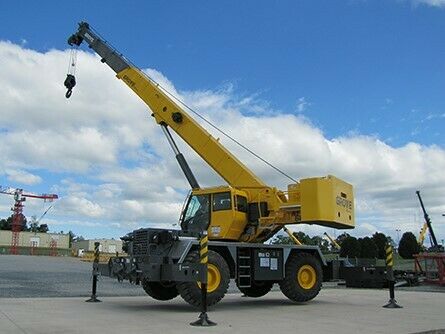
Grove telescopic crane
Hydraulic truck cranes provide a raw force to move objects, machines and even large animals that would otherwise be very difficult to move.
With a very simple hydraulic principle, these machines move thousands of pounds with relative ease, which makes them an essential component of most construction projects and a great example of the power of basic physics.
There are hybrid telescopic cranes, combining articulated arms and metallic lattice boom; to reach unsuspected heights.
Hydraulic cranes can be simple in design but can perform herculean tasks that would otherwise seem impossible.
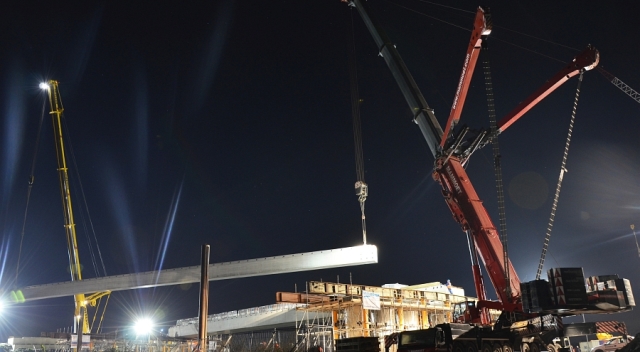
In a matter of minutes, these machines are capable of lifting multiton bridge beams on highways and heavy equipment in factories and even building houses on the beach on piles.
Hydraulic truck cranes are also used to remove killer whales like Shamu from water tanks when places like SeaWorld send whales to new destinations.
Mobile cranes manufacturers
Directory provides a list of mobile crane manufacturers and suppliers. Utilize our website to review and source mobile crane manufactures.
Grove
Altec
Mamut
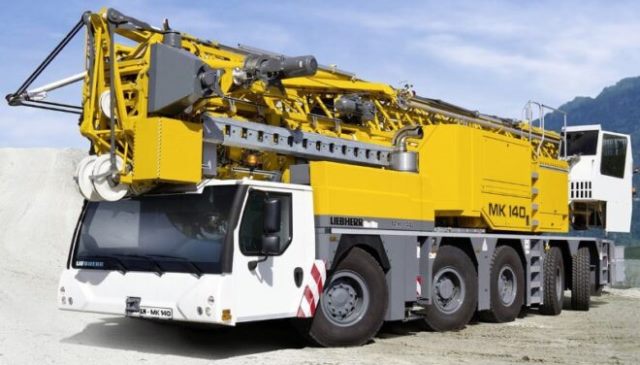
Liebherr
Terex
Pfeifer
Tadano
JCB
Sennebogen
Manitou
What is a mobile crane used for?
What is a mobile crane used for?
A crane is a type of machine, generally equipped with a hoist rope, wire ropes or chains, and sheaves, that can be used both to lift and lower materials and to move them horizontally. It is mainly used for lifting heavy things and transporting them to other places.
What does mobile crane do?
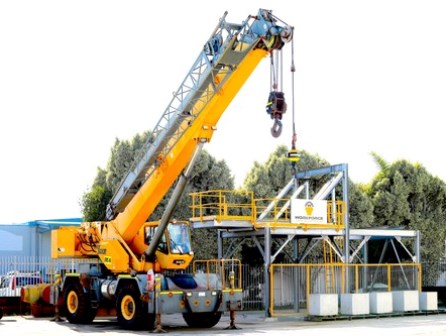
A mobile crane is a cable-controlled crane mounted on crawlers or rubber-tired carriers or a hydraulic-powered crane with a telescoping boom mounted on truck-type carriers or as self-propelled models.
Which type of crane is known as a conventional crane?
Mobile Cranes are the most standard and versatile type of crane used in construction today. The mobile hydraulic crane consists of a steel truss or telescopic boom mounted on a mobile platform, which could be a rail, wheeled, or even on a cat truck.
What is the difference between Hydra and Crane?
Hydra and crane, both are used for material handling. But in Hydra, you can lift and carry the load. Hydra can not rotate (swing) 360 degrees, while crane can. Generally, hydras are having less capacity (say 12 ton, or a bit more) while cranes can have very high capacities even 1200 ton also.
Simply put, the only way to know if the load you are lifting with a mobile crane is within the limitations of the crane is to relate the lift to the manufacturer’s load chart and notes.
All mobile crane operators must have experience and education on all aspects of material handling and mobile crane procedures, including all common manual signals for mobile crane operators.
Slewing mobile cranes incorporate a boom or jib that can be rotated. This unit requires a person operating a non-slewing mobile crane to plan the work, conduct routine checks, set up the crane, transfer load, and mobile load, and shut down and secure the crane.
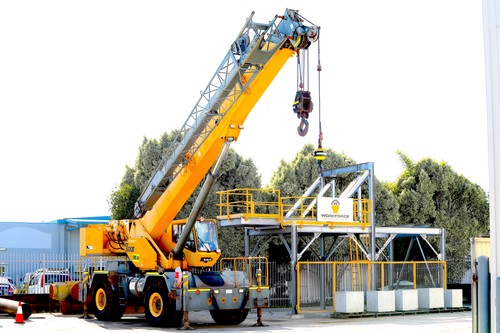
Slewing Mobile Crane
Slewing mobile crane definition
Any type of mobile crane includes truck loader, crawler, and non-slewing articulated cranes.
Mobile crane definition: A mobile mechanical plant that is able to be configured to lift or carry a suspended load. This definition includes “Fully”, “Semi”, “Portable” “Articulated” and “Truck” mobile cranes. For the purposes of the Approved Code of Practice, this definition also includes: – Construction equipment, such as excavators configured with hooks or other lifting devices and used for purposes other than duties associated with the primary function of the machine (e.g. other than placing of pipes in a trench).
Slewing Mobile Crane
Non-slewing mobile crane
In crane movement terms, a slewing crane lifts its load, suspends that load in mid-air, and then rotates it via a boom rotating mechanism. Non-slewing cranes, on the other hand, lack a rotating base section. Hold that major difference in mind as we see how it affects slewing and non-slewing mobile cranes, for their compact outlines must adjust to accommodate these differences.
Mobile Non-Slewing Cranes Don’t Incorporate Rotating Joints:
This primary difference complements a typically mobile profile. The permanent articulation joint raises a load and repositions the load elsewhere, but only when the mobile truck employs its drive section. Slew incapable, the mobile lifter is highly maneuverable due to its four-wheeled chassis, with its crane section assuming a more solid build as it chiefly lifts and lowers its payloads.
Difference between slewing and non-slewing cranes
What Type Of Mobile Crane Should I Hire?
Every business is different, with an assortment of day-to-day requirements – from lifting goods to transporting them across the state.
So when it comes to hiring equipment for your business, particularly cranes, it is important to remember that there is no one size fits all approach to follow.
Before you splash out to hire equipment you may not really need, it is worthwhile sitting down as a team to brainstorm how your workplace could benefit from hiring new equipment, such as a mobile crane.
A little planning will go a long way to ensuring the crane you hire is best suited for your business’ day-to-day workload.
The Basics to Consider
Are there safe access points, such as ladders and footholds?
How is the seat designed, is it comfortable and does it provide support?
What visibility does the crane provide?
How are the mirror, windows, and windscreen designed?
Does it come with environmental controls such as air conditioning to avoid heat exhaustion?
Slewing Mobile Crane
Different types of mobile cranes
Mobile cranes can generally be categorized into three types:
hydraulic boom cranes
lattice boom cranes and
non-slewing boom cranes.
Hydraulic Boom Cranes
For companies that need a mobile crane with some oomph, a hydraulic crane may be your best choice!
Hydraulic cranes use an internal hydraulic system, rather than a standard diesel motor, which gives the crane more power to lift those heavy loads and smooth handling.
Lattice Boom Cranes
Thanks to their structure, these cranes have many configurations that can sustain long boom lengths. This makes lattice boom cranes a great choice for businesses needing to access new heights!
Lattice boom cranes incorporate crawler cranes and are self-propelled on tracks; they are generally transported to the site and set up on-site to suit the project-specific needs.
Non-Slewing Cranes
The big difference between slewing and non-slewing cranes lies in the ability to rotate the boom or jib. Non-slewing cranes have a fixed base and are sometimes referred to as pick and carry cranes, as they can easily transport loads across your worksite.
Slewing mobile crane training
Courses to learn the necessary skills, to safely operate a mobile crane, include the following topics:
Assess ground conditions
Understand crane characteristics
Read and interpret crane specifications including load charts to enable the crane to be configured for loads
Select the appropriate slewing mobile crane in accordance with load and workplace conditions
Operate crane including all functions to their maximum extension, lifting and moving of loads with maximum safe working load
Accurately record and maintain information relating to crane operation
Use communication techniques including whistles, hand signals and use of two-way radios
Identify hazards and assess risks associated with the operation
Conduct pre-operational checks and identify faults
Slewing Mobile Crane
Crane slewing system
A non-slewing machine mounts sensibly on the rear of a flatbed truck. Evolved versions of this configuration travel on highways and dirt tracks, with the wheels of the vehicle acting as the boom conveyance mechanism. Conversely, slewing turntables add flexibility to the operation.
They’re versatile, plus they can hunker down in place thanks to a series of extending outriggers. Meanwhile, the smaller non-slewing crane finishes its workload, moves to another site, and then uses its compact outlines to conduct another lift operation. Consequently, both crane types are invaluable, but they’re designed for slightly different applications.
Slewing crane meaning
A jib crane works in such a way that it can rotate its load while the load is suspended from the boom or jib. There is a boom rotation mechanism inside the jib cranes that allows the machine to maneuver the load during the lift.
For example, a jib crane might pick up a load, rotate 90 degrees clockwise, and then lower the load. On the other hand, non-rotating cranes can pick up a load and raise it higher or lower, but cannot easily change the location of the load, since the boom and arm are not equipped with a rotating mechanism.
Jib cranes are very versatile and can do many jobs that a non-rotating crane could not.
The jib crane must be planted on the ground to ensure its stability, which means that while the crane can rotate, the base of the crane is fixed.
However, due to the rotational capabilities of a jib crane, a position on-site that allows the crane to do the job with minimal disturbance is advisable.
Jib cranes are best suited to large sites, where the crane has enough room to turn.
It is also worth considering the use of a mobile jib crane, in which the boom and arm are mounted on a turntable at the rear of a vehicle.
Mobile jib cranes are very versatile but are limited to smaller loads as they are not on land.
Slewing Mobile Crane
What is slewing in Crane?
In crane terminology, slewing is the angular movement of a crane boom or crane jib in a horizontal plane. Any type of mobile crane includes truck loader, crawler, and non-slewing articulated cranes.
This article focuses on hazards, including where they might be found in different workplaces. We also provide you with a range of further resources to make your risk assessment process as smooth as possible.
All mobile crane operators must have experience and education on all aspects of material handling and mobile crane procedures, including all common manual signals for mobile crane operators.
Mobile Crane Hand Signals: Communication between the crane operator and the signal person shall be maintained continuously during all crane movements. If at any time communication is disrupted, the operator shall stop all crane movements until communication is restored and a proper signal is given and understood.
Printable mobile crane hand signals Mobile Crane Hand Signals charts Standard crane hand signals Crane operator hand signals chart:
Mobile Crane Hand Signals: At Crane and machinery, we realize that not everyone at the job sites we go to is fully trained in mobile crane operation and safety.
For this reason, all mobile crane operators must have experience and education on all aspects of material handling and mobile crane procedures, including all common manual signals for mobile crane operators.
If the operator has any concerns regarding the requested movement of the crane or needs to communicate with the signal person, the operator shall stop all crane movement.
Crane movement shall not resume until the operator and the signal person agree on the issue at hand has been resolved. If it is desired to give instructions to the operator, other than those provided by the established signal
Mobile Crane Hand Signals
Crane signalman
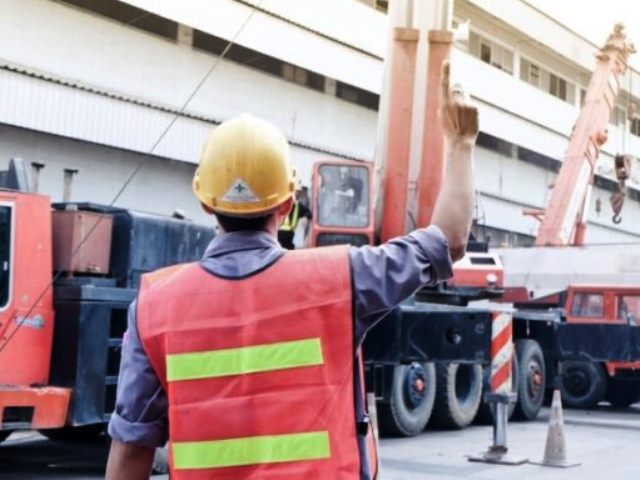
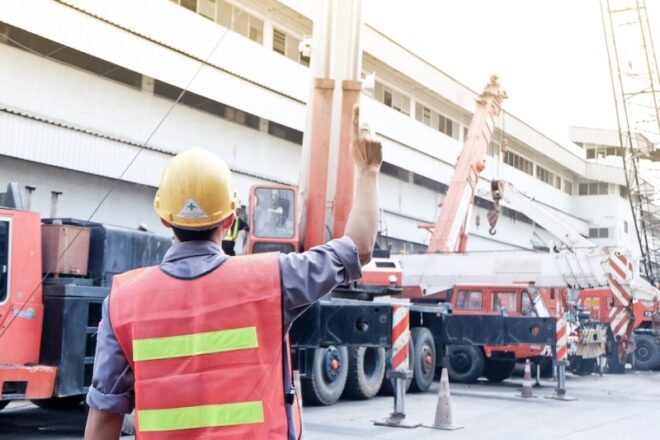
On construction sites, one of the most important jobs is that of the signal person. Sometimes known as the signalman, this individual is responsible for signaling the crane and giving the operator orders that pertain to the lift. In order to accurately and safely direct crane operators, the signal person must know and understand the relevant signals used in regulations.
Additionally, just like the machine operator, they must understand the operations and limitations of the equipment they are directing, including the crane dynamics involved in swinging, raising, lowering loads, stopping loads, and boom deflection.
Audible crane signals
While radio and other means of electronic communication with an operator are acceptable, using hand signals are the most effective and reliable way of communication.
Electronic methods communication could potentially fail to work, leaving the operator and the on-ground director without means to understand one another or give direction. When using radios or other methods, it must be through a dedicated channel so there is no interference.
Mobile crane hand signal chart
Successful communication between the signalman and the operator relies on both individuals fully understanding all hand signals used. Find below examples of standard hand signals used to control mobile crane operations
Standard crane signals
Communication between the crane operator and the signal person shall be maintained continuously during all crane movements. If at any time communication is disrupted, the operator shall stop all crane movements until communication is restored and a proper signal is given and understood.
If the operator has any concerns regarding the requested movement of the crane or needs to communicate with the signal person, the operator shall stop all crane movement. Crane movement shall not resume until the operator and the signal person agree on the issue at hand has been resolved.
If it is desired to give instructions to the operator, other than those provided by the established signal system, the crane movements shall be stopped.
Mobile Crane Hand Signals
Standard hand signals for crane operators
In some circumstances, radio communication between a crew and a crane operator is not an option. It is important to know the common signals for crane operation to ensure that it is still possible to properly operate the mobile crane. Some of the basic hand signals to use when working with a crane operator include:
LOWER THE CRANE’S LOAD: If the load needs to be lowered in place, point your forefinger downward with your arm extended toward the ground and move your hand in small circles.
RAISE THE BOOM: When the boom needs to be raised, extend your arm horizontally from your body and give the thumbs-up sign.
LOWER THE BOOM: In a similar fashion to the signal for raising the boom, extend your arm horizontally and give the thumbs-down signal to lower the boom.
SWING THE BOOM: If the load needs to move side to side while remaining at its current height, extend your arm outward horizontally and point in the direction that the boom needs to swing.
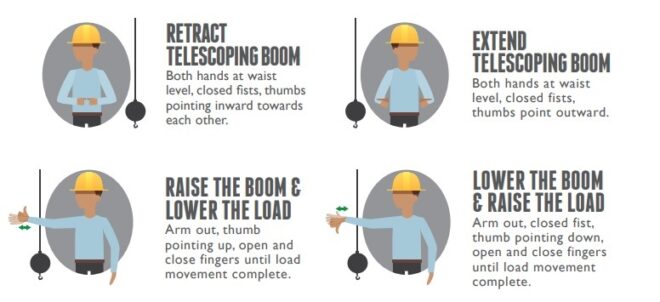
EXTEND THE BOOM: If the load needs to move farther away from the crane, lower your elbows to your waist and extend your forearms at a right angle so that your hands extend forward. Point both thumbs outwards, away from your body. This will indicate to the operator to extend the boom.
PROCEED SLOWLY: If any action needs to be done slowly and carefully, place your hand above the hand that is performing the action signal.
Mobile Crane Hand Signals
Printable mobile crane hand signals
Using standard hand signals is the most widely used manner of signaling a crane operator. A hand signal chart can usually be found on the side of the crane or it should be conspicuously posted in the vicinity of where hoisting operations are being conducted.
New signals can be given to the crane operator but they must be agreed upon beforehand by the crane operator(s), signalperson(s) and lift director (if one is used).
Mobile Crane Hand Signals
Crane signal person training
A signal person must be provided in each of the following situations:
The point of operation, meaning the load travel or the area near or at load placement, is not in full view of the operator.
When the equipment is traveling, the view in the direction of travel is obstructed.
Due to site-specific safety concerns, either the operator or the person handling the load determines that it is necessary.
Mobile Crane Hand Signals
Crane operator hand signals
Types of signals. Signals to operators must be by hand, voice, audible, or new signals.
Crane hand signals
When using hand signals, the Standard Method must be used. Exception: Where use of the Standard Method for hand signals is infeasible, or where an operation or use of an attachment is not covered in the Standard Method, non-standard hand signals may be used in accordance with paragraph (2) of this section.
Non-standard hand signals. When using nonstandard hand signals, the signal person, operator, and lift director (where there is one) must contact each other prior to the operation and agree on the non-standard hand signals that will be used.
Mobile Crane Hand Signals
New signals
Signals other than the hand, voice, or audible signals may be used where the employer demonstrates that:
The new signals provide at least equally effective communication as voice, audible, or Standard Method hand signals, or
The new signals comply with a national consensus standard that provides at least equally effective communication as voice, audible, or Standard Method hand signals.
Suitability
The signals used (hand, voice, audible, or new), and means of transmitting the signals to the operator (such as a direct line of sight, video, radio, etc.), must be appropriate for the site conditions.
Crane operations hand signals
During operations requiring signals, the ability to transmit signals between the operator and signal person must be maintained. If that ability is interrupted at any time, the operator must safely stop operations requiring signals until it is reestablished and a proper signal is given and understood.
Verbal crane signals
If the operator becomes aware of a safety problem and needs to communicate with the signal person, the operator must safely stop operations. Operations must not resume until the operator and signal person agree that the problem has been resolved.
Mobile Crane Hand Signals
Where are crane operator hand signals found?
Using standard hand signals is the most widely used manner of signaling a crane operator. A hand signal chart can usually be found on the side of the crane or it should be conspicuously posted in the vicinity of where hoisting operations are being conducted.
Who can give signals to the crane operator?
During crane operation, only one person can give signals, unless it’s for an emergency stop – then anyone on the Jobsite can give the signal. Once the qualified signal person is identified, the signal person and the crane operator must identify each other prior to giving any signals.
This article focuses on hazards, including where they might be found in different workplaces. We also provide you with a range of further resources to make your risk assessment process as smooth as possible.
Slewing mobile cranes incorporate a boom or jib that can be rotated. It excludes front-end loader, back-hoe, excavator or other earth moving equipment when configured for crane operation.