Bridge crane components: Are you looking to buy your first overhead crane system and need to know where to begin? Or, maybe you’re looking to add another crane to your facility to expand your business’ production or manufacturing capabilities?
Overhead cranes can vary so much in terms of specifications and configurations—no two crane builds are exactly alike!
So, knowing how to select the right type of overhead crane for your business is critical to maximizing efficiency, streamlining workflow, and getting the best bang for your buck.
Our goal for this post is to provide as much information as possible about:
The definition and components of an overhead crane
Different types of overhead cranes
The process of designing and buying an overhead crane
The installation of an overhead crane system
We do believe that the more that you read, the better you’ll understand how to design and specify the right overhead crane for your business needs. The more you know, the better educated you’ll be during the entire purchasing process.
We thank you for your time and we’re here to help if you have any additional questions about overhead cranes, below-the-hook devices, or other lifting or material handling solutions.
Overhead Crane components
Definition, Types, and Components
A base-level explanation of overhead cranes and how you can select an overhead crane that is best suited for your business needs.
We realize that each person we work with may need some help filling in the blanks regarding different aspects of what an overhead crane is, what an overhead crane does, what types of overhead cranes are available, and which class of overhead crane may be best for their business.
In this article, our goal is to unpack some of these questions and break them down into their simplest format.
We want to help you establish a base-level understanding of overhead cranes and how you can select an overhead crane that is best suited for your business’s needs.
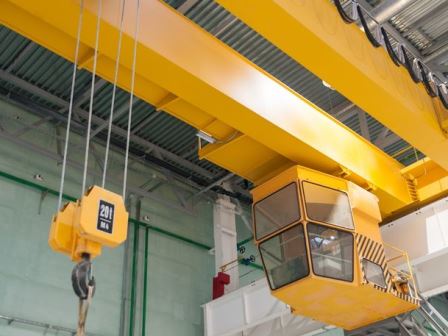
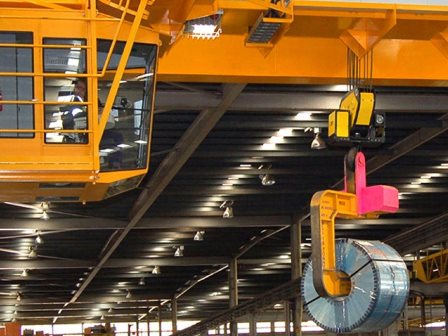
These cranes are electrically operated by a control pendant, radio, or infrared remote pendant, or from an operator cabin attached to the crane.
EOT Crane stands for Electric Overhead traveling cranes. This is the most commonly preferred EOT crane that is usually used in load lifting and shifting.
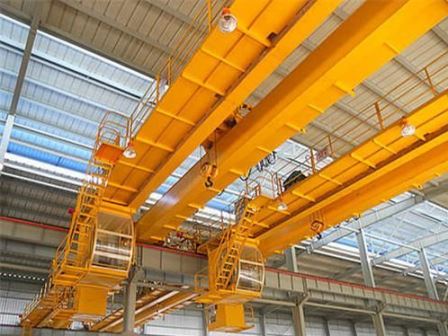
They have parallel runways and the gap is spanned by a traveling bridge. The hoist is mounted on this bridge. These cranes can be operated electrically.
What does an electric overhead crane do?
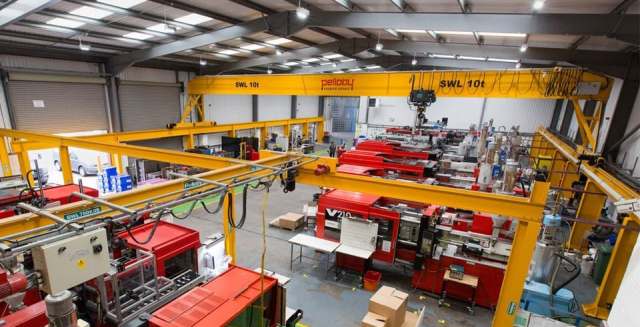
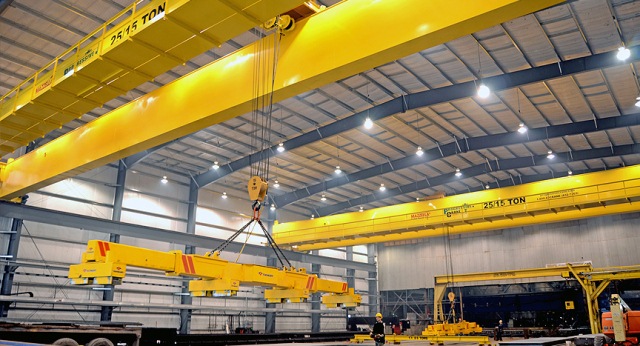
To move extremely heavy or bulky loads through the overhead space in a facility, instead of through aisles or on the floor, an electric overhead crane, also called an industrial crane, crane, or an overhead traveling crane is a machine that lifts, lowers, and moves a load horizontally.
Types of electric overhead crane
There are various types of overhead cranes with many being highly specialized, but the great majority of installations fall into one of three categories:
Top running single girder bridge cranes
Top running double girder bridge cranes
Under-running single girder bridge cranes.
Single girder cranes
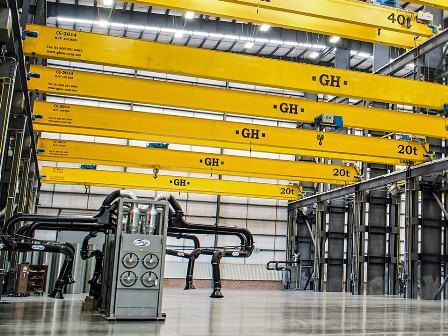
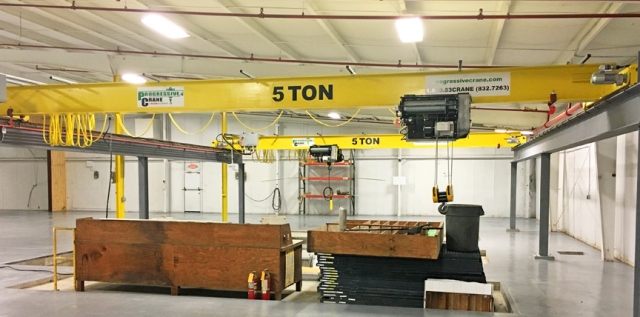
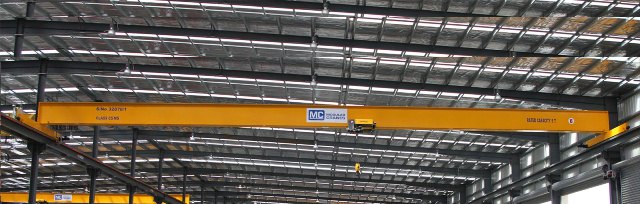
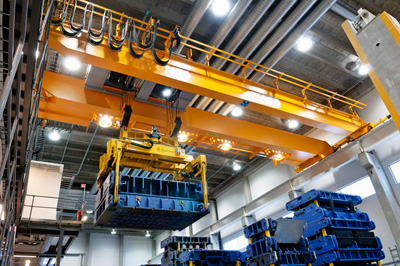
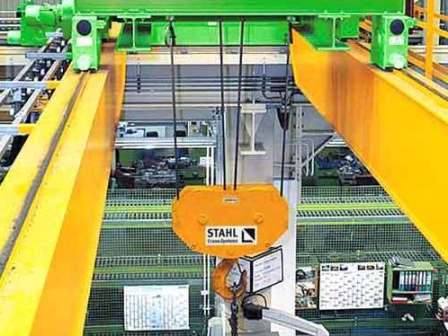
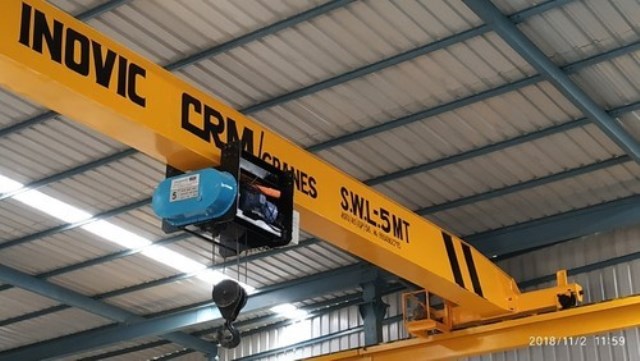
The crane consists of a single bridge girder supported on two end trucks. It has a trolley hoist mechanism that runs on the bottom flange of the bridge girder.
Double Girder Bridge Cranes
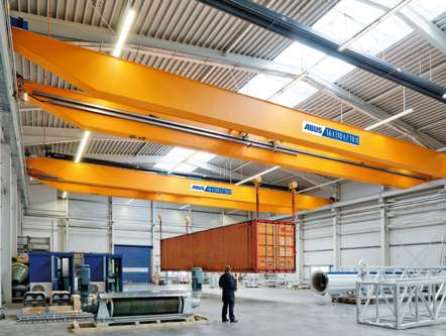
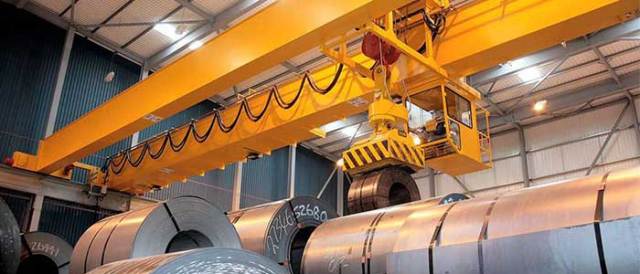
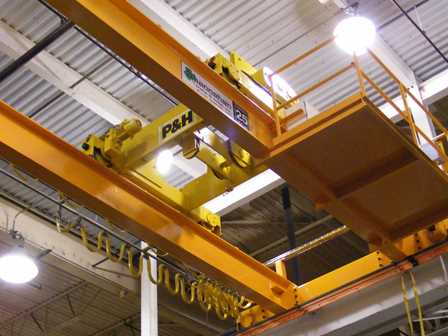
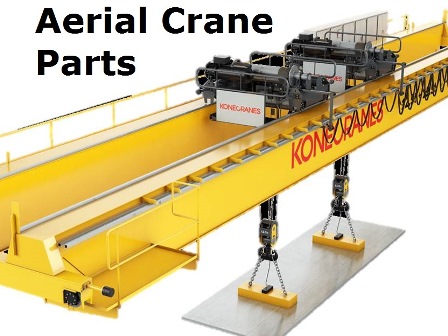
The crane consists of two bridge girders supported on two end trucks. The trolley runs on rails on the top of the bridge girders.
Gantry Cranes
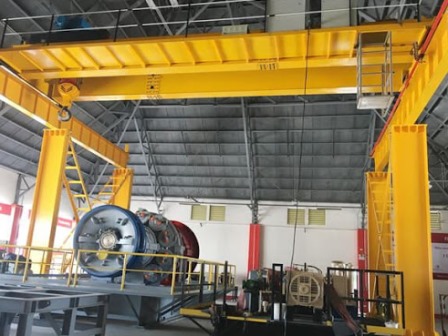
These cranes are essentially the same as the regular overhead cranes except that the bridge for carrying the trolley or trolleys is rigidly supported on two or more legs running on fixed rails or other runways. These “legs” eliminate the supporting runway and column system and connect to end trucks which run on a rail either embedded in or laid on top of, the floor.
Monorail Crane
For some applications such as production assembly line or service line, only a trolley hoist is required. The hoisting mechanism is similar to a single girder crane with the difference that the crane doesn’t have a movable bridge and the hoisting trolley runs on a fixed girder. Monorail beams are usually I-beams (tapered beam flanges).
Overhead Crane Manufacturers: Also known as hoist cranes, overhead cranes operate from an overhead steel beam or pair of beams bridged between two structural supports; a trolley runs along these beams carrying a hoist, which is used to lift and reposition heavy loads. They are powered by hydraulics, internal combustion, or electric batteries.
Some have wondered if in the United States they fix, manufacture, elaborate parts, and components of overhead cranes.
Which are the most important crane manufacturers in the United States?
Who are the main suppliers of overhead cranes?
Who designs and manufactures cranes?
What are the main manufacturers of overhead cranes?
Overhead Crane Manufacturers
Top overhead crane manufacturers
Konecranes Inc
American Crane and equipment
Whiting Corporation
Brehob corporation
Gorbel cranes
Wolverine Crane
Engineered Material Handling
Demag cranes
Overhead Crane Manufacturers
Konecranes
Konecranes, Inc. the company provides innovative overhead cranes that are ideal for a number of industries and applications. It aims to give its clients a competitive advantage and the company has a track record to prove its ability to manufacture top-of-the-line solutions.
Konecranes has an outstanding reputation that is built on over 80 years of delivering premium products and outstanding customer service. From industrial cranes to lift trucks, Konecranes is one of the best in the lifting business. The company is the world’s largest supplier of industrial cranes and also the leader in crane service.
American Crane and equipment
American Crane & Equipment is an American-based company in manufactures different kinds of overhead cranes, either single type or double girder type or cranes employed in different types of industries, whose manufacturing capability is just like Ellsen crane machinery.
This is an American-based company, which is very convenient for clients to have crane needs from America.
Whiting Corporation
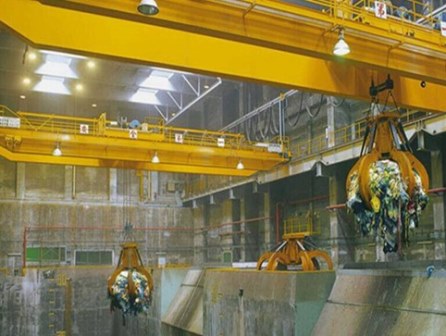
Whiting Corporation, located near Chicago, Illinois, is a major manufacturer of heavy-duty overhead cranes and railcar maintenance equipment. Whiting overhead cranes serve a variety of industries including steel mills, automotive plants, foundries, fossil fuel plants, metal service centers, refuse facilities, hydroelectric plants, and nuclear power plants.
Additionally, Whiting is a trusted name for railcar maintenance and lifting equipment for the freight and commuter railroad industries, municipal transit authorities, railcar builders, and independent maintenance shops.
Brehob corporation
What began as a business between longstanding friends and coworkers; has grown into a booming business including products such as electric hoists, air compressors, and overhead cranes.
With service available twenty-four hours a day, seven days a week; it’s easy to see why Brehob is a popular choice for electric hoists. Brehob has been providing top-of-the-line electric components for over fifty years.
With a rich history of continued innovation and technological advances, Brehob has the qualities of a company that many look for; making them an obvious choice in our industries.
Gorbel cranes
Gorbel®, Inc., an American crane machinery company, has over thirty years of experience providing overhead handling solutions to customers in a wide range of industries.
The company, just like Ellsen Crane Machinery, offers a comprehensive line of crane products, including overhead cranes, to make sure that all of the customers’ needs can be easily met.
Wolverine Crane
Design, fabrication & installation of overhead cranes, box girders, and structural runways. Crane inspections, 24/7 service & repair. Michigan.
Engineered Material Handling
Engineered Material Handling or EMH designs, sells, manufactures, installs, and services a complete line of overhead material handling the equipment. With a proven track record of helping businesses realize their potential with the latest innovative solutions, EMH stands apart in this industry.
Demag cranes
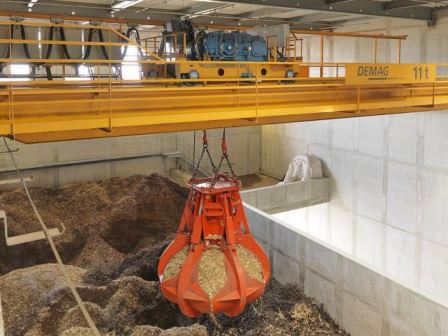
Demag is one of the world’s leading suppliers of crane technology with overhead cranes and components. Demag specializes in the development, design, and production of technically sophisticated cranes, hoists, and components, and the services for those products. They manufacture in 16 countries on five continents.
Overhead crane companies
Partnering with an overhead crane manufacturer is a big decision and one that shouldn’t be taken lightly. The design, manufacturing, and installation of an overhead crane is a big project and can be a substantial investment but, a necessary one if you want to improve your company’s efficiency and workflows.
If you’re looking to finance an overhead crane, your lender may even require you to receive multiple quotes on the purchase and installation of a new crane system. Even if you aren’t financing your new equipment, it’s still a good idea to bring in a few different overhead crane manufacturers to look at your facility and provide a scope of work and their expert opinion on the right crane system for your material handling needs.
Overhead crane inspection
Because cranes work with extremely heavy, dangerous loads, frequent inspections must be performed on overhead cranes for safety purposes.
Every day the operating mechanisms must be checked for maladjustment, the pneumatic and hydraulic parts for leakage, the hooks for deformation or cracks, and the hoist chains and end connections for wear, twist, or distortion.
The running rope and end connections should be checked on a monthly basis for wear, broken strands, and other problems.
Periodically, the overhead cranes should be checked for deformed, cracked or corroded components, loose bolts or rivets, cracked or worn sheaves and drums, other worn, cracked or distorted parts (e.g. bearings, gears, and rollers), and excessive wear on brake system parts, chain drive sprockets, and chains.
Other components to be inspected include electric or fossil-fuel motors, indicators, and electrical components such as pushbuttons and limit switches. OSHA has published a set of guidelines for the safe operation of overhead cranes.
Overhead Crane Manufacturers
Overhead crane manufacturers in USA
The CMAA (Crane Manufacturer’s Association of America) is an independent trade association founded in 1955. Companies striving for admission must undergo a thorough application and review process. Member companies represent leaders in the overhead crane industry.
CMAA member companies are concerned, with conscientious manufacturers who meet regularly to review and revise standards for the mechanical, structural, and electrical design of overhead cranes. CMAA members also formulate guidelines for the proper use, operation, and maintenance of those cranes
As a member of the CMAA, North American Industries, Inc:
meets high standards in engineering design, production, and related operations
maintains a position of technological advancement
Overhead Crane Manufacturers
Overhead crane design
What Does an Overhead Crane Manufacturer Make?
Overhead cranes are an excellent material handling solution that facilitates industrial activities. Consequently, manufacturers of an overhead crane aim to produce tools that serve as the perfect lifting solution for manufacturing and metal fabricating operations.
The systems are made using steel. The kind of steel used in producing an overhead crane and the crane design depends on the nature of the structure it will be used in as well as the weight it will need to lift and move.
For instance, carbon steel is the dominant substance used in manufacturing overhead cranes that are intended for structures that do not require very high strength. The amount of carbon present in carbon steel can vary anywhere from less than 0.015% to more than 0.5%. Carbon and iron consist of around 98% of the properties of carbon steel.
On the other hand, high-strength, low-alloy (HSLA) steels are used in manufacturing cranes that are intended for use in environments that require very high strength. Such machines are designed to lift heavier materials than those that are made from carbon steel. HSLA steels contain around 0.05% of carbon.
The steel also includes elements such as chromium, vanadium, nickel, molybdenum, niobium, and titanium, which are added to strengthen the system.
Their engineering intelligence allows overhead crane manufacturers to provide custom lifting solutions that fit with any facility and operation, all of which is done to facilitate lift activities and alleviate transport challenges.
Overhead Crane Manufacturers
Overhead Crane Manufacturers
How do overhead cranes work?
Overhead cranes cover a rectangular area, moving a load side to side and backward and forward. They typically incorporate a top running trolley hoist that moves along the top of the two bridge beams on its own set of wheels for increased headroom under the crane; also called a top running crane.
Broken Push Button Pendant or Cable?
Pendants are ergonomically designed to be easily held in one hand and are constructed of a durable thermoplastic material. The pendant cable has 2 steel wires built into the cable jacket for permanent strain relief.
Parts Availability Problems?
are components–bearings, contactors, gearboxes, motors, and electrical systems–are designed to industry standards, and most are readily available throughout the U.S. All motor nameplates and gearbox nameplates are clearly labeled with the original manufacturing information. And virtually every spare part for the crane (excluding the hoist) is in stock here in North America and can be shipped immediately.
Crane Travels Too Far Before Stopping?
If your crane coasts more than a few feet, then it is likely that it uses electric motor brakes and that, like most cranes, the brake pads haven’t been replaced (they require replacing or adjusting every 3 months).
What Does an Overhead Crane Manufacturer Make?
Overhead cranes are an excellent material handling solution that facilitates industrial activities. Consequently, manufacturers of an overhead cranes aim to produce tools that serve as the perfect lifting solution for manufacturing and metal fabricating operations.
If something like this has ever happened to you: When the hoisted load is lowered, the bottom block drifts when you let go of the button on the pushbutton control. what could be the cause?
Crane Operator test questions and answers
Crane operator interview questions and answers
Rigging test questions and answers
Overhead Crane Test Questions and Answers
Overhead crane operator test questions and answers
The following practice questions are representative of a level-1 mobile crane theory exam. These will give you a good idea of how the questions are worded and structured.
What does the hand signal indicate in the figure below?
Boom up (*)
Hoist up
Load up
Hold the swing
What is the radio protocol between a mobile piece of equipment and a tower crane sharing the same workplace?
Mobile operator uses the site channel
A separate radio with a mobile to tower crane frequency (*)
Mobile rigger maintains radio contact with tower crane rigger
Mobile operator switches to tower crane frequency once on site
What is the equivalent of 10,030 pounds in kilograms?
3,057 kg
3,238 kg
4,554 kg (*)
7,650 kg
Crane operator test questions and answers pdf
These sample questions are intended to convey something of the style and content of the National Operator Certification Program examination developed and administered by the National Commission for the Certification of Crane Operators.
They are not actual test questions, nor do they attempt to address all of the areas of knowledge tested on the CCO certification examination. Response to these questions is not necessarily an indication of performance on the CCO examinations.
What action does a signal person intend the operator to perform if he extends his arm at shoulder height, makes a fist with his hand, and sticks his thumb up?
Boom down
Swing
Boom up
Telescope out
The load line of the crane you’re operating comes into contact with an energized power line. There’s no sign of any other danger, such as fire. In such a situation, you should:
Climb down carefully from the crane cab
Jump down, feet together
Stay in the cab until the lines are de-energized
Get as far away from the crane as possible
Unless the manufacturer states otherwise, the net capacity of a crane on main boom is the capacity listed in the load chart:
minus the weight of the rigging and all attachments
plus the weight of the rigging and all attachments
minus the weight of the rigging and all attachments not in use
minus the weight of the rigging alone
Unless the operator takes account of boom deflection, when lifted off the ground, a properly rigged load may:
swing out away from the crane
swing in towards the crane
raise absolutely vertically
shift in its rigging
NCCCO test questions and answers
While there are other companies seeking to certify crane operators, only one organization, the National Commission for the Certification of Crane Operators (NCCCO), provides CCO certification.
Tips for Passing the NCCCO Exams
Take a preparatory class. Training is the key to passing. You may think you know everything about cranes, but how well do you know OSHA and ANSI/ASME rules, regulations and industry best practices? A preparatory class builds confidence so you won’t be intimidated by the test.
Read the Candidate Handbook. The manuals tell you everything you need to know about the NCCCO exams, from start to finish. Focus on the outline of the written exams, the outline is like the “blueprint” for the exams.
Forget how you do it daily. You may be doing it safely, but are you following the rules, manufacturer recommendations, and industry best practices? Come to class with an open mind. In fact, you may learn something you didn’t know before.
Exams require experience. The Candidate Handbook states: “CCO certification exams are designed for operators who are trained and currently working in crane operations.” If you are inexperienced, you will need extensive training to get to that level. You can’t get lucky on this test.
Study the load tables. One of the most important parts of this test is being able to solve a load graph problem. If you take a CCO Prep training class, you will be provided with a sample problems and loading diagrams.
Crane operator practice test
NCCCO test questions and answers:
This mobile crane preparation certification study manual is all you need to prepare to take the certification exams for all types of mobile cranes without wasting your time.
It includes selected information to help make sure you learn exactly what you need and avoid all the clutter. Includes 5 valuable prep tests (with answer keys) for you:
General knowledge test (100 questions)
Technical knowledge test (66 questions)
Site-Specific Test (42 Questions)
Crane Load Chart Test (49 questions) and
Practical evaluation test form for your practical operational use.
A free mobile crane inspection checklist is also provided for your use.
The specifications depend on the essential terminology when using overhead cranes, each part, part layer, must be defined and specified. The electrical system, height, load capacity (5 tons, 10 tons, 20 tons), are specific to each crane and you must answer questions such as:
In normal operations, the maximum load that will be placed on the structure of a crane is?
A basic overhead crane will have at least how many moves?
A sound or other effective audible warning signal must be provided, for which types of cranes?
What is the capacity of a crane?
Overhead Crane Specifications
Crane Capacity
The rated capacity of the crane is the maximum working load that can be lifted.
Crane capacity is stated in US tons or metric tons and is required by code to be marked on each side of the crane and hoist; and if the crane has more than one lifting unit, each hoist must have its nominal load marked.
Please note that the load block, hook and ropes are not included in the rated load.
If the crane is intended to be used in conjunction with a magnet, “C” hook, grab, or any other device, the deadweight of such device must be specified so that the safe working load of the crane can be properly determined.
OSHA regulations state that the crane must not be loaded beyond its rated load, except for testing purposes. The load test shall be carried out at or near 125% of the rated load.
Rated working load limit
Caution: never choose more than the rated working load limit (WLL) as many factors go into the design of a crane and one must take into account the safety factor of all components such as wire rope, motors, bearings, pulleys. , drums, wheels, rails, lifting speeds and sizes of beams and steel. On many cranes this will print as the safe working load (SWL).
Electrical Requirements
Ideally 480 volts, 3 phase, 60 hertz for US requirements.
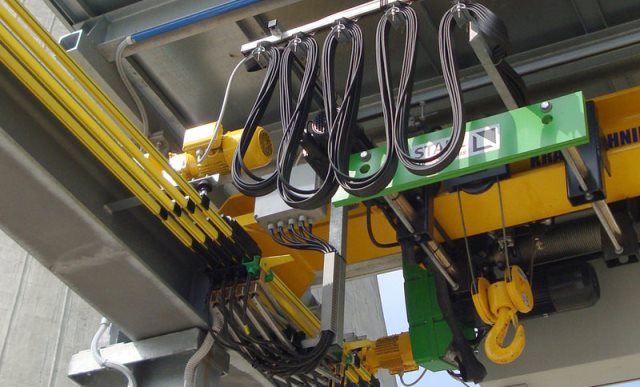
The runway power is usually by a conductor bar, and a hoisting trolley by festoon cable. The control circuit voltage at pendant push buttons shall not exceed 150 volts for AC and 300 volts for DC.
Long travel
‘Long travel’ is the direction of travel of the bridge along the rails.
Cross travel
‘Cross travel’ is the movement of the ‘crab’ from one side of the bridge to the other.
Hook Height
Hook height is the distance from the reference point to the highest position of the hook.
This dimension is essential in most applications, since it determines the height of the track from the ground and depends on the internal free height of the building. The effective lift is the distance between the beam and the floor, minus the height of the hoist.
Runway Height
The distance between the grade level and the top of the rail.
Side Clearances
Side clearances are measured from the center of the supporting rail to the face of the supporting column and are required for operation, safety and wheel maintenance.
Vertical Clearances
The crane must be able to travel within the building while avoiding obstructions in the building such as lights, equipment, and structural framing.
The vertical clearance is based on the size of the crane bridge, location of the hoist and trolley, rail and safety allowance. The lower the crane headroom is, the higher will be the vertical clearance and the lower could be the building height.
Clear span
The span of the crane is the horizontal center distance between the rails of the runway on which the crane is to travel. Typically the distance is approximately 500 mm less than the width of the building.
How much span a crane requires depends on the crane coverage width dictated by the application. Crane coverage is the horizontal crane coverage and is defined as the crane span less the left side hook approach and right side hook approach.
Runway Length
The longitudinal run of the runway rail parallel to the length of the building.
Hook approaches
The maximum hook approach is the distance from the wall to the nearest possible position of the hook. The smaller the distance, the better will be the floor area utilization.
End Approach
This term describes the minimum horizontal distance parallel to the runway, between the outermost extremities of the crane and the centerline of the hook.
Crane speed calculation
Bridge, Trolley and Lift Speeds: The speed at which the bridge or trolley travels or the hoist is raised is usually specified in feet per minute or FPM.
Crane operating speeds are selected to allow safe operation while using the pendant.
Dual operating speeds are normally used, typically a fast and slow speed with a 4:1 ratio, but for optimum control, a variable speed control system is preferred.
Overhead cranes can come in many shapes and sizes, so if you’re not certain of the terminology it’s best to start by asking: what exactly is an overhead crane?
Rewiring the electrical parts within a crane or hoist presents an opportunity to modernize your equipment to improve performance on a budget.
Overhauling your drive, interrupt, and switch systems can power your equipment at a fraction of the cost of buying new machinery.
Traveling cranes require circuit breakers, transformers, variable frequency drives, and surge suppressors, among many other components.
All electrical components for cranes meet industry standards set by the Crane Manufacturers Association of America (CMAA), formerly known as the Electric Overhead Crane Institute (EOCI).
Overhead Crane Electrical Components
Overhead crane power supply
Reliable and dynamic cable management is one of the greatest challenges in modern crane technology. While the components must be modular, they should also be consistently easy to install, low maintenance, and cost-effective.
Engineers often turn to two power supply variants to try and meet these demands: festoons and energy chains.
Which solution is best for your crane application? Read this tech talk and get a full understanding of the differences between the two technologies.
This section regulates voltage, cabling, design, and construction of pendant controls to protect lifting equipment operators and other personnel from electrical shock.
These specifications support OSHA, which lays out employers’ responsibilities to provide employees a workplace that minimizes the risk of arc-flash and other electrical hazards
Electrical Equipment
Wiring and equipment shall comply with subpart S of this part.
The control circuit voltage shall not exceed 600 volts for a.c. or d.c. current.
The voltage at pendant push buttons shall not exceed 150 volts for a.c. and 300 volts for d.c.
Where multiple conductor cable is used with a suspended pushbutton station, the station must be supported in some satisfactory manner that will protect the electrical conductors against strain.
Pendant control boxes shall be constructed to prevent electrical shock and shall be clearly marked for identification of functions.