Category Archives: forklift

Forklift Yard Ramp

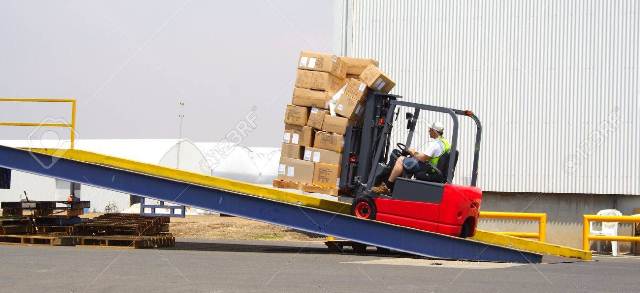
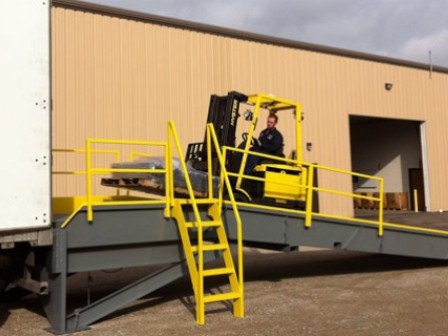
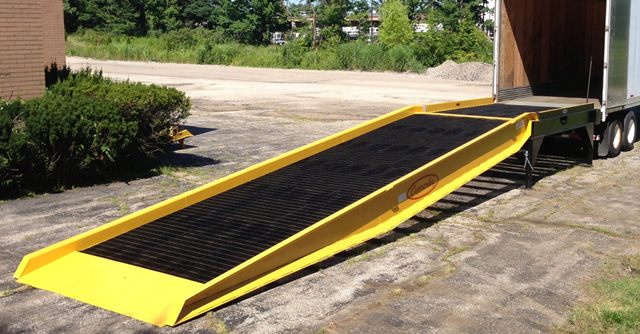
Forklift Ramps for Containers – Forklift Yard Ramp: A yard ramp is a portable loading dock. It is a ramp that can be moved anywhere in the shipping and receiving yard to give forklift access to a shipping container or semi-trailer at a loading dock level.

Yard ramps fulfill an important niche as a productivity tool, enabling the user to move heavy equipment via forklift from ground level to loading dock level. The chief purpose of a yard ramp is to facilitate the loading and unloading of semi-trailer trucks at locations that lack a loading dock. Alternatively, a yard ramp can be used to allow vehicles to enter a warehouse through a loading dock door.

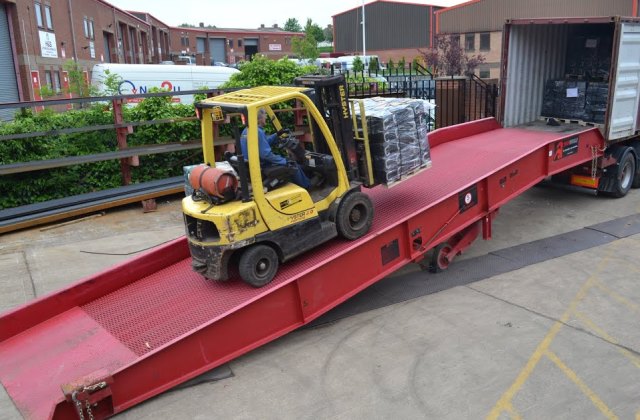
Forklift ramps for containers

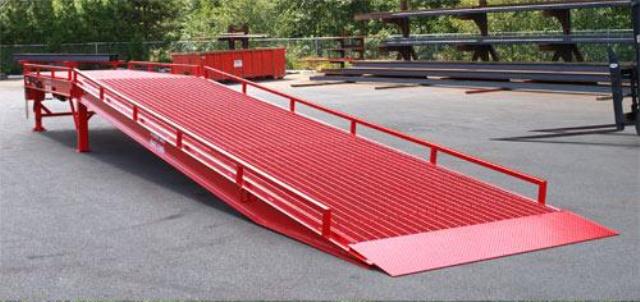
Portable steel yard ramp

The yard ramp allows for traffic to move from the dock level down to the ground or from the ground up into the back of a truck, which helps loading/unloading flow smoothly. The 18” industrial solid rubber pneumatic tires allow for easy movement of the ramp around your shipping yard to have you ready in minutes to begin loading/unloading. The hydraulic adjustment system permits fast reliable height adjustment of the yard ramp with virtually any trailer bed height.

Portable Steel Yard Ramp Highlights

  • All steel welded construction
  • Capacities from 16,000 to 60,000 pounds
  • Wide range of capacities and sizes available
  • Solid rubber tires standard, pneumatic tires optional
  • Steel serrated grating
  • Double-action hydraulic pump
Forklift Yard Ramp

Portable yard ramps

Forklift Yard Ramp features

  • Versatility is Paramount in a Yard Ramp: The standard heavy-duty axle assembly with 18” industrial solid rubber pneumatic tires provide excellent mobility for positioning. In addition, the axle assembly can be removed or raised for permanent dock ramp installations.
  • Heavy Duty Structure: Structure consists of heavy-duty formed steel side girders fully welded to high strength steel joists. (Picture shows the underside of ramp.)
  • Tow Clamp: The “tow clamp” connects between the ramp pocket and the tow hitch of your fork truck and permits easy transportation of the ramp over longer distances.
Forklift Yard Ramp

Portable forklift ramps

Forklift Yard Ramp:

Portable forklift loading ramp: When you need to unload a truck, trailer or railcar and dock space aren’t available, our heavy-duty 22,000 lb capacity steel yard ramp is the solution to your problem.

Easily movable on solid rubber wheels, each yard ramp includes a dual cylinder hydraulic pump to raise or lower the ramp to the proper loading height.

Two steel ramps ensure a smooth transition from the ground to the ramp. This steelyard ramp is designed for loading and unloading a truck, trailer, or railcar when dock space isn’t available.

The surface of the ramp includes a middle diamond plated strip that is surrounded by serrated steel grating, which allows for snow, dirt, and debris to fall through, preventing dangerous build-up on the ramp (please note, the grated surface of this ramp is not designed for forklift turning maneuvers).

Additional safety features include 8” tall side rails on either side to prevent forklifts from driving over the edges, and two 60” safety chains to hold the ramp secure to the loading surface.

The chains can be attached to a semi-truck trailer’s ICC bumper to prevent the ramp from kicking out. This yard ramp also includes a dual-action hydraulic pump for smooth raising and lowering of the yard ramp.

To use the pump, simply push the lever forward or back to raise the front and open the release valve to safely lower the ramp into position. The pump is conveniently stored internally for safety and protection.

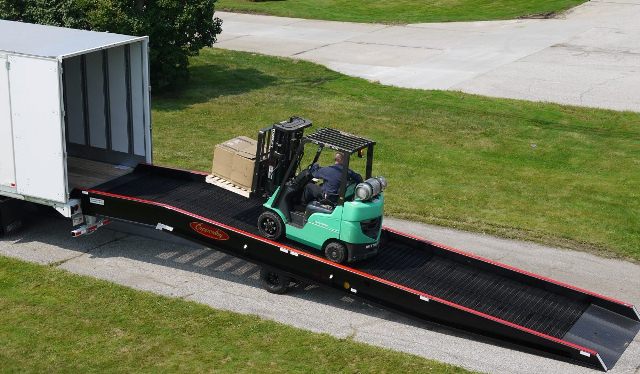
Forklift Yard Ramp

Forklift ramp slope

Forklift Yard ramp design

Some yard ramps are constructed from aluminum, but although this has weight advantages, their cost is typically much higher than their steel equivalents; most yard ramps are therefore constructed from welded steel unless the weather conditions are such that aluminum needs to be used, i.e. in climates with temperatures well below freezing.

There are a variety of choices for the decking material as it is required to be both tough and non-slip in a range of operating conditions. Most manufacturers use some form of open grill sheeting supported on a rugged base structure.

The basic layout of a yard ramp is an inclined section of about 9 m (29’6″) in length and 2.25 m (7’5″) in width, followed by a flat approach section of about 2.5 m (8’3″) in length at the top, with a lip to enter the container or truck being loaded or unloaded.

Both sides of the ramp usually have safety rails to prevent forklifts from accidentally driving over the edges. Standard height should be at 7″ and 4″ thick. The yard ramp is supported on an undercarriage, or adjustable legs, fitted with wheels which are used to transport the yard ramps around.

The undercarriage/legs are adjustable so that the height of the ramp can be raised whilst the truck is put into position, and then the yard ramp is lowered so that the front lip supports the weight of the yard ramp on the container or truck floor. It is then vitally important that the yard ramp is allowed to float up and down with the vehicle as it raises/lowers on its suspension.

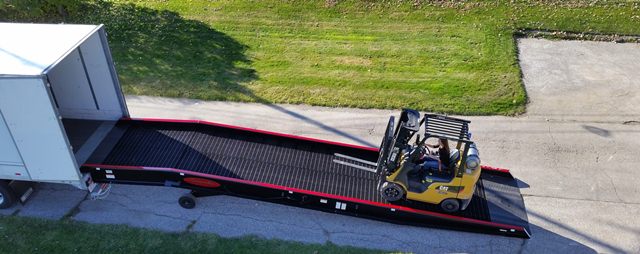
Forklift Yard Ramp

OSHA forklift ramp requirements

  • 1910.178(n)(7)(i) When ascending or descending grades in excess of 10 percent, loaded trucks shall be driven with the load upgrade.
  • 1910.178(n)(ii) On all grades the load and load engaging means shall be tilted back if applicable, and raised only as far as necessary to clear the road surface.

Forklift gradeability

Gradeability ratings apply to a particular make and model of the machine and are legitimately supplied only by the manufacturer. The ratings identify on which grade a machine is capable of climbing and stopping with a full capacity load. For example, a Toyota 8FBCU25 forklift is rated at approximately 20% which is only 12 degrees. However, some 4-wheel drive rough terrain forklifts have as much as a 30-40% gradeability rating.

OSHA loading ramp requirements

Climbing excessive grades can have a negative effect on battery cycle time, fuel consumption, component temperature, longevity and reliability of the machine. While the ability to reliably climb a ramp is important, safely descending a ramp when carrying heavy loads is equally concerning. The forklift must be able to safely stop on the required grade. Operators should be trained to follow specific travel rules for their own safety.

Forklift Yard Ramp

Forklift ramps for containers

Forklift ramps for containers: The perfect answer for loading and unloading freight from shipping containers

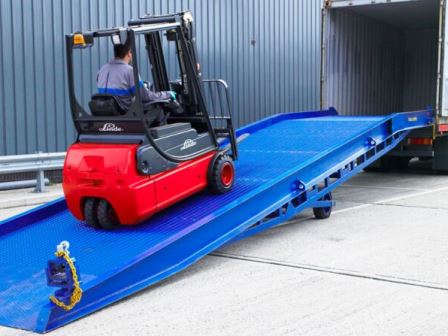
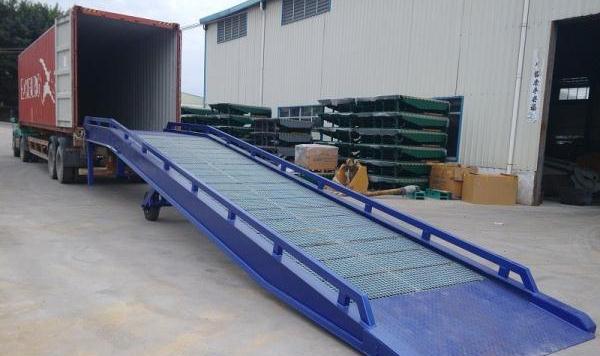
The Shipping Container Ramp is used to load and unload cargo from shipping containers with a forklift. It allows you to safely navigate the transition from the ground to the bed of the shipping container.

Container Ramps are built tough to withstand heavy use. They are built to last.

These Shipping Container Ramps feature a full-width stiffener to provide strength and to bump up against the container. Locking chains with a specially designed keeper allow you to easily lock it into the holes in the container. After the keepers are in place, taking up the slack in the chain is simple and quick with the sturdy grab notch bracket welded to the sides of the Container Ramp. The result is a safe, sturdy loading ramp locked firmly to the shipping container. You can now load and unload your container safely.

Forklift Yard Ramp

What is a good slope for a ramp?

For commercial use when somebody is sitting in the wheelchair or scooter while it climbs the ramp, ADA recommends a 1:12 slope, which means that every 1″ of vertical rise requires at least 1′ (12″) of ramp length (5 degrees of incline). Example: A 24″ rise requires a minimum ramp length of 24′ (288″) (24 divided by 1).

what is a forklift ramp for containers?

The Shipping Container Ramp is used to load and unload cargo from shipping containers with a forklift. It allows you to safely navigate the transition from the ground to the bed of the shipping container. Container Ramps are built tough to withstand heavy use.

How do you calculate the slope of a ramp?

Slope percentage is calculated in much the same way as the gradient. Convert the rise and run to the same units and then divide the rise by the run. Multiply this number by 100 and you have the percentage slope. For instance, 3″ rise divided by 36″ run = .083 x 100 = an 8.3% slope.

What is a yard ramp?

A yard ramp, sometimes called mobile yard ramp or container ramp, is a movable metal ramp for loading and unloading of shipping containers and vehicle trailers, without the need for permanent docking bays.

When driving a forklift the forks should be at what height?

When the forks are too low, it could scrape the floor surface. It is also dangerous when you reach an incline or slope, that is why when traveling in slope, drive the forklift in reverse. In a typical warehouse set up with an even floor surface, the forks should be above the ground at a height of 5 to 10 centimeters.

The most read

Forklift Container Ramps for Sale

  • What kind of forklift ramps are there?
  • How much does a container ramp cost?

More on this story

Forklift Dock Ramp

Loading docks perform a critical function in the logistics system infrastructure. They form the link between manufacturing and transportation, and between transportation and storage functions.

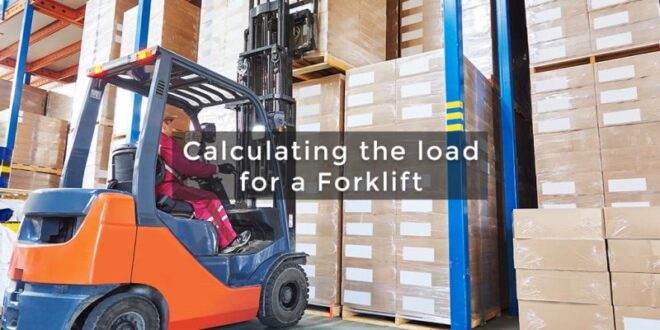
Looking for the Formula to rate the capacity on Forklifts

The capacity rating plate on the forklift truck must be corrected when attachments are installed. This is called derating the lifting capacity. This is a rules and regulations mandate.

Looking for the Formula to rate the capacity on Forklifts.

Looking for the Formula to rate the capacity on Forklifts

Forklift lifting capacity

The calculation formula is provided below. It is the forklift owner’s responsibility to contact their forklift truck manufacturer/distributor with this information to obtain a new capacity rating on the forklift’s nameplate.

  • The FLSC forklift scale comes in an ITA Class II (16” high, 5,000 lb/2,500 kg) model.
  • The QTLTSC forklift truck scale comes in ITA Class II (16” high, 5,000 lb/2,500 kg) and
  • ITA Class III (20” high, 5,000 lb/2,500 kg and 10,000 lb/5,000 kg) and
  • Class IV (25” high, 10,000 lb and 16,000 lb) models.

Each class comes in several widths for cleat type carriages. Measure the height and width of the forklift truck carriage. Select from the tables in this document, the appropriate width that best meets the dimensions of the forklift truck carriage.

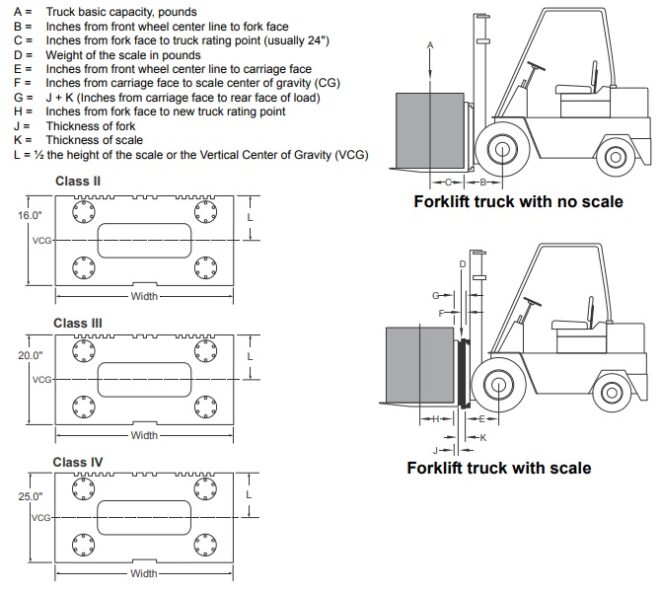
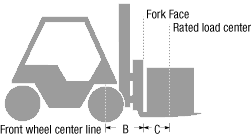
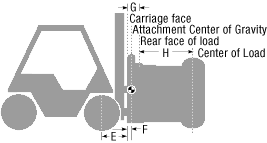
Use the weights, dimensions and the following formula to calculate the net lifting capacity of your forklift truck with a scale attached. Refer to the illustrations.

formula to rate the capacity on forklifts

Forklift lifting capacity calculator

The calculator that is used to decide on forklift load capacity was designed with the average individual in mind. The reason for this is easy and this is because the addition of attachments to a forklift carriage creates an entirely new dynamic to the stability of the lift and will change the carrying capacity. There is actually a very complicated interrelationship going on with a multitude of forklift parameters which is often too detailed for the average person to comprehend.

Deciding on forklift load capacity is critical because there are several issues that can impact residual capacity. Included among these are forklift model, tires, mast, carriage, side-shift distance, rotational torque, horizontal load center, vertical load center, attachment specifications, fork specifications, many others, which the calculator takes into deliberation.

Rated capacity forklift

Specifications are affected by the condition of the vehicle and how it is equipped, as well as the nature and condition of the operating area. Inform your dealer of the nature and condition of the intended operating area when purchasing your Truck.

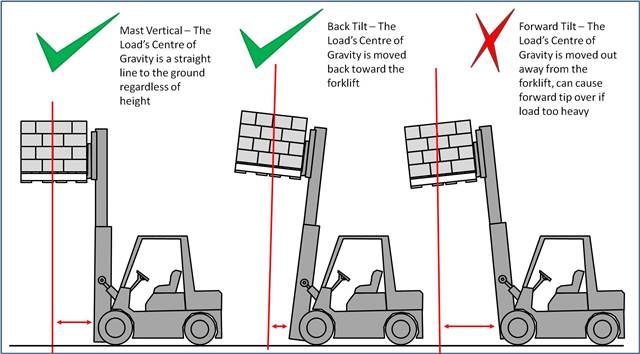
Care must be exercised when handling elevated loads. When the carriage and/or load is elevated, truck stability is reduced. It is
important that the mast tilt in either direction is kept to a minimum when loads are elevated.

Operators must be trained and must read, understand and follow the instructions contained in the Operating Manual. All values are nominal values and they are subject to tolerances. For further information, please contact the manufacturer.

  • Weights are based on the following specifications: Complete truck with cab, pneumatic tires, mast, carriage, and forks.
  • Unladen with new tires
  • Bottom of forks n +/- 3% tolerance depend on tire inflated pressure or tire brand.
  • Full suspension seat in the depressed position.
  • Add 50 mm with load backrest
  • Optional equipment
  • Stacking aisle width is based on the VDI standard calculation as shown on the illustration. The British Industrial Truck Association recommends the addition of 100 mm to the total clearance (dimension a) for extra operating margin at the rear of the truck.
  • Distance center truck to the centre of the internal turning radius.
  • Travel speed laden/unladen limited at 25 km/h as factory default.
  • Gradeability figures are provided for comparison of tractive performance but are not intended to endorse the operation of the vehicle on the stated inclines. Follow instructions in the operating manual regarding the operation on inclines.
  • Engine data based on low mount exhaust.
  • Data available on request, as values are dependent on application.

Forklift load centre calculator

Safely operating a powered industrial truck, or forklift requires the driver to be cognizant of how much weight is loaded on the forks.

Each machine has a load capacity rating that limits the amount of weight the forklift can carry, which often changes depending on the size, shape, and position of the load on the forks. However, these measurements can be made in the field through simple calculations.

Calculate forklift capacity height

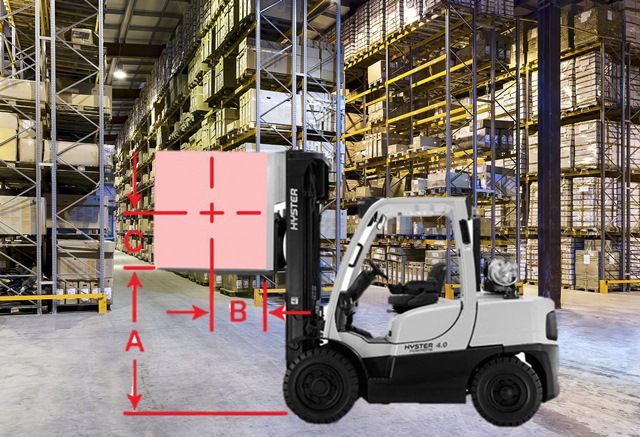
Consider the size, shape, position and weight distribution of the load to determine if the machine can make the lift. Forklift manufacturers frequently calculate load capacity by measuring with an evenly distributed, square object at a 24-inch horizontal distance from the mast.

However, the majority of loads are not palletized squares or cubes, and the size or shape of the load may reduce the capacity. If the machine becomes overloaded, it could tip over, raise the rear wheels and affect steering control or cause the load to fall off the forks, resulting in property damage, injury or even death.

Prevent exceeding the machine’s load capacity by always reading the instructions on the forklift data plate or nameplate. Minimize the load distance from the front wheels to the load center by placing the load close to the front wheels.

The U.S. Department of Labor’s Occupational Safety and Health Administration (OSHA) also recommends arranging the heaviest part of the load closest to the mast.

How do you calculate the load capacity of a forklift?

It is easily calculated by measuring the load to be carried, and dividing by two (providing the load is evenly distributed, and positioned to butt up to the forklift backrest). You will often see a forklift truck’s nominal capacity quoted in a form such as 2,000kg @ 500mm load center.

What is the load center of a forklift?

The load center is the distance from the face of the forks to the load’s center of gravity. Many forklifts are rated using a 24-inch load center, which means that the load’s center of gravity must be 24 inches or less from the face of the forks.

The most read

Forklift Safety Procedures

Forklifts are extremely useful workplace vehicles, as long as they are used safely and appropriately by operators who are appropriately trained and competent to use them.

More on this story

How to operate a stand-up forklift?

Two main ways of operating a forklift exist. Operating while sitting down, and operating while standing up.

Forklift Capacity Calculator

The lift capacity factor of the forklift is important in your equipment selection regardless of whether you are buying the truck with the attachment or are adding the attachment to a truck yourself.

In addition to the safety aspect, stability, and avoidance of damage to the truck, you should assure yourself that the forklift truck can do the work you need to be done.

With this, there are still questions, how to read the forklift load capacity chart? how to calculate load center on forklift

Forklift Operator Certification and Recertification: All you need to meet forklift operator compliance.

An effective and efficient forklift operator certification packaged kit for individuals and employers seeking operator certification for themselves or personnel for the operation of various types of forklifts.

Forklift Capacity Calculator

Forklift lifting capacity calculator

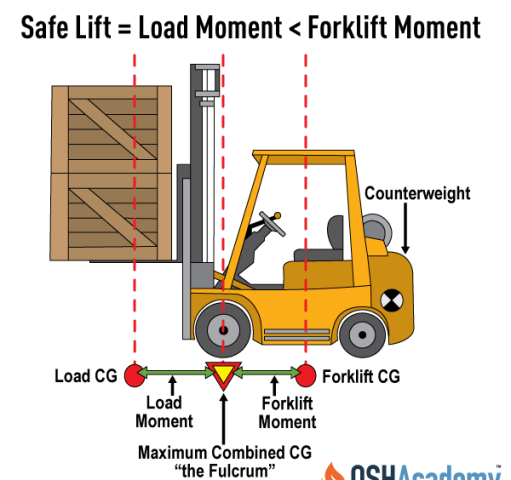
Normally, an attachment tends to move the center of gravity of the combined truck and load forward. It does this by adding its own weight to the load side of the fulcrum, and by moving the truck’s load center forward. The farther forward the center of gravity moves, the smaller the load weight must be and the more likely the truck is to tip forward.

Truck manufacturers generally calculate the net capacity of a truck, with an attachment, using simple formulas. The formula used in the illustration is typical.

Lift truck capacity calculator

Looking for the formula to rate the capacity on forklifts – Lift truck capacity calculator:

Many truck manufacturers prefer not to rely on arithmetic alone, but use test methods, such as the tilt-table test.

The formula used here helps you find the net capacity which is, in effect, your load-weight limit, and can be substantially lower than the truck’s original rated capacity.

If the load-weight limit is too restricting for your job, you will probably need a truck with a higher original capacity rating. Thus the selection of an attachment can also involve the selection of a truck.

It may be wise not to regard arithmetic formulas as anything more than rules of thumb. They provide a good basis for discussion with your supplier and give you an idea of your ballpark limits.

For the exact determination of the attachment/truck capacity, you should contact your truck manufacturer. Customer Service will supply your weight, lost load, and center of gravity figures for the truck manufacturer’s calculations.

forklift capacity calculator
lift truck capacity calculator

Calculate forklift capacity height

If the data plate on your forklift says its rated capacity is 10,000 lbs, that doesn’t necessarily mean you can lift any load weighing less than 10,000 lbs. The load dimensions, placement, weight distribution of the load and any forklift attachments affect your lift truck’s true maximum capacity.

forklift capacity calculator: blog post will answer the questions:

  • What is rated capacity vs. net/payload capacity
  • How much can a forklift actually lift?
  • What is the load center?
  • How to choose a forklift with the right capacity

forklift lifting attachment

Forklift attachments and capacity: forklift capacity calculator

Adding a forklift attachment reduces the lifting capacity of the truck due to the additional weight of the attachment itself and because an attachment typically moves the truck’s load center farther forward. As the center of gravity moves forward, the maximum load weight must decrease to prevent tip-overs.

Fork truck capacity calculator

Correctly establishing forklift load capacity is critical. This is because not getting it right can result in numerous problems. Included among these are injuries to employees that can be major.

It can also lead to significant financial troubles. Included among these are any benefits that have to be paid to workers who have been hurt, in addition to delays in the delivery of services. You also have to think about fines that could result from unfavorable ergonomic conditions.

Lift Truck Capacity Calculator knows how important ascertaining forklift load capacity is, but do you?

You can depend on the lift truck capacity calculator for details about forklift load capacity because it was created by engineers with many years of practical experience in offering forklift capacity ratings for some of the world’s largest forklift manufacturers. These are professionals who know what they are doing and they have imparted their wisdom in developing the calculator.

forklift capacity calculator

Forklift Capacity Calculator

You will also be optimistic when you learn that it is the world’s first professional forklift load capacity rating system for forklift capacity that is available to all manufacturers, dealers, brokers or customers that focuses on the need for fast and accurate capacity information that is required to properly and safely specify a forklift configuration for a material handling application.

What is the fulcrum point?

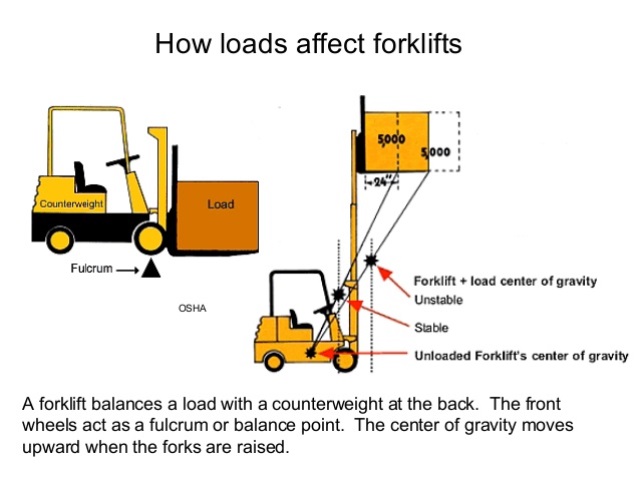
The fulcrum is the central pivot point of a seesaw. The front axle is the fulcrum of the forklift where the counterweight and the load find balance.

One of the hardest things for lift truck operators to learn during training is how to maintain their center of gravity within their stability triangle. A forklift has a three-point suspension system. The points are found over both of the two load (front) wheels and midway between the rear wheels.

Forklift Load Capacity

Deciding on forklift load capacity is critical because there are several issues that can impact residual capacity. Included among these are forklift model, tires, mast, carriage, side-shift distance, rotational torque, horizontal load center, vertical load center, attachment specifications, fork specifications, many others, which the calculator takes into deliberation.

Forklift Driver Safety Handbook

A practical guide to preventing powered industrial truck incidents and injuries

The forklift handbook provides reminders and best practices to help you avoid accidents and injuries while operating forklifts, order pickers, motorized hand carts, and similar equipment.

Handy forklift driving reference helps you recognize and identify potential hazards, follow safe operating practices and protect yourself and your coworkers

The Guide to Forklift Training

“The Guide to Forklift Training” is an essential resource for anyone who operates or manages a forklift. This book covers everything from the basics of forklift operation to advanced safety techniques, providing readers with the knowledge and skills they need to operate forklifts safely and efficiently.

With practical tips and real-world examples, this book is an invaluable resource for anyone who works with forklifts.

What is the capacity of a forklift?

Forklift capacities range from about 3,000 lbs up to more than 70,000+ lbs. You can find the rated capacity of a forklift on its data plate. OSHA requires “only loads within the rated capacity of a truck shall be handled.” It’s easy to think the rated capacity is the same as a maximum capacity, but it’s not that simple.

How do you find the load center of a forklift?

It is easily calculated by measuring the load to be carried, and dividing by two (providing the load is evenly distributed, and positioned to butt up to the forklift backrest). You will often see a forklift truck’s nominal capacity quoted in a form such as 2,000kg @ 500mm load center.

How much can a 5000 lb forklift lift?

A 5,000-lb. a capacity forklift will lift that much weight up to 48-inch forks (with a 24-inch load center) but going out to 60 inches (with a 30-inch load center), for example, drops the capacity to 4,000 pounds.

What is the center of gravity on a forklift?

When at rest, on level ground, the forklift’s center of gravity is within the stability triangle. But if the forklift is put in motion, or sits on a sloping surface, it’s center of gravity shifts.

The most read

High Capacity Forklift

Rough terrain forklifts or high capacity forklifts have become a common piece of equipment in all aspects of the construction industry.

More on this story

Warehouse Lifting Equipment

As you know, before buying or renting the forklift that best suits the warehouse where you work, you have to take into account several factors.

Forklift Lifting Capacity

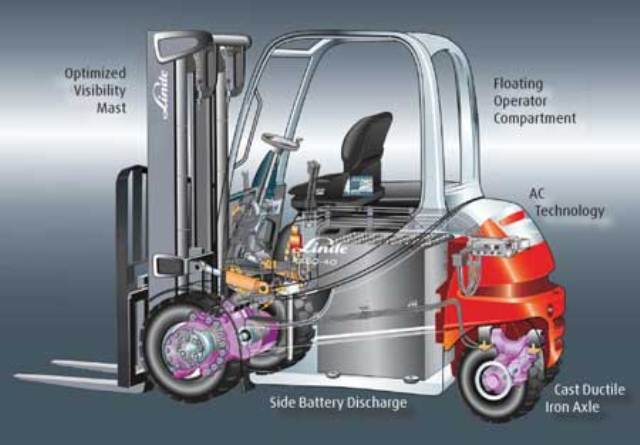
FORKLIFT LIFTING CAPACITY: high capacity forklift loader truck, forklift attachments, side loader forklift, used forklifts for sale, battery.

Forklift Battery for Solar

If you’ve decided to power your off-grid homestead with solar power, you may be considering using rechargeable forklift batteries to store the power from the sun. Here are a few important things to understand about using forklift batteries for solar off-grid power.

Forklift Battery for Solar

Used forklift batteries for solar

The Benefits Of Using A Forklift Battery for Solar Power

Living off-grid is a very interesting lifestyle that catches a lot of attention nowadays. It is a sustainable way of life that has a huge positive impact on our environment. But it also presents a fair share of challenges. Power is one of the main concerns that you have to address when deciding to live off-grid.

Since you won’t have any support from an electrical grid, you have to rely on stand-alone power systems for electricity. One of the most popular options that you have is a solar panel system. Some off-grid experts recommend using a forklift battery for solar panel power systems.

recharging electrical for forklift, battery charger.

Forklift battery for solar system

The Top Choices Of Batteries For Off-Grid Systems

When it comes to choosing the battery that you will use for an off-grid or renewable power system there are several aspects that you have to consider. If you want a stable power grid that can handle a lot of electrical loads and last for years.

You have to use a battery that can keep up or better yet exceed your demands. Power cells that can store massive amounts of energy and have toughness and durability withstand the test of time. Just to give you an idea, the idea is to look for a lead-acid battery that has deep cycle capabilities, is extremely durable, and as much as possible a flooded type of battery.

Like the three types of batteries listed below.

Golf cart batteries

These power cells are deep cycle batteries and are considered to be one of the most manufactured types of batteries. Golf cart batteries are also the most commonly used battery for various renewable energy power systems worldwide.

These batteries are also available everywhere, and they are easy to find, making them very convenient for a user to replace. Although they can only offer a maximum of six years of life expectancy, golf cart batteries are cheap and very reliable.

L16 battery

The L16 Power Cells – An L16 power cell is a type of battery specially designed to offer more power storage. Compared to golf cart batteries, they have a higher amp rating and last longer than can reach up to eight years. However, these batteries are more pricey, and most of their 6V units are a lot heavier compared to their golf cart battery counterparts.

forklift battery

Forklift or Industrial Batteries – Finally, the most recommended by off-grid experts, are industrial batteries or forklift batteries. This type of battery features a hefty and bulky build that makes it heavy.

However, a single forklift battery can be equivalent to a string of multiple golf cart batteries when it comes to electrical storage capacity.

These batteries also offer extreme toughness and exceptional durability that can offer a service life of up to two decades. However, a new battery unit of this kind is really expensive, but there are a lot of ways of getting an old one for a cheap price.

Forklift Battery for Solar

Forklift battery for home solar

You may be thinking of new technologies involving sealed batteries of different materials. However, from what I have seen, the prices are still too high for these units. What I would call your attention to is still the standard lead-acid deep cycle battery, but one of a different variety.

They are sometimes right under our nose and for some reason, we don’t even think of them as an option. What could this possibly be?

Industrial forklift batteries

The lowly forklift or industrial battery is used in electric forklifts or pallet jacks. It is simply an incredibly heavy-duty, incredibly large, and surprisingly cost-effective lead-acid deep cycle battery.

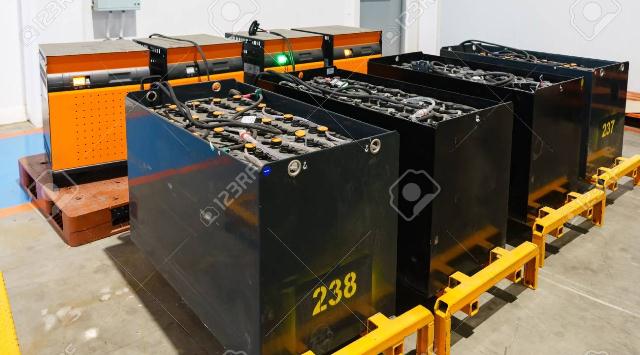
Forklift batteries come in a variety of voltages (12, 24, 36, or 48) and sizes (from 1,000 pounds to several thousand pounds). They are available at local industrial battery suppliers or in at least one situation, from the manufacturer.

The lead plates on a forklift battery are far thicker and should last much longer than any L-16 battery made for renewable energy. The battery is composed of 2-volt cells, all packed in a heavy-duty metal case and tied together with metal bars in the proper configuration to add up to the labeled voltage.

When used with a forklift every day, these batteries typically last no more than seven or eight years but the expected lifespan is up to 15 or 20+ years when used with a renewable energy system, properly maintained, and not deeply discharged.

Forklift battery price

Where to Buy?

Forklift batteries are readily available from industrial battery dealers in most large cities. And while it is certainly worth checking those local sources, it is very possible that your best deal may come from an out-of-town source.

In addition, anytime you buy a battery for off-grid purposes from a forklift dealer, you have to expect that the dealer won’t be much help.

They may be very well versed in forklift batteries for use in forklifts, but we have found them to not only be clueless about off-grid usage but to actually give information that is just plain inaccurate. You see, what may be good advice for a forklift user could be positively bad advice for an off-grid user. We use our batteries VERY differently.

How much does a forklift battery cost?

How much does a forklift battery cost?

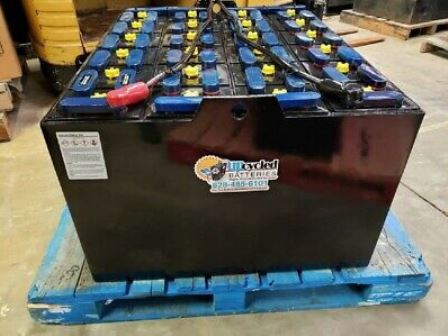
Used forklift batteries usually cost around $1,500 to $3,500. You can buy used industrial batteries through a local material handling or battery dealer.

How many hours does a forklift battery last?

Most modern forklift batteries are designed to last a minimum of 1,500 charge cycles. If a battery is under heavy use and requires daily charging, the 1,500 charge cycles would represent approximately five years of service.

How often should you equalize a forklift battery?

How often you should give your battery an equalized charge depends on the age of the battery. Newer batteries should have an equalizing charge every 10 charging cycles while older batteries need an equalizing charge every fifth charging cycle

What kind of batteries do forklifts use?

Lead-acid forklift batteries provide a power source and act as a counterweight to a lift truck. A typical lead-acid battery is made up of a battery case, battery cells, and battery cables that come together to house a liquid electrolyte mixture of sulfuric acid and water.

The most read

Forklift Batteries for Sale

How to buy the right forklift battery? Before you spend hundreds of dollars on a battery, take a moment to learn how to choose the battery for your forklift.

Forklift Battery Price

When it comes to buying a battery for your forklift, the true cost of a forklift battery involves much more than just the initial price.

More on this story

Reconditioned Forklift Battery

How do you recondition a forklift battery?
How do you refurbish a forklift battery?

Forklift Battery Charger

Your forklift truck will run on its own battery if it’s an electric vehicle. The battery is a vital piece of equipment and must be cared for and kept charged in order for your truck to work properly.

Deep Cycle Forklift Batteries

Are forklift batteries deep cycle?

Forklift Load Backrest

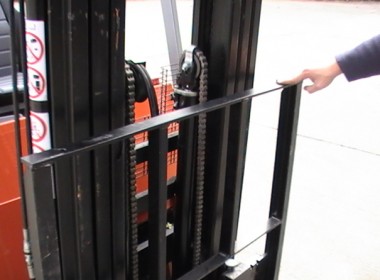
Forklift Load Backrest: Steel Load backrests are designed to prevent the load from falling toward the equipment driver. This allows product to rest against a square, flat surface that makes loading/unloading safe.

These OSHA required backrests to feature a steel grid area above the forks. Heavy-duty steel framing secures the attachment to sides of forklift carriage.

All load backrests are either bolt-on or slip-on style. Special backrests, such as notched center and electric pallet truck backrests are available upon request.

Load backrests are manufactured to order based on certain specifications.

Forklift Load Backrest

Forklift backrest

Forklift manufacturers offer various heights for the load backrest. When selecting a forklift, research the warehouse application and the heights of loads to purchase load backrests that meet rather than exceed the requirements. The proper load backrest will provide protection for the forklift operator while reducing the possibility of product and facility damage.

Other solutions include shrink wrapping or banding the loads and restricting a forklift with a removed load backrest to specific areas (i.e. the dock for loading and unloading trailers).

Forklift Load Backrest

Backrest extension forklift

Universal Backrests

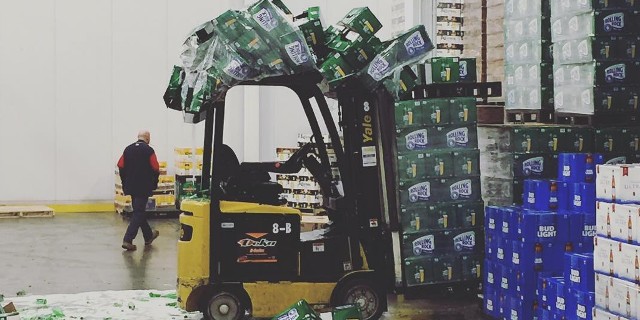
A forklift load backrest is designed to ensure a forklift’s load doesn’t suddenly – or ever – fall on your driver.

They can come in many shapes and sizes and it can be difficult – or at least somewhat annoying to find one that fits your forklift.

But the Universal Load Backrest pretty much fits most forklifts. Using the Universal Load Backrest means you can reduce – if not eliminate – the need for service calls for measurements. You’ll also cut way back on returning load backrests because they don’t fit.

The packaging and universal design of these backrests make them ideal for dealers to stock them, as well.

Once you start using the Universal Load Backrests, be sure your technicians perform the following regular inspection tasks regularly:

  • Look out for cracking, missing vertical bars and bends.
  • Make sure the backrests aren’t in contact with any other part of the pallet truck, forklift truck during operation of the mast.
  • Be sure to look for missing or loose mounting bolts.

Universal Load Backrests aren’t inexpensive to replace or even repair, so it’s a good idea to train your workers to make sure they don’t use it as an anchor when they’re pulling things with the lift.

Load backrest extension forklift

forklift backrest specifications: Forklift Load Backrest

  • Load backrests support loads that extend over the height of the carriage
  • Protects the forklift operator by preventing loads from falling onto the cab while tilting
  • Backrest mounting is manufacturer specific
  • Aftermarket backrests available for a fraction of the OEM cost
  • From forklifts to telehandlers, the load backrests guarantee your productivity and safety.
  • Forklift load backrests extend the height of the carriage to support taller loads and protect the operator by preventing loads from falling while tilting.
Forklift Load Backrest

OSHA forklift regulations

Removing the load backrest and reminding your forklift operators to be careful is not an accurate solution based on OSHA’s code of federal regulations.

  • OSHA CFR1910.178(e)(2)
    Safety Guards: If the type of load presents a hazard, the user shall equip fork trucks with a vertical load backrest extension.
  • OSHA CFR1910.178(m)(10)
    Truck Operations: A load backrest extension shall be used whenever necessary to minimize the possibility of the load or part of it from falling rearward.
  • OSHA CFR1910.178(q)(6)
    Maintenance of Industrial Trucks: Industrial trucks shall not be altered – either by the addition of extra parts – or by the elimination of any parts.

All loads handled by the forklift and the facility it operates within must meet one of the requirements below:

  • All loads do not go higher than the top of the forks.
  • All loads are one-piece, shrink wrapped, banded or crated.
  • No loads in the facility are stacked or racked higher than the operator’s head that does not meet the load requirements above.

Forklifts with the load backrest removed must be restricted to handling only loads meeting the requirements above or is restricted to a specific area of the facility that does not contain any loads presenting a hazard.

Forklift Load Backrest

Removing the forklift load backrest

can you remove the forklift load backrest?

If an object above the forklift gets hit, do you blame the load backrest – or the operator? To put another spin on this question, if a co-worker said “I keep backing into things with the bumper on my pick-up truck”, would you suggest removing the bumper? Or would you mention to your co-worker that he or she needs to be more alert to hazards near the pick-up truck?

What is the purpose of a load backrest on a forklift?

forklift backrest pads: What is a Forklift Load Backrest?

What is a Forklift Load Backrest? What is the purpose of a load backrest?

Steel Load backrests are designed to prevent the load from falling toward the equipment driver. This allows product to rest against a square, flat surface that makes loading/unloading safe. These OSHA required backrests to feature a steel grid area above the forks.

Do we need written approval from the manufacturer to remove the backrest extension?

OSHA does not consider the removal of the backrest extension a modification of the forklift.

Is a load backrest required on a forklift?

OSHA standard requires that if a load can fall back onto the operator; the employer must equip the forklift with a vertical load backrest extension. As long as the forklift’s load does not present a hazard to the operator, the forklift is not required to be equipped with a backrest extension.

What is the carriage on a forklift?

The carriage is a platform located in front of the forklift mast that is used to mount objects to be controlled by the mast. This includes the forks of the forklift, the load backrest and other features of a forklift truck that come in direct contact with the loads.

The most read

Load Backrest Extension Forklift

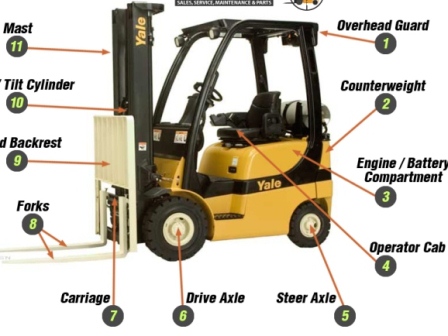
Locating the common parts of a forklift is vital to make certain that your operators are reliably using equipment as intended in a safe manner.

More on this story

Forklift Mast Types

Also referred to as an ‘Upright’, the mast is the vertical assembly on the front of the forklift that does the work of raising, lowering, and tilting the load.

Forklift Mast Types

Also referred to as an ‘Upright’, the mast is the vertical assembly on the front of the forklift that does the work of raising, lowering, and tilting the load. Most masts are ‘three-stage’ meaning there are three channels on each side. The channels are similar in appearance to I-Beams.

Attached to the mast is the carriage. Attached to the carriage are the forks. The carriage is actuated by the hydraulic piston in the middle of the mast. Pulling the mast lever on the cowl raises the load by actuating that piston, thus lifting the forks and your load.

All masts lift by hydraulic displacement and lower by the force of gravity. From a simple direct lift to multiple channel staging, each mast type has features that enhance performance or extend the application range of the lift truck.

Free lift is the distance that the carriage will raise prior to the inner channel extending. This feature is imperative for double stacking in a trailer.

Another feature that is an option but is now considered essential to most users is “side shift”. This feature allows horizontal movement of the forks to more precisely pick and place loads in less time.

Forklift Extensions

  • What types of masts are there?
  • What is the size of a forklift mast?
  • What is the difference between a 2 stage and 3 stage mast?
Forklift Mast Types

Forklift mast

What type of mast do you need for your forklift?

This may be a question posed to you during your next forklift purchase. Understanding the types of masts available and what each can do is helpful for selection. Below defined the four basic types of uprights and masts: standard, duplex, triple stage, and quad.

Forklift Mast Types

Single-stage mast forklift

Single Stage: The single-stage mast has one channel with a limited lifting height. Free lift (the ability to lift the load and forks without moving the mast channels) is not available.

Due to this limitation, the mast must extend higher than other mast options in order to stack loads. This type of mast is frequently seen in outdoor applications where overhead clearance is not a concern, due to the lack of height clearance restrictions.
standard forklift mast height

The standard upright is a two-stage assembly with two rails, one stationary and one movable inner rail. This upright uses two side-mounted lift cylinders to provide direct lift to the inner rails and indirect chain lift to the carriage/fork assembly. The chain raises the carriage at a rate of two inches for every inch of cylinder rod extension.

Single-stage mast forklift

2 stage mast forklift

Two-Stage: The two-stage mast is more common and has a free lift available. These are typically used for stacking and double stacking for indoor applications with limited overhead clearance. They provide excellent visibility and are ideal for use in trailers and boxcars.

Duplex mast forklift

The duplex upright is a two-stage assembly with a full free lift. This upright resembles the standard upright and works in the same way, except a primary, center-mounted cylinder provides full free lift.

The primary cylinder also raises the carriage at a 2-to-1 ratio but raises the carriage to the top of the inner rails before the hydraulic fluid is rerouted to the side-mounted secondary cylinders for direct rail lift.

2 stage mast forklift

3 stage forklift

Three Stage – The three-stage mast is the most common and versatile forklift mast available. Its free lift and greater heights provided by three stages make for a great lift for stacking in general warehouse applications.
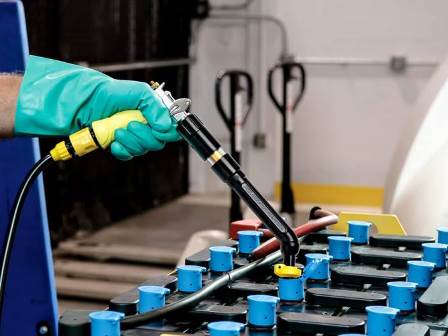
3-stage mast forklift

Triple Stage Upright: The triple-stage upright uses three sets of rails, two movable rails, and one stationary rail for three stage lift with a full free lift. The same principles of operation apply in the triple-stage lift as the hi-lo model but with an extra stage of the lift.

The primary cylinder provides the full free lift of the carriage and forks. The secondary lift cylinders are attached to the intermediate rails. When these cylinders begin to lift, they lift the intermediate rails directly while the chains pull the inner set of rails along with the carriage/fork assembly.

3 stage forklift

4 stage mast forklift

A four-stage mast provides the highest reach thanks to its four sets of moving rails. These are designed for very high stacking in specialized warehousing and other industries.

Quad mast forklift

The quad upright uses four sets of rails and an added set of chains to provide four stages of lift with a full free lift. Quad uprights work basically in the same way as triple-stage uprights except in that the second set of chains and pulleys operated by the secondary lift cylinders provide the fourth stage of the lift.

4 stage mast forklift

Forklift lifting capacity

The lifting capacity of the forklift decreases as its load is raised

Many people may wonder why some of these differences matter. One would think the only important aspect of a forklift mast is how high it can lift. However, the lowered height is sometimes just as crucial as the maximum lift height. If your application requires you to take a load through a door or your facility has any overhead restrictions, the down height is very important.

Can you make it through all your doors? One step further, can you make it through your doors with your load raised 6″? a full free lift can make that difference when loading and unloading trucks on a dock, in a container, etc…

Keep in mind your capacity as well. Forklifts have a certain base capacity. Take a 5,000 lb. cushion forklift with a triple mast and a side-shift attachment. While the forklift was built to handle a capacity of 5,000 lbs., that was before the triple stage mast and side-shift.

Those features (and others, i.e. extended tilt) can “de-rate” your forklift so your maximum capacity is raised all the way to 188″ and tilted all the way forward while using your side-shift, which could be as low as 2,500 lbs.

Straight mast forklift

Straight mast forklifts are the upright vertical assembly on the front of the machine, raising and lowering the load. All forklifts of this nature work through hydraulic displacement for lifting, and gravity for lowering, but there are different mast types with various benefits.

  • Single-Stage Mast forklifts
  • Two-Stage Mast forklifts
  • Three Stage Mast forklifts

How many mast types are there?

How many mast types are there?

Understanding the types of masts available and what each can do is helpful for selection. Below defined the four basic types of uprights and masts: standard, duplex, triple stage, and quad.

What is a simplex mast?

A simplex mast is a single-stage mast with a single channel. The mast and carriage ride simultaneously. It is built in different sizes to meet various lift heights.

What is a duplex mast?

A duplex mast has two carriages, or stages, whereas a triplex mast has three carriages or stages. Triplex masts are generally more sought after as the inclusion of an additional carriage ensures maximum lift height that condenses down into minimal closed height.

What is 3 stage mast in a forklift?

3-Stage – A three-stage mast, or triplex, is the most versatile forklift mast and also the most popular. The outer rails allow for free lift, and the two inner sections can lift loads higher than a two-stage.

What is a quad mast forklift?

A quad or four-stage mast is designed for very high stacking. Quad masts allow for a shorter collapsed height when compared to a three-stage with equivalent MFH (maximum fork height).

What is a free lift mast?

‘Free Lift’ refers to a forklift truck’s ability to lift its forks without raising the masters. This is particularly useful when operating within tight height restrictions.
What is a straight mast forklift?

Straight mast forklifts are the upright vertical assembly on the front of the machine, raising and lowering the load.
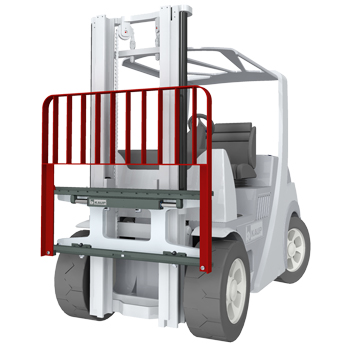
The most read

3 Stage Mast Forklift

A three-stage mast consisting of an outer mast, a middle mast, and an inner mast, each mast slidably and nestable engaging an adjacent mast and configured for a positive and negative lift along the length of each mast.

More on this story

Swing Mast Forklift

Articulated & swing mast forklifts can help you get the most out of your warehouse storage space, but there are other ways to optimize your warehouse design to ensure optimal efficiency.