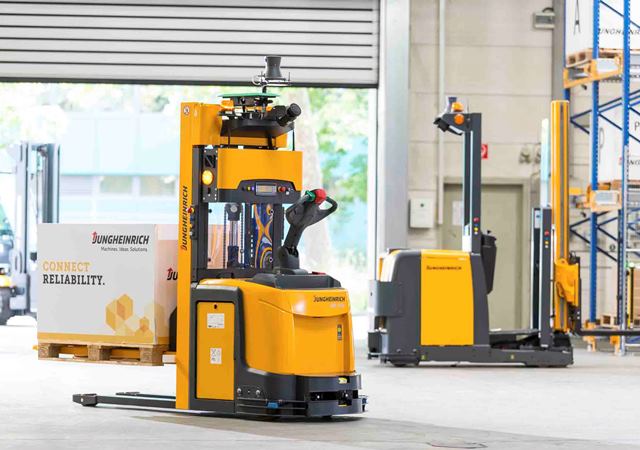
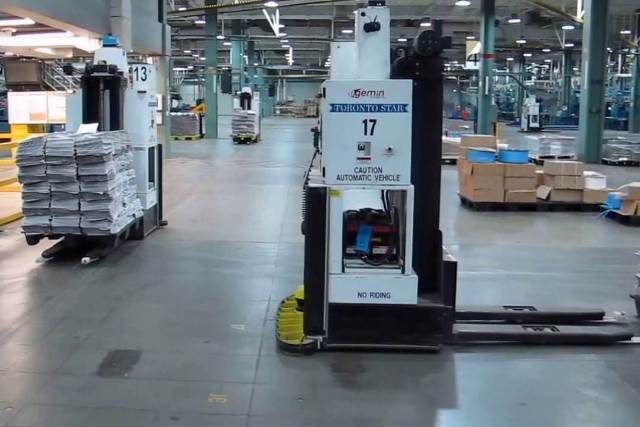
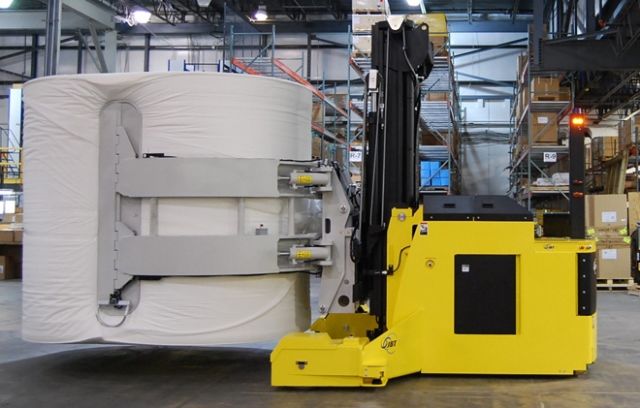
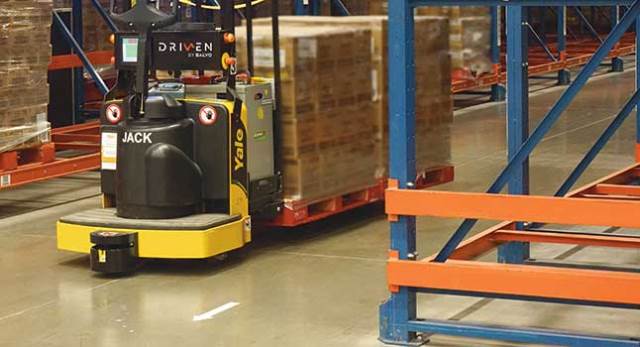
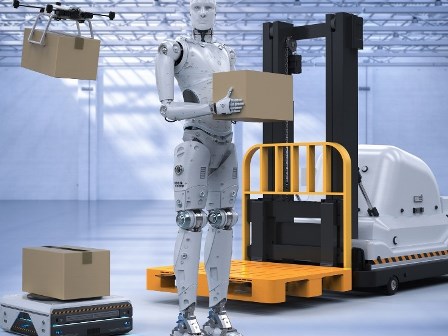
Robotic forklift system or Automated Guided Vehicles and robotic forklifts are increasingly becoming a mainstay in manufacturing facilities and distribution center operations where tasks are highly standardized, repetitive, and easily accomplished without the need for advanced human management.
While some Automated Guided Vehicle technologies like wire- and track-guided systems are at use in many locations today (and play an intricate role in improving efficiency), new technologies are making AGV forklifts and AGV pallet jacks an even more integral solution in your current material handling operation.
Many observers believe that automated forklifts are on the verge of making significant headway in warehouse applications. So why are driverless industrial trucks getting so much attention now? Who is adopting and implementing them? And what do potential buyers need to know before they make the leap?
Robotic Forklift
Robotic Forklift system
What if you could automate repetitive picking tasks and free up workers to take on more valuable roles?
With robotic forklift trucks, you can.
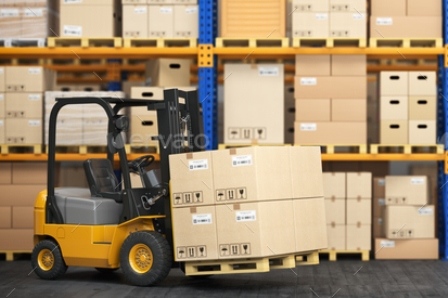
Built on standard production chassis, robotic lift trucks allow you to automate repetitive, low value-added tasks by picking up, transporting and dropping off pallets independently and reliably.
Robotic Forklift
Automated Guided Vehicles
The ideal solution for autonomous logistic applications. Industrial manufacturing associated to its innovative and proven unmanned solutions allows now industrials to optimize their logistics for complex operations inside or outside their premises.
This solution is dedicated to the autonomous management of heavy loads in the industrial environment. It consists of a fleet management system and of one or more Self Driving Vehicles of different types specifically adapted for transportation.
This system operates indoor or outdoor with high accuracy localization working independently from any external device (like satellites for the GPS or reflectors for laser positioning systems).
Robotic forklift cost
Do you face labor shortages, increased SKU counts, and increasing demands to move more, faster than ever before? Then automating your operation with robotics could be the ideal solution to meet your tremendous materials handling needs.
How can you decrease your cost of operations while stabilizing your workforce?
You will always need great people, but good people can be hard to find and even harder to retain. One forklift operator could cost a company up to $25.00 per hour. Fortunately, the average operating cost of a robotic lift truck is $7-$10 per hour. And it won’t leave your warehouse for a raise at a competitor down the street.
Your robotic lift truck can be programmed to perform many of the repetitive, day-to-day tasks for your operation. That offers your employees the opportunity to do more rewarding, higher responsibility work, which keeps them happier on the job.
With better retention and lower cost of operation, you could reap the full return of your investment in as few as two years
Comprehensive software integration: The robotic software interfaces with systems, giving your supervisory staff a complete view of your robotic “operators” in real-time.
Dual operating modes: A robotic lift truck can run autonomously on its programmed path or be driven by an operator. An operator can take manual control of the robotic lift truck at any time during its operation.
Cost-effective with no added infrastructure: Traditional automatic guided vehicles (AGVs) are designed as highly-specialized equipment that needs costly infrastructure. The forklift trucks add robotic components to a standard production chassis to produce a high-quality, cost-effective solution that requires no added infrastructure. That’s right–no laser reflectors, guide wires or magnets needed.
Improved inventory accuracy: The average inventory inaccuracy rate is currently 1.25%.* In an operation with $100M in annual revenues, that’s a $1.25M impact. Robotic lift trucks put loads where they are programmed to be, reducing costly time spent hunting for misplaced inventory.
Robotic Forklift
Robotic Autonomous Forklifts
Robotic Autonomous Forklifts Are Revolutionizing Warehouse Work.
Robotic autonomous forklifts are now hard at work in a growing number of warehouses and distribution centers — powered by amazing new technology that enables companies to reduce labor costs, optimize workflow and increase the bottom line.
However, many companies have adopted a wait-and-see approach when it comes to reaping the benefits of robotic forklift technology, impressed by the game-changing capabilities but uncertain whether the added expense would make it a worthwhile investment.
Well, the good news is that as technology continues to evolve, calculations around return on investment are now more favorable than ever.
In industry-wide conversations about robotic materials handling solutions, the question is no longer whether you can afford to consider integrating robotics into your operation. Instead, the question becomes: Can you afford not to?
Robotic Forklift
Work automation
As the world begins to adopt more forms of automated systems, it raises concern for the impact on job loss. While robotics can automate and improve efficiency it is not a substitute for all operations and human labor in the industry.
A study shows that 60% of companies are utilizing robotics as an assist to with current workforce rather than to replace it altogether.
This will lead to a fundamental change in the duties assigned to human roles. Repetitive, labor-intensive, and oftentimes potentially dangerous tasks will be replaced by robotics while more crucial and analytical roles will still need a personalized touch of human involvement.
Robotics help boosts productivity, efficiency, resilience, and even safety within a facility, however, humans are still needed to play critical roles in the overall system. The ideal solution is a blend of human involvement and robotic automation.
The pandemic showed the world that the current supply chain model was modeled after a world that does not exist anymore.
Customers demand easy access to products, speed of delivery, and high-touch customer service.
Businesses must evolve quickly to navigate the e-commerce demand and to stay ahead of their competitors.
Businesses that can serve eCommerce customers efficiently and effectively will win market share.
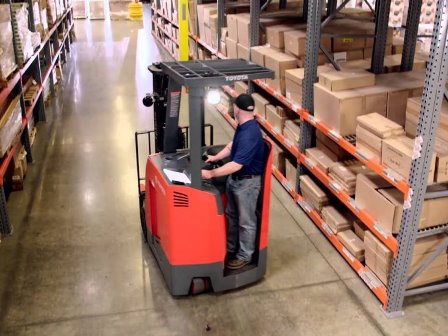
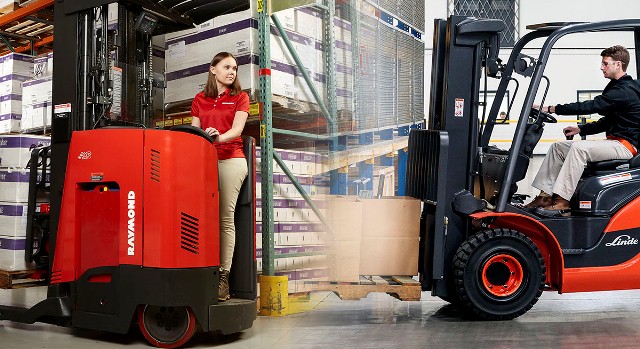
Stand-up forklifts (also known as stand-on and electric riders) are designed for applications where the operator must get on and off the lift truck frequently.
There are many different ways to handle a forklift and a diverse array of different vehicles. Nevertheless, there are fundamental responsibilities that are paramount, here are the most important responsibilities of a forklift operator:
Forklift Operator Responsibilities
Warehouse forklift truck
Forklift operator description
Forklift operator’s key responsibilities
Forklift Operator’s key responsibilities
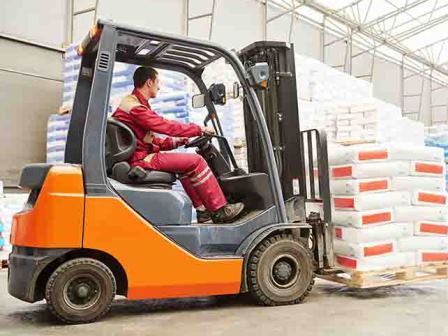
Forklift Operators drive industrial trucks and specialize in warehouse transportation. Their primary responsibilities include loading and unloading warehouse material, optimizing loads to ensure operational efficiency, and identifying damages to vehicles.
Forklift Operator Responsibilities
Forklift operator duties and responsibilities
Forklift operator duties and responsibilities:
Identify and report faulty pieces of equipment, damages, and safety concerns to the Supervisor immediately.
Load and unload products from trailers using forklift trucks and other material handling equipment.
Store the products in the proper places in the warehouse.
Transport products to and from warehouse and distribution centers.
Deliver products to various units in a safe and timely manner.
Sort, pack, wrap, tie and label products as per company procedures.
Weigh products and record weight and other data in product labels.
Monitor and maintain accurate inventory.
Forklift driver job description
Forklift driver responsibilities:
Move and load hazardous wastes under the direction of a supervisor.
Clean work area and equipment regularly by removing empty pallets, wood, and plastic.
Follow company standards and legal regulations to ensure a safe and positive work atmosphere.
Maintain forklift equipment by troubleshooting breakdowns, performing preventive maintenance, recommending repairs, and performing routine pre and post-inspections.
Maintain material handling equipment by recharging, cleaning, oiling, refueling, and other necessary actions, and record all information on the log sheet.
Study the production schedule to determine material requirements, movements, and deliveries.
Record information regarding the movements of supplies, materials, and finished products.
Forklift Operator Responsibilities
Forklift operator job description
Being a forklift operator is much more than just obtaining your forklift license and starting the job, although that is the first step. An operator has many responsibilities not only to the company he/she is working for but also to OSHA.
OSHA (Occupational Safety and Health Administration) is a branch of the United States Department of Labor that assures a safe and organized work environment.
As stated on its website’s mission statement, OSHA provides and enforces standards by providing training, outreach, education, and assistance. Putting safety first when on the job is the main trait a forklift operator must have before anything else.
An operator needs to be trusted to carry out his/her duties in a safe manner and in compliance with OSHA and company policies. When you accept a job you need to make sure that you know company policies and regulations so that you can be in compliance with your company as well as OSHA.
Forklift operator safety responsibilities
Inspecting Forklift Before Operation
A forklift operator should inspect the forklift before operations begin.
First, the operator must check both the fuel and voltage levels before the operation.
Failing to do so can result in a malfunction of the machinery and ultimately result in collateral damage to goods or injury to personnel.
Another key survey is hydraulic oil. Hydraulic oil permits the forklift to raise and lower its lift platforms throughout the operation.
A responsible forklift operator should check hydraulic oil to prevent accidents during usage.
It is worth mentioning that inadequate amounts or bubbly hydraulic oil can result in immediate failure of the mechanisms.
Finally, it is also crucial to check other fluids that will enhance the use of the vehicle and also check some of the parts to make sure they are not worn or damaged.
Forklift Operator Responsibilities
Operate a forklift
Continuous Safety Training
The best forklift operators are committed to maintaining up-to-date knowledge of industry-leading safety practices. To complement this, it is prudential for any forklift operator to drive efficient yet safe workplace methodologies and lead the way in promoting an environment that values the welfare of personnel.
This is most important when you consider the gravity of using a heavy machine such as a forklift, a device that can easily cause injury or death if not properly used inappropriate faculties. In addition to safety awareness, a forklift operator should likely retain certifications in various material handling capacities to further drive safe operations.
What are the duties of a forklift operator?
Forklift operators are responsible for operating and managing industrial trucks to load and unload materials and deliveries and move them to and from storage areas, machines, and loading docks, into railroad cars or trucks or storage facilities.
Who is responsible for the safety of persons working in a forklift area?
From a legal perspective, the employer is responsible for safety in the workplace. When you drill down, it’s specifically the supervisor.
The warehouse forklift driver resumes the sample
Are you ready to launch a new career?
It’s time to create a fantastic resume that will introduce your skills and experience to potential employers. A quality resume will call attention to your skills and showcase your qualifications.
Your resume is one of the most valuable marketing tools you’ll use in your job search, so make sure yours stands out from the rest. Don’t be shy when it comes to highlighting exactly what you’re capable of.
Note that a forklift operator’s resume is incomplete without discussing your experience transporting goods. It’s important to highlight any experience you have operating a variety of forklifts.
This lets potential employers know that you’re not only comfortable operating heavy machinery but that you’re experienced, as well. It’s also important to showcase any professional safety training you’ve had. If you can fix minor forklift problems yourself, this should also be highlighted on your resume.
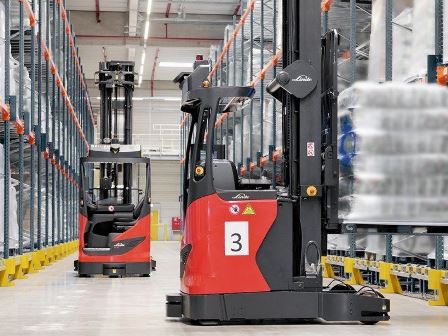
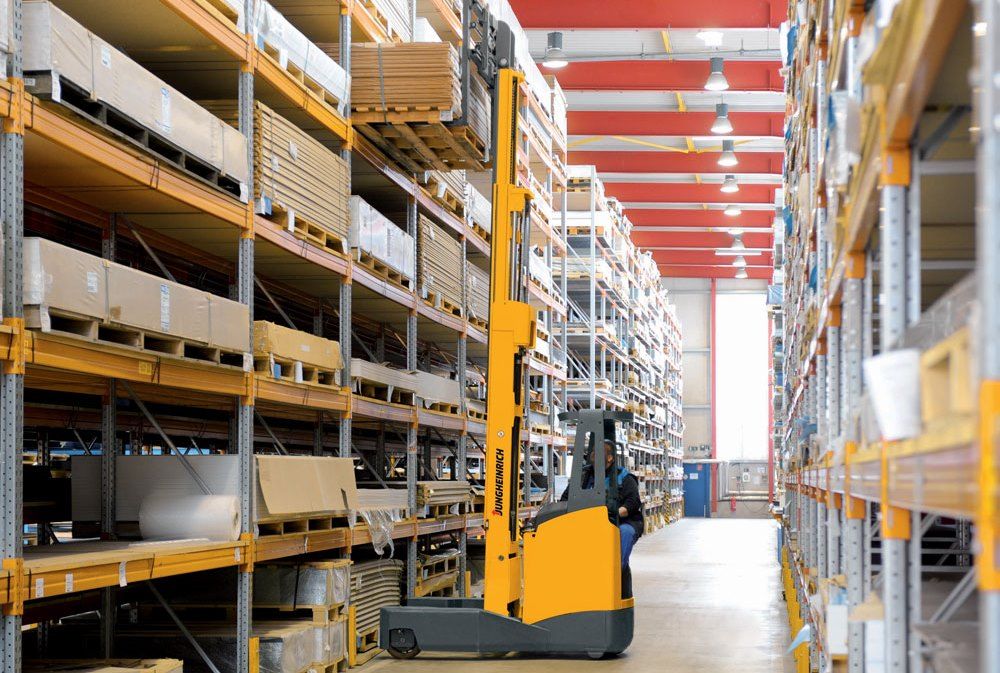
A reach truck is designed to reach extreme heights. They are best suited for narrow aisles lined with tall shelving and are traditionally found in indoor work environments.
They are very maneuverable and can be extended beyond their stabilizing legs to obtain products that are difficult to access. Additionally, most reach trucks have a tilt mechanism that allows better visibility for operators.
What is the difference between forklift and reach truck?
A reach truck is a smaller vehicle than a forklift, allowing it to remain much more agile.
It has a slimmer chassis and holds loads closer to its wheelbase, allowing it to perform well in warehouses with narrow aisles and tighter spaces.
Instead of a counterweight, a reach truck has two outer stabilizing legs that distribute the weight of the load.
Difference between Forklift and Reach truck
What is the difference between forklift and reach truck?
Understanding the difference between a forklift and a reach truck is important, whether you’re planning to lift lightly or begin your operator training.
Not many people know this, but forklifts are a general term for a variety of lifting and loading vehicles that are made for specific jobs. Each type of forklift has a specific method of operation.
Two of the main types of forklifts include: counterbalanced forklifts and reach trucks
Our goal here is to help you better understand these two forklifts so that you can choose the right one for the job at hand.
What is reach truck?
Reach trucks are forklifts used in narrow aisle applications such as warehouses.
They are designed to have two outer legs that help distribute the load and a single set of wheels at the rear. The wheels are located under the operator, helping to create a tighter turning radius.
This allows operators to navigate smaller spaces and still be able to reach higher racks.
Making your aisles taller and narrower is a good way to create more space when your warehouse gets tight, but it can also make navigation and material handling difficult.
Reach trucks can be used in any warehouse, allowing operators to easily enter and exit narrow aisles and reach significant heights, all while maintaining lifting capacity. Reach trucks enable unmatched confidence in challenging warehouse environments.
Although some models allow a forward stance, the operator generally sits on the side, allowing for maximum comfort and maneuverability.
Reach trucks include several features to improve operator visibility.
The cab can be tilted to help the driver have a better view or have an open protective roof.
Many reach trucks come with a camera, allowing the operator to see what is happening overhead on a video screen.
Reach truck capacity
Reach trucks can generally handle less capacity than a traditional counterbalanced forklift.
Besides working in tight spaces, the other advantage of a reach truck is its maximum height.
With maximum lift heights on some models extending above 40 feet, reach trucks allow your business to scale your storage vertically.
In addition, since all forklifts have a multi-capacity electric battery, they are quiet and emit no emissions, making them even more suitable for indoor work environments.
Stability triangle forklift
One of the main differences between a counterbalance forklift and a reach truck is the method used to stabilize their loads.
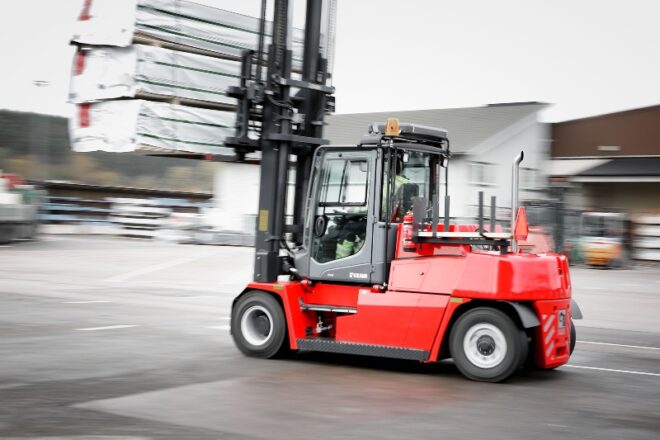
As the name suggests counterbalance forklifts are designed with a larger counterweight in the rear of the unit.
This weight directly offsets the weight of the load being carried out front on the tynes thus greatly reducing the likelihood that the unit will tip over when operating.
Reach trucks do not have an external counterbalance weight instead they rely on two features to stabilize their loads, stabilizing legs extend out and to the side of the tynes combined with the weight of the unit’s battery to keep the unit stable reducing the risk of it tipping over.
Counterbalance forklifts and reach trucks have been specifically designed to carry out different tasks.
The ability to design counterbalance forklifts with larger counterweights in the rear allows them to lift and move heavier weights than reach forklifts.
Stand-up forklifts (also known as stand-on and electric riders) are designed for applications where the operator must get on and off the lift truck frequently. They are more maneuverable and need less space to operate than sit-down forklifts.
In a forklift, the main characteristic is its price, maintenance, and spare parts. The capacity of these machines to support weight simplifies the movement, transfer, and order of the merchandise.
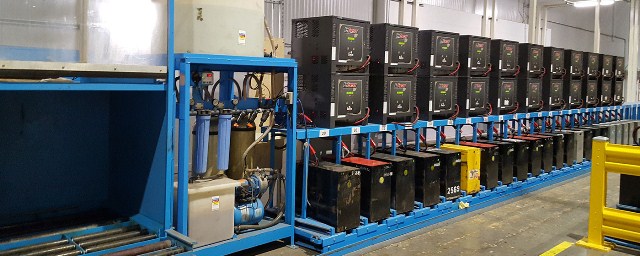
Reconditioned Forklift Battery: In some instances, a loss of battery capacity can be caused by battery sulfation. Sulfation is a crystallization which forms a hard shell surrounding the lead plates within the battery cell, this shell prevents efficient charging and discharging of the battery.
This crystallized shell can be dissolved using a special charge and discharge procedure, giving your battery a new lease of life. This type of repair is not always possible and is not a magic cure for a failing battery.
The process of the ways to restore forklift batteries is more complex as compared to a car’s lead-acid battery. But you can do it by yourself as well just like in regular batteries. However, if you feel that you need help, you can always call the professionals to do it for you.
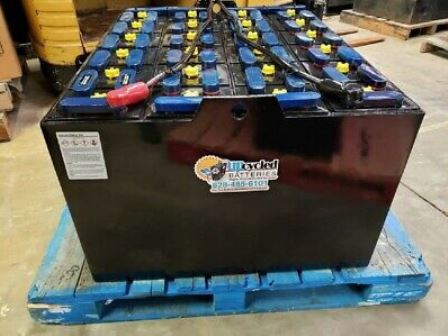
Refurbished forklift batteries
What Are Used Forklift Batteries?
These batteries have usually become available after being removed from scrapped Forklift trucks or they may have been previously rented out.
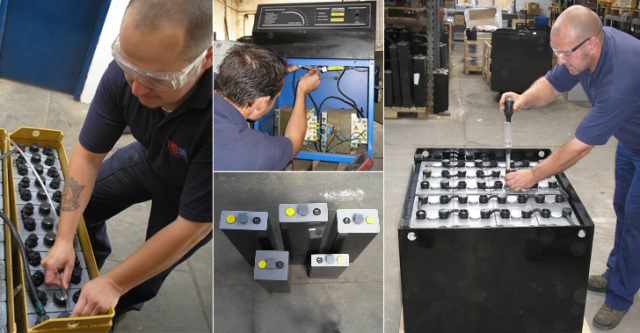
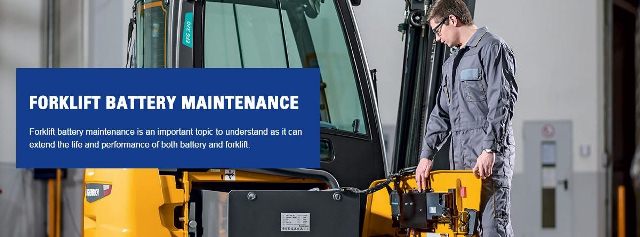
Servicing a forklift battery is almost identical to servicing a regular 12-volt automotive battery. These tests should be performed monthly if you want to get the longest possible life from your very expensive electric forklift batteries.
You still have to be very careful not to short-circuit any tool, or your body to metal when working on these batteries as the stored voltage is very high and can cause death or severe burns and injuries.
Do not wear any metal rings, bracelets or any other metal objects while working on High voltage direct current batteries.
If you should ever ground the positive terminal to any part of the metal forklift then you will be severely injured.
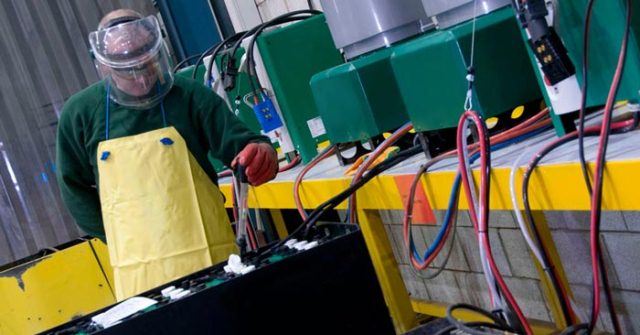
Always wear eye and face protection and proper clothing to protect yourself from acid spills or splatter.
Never smoke or make flames or sparks near batteries and always work in a well-ventilated area with a fan blowing if possible to prevent the accumulation of explosive or toxic gases.
Place the forklift in a clear area where there is plenty of room to work and good ventilation.
Be sure the power key is off so the forklift will not move if anyone accidentally presses the accelerator.
Once you expose the battery for service the first thing you do is determining the operating voltage of the battery by counting the cell water filler caps and multiplying the number of filler caps by 2 volts.
12 caps = 24 volts
18 caps = 36 volts
24 caps = 48 volts
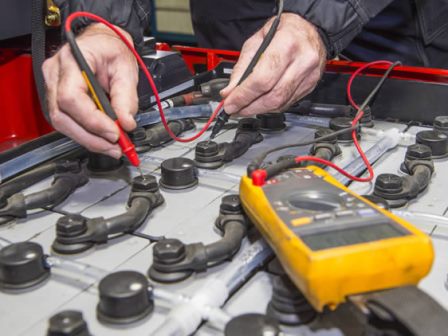
The next thing to do is to take your DC voltmeter, set it for the proper voltage to match the battery voltage and measure from the + terminal to the – terminal and record this voltage.
How Does the Process Work?
The first step regardless of the forklift is to check out the overall voltage of the battery. You are hoping the volt amount reaches the amount it is listed at, although with some models you might be okay at 80%. On an older battery, it is fully possible that you will need to replace one or more batteries.
The next step involves removing the battery caps and testing each cell. This can be a little bit of work depending on the number of batteries, their age, and the particular setup of whichever forklift you are using. You also need to have the right tools and an understanding of how to use them.
Truth be told, it isn’t hard to check the condition of each cell of a forklift battery. With a DC voltmeter and a pair of metal probes, you can test each one and know what needs to be replaced and what can be reconditioned to be nearly as good as new.
Sometimes it only takes some really basic fixes to really get new results from a seemingly dying battery.
Water levels often have a major part to play in this. Maybe you have too much or too little – and a little bit of a clean and a fix-up can make all the difference.
There are obviously more steps to this, and when you’re ready to actually start restoring these batteries, I recommend you learn exactly how to do this in a step by step plan, which my friend Tom has laid out here.
The benefits of learning how forklift battery reconditioning works are many. Not only are you saving money and being more efficient with your business, but you’re also being green by throwing away fewer batteries.
Forklift battery brands
industrial forklift batteries for the most popular models:
Barrett
Blue Giant
CAT
Clark
Crown
Daewoo
Dockstocker
Drexel
Elwell-Parker
Hoist
Hyster
Jungheinrich
Komatsu
Linde
Mitsubishi
Nissan
Raymond
Schaeff
Schreck
TCM
Toyota
Yale.
Reconditioned forklift batteries for sale
How To Recondition A Forklift Battery
The battery of a forklift is almost the same as that of a lead-acid battery of a car. However, forklift batteries are much bigger, heavier, and they are a lot harder to try to recondition. Nonetheless, it is not impossible to do so.
Forklift batteries are deep cycle batteries. This means that they can be discharged at a very low level and you won’t have any issues with them getting damaged.
There are several steps that you can do so that you can restore your forklift batteries. However, if the battery is really beaten up and you feel that you won’t be able to do it, it is best to let the experts handle the reconditioning process for you.
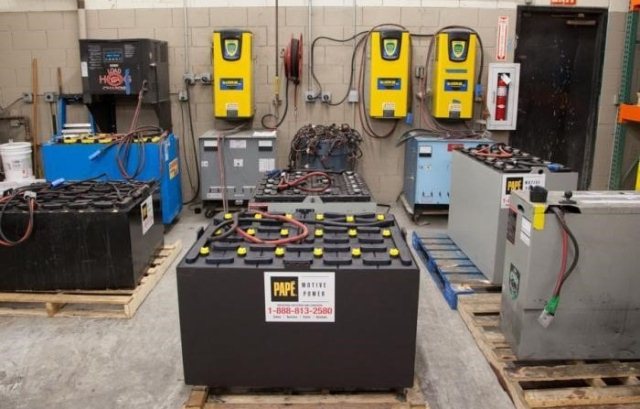
Industrial battery maintenance
Prepare The Battery To Be Revived: A single battery of a forklift is very heavy. It can get as heavy as a few thousand pounds. For you to remove the battery, you are going to need a forklift to help you out. To be sure, read the user’s manual of your forklift so you can see the specific instructions on how to remove as well as maintain the battery of your forklift.
When you have successfully removed the battery from the forklift, put it somewhere where there is good ventilation. Prepare the voltmeter so you can check the voltage of the battery. Compare that with the voltage on the battery’s label. When you have taken note of those number, discharge the forklift battery to 80% of the voltage that you see on the label.
forklift battery acid clean up
Once you have discharged the forklift battery to the right level, you can proceed to clean the terminals of the battery. To do this, put some baking soda onto the terminals as well as on top of the forklift battery. After that wet the surface with water and then brush it with a soft-bristle brush.
While the baking soda can neutralize any acid that is on the surface of the battery, you should still use protective clothing, gloves, and goggles. The acid of the battery is corrosive so you should be careful not to touch it with your bare skin. If you observe that the baking soda didn’t remove all of the dirt completely, you can put some dishwashing detergent on the battery so you can remove any grime and dirt left.
Distilled water for battery
Measuring the battery water acidity: To be able to access the water inside the battery, you need to take off the cell caps. Ideally, the battery water should have 30% sulfuric acid and then 70% distilled water.
Here, you need to use a hydrometer so you can measure the acidity of each of the battery’s cells. By measuring the acidity, you will know the amount of acid or water that you are going to have to add to the cells.
To restore the needed acid-to-water ratio for each of the cells, you should add water or acid to the individual cells of the battery. Remember not to use tap water because it has contaminants and minerals that can lead to your battery getting damaged.
During this particular process, it is important for you to check the concentration of the acid so that you will know the amount of acid or water that you are going to add. Each cell may need a different ratio, so you need to check them individually.
After that, put the cell caps back, and then you can connect the battery charger to the battery. Charge it for about eight hours or until it is charged completely. Check to see if the forklift battery was able to reach the required voltage. Recheck the acid-to-water ratio of each of the cells and then make the necessary adjustments. You can then try to charge it again
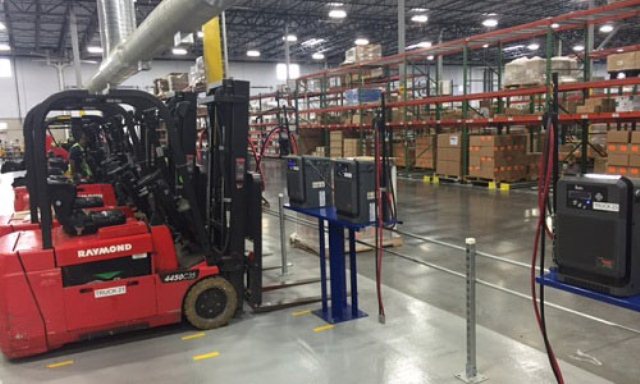
Forklift battery charger
You have to take note that you should discharge the forklift battery before you try to recharge it for a new cycle. This is to avoid any overcharge as it can damage the forklift battery permanently.
You may have to do this process a few times. If you have checked that the ratio of acid to water is correct, then there must be an issue with the cells themselves. Using a voltmeter, check the voltage of each cell so that you will know which of them is faulty or damaged.
To do this, put one probe of the voltmeter into the terminal and then immerse the other in the liquid. If you find any faulty cells, you may have to have them replaced or reconditioned by professionals.
Remove The Sulfation: One of the leading causes of why lead-acid batteries fail is because of sulfation. When you do not use the battery, the sulfate crystals begin to form. These crystals can then deposit on the negative plates of the battery.
How long do forklift batteries last?
How long do forklift batteries last?
Most modern forklift batteries are designed to last a minimum of 1,500 charge cycles. If a battery is under heavy use and requires daily charging, the 1,500 charge cycles would represent approximately five years of service.
Does Forklift Battery Reconditioning Actually Work?
Replacing the battery for a forklift is one of those expenses that no one wants to deal with, but it is going to come up at some point. This is true whether you have one forklift you need to keep working or an entire fleet of them. If you have the latter, then you know how expensive it can get to replace an entire group of batteries! Reconditioning forklift batteries definitely works, however, I recommend you follow a step by step guide to do this properly.
Can Reconditioning Really Work on Forklift Batteries?
This is a question that actually comes up relatively frequently and the good news is that, yes, forklift batteries can absolutely be reconditioned and end up providing months or even years of good charge after that process. This is a common practice that not only is more efficient, but it saves a lot of money by putting off replacements and getting more out of each battery.
How often do you water forklift batteries?
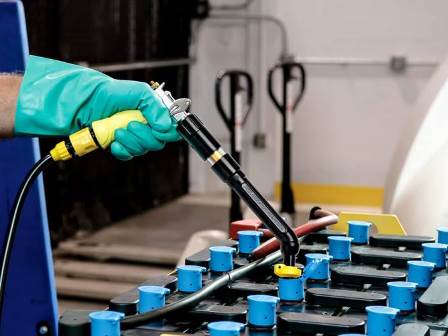
Forklift batteries typically need watering about once a week when used every day. Batteries that have been in use for an extended period of time, or are reconditioned, should be checked after every five charges. If properly maintained, new batteries can be checked every ten charges for the first few years of use.
Can you overcharge a forklift battery?
It is important to note that both undercharging and overcharging a forklift battery can considerably lessen its life span. The best way to charge is to have a fixed charge cycle and not interrupt the cycle.
How to buy the right forklift battery? Before you spend hundreds of dollars on a battery, take a moment to learn how to choose the battery for your forklift.
Your forklift truck will run on its own battery if it’s an electric vehicle. The battery is a vital piece of equipment and must be cared for and kept charged in order for your truck to work properly.
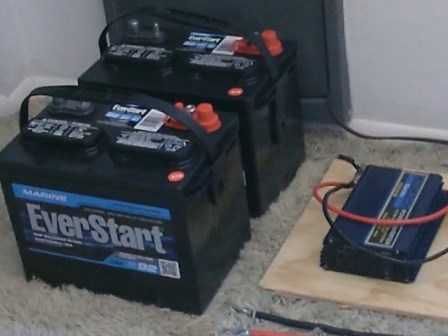
If you’ve decided to power your off-grid homestead with solar power, you may be considering using rechargeable forklift batteries to store the power from the sun.
If you’ve decided to power your off-grid homestead with solar power, you may be considering using rechargeable forklift batteries to store the power from the sun.
Forklift Manufacturers: It was another “up” year for the North American forklift industry, as all five truck classes(electric rider trucks, motorized hand trucks, and internal combustion-powered trucks) saw growth in 2019. That marks the fourth year in a row that sales have reached an all-time high, with the 260,000 total units sold in 2019 topping the previous benchmark of 250,000 units set in 2018.
“The forklift market contributes more than $25 billion annually to the U.S. GDP,” “and for every direct job in the industry, an additional 2.5 jobs are supported elsewhere in the economy.”
Forklift Manufacturers
Top forklift manufacturers 2020
If you’re considering adding new products to your fleet of forklifts, you may feel overwhelmed by the decisions you have to make.
Because there are so many forklifts on the market —which vary in size, power, price, capacity, energy efficiency, and much more— one of the best ways to start narrowing down your options is to consider the top forklift manufacturers and suppliers.
These companies are on the leading edge of innovation, creating high-quality and high-capacity products at a range of price points in order to meet the varying needs of warehouse workers, construction companies, and many others.
Here are a few of the top forklift manufacturers and suppliers of 2020 to give you a jumping-off point for building out your forklift equipment:
Forklift manufacturers list
Toyota Forklifts
Crown forklifts
Yale Forklift
Clark Forklifts
Komatsu Forklifts
Caterpillar Forklift
Top forklift manufacturers in USA
This article will present information on the top suppliers and manufacturers of forklifts both globally and in the U.S. Additional information concerning forklifts will also be summarized.
Toyota Forklifts
From pallet jacks to scissor lifts to reach trucks, Toyota’s forklift equipment is consistently ranked at the top of the list for quality, durability, reliability, and value. The company has manufactured more than half a million forklifts in the United States and topped standard forklift rating lists for more than 15 years.
Its state-of-the-art three-wheel forklift has become an industry breakthrough, while just this year it introduced an on-site appliance that relies on water and electricity to produce pure cell-grade hydrogen for refueling.
Crown forklifts
Crown Equipment Corporation has been designing, manufacturing, distributing, and servicing material-handling machinery, including forklifts, since 1956. Especially significant are Crown’s innovative forklift designs and varied product catalog, as well as the company’s vertically integrated approach to business.
According to industry figures, Crown produces some 85 percent of its forklifts’ components, including their electronic modules, motors, and drive units.
Beyond this, Crown’s primary focus is providing its customers the safest, most efficient, and most comfortable forklifts anywhere. Among the many types of machines the company manufactures are hand trucks, turret trucks, and forklifts, as well as other kinds of lifting trucks.
Yale Forklift
Yale Materials Handling Corporations specializes in manufacturing forklifts and has, consequently, become an industry leader in top-of-the-line, high-performing forklift production.
Among its offerings are forklifts powered by diesel, liquid propane, gasoline, and electricity, and it also offers equipment-use training, financing, and maintenance services, as well as part services.
Furthermore, Yale is well-known for its customer service, often bending over backward to help its customers secure everything they need to finance and manage their lift-truck fleets.
Clark Forklifts
Clark is the first forklift manufacturer across the globe to be certified in compliance with ISO 9001, a quality-management certification that ensures its products and services meet both customer expectations and regulatory standards.
Many of its products are also equipped with green-friendly technologies.
Clark as a top forklift manufacturer is connected to its broad and innovative product line, which features five distinct lines and leading safety features that rely on modern technological advancements.
Komatsu Forklifts
Consistently high rated by customers, Komatsu forklifts are a global leader in the forklift manufacturing industry.
With 25 plants across the world and a record of nearly 100 years in operation, Komatsu aims to provide durable and dependent equipment that stand up under a range of conditions and deliver low-cost operation.
Its products are uniquely designed to navigate narrow spaces as well as to transport pallet loads, with a product list that includes several types of electric forklifts, as well as diesel machinery, including its 10-ton option and another with a hydrostatic transmission.
Caterpillar Forklift
Caterpillar offers a wide range of materials handling equipment, including ride-on pallet trucks, walkie trucks, order pickers, and reach trucks. Their forklift trucks feature capacities from 2,500 to 100,000-plus pounds, and they are available in either electric, liquid propane, diesel, or gasoline-powered type machinery.
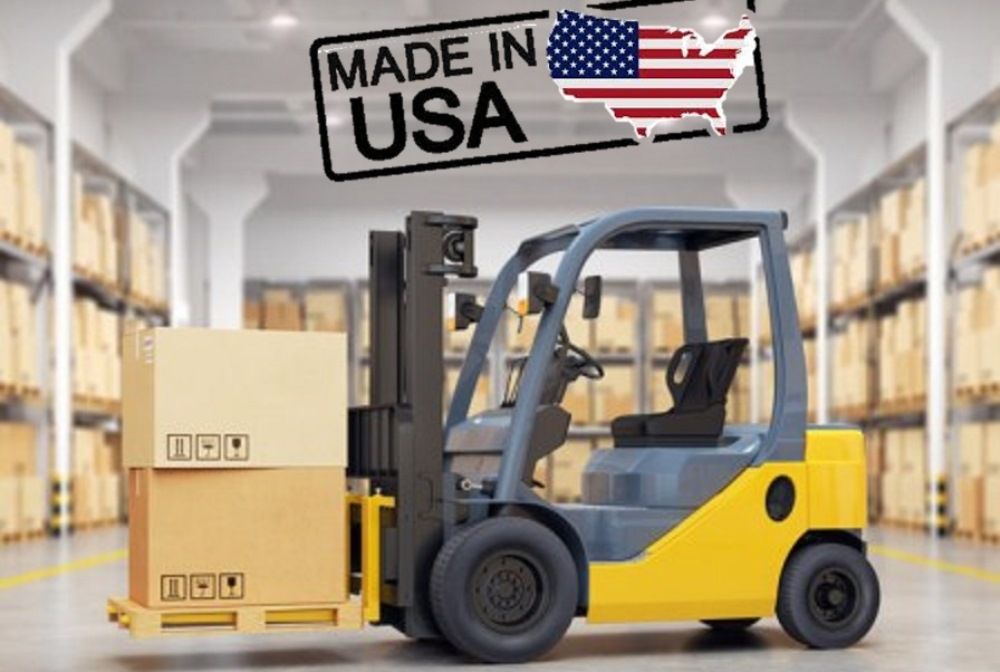
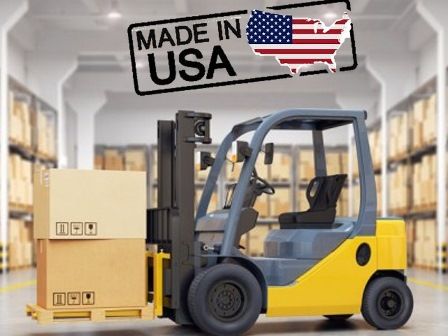
American made forklifts
“Made in America” used to mean the highest quality product. You knew you had the best because it was made right here.
Does this still hold true today?
We think so. Many of our products do come from overseas manufacturing (and we wouldn’t carry them if they weren’t high quality), but much of the forklift inventory is made right here in the U.S.
Due to anticipated depreciation in the value of the US dollar, exports are expected to rise during the outlook period, while imports are expected to comprise a smaller share of domestic demand compared with the previous five-year period.
Construction markets will continue to generate demand for forklift purchases and rentals, for use in loading and transporting construction materials within and between work sites.
American forklift companies
Forklift Market size exceeded USD 50 billion in 2019 and is set to grow at around 10.5% between 2020 and 2025. The global industry shipments are projected to exceed 3 million units by 2025. The market growth is due to the increasing deployment of this equipment for enhancing the safety and security of workers while performing tasks of lifting and transporting heavy loads.
The shifting dynamics supporting this growth make it critical for businesses in this space to keep abreast of the changing pulse of the market. Poised to reach over US$13 Billion by the year 2025.
Who is the largest forklift manufacturer in the world?
Toyota has been the leading forklift manufacturer for many years. Known for its quality and reliability, Toyota offers electric trucks in a variety of models.
Who is the best forklift manufacturer?
Today’s leaders, especially Toyota, Caterpillar, Hyster, etc. They continue to expand their reach beyond industrial trucks and into the broader supply chain services market.
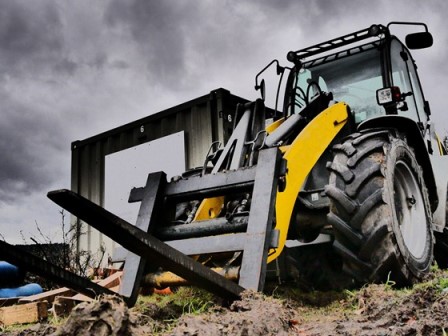
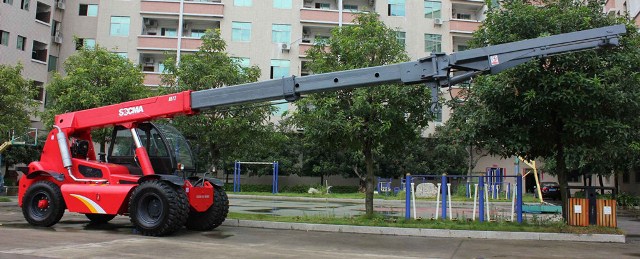
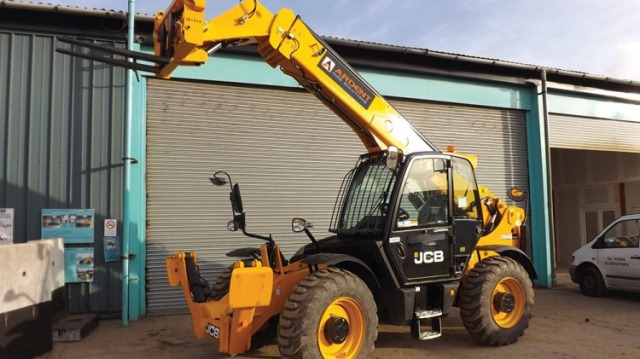
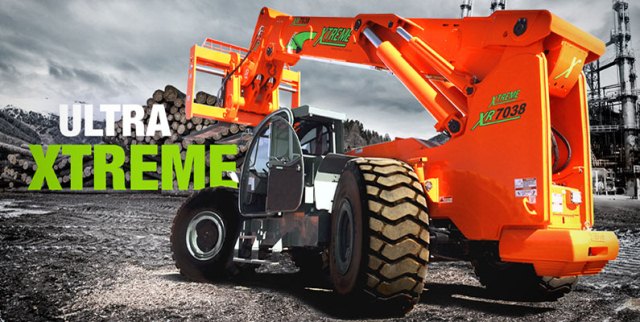
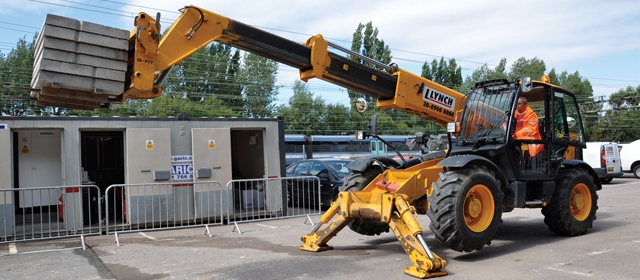
A Telehandler Forklift also known as a telehandler handler, telescopic handler, teleporter, or rough terrain forklift, is a vehicle with an extendable boom, which can be extended forward and upward from the vehicle, so it can be equipped with various lifting equipment.
Telehandlers have several attachments, such as a winch, pallet forks, muck grab, or bucket, and can be used for material handling, and personnel elevation. A telehandler can be rented by the day, week, or month.
Telehandlers are widely used in construction, agriculture, industry, mines and quarries, environment, logistics, and other markets. When you want to rent, buy or sell you can find it with these names on the web pages:
Extended forklift
Telescopic lift
Teleporter forklift
Telescopic loader
Telescopic forklift
Telehandler Forklift
What is a telehandler forklift?
Telescopic forklift:
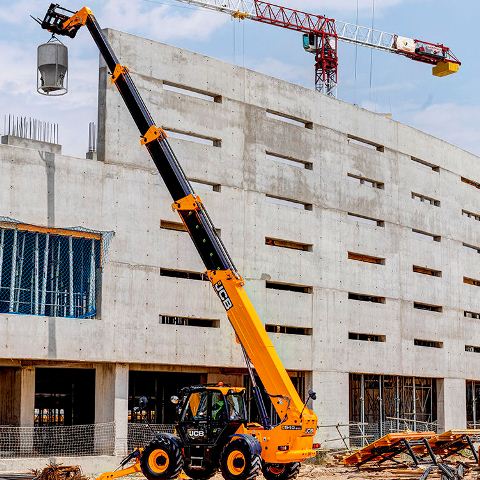
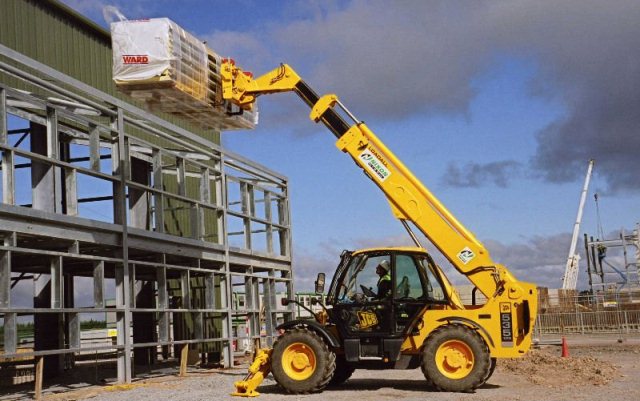
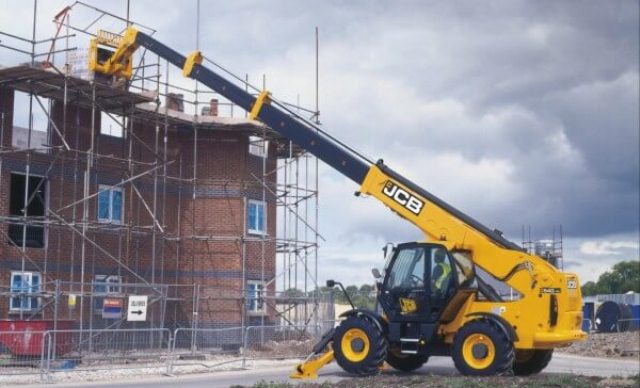
Telehandlers (also known as Rough Terrain Telescopic Handlers or Variable Reach Trucks) make a valuable contribution to the construction process by enabling materials to be unloaded from delivery vehicles, transported around construction sites, and placed at height (reach).
They are versatile machines that can be fitted with a wide range of attachments such as buckets, skips, work platforms, and crane jibs.
Telehandler Forklift
Forklift telehandler for Rent
Whether used for agricultural applications or on a construction site, a telehandler forklift is one of the most common industrial pieces of equipment. Despite its frequent use, however, many people confuse these vehicles with forklifts or cranes.
A telescopic handler provides some of the benefits of each of these pieces of equipment, making it suitable for a variety of tasks.
With this guide, you’ll learn more about telehandlers, including how they’re used, popular telehandler models, how much does the rent cost? and safety tips for using them.
But first, take a closer look at some of the basics of telehandlers.
To find a line of telehandlers available, although availability will vary based on your location, the following are some examples of the types of telehandler models you can find for rent:
Rotating Telehandler
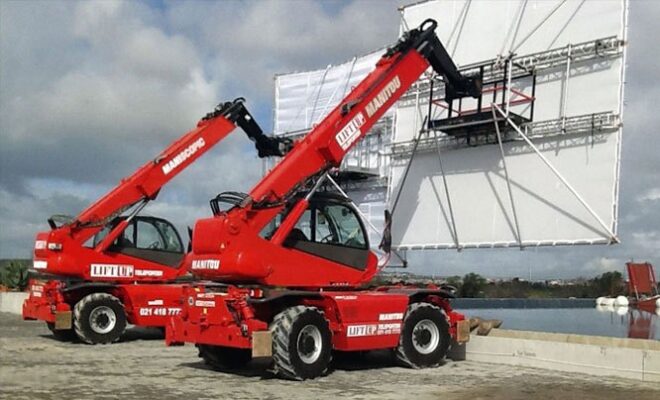
Rotating telehandlers have all of the features of the non-rotating type with the addition of a rotating or slewing superstructure on which the boom and operator’s cab is mounted.
These machines also have outriggers fitted at either end of the chassis which enable the entire chassis to be lifted clear of the ground for maximum stability.
The main advantages of these machines over the non-rotating type are compact chassis size, enhanced lifting height, increased stability, and ease of placing loads without moving the chassis. All telehandlers can be fitted with a wide range of attachments such as buckets, skips, work platforms, and crane jibs.
Telehandler Forklift
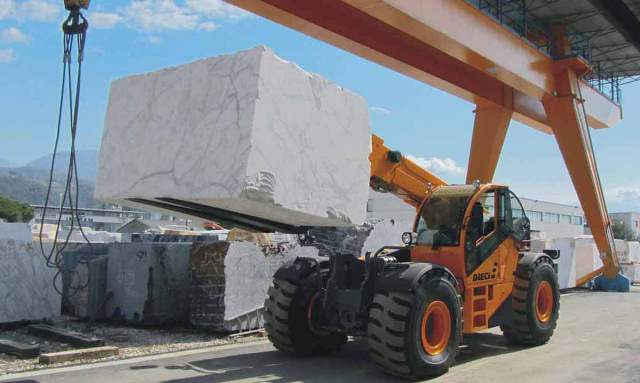
Heavy lift telehandler
Non-rotating telehandler
These machines comprise a powered wheeled chassis onto which is mounted a telescopic boom, pivoted on the chassis, which can be elevated from below the horizontal to an angle approaching the vertical. The outer end of the boom is fitted with a fork carriage and forks for handling unit loads. Leveling of the forks in the longitudinal plane, as the boom elevation changes, is carried out automatically.
These machines are able to transport loads from one part of a site to another and place the load at height. On construction sites, the wheels are generally fitted with lug grip tires to enable the chassis to negotiate unpaved ground. Many telehandlers are fitted with stabilizers which are deployed when the machine is stationary to provide additional stability and enhance the machine’s lifting capacity.
Telehandler Forklift
Construction forklift telehandler
It is essential that in managing the use of telehandlers, adequate attention is paid to all aspects of the process – selection of the correct equipment for the application, planning its use by competent people, monitoring the activity and rectification of issues; if anyone aspect is ignored the probability of an incident will increase significantly, putting both the machine operator and people in the vicinity at risk.
Telehandler Forklift
Forklift extensions
An effective and safe telehandler is one that is well matched to the type and size of load to be carried and lifted, together with the environment in which it is to be used. Attachments for use with telehandlers should be chosen with care to ensure that the combination of telehandlers and attachments is both safe and productive.
It is essential that all attachments are compatible with the telehandler with which they are to be used. Where necessary and appropriate, the telehandler manufacturer should be consulted when third-party attachments are to be used. The selection of the telehandler and any attachments should be part of the planning process.
The Provision and Use of Work Equipment Regulations require that employers ensure that work equipment provided for their employees is the most suitable for the purpose for which it is being used and reduces or eliminates risks to the user and other people.
Telehandler Forklift
Telehandler safety
Unfortunately, there have been a significant number of accidents involving the use of telehandlers, which have tragically included a number of fatalities. *
Safe Use of Telehandlers
Two of the most significant hazards associated with telehandler operation are lateral stability and visibility.
Lateral stability
As a load on the forks of a telehandler is lifted, the center of gravity of the whole machine rises.
This does not matter if the machine is level: if however, the machine is on a cross slope, the center of gravity will move towards the tipping line as the load is raised with a risk of overturning. This effect is exacerbated when the telehandler is driven with a raised load. Lateral stability is also an issue when lifting and traveling with suspended loads as the load may swing, adding to potential instability.
Visibility
Restricted visibility when the boom is raised or when large loads are carried, plus poor segregation has been identified as a major cause of accidents involving pedestrians and telehandlers.
Telehandlers are often fitted with aids to improve visibility and the operator’s awareness of people in the vicinity of the telehandler.
These aids should be in good working order and properly adjusted. It is the operator’s responsibility to check the condition of all secondary aids to visibility and NOT TO USE THE MACHINE if they are not present or not working correctly. It is the Supervisor’s responsibility to fully support the operator in this action.
Whilst the Principal Contractor has the primary responsibility to ensure adequate segregation and the Supervisor must ensure that it is enforced, it remains the operators’ responsibility to look around and check for the absence of pedestrians before moving and whilst maneuvering and traveling.
If the operator cannot see clearly, they should seek assistance or leave the cab to look around to confirm it is safe to continue the procedure.
Wherever possible pedestrians should be segregated from moving vehicles, including telehandlers.
Visibility aids and operator vigilance are valuable control measures, but segregation should always take priority.
Thought should also be given to the operator’s ability to keep the load in view at all times, particularly with high reach telehandlers where the operator may have difficulty in judging distance at height
Telehandler Forklift
Forklift maintenance procedure
Maintenance and Inspection
The effective maintenance of a telescopic forklift is an essential part of safe operation. As with all machines, a telehandler will wear, deteriorate, and can suffer damage over time.
The maintenance process, including checks and inspections, monitors, prevents, and rectifies this deterioration. It is important that the person asked to carry out these tasks has the necessary machine-specific training, experience, and competence in both periodic and breakdown maintenance.
Telehandlers require the manufacturer’s preventative maintenance instructions to be strictly complied with if safety is to be maintained in use. Checks and inspections should be carried out taking into account the frequency of use of the telehandler and the environmental conditions in which it works.
Both the user and owner of the telehandler and any attachments used with it, have a responsibility to ensure that they are maintained in a safe working condition. In practice, the maintenance, other than pre-use checks, is normally undertaken by the telehandler owner on behalf of the user.
Teleporter forklift Design
Design Principles:
The scope of this Standard very clearly states that it applies only when the telehandler is stationary and lifting on substantially flat, level, and compacted ground or traveling with a load. It also applies only to use with forks. Consequently, if a telehandler is used in other circumstances such as traveling or lifting on slopes or with attachments other than forks, the additional risks need to be reassessed.
As part of the test process to ensure conformance with the Standard, telehandlers are placed on a platform, which must be tilted to preset angles to assess stability. Across the slope, and with a rated maximum load at full lift height*, this angle is only 7°. Most telehandler operators and supervisors, when asked, estimate that it is in the region of 25°- 30°, which is a significant overestimate.
*The procedure is somewhat more complicated than this in reality
Telehandler Forklift
Telehandler lift
With the rated load in the traveling position, the minimum tilt platform angle required is somewhat greater at 26 degrees. However, it is clear that raising the mass of the boom and/or load greatly decreases stability.
Because telehandlers normally have freely oscillating rear axles, the tipping lines form a triangle, rather than the rectangle of machines supported on outriggers such as rotating boom telehandlers and mobile cranes. This has the effect of reducing lateral stability, particularly with the boom raised.
All the stability tests carried out on telehandlers during their design and development are performed with a standard load which consists of a cube with 1-meter sides. Using a load with physically larger dimensions, or which is not homogeneous, presents extra risks that must be assessed.
To maintain stability a telehandler:
Should only be used on firm ground that resists sinking of the wheels or stabilizers (if fitted);
Should lift vertically, either being on level ground or using a frame leveling feature;
Maybe less stable with a different shaped load;
Should be stationary with the brake applied, for all “normal” lifts;
Should only be used by a trained, certificated and competent operator.
Telehandler Forklift
Telehandler Tyres
The Effect of Tyres on Stability: Tyres play a vital part in the stability of telehandlers. Stability and load-carrying capacity can be adversely affected by issues such as:
Incorrect tyre pressure
Differences in the diameter of tyres on the same axle due to differential wear
Incorrect ply rating
Use of tyres which are not of the required performance specification
Tyres with identical nominal sizes being of different physical size
Poor tyre repairs.
Load moment indicator
From the first designs in the mid-1970s, telehandlers have been fitted with a device that monitors the tendency of the telehandler to tip over in the forward direction. The correct name is a Longitudinal Load Moment Indicator – LLMI.
It’s vital to understand the functioning and, particularly, the limitations of this device. First, and most important, it is not a Safe Load Indicator!
The LLMI works by sensing the load upon the back axle. As the load on the forks is increased, or the boom extended, the load moment (load x distance) increases and the rear axle becomes ‘lighter’. At a preset value, the LLMI sounds and shows a warning. However, the LLMI only senses forward stability, not rearward or lateral stability and it is essential that operators understand this limitation.
Some manufacturers have linked this with a control device, which blocks further destabilizing motion when the stability limit is approached. In this case, the device is called a Longitudinal Load Moment Control or LLMC. These are fitted on a new telehandler manufactured after September 2010, however, there is no requirement to retrofit on older machines.
Telehandlers for sale
Previous models for rent, for sale, new or used have to be reviewed in more detail by exploring the equipment. You’ll find all kinds of written and video reviews from renters, landlords, and industry experts for various models of telehandlers when you search online.
Telescopic forklift training
Driving with the Boom Raised
Telehandlers should always be driven with the boom lowered to ensure that the center of gravity of the machine and the load are as low as possible. Driving with the boom raised should never be considered as “normal” practice, for all of the above reasons. It introduces an extra risk that must be assessed.
If the site is so restricted that maneuvering is impossible without raising the boom, site management should re-assess the use of a telehandler at all or, at least, consider the reselection of the machine chosen. In the past, operators have raised the boom in order to see under it.
The modern design of telehandlers makes this unnecessary and regular driving of a telehandler with the boom raised should ALWAYS be challenged by supervisors.
Suspended load safety
Lifting suspended loads
Telehandlers are often used to place suspended loads into position. The standard rating of a telehandler is for lifting unit loads on the forks; consequently, the standard load chart will not be valid for lifting suspended loads due to different load centers and the effect of any side slope.
From 2010 newly manufactured machines should be fitted with a longitudinal load moment control (refer to operator’s manual), and indication will be provided to the operator regarding longitudinal stability when stationary and the operator will be prevented from operating the machine outside of the limits determined by the manufacturer. Such machines may provide additional safety when lifting suspended loads.
Telehandler forklift driver
Travelling with suspended loads
Traveling with a suspended load involves traveling with the boom raised from the normal transport position, with additional dynamic forces due to the swinging of the suspended load.
If the information for traveling with a suspended load is provided by the manufacturer and the activity is permitted by the site, the following points should be adhered to:
The boom and load should be kept as low to the ground as practicable (load 300-500mm above the ground). To facilitate this the correct length of chains, slings, etc. should be selected.
If necessary the boom should be extended from the fully retracted position by the minimum amount required to ensure that the load does not interfere with the front of the telehandler chassis. It is essential that the load radius remains within that allowed by the load chart for the magnitude of the load being lifted.
Visibility may well be reduced and planning should identify appropriate control measures, such as a marshaller to guide the operator.
Any load swing must be minimized by the delicate use of controls and slow travel speeds.
Operators should take care when braking and/or turning as this creates dynamic forces transmitted to the boom, thereby reducing stability.
Slinger/signallers and other personnel should never walk in front of the telehandler to steady a swinging load as it is very easy to trip, fall and be crushed by the telehandler wheels.
Telehandler operator
The machine should travel extremely slowly and never above walking pace.
The operator should follow the manufacturer’s instructions for traveling on slopes and inclines. It is essential that they do not attempt to climb, descend, or cross inclines in excess of manufacturer’s limiting values, as this significantly increases the likelihood of overturning.
Lightweight but bulky items like roof trusses pose a special risk. Although relatively light, they are physically large, leading to large dynamic forces and are significantly affected by the wind. Physical restrictions on-site may require the boom to be elevated in order to clear fixed obstructions. Any carrying and placing of such items with a telehandler carries a significant extra risk that must be addressed by the site risk assessment.
Care should be taken to avoid overhead obstructions including overhead power lines.
How much does it cost to rent a telehandler?
How much does it cost to rent a telehandler?
Prices are quoted per day, week or month. It depends on the capacity of the forklift which ranges from 5,000 to 20,000 pounds and the average rental price is 200 to 400 dollars per day, 600 to 1,200 dollars per week, and 1,500 to 3,200 dollars per month.
What is a telehandler used for?
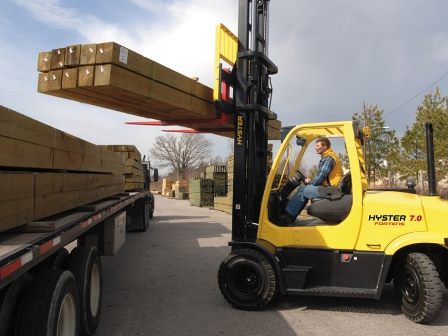
In the industrial sector, the most common telehandler attachment is pallet forks. The telehandler is used to move loads to and from places unreachable for a conventional forklift. For example, they can remove palletized cargo from inside a trailer and place those loads on rooftops and other high places.
what is a telescopic handler?
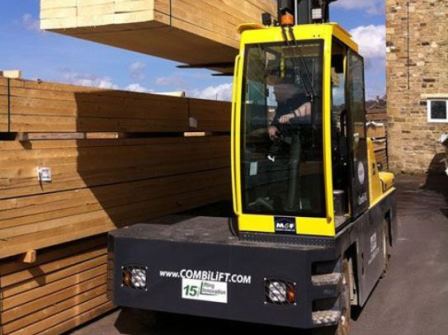
A telescopic handler, also called a telehandler, teleporter, reach forklift or boom lift is a machine widely used in agriculture and industry.
Because there are so many forklifts on the market, one of the best ways to start narrowing down your options is to consider the top forklift manufacturers and suppliers.