All posts by Loganx

Professional Web Writer | Motor Enthusiast | Content Creator | Logan is a dedicated and skilled web writer, passionate about engines and machines and with a talent for creating engaging and informative content. She specializes in writing about a diverse range of topics including construction, forklifts, heavy equipment, excavators, etc. SEO Optimization: Proficient in SEO best practices, ensuring high visibility and engagement for all published content.

Crane Risk Assessment

This General Guide provides information on how to manage the risks of cranes at a workplace.

It is supported by specific guides on tower cranes, mobile cranes, inspecting and maintaining cranes, and information sheets on:

  • Bridge and gantry cranes
  • Vehicle loading cranes
  • Vessel-mounted cranes
  • Crane-lifted workboxes
  • Using other powered mobile plants as a crane, and
  • Quick-hitches for earthmoving machinery

Who should use this Guide?

You should use this guide if you own, hire, lease, handle, store, transport, maintain or manage the use of a crane in the workplace.

Who has duties under the law?

Everyone in the workplace has a work health and safety duty. A range of people have specific responsibilities for cranes including the:

  • crane designer, manufacturer, importer, and/or supplier
  • crane owner and other persons with management or control of the crane or the workplace where a crane will operate
  • competent person who inspects cranes, and
  • crane operator
Any person who operates, leased, rented, or borrowed heavy equipment (regardless of job series) must take many hours of safety training for each type of equipment before they operate the equipment

Crane operators’ risk assessment

Duty holders and their obligations

Functions of construction management

A person conducting a business or undertaking has the primary duty to ensure, so far as is reasonably practicable, that workers and other people are not exposed to health and safety risks arising from the business or undertaking.

This duty requires the person to manage risks by eliminating health and safety risks so far as is reasonably practicable, and if it is not reasonably practicable to eliminate the risks, by minimizing those risks so far as is reasonably practicable. It also includes ensuring so far as is reasonably practicable the:

  • provision and maintenance of safe plant including cranes, and
  • safe use, handling, storage, and transport of plant.

The Work Health and Safety (WHS) Regulations include specific duties for a person conducting a business or undertaking with management or control of a plant, powered mobile plant, and plant that lifts or suspends loads.

If you own a crane you are the person with management or control of that plant.

If you hire or lease a crane, you have management or control of that plant for the period you have hired it. Both you and the person you have hired or leased it from will have duties to eliminate or minimize the risks associated with the plant, so far as is reasonably practicable.

crane manufacturers

Designers, manufacturers, suppliers, and importers

Designers, manufacturers, suppliers, and importers of plants must ensure, so far as is reasonably practicable, that the plant they design, manufacture, import, or supply is without risks to health and safety.

This duty includes carrying out analysis, testing, or an examination and providing specific information about the plant. The information must, so far as is reasonably practicable, be passed on from the designer through to the manufacturer and supplier to the end-user.

Suppliers must provide a purchaser of a crane that requires plant design registration with the design registration number.

company directors

Officers, such as company directors, have a duty to exercise due diligence to ensure the business or undertaking complies with the WHS Act and Regulations.

This includes taking reasonable steps to ensure the business or undertaking has and uses appropriate resources and processes to eliminate or minimize risks from plant.

Workers and others

Workers and other people at the workplace must take reasonable care for their own health and safety, co-operate with reasonable policies, procedures and instructions and not adversely affect other people’s health and safety

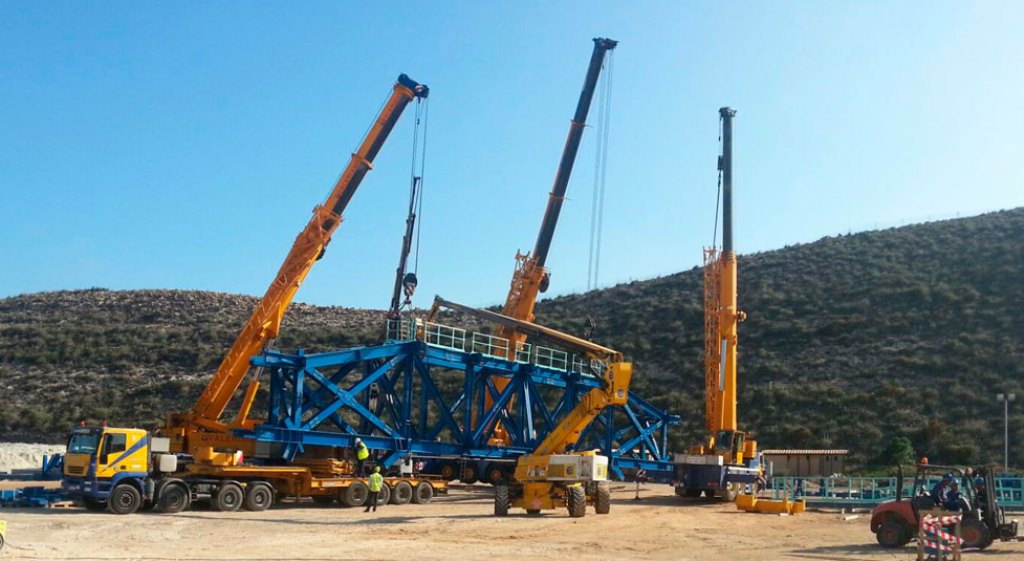
Crane Risk Assessment

How can risks be managed in a project?

Use the following steps to ensure, so far as is reasonably practicable, that workers and other people are not exposed to health and safety risks:

Hazard identification methods

Find out what could cause harm. The following can help you identify potential hazards:

Observe the workplace to identify areas where cranes operate and how they interact with other vehicles, pedestrians, and fixed structures like overhead electric lines.

Ask the crane operator, crane crew, and others about problems they encounter at the workplace including operation, inspection, maintenance, repair, transport, and storage requirements.

Review your inspection, test, and maintenance records e.g. logbooks, and incident and injury records including near misses.

Assess the risk

In many cases, the risks and related control measures will be well known.

In other cases, you may need to carry out a risk assessment to identify the likelihood of somebody being harmed by the hazard and how serious the harm could be.

People who work with or near cranes are most at risk. Some of the risks when using a crane include:

  • structural failure, overturning, or collapse of the crane
  • contact or collision of the crane or its load with people or other plants and structures, and
  • falling objects.

A risk assessment can help you determine what action you should take to control the risk and how urgently the action needs to be taken.

Risk controls Examples

Take action to control the risk. The WHS laws require a business or undertaking do everything reasonably practicable to eliminate or minimize risks.

The ways of controlling risks are ranked from the highest level of protection and reliability to the lowest. This ranking is known as the hierarchy of risk control. You must work through this hierarchy to manage risks.

You need to consider possible control measures and make a decision about which are reasonably practicable for your workplace.

Deciding what is reasonably practicable includes the availability and suitability of control measures, with a preference for using substitution, isolation, or engineering controls to minimize risks before using administrative controls or personal protective equipment (PPE).

Cost may also be relevant, but you can only consider this after an effective review of all reasonably practicable control measures.

The first thing to consider is whether crane-related hazards can be completely removed from the workplace.

For example, designing items of size, shape, and weight so they can be delivered, handled, or assembled at the location where they will be used without the need for a crane.

If it is not reasonably practicable to completely eliminate the risk then consider the following options in the order they appear below to minimize risks, so far as is reasonably practicable:

  • substitute the hazard for something safer e.g. replace a crane operating cabin with a restricted field of vision with one that has a clear field of vision or use remote control, for example, a pendant control
  • isolate the hazard from people e.g. use concrete barriers to create an exclusion zone to separate crane operations from workers and powered mobile plant, and
  • use engineering controls e.g. enclosing the operator with a falling object protective structure (FOPS) to minimize the risk of the operator being hit by a falling object.

Control measures

If after implementing the above control measures a risk still remains, consider the following controls in the order below to minimize the remaining risk, so far as is reasonably practicable:

  • use administrative controls e.g. schedule crane operations to avoid or reduce the need for pedestrians and vehicles to interact with the crane in the area of operation, and
  • use PPE e.g. gloves, hard hats, high visibility vests, earplugs/muffs, and eye protection.

Check your control measures

Control measures need to be regularly reviewed to make sure they remain effective, taking into consideration changes, the nature and duration of work, and that the system is working as planned.

Control measures in the workplace

Who is involved?

You must consult your workers and their health and safety representatives if any when deciding how to manage the risks of using a crane in the workplace.

If there is more than one business or undertaking involved at your workplace you must consult them to find out who is doing what and work together so risks are eliminated or minimized so far as is reasonably practicable.

This may involve discussing site-specific requirements including the type of crane to use, operator training, and traffic management.

Further information on consultation requirements is in the Code of Practice: Work health and safety consultation, co-operation, and coordination

What should be done before using a crane?

The person with management or control of the plant at a workplace must ensure, so far as is reasonably practicable, that the plant used is specifically designed to lift or suspend the load.

A crane is one type of plant generally designed to especially lift and suspend loads.

The type of work you will be doing, how it will be done, and who will be involved should be planned and discussed between the people involved in the work before deciding what type of crane will be used.

This includes people directly, for example, crane operators and other workers, and indirectly, for example, suppliers, designers, and crane hirers involved with the work.

Crane selection chart

Before you choose a crane you should discuss your workplace needs with suppliers and identify the cranes most suited to the workplace and the work for which they will be used.

Take into consideration the complete life cycle of the crane, how long you are likely to keep the crane, how often the crane is likely to be used, the conditions under which it will be used and the maximum loads the crane is likely to bear.

A second-hand crane is more likely to have outdated or missing safety features.

Suppliers of second-hand cranes must do what is reasonably practicable to supply equipment that is safe to use at work and where practicable, fits safety features.

Some of the things to look for when choosing a crane are:

  • safe access points e.g. ladders, footholds, steps, and grabs rails
  • seat design e.g. comfort and back support
  • visibility e.g. mirror, window, and windscreen design, and
  • environmental controls e.g. temperature control units to avoid worker heat stress

Crane rental

Anyone hiring or leasing a crane to others has duties as both a supplier of the crane and as a person with management or control of the crane at the workplace.

They must check the crane is safe to use and properly maintained and provide specific information about the crane including instructions on how to operate it safely.

Before you hire a crane you should check it is suitable for its intended use. You should also consider whether you need to hire a crane only or a crane with a trained and licensed crane crew.

If you do not have the knowledge or expertise about crane specifications, limitations, and operational requirements, you should talk to the crane supplier and provide relevant information about the work to be done, the workplace and the type of lifts to be completed so the supplier can provide a suitable crane.

More on this story

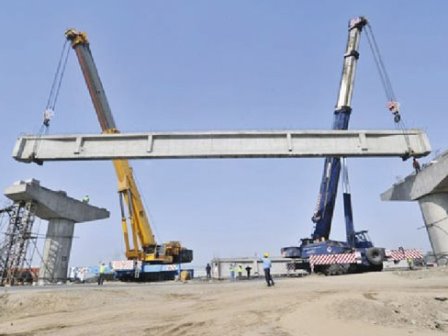
Lifting Operations Risk Assessment

The manual provides practical guidance for the safe operation of the crane, provided that the crane is used in accordance with the manufacturer’s recommendation.
Heavy Equipment Rental

Rental is a prominent and growing model in the construction business. The development of the rental industry in new markets requires a certain level of trust in a country and in society.
Job safety analysis for loading and unloading

We can not get rid of danger completely however we can reduce the risk and control it by utilizing normal procedures and good work practices.

Heavy Equipment Safety Topics

Any person who operates, leases, rented, or borrowed heavy equipment must take many hours of safety training for each type of equipment.

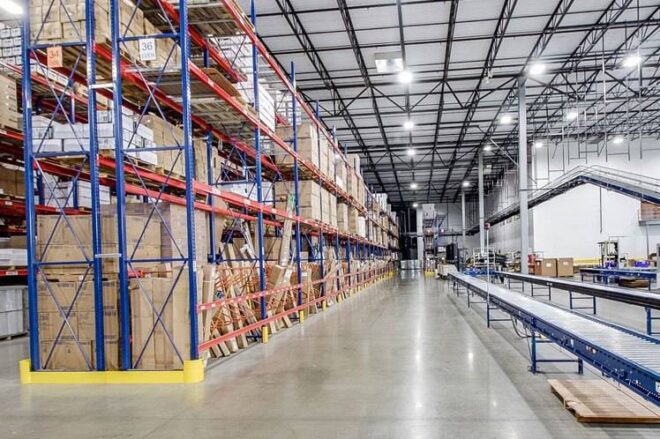
Warehouse Layout Design

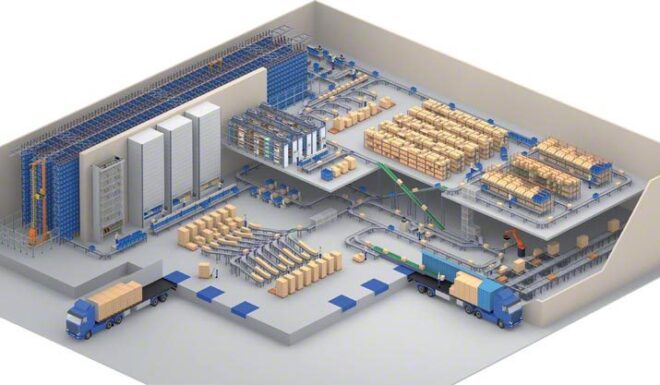
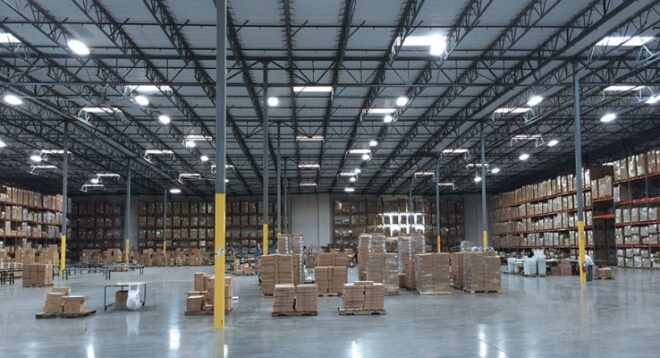
Warehouse layout design: With the continued growth and domination of e-commerce in the retail market, the demands on warehouses and distribution centers across the globe are also rising.

Designing a warehouse layout seems like a simple undertaking, but it’s actually quite complex. In fact, the design and layout of your warehouse can make or break your operation’s productivity, impacting picking time, labor hours, and even increasing safety risks through poor traffic flow.

We’ve rounded up expert warehouse design and layout ideas, tips, and strategies to help you design the ideal layout for your facility to optimize productivity and enhance safety:

  • Warehouse Layout Planning Tips
  • Considerations When Designing a Warehouse Layout
  • Warehouse Layout Design Ideas

From higher customer expectations — such as an increase of available product SKUs, overnight delivery, and free returns — to e-commerce brands offering both online and brick-and-mortar shopping and pickup options, the future indicates a need for more warehouse square footage that is managed efficiently to meet these demands.

Warehouse Layout Design

Warehouse Layout Design

The Need for Storage and Warehousing – Warehouse Layout Design:

A warehouse is a point in the supply chain where raw materials, work-in-process, or finished goods are stored for varying lengths of time. A public warehouse is a business that rents storage space to other firms on a month-to-month basis. They are often used by firms to supplement their own private warehouses.

  • Warehouses can be used to add value to a supply chain in two basic ways:
    • Storage—allows product to be available where and when it’s needed.
    • Transport economies—allows product to be collected, sorted, and distributed efficiently.

Warehouses only add value if the benefits of storing products in a warehouse enough to offset the additional cost associated with carrying any inventory.

warehouse layout optimization

Other potential benefits associated with storage include the following: time bridging, which allows the product to be available when it is needed (e.g., storing spare machine parts at the facility); processing, where for some products (e.g., wine), storage can be considered as a processing operation because the product undergoes a required change during storage; and securing, e.g., nuclear waste storage.

In production, ideally, raw material should arrive at a manufacturing facility just when it is needed and then immediately processed, the resulting products should be fabricated and assembled without delay, and the final finished products should be immediately shipped to their customers; in this situation (what could be termed pure “Just-In-Time” or JIT) there is little need for buffering or storing materials. In practice (including real-world JIT), there usually are economic benefits associated with the buffering and/or storage of raw materials, work in process (WIP), and/or finished goods.

In distribution, the ideal of no storage can sometimes be realized using cross-docking, where there is a direct flow of material from trucks at the receiving docks to the shipping docks without buffering or storage in-between, but cross-docking requires detailed planning and coordination (e.g., implemented using EDI) that in many cases may not be feasible.

In most cases, the benefits associated with buffering and storage are due to the fixed costs associated with the other elements of production and the impact of variability pooling on achieving a target service level. Storing a product allows the other elements of production to operate more efficiently on a per-unit basis because the fixed costs associated with utilizing the element can be spread over more products; e.g., storing up to a truckload of product in a facility reduces the per-unit costs of shipping, and WIP buffering or storage enables batch production, which reduces the per-unit setup costs.

Warehouse Layout Design

Storage System Design

Each distinct type of load is termed an item or stock-keeping unit (or SKU); e.g., each different style, size, and color of a garment would be assigned a unique SKU. Units of each item are stored in slots (short for storage location). A slot is a generic term for any of a variety of different types of identifiable storage locations (e.g., racks, bins, marked-off floor areas for block storage). Each slot-item combination has an associated capacity corresponding to the number of units of the item that can be stored in the slot.

The handling costs for the units within an SKU can usually be minimized by always storing and retrieving a unit at the nearest (i.e., least handling effort or cost) available location, or what is termed a closest open location (or COL) policy. As long as the inventory levels of each SKU are controlled, a COL policy will result in an approximate uniform rotation of the items; but, if inventory is not controlled, using a COL policy can result in items remaining at far away slots for a long time. If a strict uniform rotation of the items is required (e.g., due to the items being perishable), then a first-in, first-out (or FIFO) policy can be used. In addition, a last-in, first-out (or LIFO) policy can be used.

Design Trade-Off

As shown in Table 1, warehouse design involves the trade-off between building and handling costs. Handling costs usually dominate building costs when a warehouse is only used for short-term storage while building costs dominate for longer-term storage.

Storage Locations

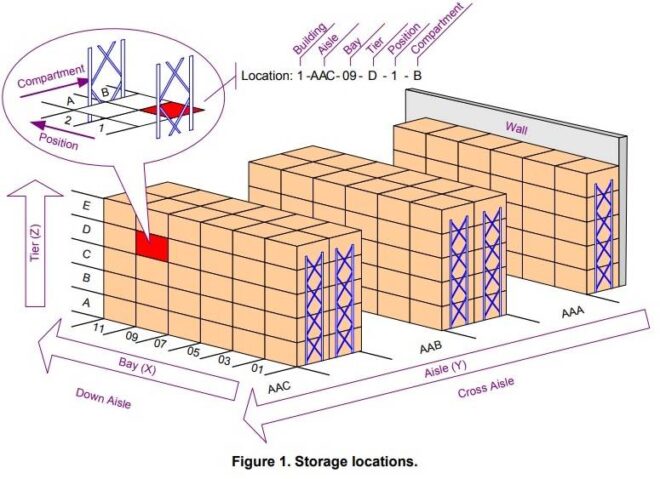
Each accessible storage location in a warehouse is assigned a unique address. Multiple units of an item assigned to a single location correspond to the capacity of the location. It is common to alternate between numeric and alphabetic characters in an address to improve readability and to use even and odd numbers to designate each side of a down aisle.

  • The single address scheme shown in Figure 1 can be used for each different storage medium in the warehouse:
    • Pallet racks: Compartment dimension not used since only the front unit of each position is accessible.
    • Shelves: All dimensions can be used if the compartment dimension is accessible.
    • Drawers: Position dimension not used if the drawer has odd-shaped compartments.
    • Block stacking: Only building, aisle, and bay dimensions used to address each lane of storage.
    • Misc. locations: Receiving, shipping, holding areas, outdoor trailer storage, etc., can all be given unique addresses.
Warehouse Layout Design

Storage policy warehouse

For multiple SKUs, three types of storage policies (see Figure 2) can be used to select storage locations (or slots):

  1. Dedicated (or Fixed Slot) Storage—each SKU has a predetermined number of slots assigned to it.
    The total capacity of the slots assigned to each SKU must equal the storage space corresponding to the maximum on-hand inventory of each individual SKU, where the actual storage space might be greater than this due to “honeycomb loss.” Minimizes handling costs and maximizes building costs. Control is not difficult because each lane can be identified with a permanent label.
  1. Randomized (or Open Slot or Floating Slot) Storage—each SKU can be stored in any (usually the closest) available slot. The total capacity of all the slots must equal the storage space corresponding to the maximum aggregate on-hand inventory of all of the SKUs, where the actual storage space might be greater than this due to honeycomb loss. Minimizes building costs and maximizes handling costs. Control is more difficult than dedicated storage because the identity of SKU stored at each slot needs to be recorded for retrieval purposes.
  1. Class-based Storage—a combination of dedicated and randomized storage, where each SKU is assigned to one of several different storage classes. Randomized storage is used for each SKU within a class, and dedicated storage is used between classes. Building and handling cost in-between dedicated and randomized. Classes can be formed from SKUs whose individual on-hand inventory is negatively correlated (or, at least, uncorrelated).

Dedicated vs random storage

Storage policy warehouse:

Based on just storage space requirements, a randomized policy would be preferred; but a dedicated or class-based policy may be preferred because they can sometimes reduce the handling requirements enough compared to randomized to offset their increase in storage requirements (this is an example of the trade-off between building and handling cost).

In general, as long as the on-hand inventory of each SKU is not at its maximum at the same time, randomized storage will require a lesser number of slots as compared to dedicated storage.

A combination of dedicated and randomized storage termed “supermarket” storage is used in most less-than-unit-load order picking operations, where randomized storage is used for reserve stock and dedicated is used for forwarding stock.

Cartons are picked from forwarding stock (in flowthrough racks), and full pallet loads of cartons are taken from reserve stock (in bulk storage) and used to replenish the forward stock.

Cube Utilization and Honeycomb Loss

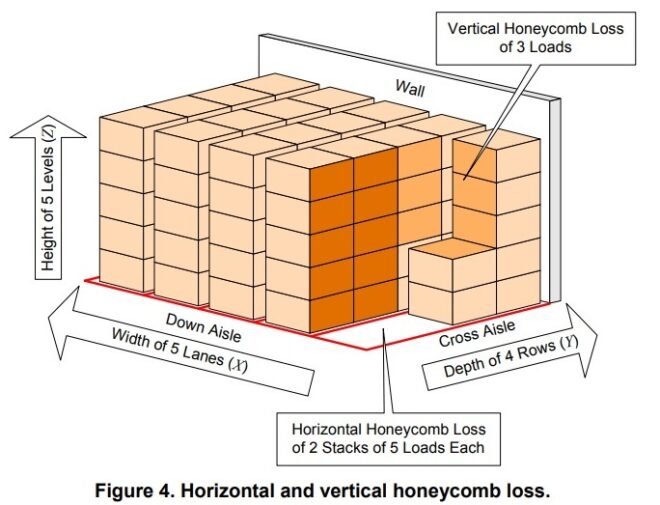
When storing multiple SKUs in a single region, full utilization of all of the available space is not desirable because it could result in some items not being accessible. Honeycomb loss, the price paid for accessibility, is the unusable empty storage space in a lane or stack due to the storage of only a single SKU in each lane or stack since storing items from different SKUs would block access.

The empty space associated with partially filled lanes and stacks is termed “horizontal” and “vertical” honeycomb loss, respectively (see Figure 4). When a single SKU is stored in a region, there need not be any honeycomb loss since the depth and height of the region can exactly match the storage space need for the SKU.

Cube utilization is the percentage of the total space (or “cube”) required for storage actually occupied by the loads being stored.

There is usually a trade-off between cube utilization and material accessibility:

  • increasing cube utilization -> decreased accessibility
  • increasing accessibility -> decreased cube utilization.

Bulk storage using block-stacking can result in the minimum cost of storage since cube utilization is high and no storage medium is required, but material accessibility is low since only the top of the front stack is accessible and loads at bottom of a stack must not require support. Storage racks are used when support and/or material accessibility is required.

Warehouse Layout Design

Estimating Handling Costs

Minimizing handling costs usually increases building costs, where the cost of racks, etc., are included as part of the building costs. Warehouse design involves determining the best compromise between these issues. Handling costs can be estimated by determining:

  • Expected time required for each move based on an average of the time required to reach each slot in the region.
  • A number of vehicles needed to handle a target peak demand for moves, e.g., moves per hour.
  • Operating costs per hour of vehicle operation, e.g., labor, fuel.
  • Annual operating costs based on annual demand for moves.
  • Total handling costs as the sum of the annual capital recovery costs for the vehicles and the annual operating costs.
Warehouse Layout Design

The most read

More on this story

Pallet Racking system

Selecting warehouse storage rack systems involves careful planning and appropriate system choices to ensure you get the most from your capital expenditures, reduce overhead, and respond quickly to distribution needs.

Pallet Racking Types

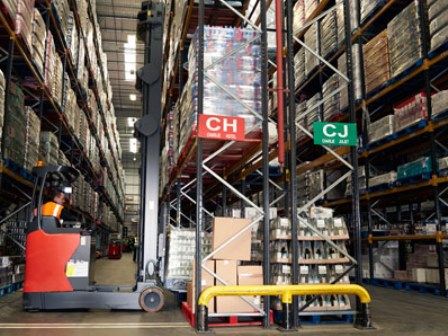
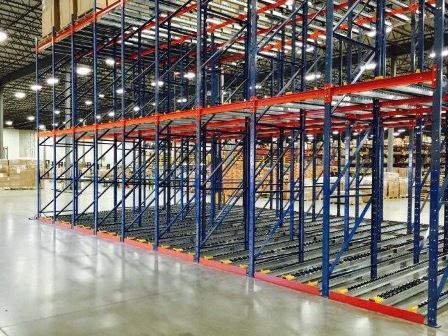
Pallet racking is a material handling storage rack system designed to store products and materials on pallets in horizontal rows and on multiple levels. Most warehouses prefer using pallet racking systems to maximize the storage space they have available.

Lawn Mower Storage shed

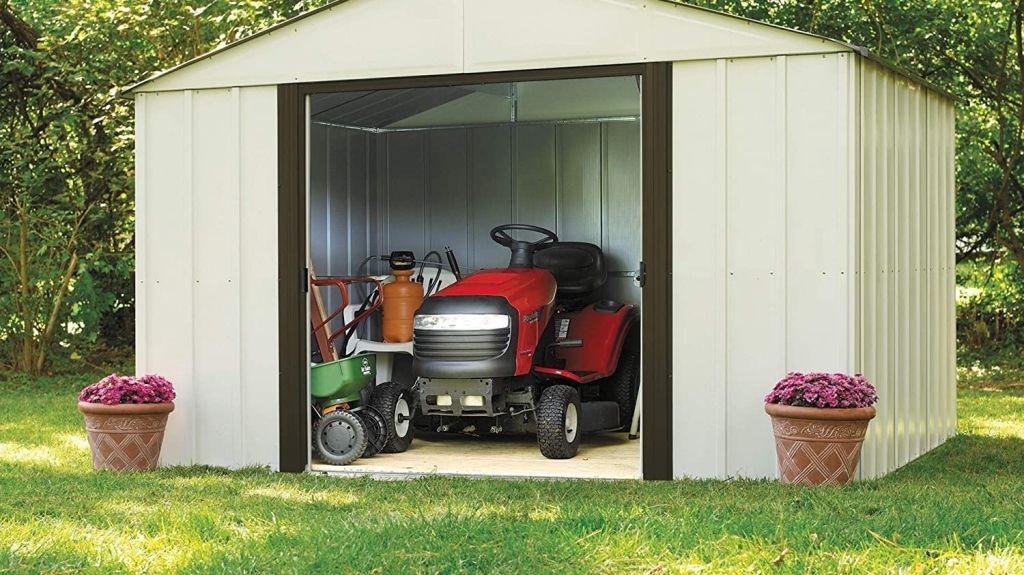
If you invested in a heavy-duty lawnmower or lawn tractor this spring, then you need a lawnmower shed. Your lawnmower is an expensive piece of equipment, so take care of it like one.

Think of it this way, your lawn mower was a great investment and you are planning to get many years of performance out of it. Storing it properly is a crucial component to enjoying the longevity you expect.

Also, keep in mind the size and weight, this is not a conventional lawn mower. The dimensions of your lawn mower may be too large for smaller sheds. Also, the weight of your ride-on mower (often over 1,000 pounds) can break or damage even the most fragile of sheds.

Lawn Mower Storage shed

Shed for lawn mower

Sheds are important storage facilities that provide a variety of shelter options for your lawnmower and other accessories.

Investing in a storage shed is a great way to keep your lawn mower safe and out of the elements of nature, such as rain or hail.

Storage sheds are available in a variety of styles and sizes and can fit many different types of needs and budgets.

Once you have a well-constructed storage shed that suits your needs, you won’t have to worry about the weather or security since all your tools and equipment will be locked inside.

Outdoor lawn mower storage

You can’t deny it any longer: the days are shorter, the weather is colder, and as much as you don’t want to admit it, winter is here.

If you live in a hot climate, consider yourself lucky to have to mow your lawn year-round. For the rest of the country, the time has come to consider storing your lawnmower for the winter.

When storing a lawnmower for the winter, there is a wide range of recommendations.

Some people follow each step meticulously. Others leave their mowers outside in the snow and hope for the best.

The most important thing you can do when storing a lawn mower is to take care of the fuel system. Taking this step will drastically reduce your chances of problems when the warm season arrives.

It pays to winterize your lawnmower like you would a car or boat, especially if you have an expensive lawnmower.

These lawnmower storage steps will help maintain and increase the longevity of the equipment.
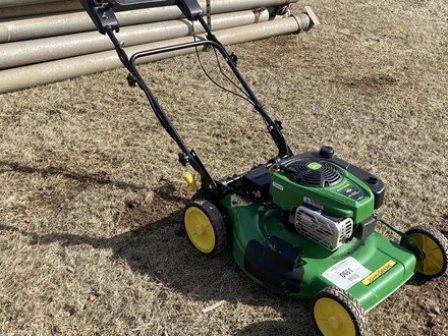
Do as many as you can and be sure to take all the proper precautions when winterizing your mower.

  • Prevent mower from kick-starting
  • Drain gas or add fuel stabilizer
  • Drain or change oil
  • Clean deck and undercarriage
  • Remove and sharpen the blade
  • Replace the spark plug and air filter.
  • Keep mower covered in storage.

More on this story

Lawn Mower made in USA

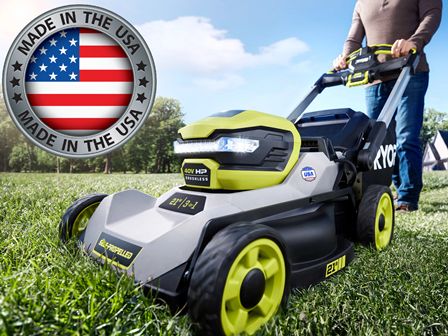
Have you noticed that finding a reliable lawn mower made in the USA is much more complicated than it seems?

What Kind of Oil for a Lawn Mower?

What type of oil is used for a lawn mower?

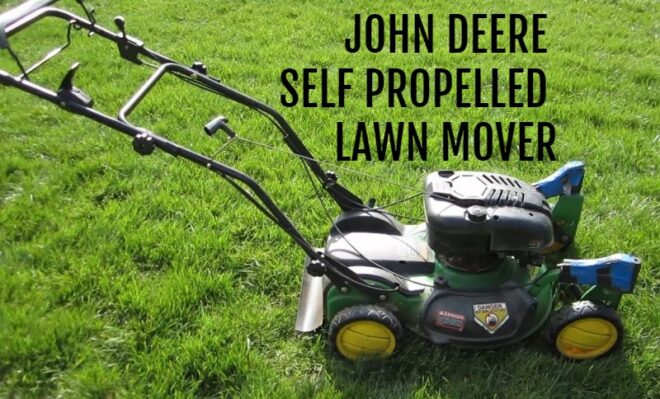
John Deere Self propelled Lawn Mower

Pushing a lawnmower around is an old tradition that nobody follows anymore!

Does John Deere make push mowers?

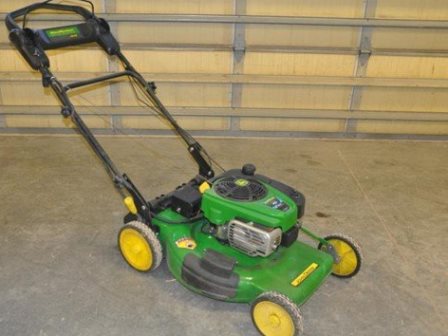
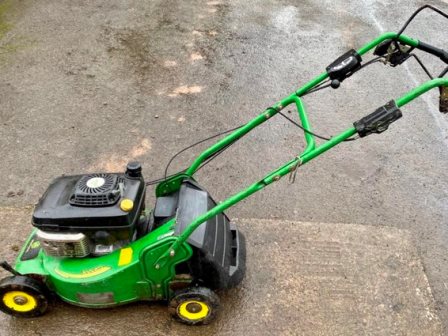
Yes, John Deere manufactures and distributes motorized lawn mowers, in various models and sizes. They are models with ergonomic controls. And so they make sure that the control is correct. Also the hand position is ergonomic to minimize fatigue. All for ease of use and trouble-free operation.

All models feature hydrostatic transmission systems that provide positive reverse for more power and smoother operation. Infinite ground speed settings on the units allow for a smoother transition from one speed to another.

As for its ability to climb curbs, it just can’t beat pedestrian vehicles, with 8 1/2 inches of ground clearance and positive reverse performance the units bring even the toughest curbs to their knees.

John Deere Self propelled Lawn Mower

There are so many great ways to tame your lawn right now. Pushing a lawnmower around is an old tradition that nobody follows anymore!

What Kind of Oil for a Lawn Mower?

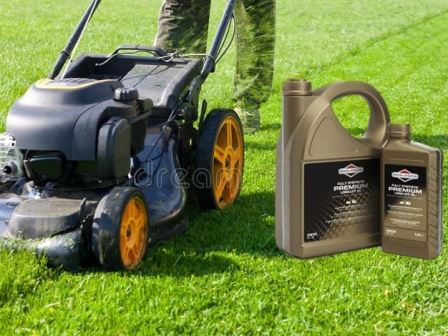
The type of mower you use, the engine inside, and the outside temperature determine what type of oil to use, how much you need, and the cost of the oil.

Lawn Mower made in USA

Have you noticed that finding a reliable lawn mower made in the USA is much more complicated than it seems?

John Deere Self propelled Lawn Mower

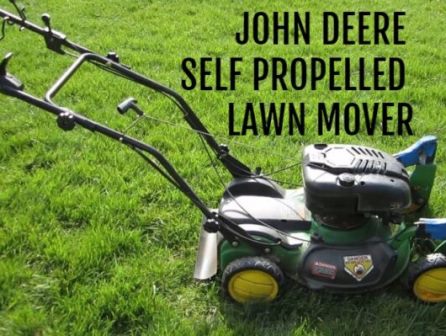
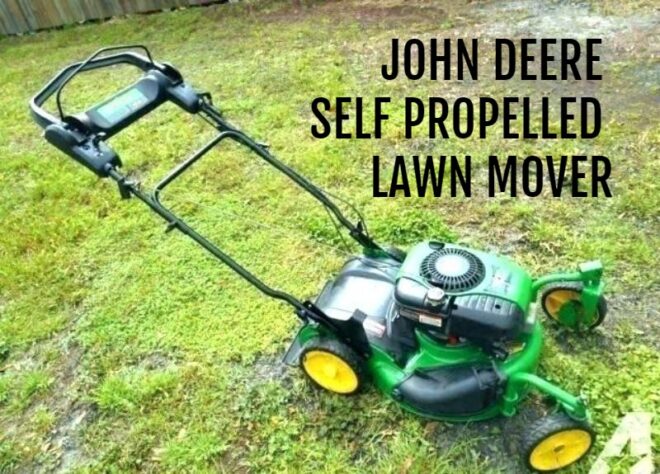
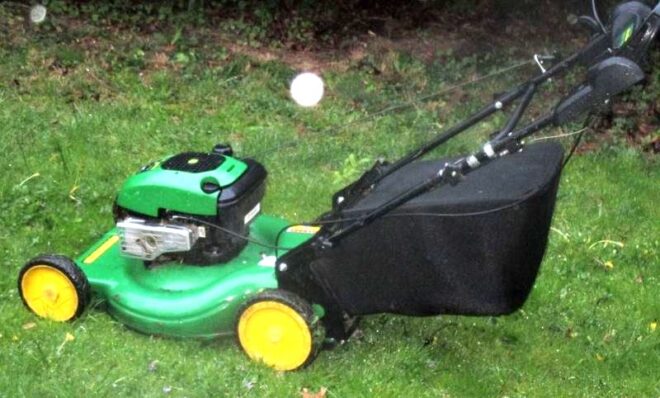
John Deere Self-propelled Lawn Mower: There are so many great ways to tame your lawn right now. There are mowers powered by gas engines that require no oil change; there are mowers, both ride and walk behind, powered by an electric motor and lithium-ion battery.

You may push a mower that you walk behind, or it may propel itself using a drive system at its rear wheels or pull itself from its front wheels—or both.

You may ride on a mower that has its engine in front of you or behind you, and you may steer this machine with a steering wheel or control it by two lap bars, each tied to an independently-operated transmission.

John Deere Self propelled Lawn Mower

John Deere self propelled mower

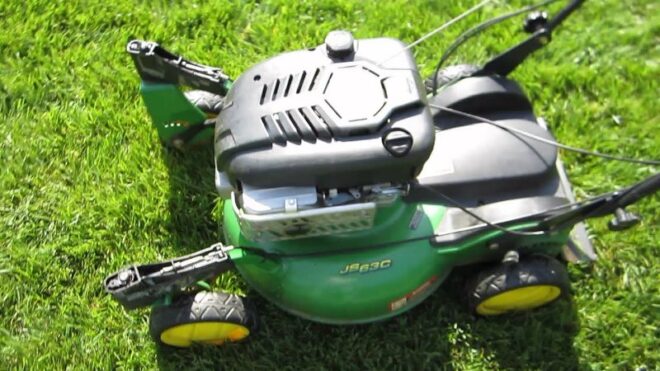
John Deere Self propelled Lawn Mower: Pushing a lawnmower around is an old tradition that nobody follows anymore! Technology and improved engines have made it possible for lawnmowers to make their way across your lawn on their own; all that you have to do is steer them. John Deere has been a brand that has produced the best landscaping tools for many years.

John Deere Self propelled Lawn Mower

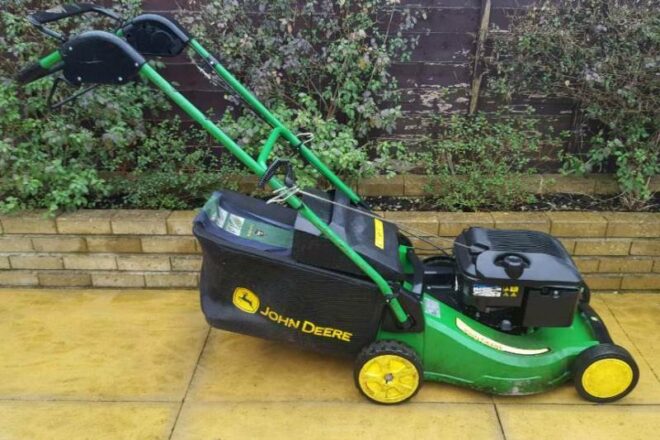
John Deere self propelled push mower

Aside from your budget, there are a few things that determine the mower you buy: do you want gas or electricity, how much grass you have to cut and how you want to cut the grass.

John Deere self propelled push mower: Gas-Powered or Electric Mower?

One question today is whether you buy a gas engine mower or an electric mower. Answer: electric mowers are great for small, tidy yards. We’re talking under 5,000 square feet of grass and no mowing of non-lawn areas.

For a larger grass area, especially one that may have a lot of leaves on it during the fall or other tree debris, like pine needles, buy a gas-engine mower. Especially buy a gas mower if you occasionally mow at the lawn’s edge, pushing back tall grass and weeds or if you mow rough, non-lawn areas.

John Deere Self propelled Lawn Mower

Best self-propelled lawn mower

What is the best self-propelled lawnmower?

We have tested the best self-propelled lawn mowers on the market to provide you with all of the facts, helping you to decide which tool is perfect for you and your needs. The best brands for the self-propelled lawn mower is:
-Honda
-Husqvarna
-John Deere

What is a self-propelled lawnmower?

Self-Propelled Lawn Mowers – How Do They Work? Self-propelled lawnmowers work on a drive system (making them vehicle-like) that requires the operator to squeeze a bar (called a “bail”) on the handle to engage the mower. After that, the mower moves forward on its own (you don’t have to push it).

How does a self propelled lawn mower work?

The engine powers up the mower and the blade begins to rotate. The operator pulls on the drive control lever-typically the lower lever on the handle – to engage the drive wheel and propel the mower forward. The blades spin underneath the deck at a high speed causing them to cut the grass.

Self propelled lawn mower reviews

Self Propelled Lawn Mower Buyer’s Guide: Still stuck on what you should buy? Your choice of the best self-propelled lawn mower is an important decision to make, as you will likely use this machine for years to come.

A self-propelled lawn mower is not only easier to maneuver but it can come with many options. Here are the top considerations you need to make when you are shopping for the best walk behind mower for your needs.

John Deere Self propelled Lawn Mower

How does self propelled lawn mower work?

How Do Self-Propelled Lawn Mowers Work? There isn’t a lot of mystery behind how self-propelled lawn mowers work – they operate in a relatively straightforward fashion. These mowers have a drive system just like cars do – once you start the motor, a device squeezes an internal handle and spurs it into motion. This also influences the cutting motion for the grass.

As the operator, all you will need to do is turn the lawnmower where you need it to go, controlling its direction and speed.

Self propelled lawn mower speed adjust

While several older self-propelled lawn mowers have just one speed, while others allow you to adjust for speed. Most allow for adjustments all the way up to 4 miles per hour. If you have a larger lawn, you might want more options for speed settings, while those with smaller lawns may find that a single-speed mower works just fine.

Lawn mower weight

Since you won’t necessarily have to push it, weight might not be as important a factor to you when you are buying your machine. However, keep in mind that some self-propelled lawn mowers can be on the heavier side.

Weight might be an important determining factor in your buying process – this is particularly true if you need to move your mower often (to get it in your vehicle to move it to another site, for example).

Lawn mower decibels

Lawnmower decibels: Consider how your self-propelled lawnmower operates. Is it gas-powered or battery-operated? Gas-powered self-propelled mowers are more popular, but they also tend to be louder. Therefore, if you are concerned about noise, you might want to spring for a quieter self-propelled lawn mower that uses a lithium-ion battery instead.

Lawn mower maintenance

Necessary Maintenance: Even if you don’t plan on tinkering with your self-propelled mower yourself, it’s important that you do your research ahead of time about how much maintenance the mower will require. Most self-propelled lawn mowers will require regular maintenance in the form of oil changes, cleaning, and more.

When you’re looking for the best self-propelled lawn mower, you might also want to consider the other features that come with your unit. Does it matter to you whether your mower can mulch or bag your grass clippings? If you’re planning on using your clippings as mulch or compost, this might be an important feature. Even if you simply want the clippings off your lawn so they don’t rot there, you might want to invest in a mower that has 3-in-1 capabilities to suit this need.

Lawn mower specifications

Some mowers come with additional safety features, too, like auto shut-off that power down the device if you let go of the handle. This is a good feature to have, as self-propelled mowers are responsible for quite a few emergency room visits each year. Others come with fuel shut-off in case of a fire.

What is the Best Self-Propelled Lawn Mower? Of all the mowers we reviewed, nothing quite comes close to the John Deere Self-propelled Lawn Mower. While most of these mowers have a smooth design and features to make operation more seamless, the John Deere Self-propelled Lawn Mower is a cut above the rest. It is versatile and easy to handle and comes at an affordable price that makes owning it not only possible, but practical.

John Deere Self propelled Lawn Mower

John deere push mower

It’s time to gut the grass again. You may roll your eyes, pretend to be busy, make whatever excuses you can think of, but it has to be done. One of the main reasons that people hate to cut the grass is because many of them are relying on old, hand-me-down mowers that just don’t cut it anymore, no pun intended.

Why not go out and buy a John Deere lawnmower? Sure, you know they make big tractors for farmers and ranchers, but did you also know they make lawnmowers for everyday homeowners such as yourself?

As John Deere’s motto goes, “Nothing runs like a Deere.” This motto is most certainly true and has been embraced by tractor enthusiasts the world over. In fact, John Deere owners have an almost club-like fanaticism about their machines. It’s when you look at what they have put into their riding mowers that you truly appreciate the quality of John Deere lawnmowers.

John Deere lawnmowers are truly the elite machines that you think they are. Some of them have engines in them that could be found on a motorcycle tearing down the highway!

Regardless, they are all solidly built and certain to last you for decades to come. Though they are a bit high-end in price, they are most certainly worth every penny. If you are serious about taking care of your lawn and garden, you must have a John Deere lawnmower

More on this story

John Deere Self Propelled mower price

John Deere JS46 is one of the most frequently sold models by John Deere. The price of the self-propelled Lawn Mower was $499 US at the time of this review.

Does John Deere make push mowers?

Yes, John Deere manufactures and distributes motorized lawn mowers, in various models and sizes.

John Deere Push Mower

Only John Deere ​push mowers to provide our legendary combination of durability, reliability, and innovation.

Lawn Mower made in USA

Have you noticed that finding a reliable lawn mower made in the USA is much more complicated than it seems?

What Kind of Oil for a Lawn Mower?

Before you can change the oil in your mower, it is important to understand the type of oil and the capacity required. What Kind of Oil for a Lawn Mower?

The type of mower you use, the engine inside, and the outside temperature determine what type of oil to use, how much you need, and the cost of the oil.

Lawn mower motor oil might actually be the only type your mower can tolerate.

Using motor oil designed for a tractor or car can clog some units completely due to their higher viscosity. Always check your manufacturer’s specifications first.

What Kind of Oil for a Lawn Mower?

What kind of oil for a lawn mower?

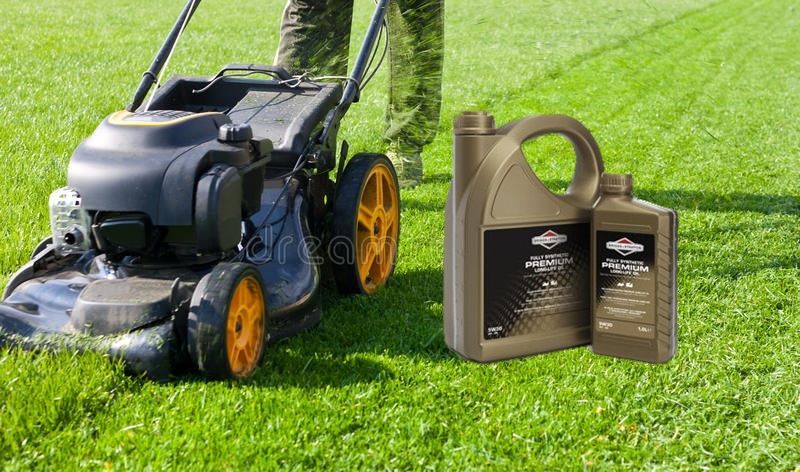
Synthetic oil is superior to lubricants made from crude oil, and your lawnmower motor can last longer if you use synthetic.

It is an artificially created lubricant with a mixture of chemical compounds designed to obtain the best performance and protection for the engines that are used, since it is possible that natural oil cannot provide it.

  • The use of synthetic oil does not alter the required oil change intervals.
  • Regular non-synthetic oil works well too.

What type of oil for lawn mower?

Your lawn mower works long hours and like any other internal combustion engine, it relies on engine oil to keep everything lubricated.

While it is easy to forget about the oil in your lawn mower, this is not a good idea.

Some experts say that the more expensive “small motor oil” is the only type you should put in your mower, but that is not true.

The standard motor oil manufactured for cars and trucks is of the highest quality available today and works optimally with all engines.

Any two-stroke engine oil manufactured for air-cooled engines, such as those for chainsaws, water pumps, etc. it will work perfectly on your two stroke lawn mower engine.

Different types of oil can work best at certain temperatures. Learn which one to choose for your climate.

SAE 30 oil

Warmer temperatures, common small engine oil. SAE 30 oil is a motor oil that has been given a viscosity rating of 30 by the Society of Automotive Engineers. Motor oils typically have ratings from 0 to 50.

SAE 10w30 engine oil

You can vary the temperature range, this grade of oil improves cold weather starting, but can increase oil consumption. The 10W30 designation on engine oil means that the viscosity of the oil is 10W when the engine is cold and 30 when the engine is warm. This is different from an oil labeled 5W30, which has a thinner viscosity when the engine is cold at 5W.

Synthetic SAE 5w 30

The best protection at all temperatures and improved starting with lower oil consumption. When it’s brand new, 5W-30 conventional motor oil acts exactly like 5W-30 synthetic motor oil.

SAE 5w 30

Very cold temperatures. A 5W oil is a usual choice for winter use because it has less viscosity, or thickness, in the cold than 10W oil, and will flow easier through the moving parts of a vehicle engine.

Vanguard 15w50 synthetic oil

Variable temperature range. For continuous use such as commercial lawn mowing or pressure washing. Vanguard Oil is designed to maximize engine protection and performance.

When to change lawn mower oil?

Most experts agree that you should change the oil in your lawn mower every 50 hours of use for a walk-behind model and every 100 hours of use for a ride-on lawn mower, or annually, whichever happen first.

Regular oil changes can help improve the overall performance of your lawn mower.

How to check oil in lawn mower?

You should check the oil level in your lawn mower regularly. This is done in a similar way to how you would check the oil level in your vehicle.

  • Simply remove the dipstick from the mower and wipe it with a clean rag.
  • Then fully insert the dipstick into place.
  • For best results, you should rotate the dipstick back into place before pulling it out to check.
  • Oil residue on the dipstick should be somewhere between the full and added marks.
  • If it’s below the add mark, it’s time to put more oil in your lawn mower.

How to choose lawn mower oil?

The type of oil you should use for your lawnmower depends on several factors, including the type of mower you own, the engine in the mower, and the outdoor temperature in the area where you will be mowing.

Type of lawn mower

Lawnmower manufacturers generally recommend a specific type of oil for use in mowers. Take a minute to read your lawnmower owner’s manual to determine what type of oil the manufacturer recommends for your specific lawnmower. Most manufacturers also provide this information online.

Lawn mower engine

You need to know what type of motor your lawn mower has.

  • You cannot use standard motor oil in two-stroke engines. These types of engines require a specialized lightweight oil.
  • Four-stroke engines, on the other hand, use standard motor oil because the engine stores gasoline and oil separately.
  • The specific type of motor oil to use with a four-stroke engine depends on the outside temperature in the area where you are mowing.

Type oil for lawn mower

  • In warmer temperatures, SAE 30 is your best option.
  • In colder areas, you should stick with SAE 5W-30 motor oil.
  • If you live in an area where the temperature fluctuates between 0 ° and 100 °, then you should use an SAE 10W-30 motor oil.

can you use car oil in a lawn mower?

It depends on the engine of your mower. Car oil ruins two-stroke engines, but it lubricates four-stroke engines well. If it’s a premium oil like SAE 30 or 10W-30 oil, you can use car oil in your four-stroke lawnmower.

Can you use regular motor oil in a lawn mower?

SAE 30 motor oil is commonly recommended for use in a lawnmower engine, but it is the best and safest to use the type of oil recommended by your lawnmower manufacturer. Oftentimes, the same types of motor oil that are used in vehicles can also be used in lawn mower.

What happens if you put car oil in a lawn mower?

At best, the oil can be ineffective. In the worst case, it could damage the motor or represent a safety problem. This is where the auto oil issue comes into play. To make a long story short, yes, you can use automotive oil to power your lawn mower, but it must be of high quality.

What motor oil to use in my lawn mower?

Before changing the mower oil in your engine, it is important to understand the type of oil and the capacity required. The type of mower you use, the indoor motor, and the outdoor temperature determine what type of oil to use, how much you need, and the cost of the oil. Use the recommended oil for your lawn mower.

More on this story

John Deere Self propelled Lawn Mower

There are so many great ways to tame your lawn right now. Pushing a lawnmower around is an old tradition that nobody follows anymore!

John Deere Push Mower

Only John Deere ​push mowers provide our legendary combination of durability, reliability, and innovation.

Lawn Mower made in USA

Have you noticed that finding a reliable lawn mower made in the USA is much more complicated than it seems?