Category Archives: construction crane

Ancient Cranes (Machines for Lifting in Antiquity)

  • How were ancient cranes built and operated?
  • Who invented the first crane?
  • What materials were ancient cranes made of?
  • How did cranes change construction in ancient Greece and Rome?

The ancient cranes have been evolving from the load prop to perform various tasks. There are ancient documents where the use of machines similar to cranes by the Sumerians and Chaldeans is evidenced, transmitting this knowledge to the Egyptians.

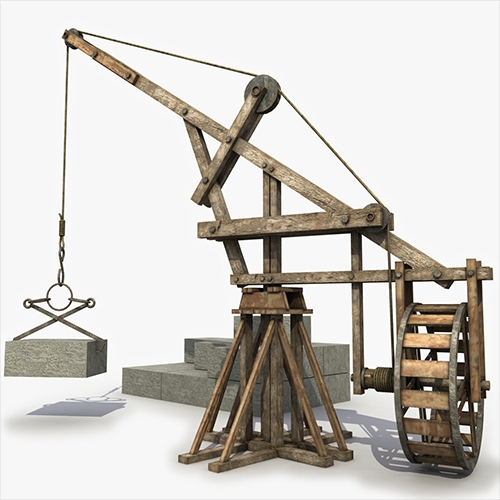
medieval crane

Who invented the crane?

For centuries, archaeologists and historians have been baffled by how Stonehenge was built. The largest of the Sarsen stones transported to Stonehenge weighs 50 tons — which means that transportation by boat would have been impossible. Legend holds that ancient druids levitated the stones into place with their eldritch rituals.

The truth may be a bit less exciting, but just as interesting. The prevailing theory is that the stones were literally dragged using an intricate series of sledges, ropes, ramps, and levers.

The stones of the Pyramids of Giza were likely hoisted into place in a similar fashion. The “regular” slabs that tourists see on the outside surface of the pyramids are 3 tons each, but the biggest supporting slabs weigh up to 70 tons. Think that’s impressive? The Colossi of Memnon each weighed 700 tons each. By comparison, most common tower cranes today have a lifting capacity of only 12 to 20 tons, and most construction cranes go up to 300 tons.

History of cranes

For thousands of years, people have used innovative ways of lifting really heavy objects and bringing them where they’re needed. As demonstrated at Stonehenge, the Pyramids of Giza, and countless ancient sites around the world, the history of the crane is closely aligned with the history of the limits of man’s strength.

The birth of the crane is inextricably tied with the birth of the pulley — first devised by ancient Mesopotamians as early as 1500 BC for hoisting water. The first compound pulleys were created by Archimedes of Syracuse around 287 – 212 BC, which he used to lift an entire warship, along with its crew.

Ancient Egypt

Most of the stones that make up the almost 140 Egyptian pyramids discovered have a weight of “only” 2 to 3 tons each, but all these structures (built between 2750 and 1500 BC) also have stone blocks that weigh 50 tons, a more times.

The temple of Amon-Ra in Karnak contains a labyrinth of 134 columns, of a height of 23 meters high and transversal beams that weigh 60 to 70 tons each.

The question is answered by a group of scientists from the University of Amsterdam and the Foundation for Fundamental Research on Matter (FOM), who discovered the techniques that allowed to build these monumental buildings at a time when there were no cranes.

In this painting the ingenious technique is observed. Water would have been the key element. According to the study, the ancient Egyptians moistened the sand where the wooden sleds on which the stone blocks were transported moved. The key would have been to spill the precise amount of water.


Ancient Greek inventions

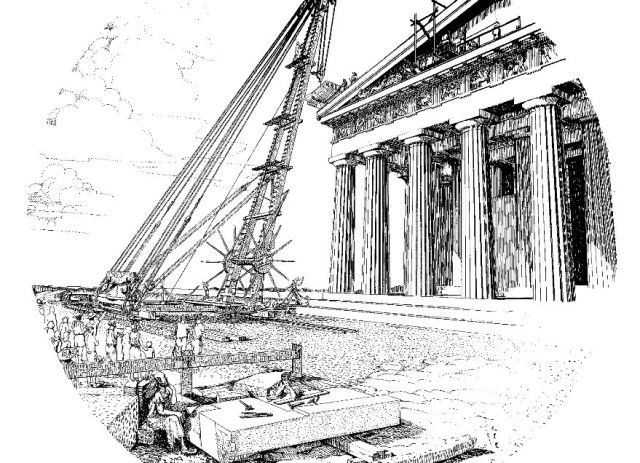
Cranes in ancient Greece: The first vestiges of the use of cranes appear in Ancient Greece around s. VI a.C. These are iron tongs marks on the stone blocks of the temples.

It is evidenced in these marks (distinctive cuts c. 515 BC) its purpose for the elevation since they are made in the center of gravity or in equidistant pairs of a point on the center of gravity of the blocks. The introduction of the winch and the pulley soon leads to an extensive replacement of ramps as the main means of vertical movement.

Greek buildings

For the next two hundred years, the Greek buildings contemplate handling of lighter weights, because the new lifting technique allowed the loading of many smaller stones to be more practical, than a few larger stones.

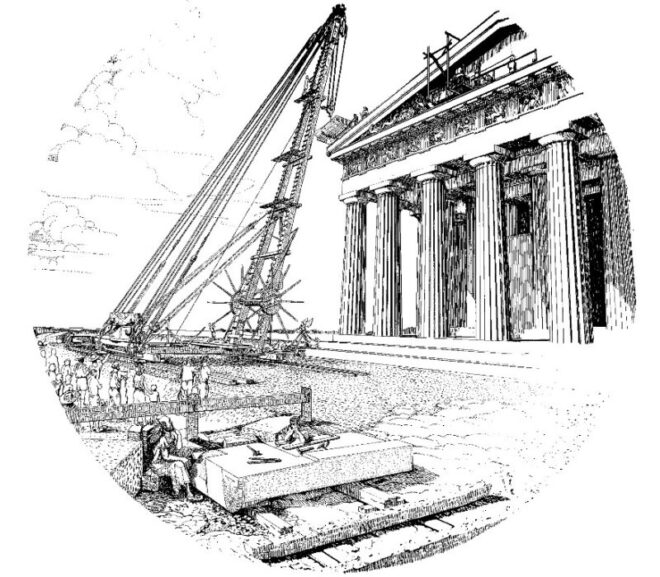
In contrast to the archaic period and its tendency to increasing block sizes, Greek temples of the classical age such as the Parthenon offered an invariable amount of stone blocks that could be used to load no less than 15-20 tons.

Also, the practice of erecting large monolithic columns was abandoned practically to then use several wheels that make up the column.

Although the exact circumstances of the change of ramp to crane technology remain unclear, it has been argued that Greece’s volatile social and political conditions made it more convenient to employ small teams for construction professionals than for instruments. Great for the work of inexperienced, making the crane preferable to the Greek polis than the ramp that required a lot of work, this had been the norm in the autocratic societies of Egypt and Assyria.

The first unambiguous literary evidence to support the existence of the system composed of pulleys appears in the mechanical exercises (Mech.18, 853a32-853b13) attributed to Aristotle (384-322), but perhaps drawn up at a slightly later date.

Around the same century, the block sizes in the Greek temples began to resemble their archaic predecessors again, indicating that the most sophisticated compound pulley in the later Greek works must have been found.

Ancient Rome

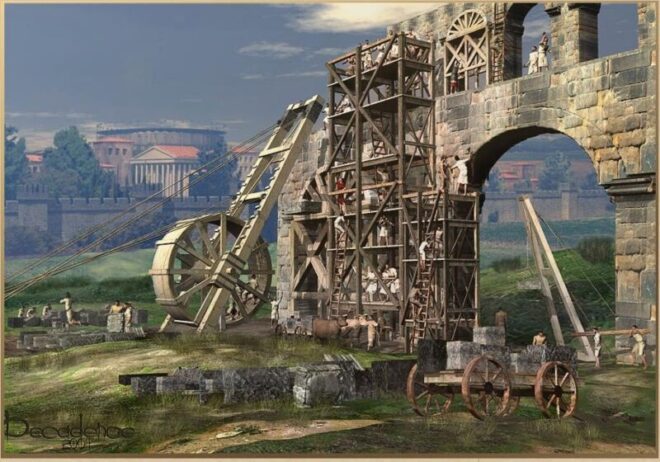
The height of the crane in ancient times came before the Roman Empire when the construction work was increased in buildings that reached enormous dimensions. The Romans adopted the Greek crane and developed it.

Trispastos

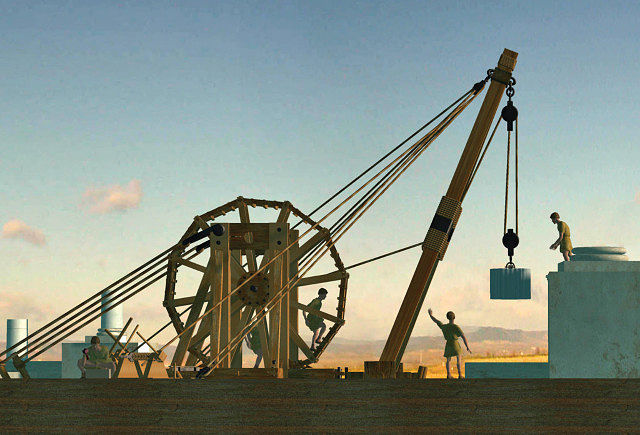
The simplest Roman crane, the Trispastos, consisted of a single beam, a winch, a rope, and a block containing three pulleys.

Having thus a mechanical advantage of 3: 1, it has been calculated that a single man who worked with the winch could lift 150 kilograms (3 pulleys × 50 kg = 150 kg), assuming that 50 kilograms represent the maximum effort a man You can exercise over a longer period.

Pulley system

Pentapastos: Heavier types of crane offered five pulleys (Pentaspastos) or, in the larger case, a system of three by five pulleys (Polyspastos) with two, three or four masts, depending on the maximum load.

Polyspastos, the cranes of Rome

The Polyspastos, when operated by four men on both sides of the winch, could lift up to 3000 kg (3 ropes × 5 pulleys × 4 men × 50 kg = 3000 kg). In case the winch was replaced by a coupling, the maximum load even doubled to 6000 kg with only half the equipment, since the coupling possesses a much larger mechanical advantage due to its larger diameter.

This meant that, with respect to the construction of the Egyptian pyramids, where about 50 men were needed to move a block of stone of 2.5 tons above the ramp (50 kg per person), the lifting capacity of the Polyspastos Roman proved to be 60 times higher (3000 kg per person).

Roman Architecture

However, Roman buildings offer numerous blocks of stone much heavier than those.

Led by the Polyspastos indicate that the total lifting capacity of the Romans went much further than that of any single crane.

In the temple of Jupiter in Baalbek, the blocks weigh up to 60 t each, and the cornices of the corner block even over 100 t, all raised to a height of 19 m above the ground.

In Rome, the capital block of the Trajana column weighs 53.3 tons and rises to a height of 34 meters.

It is assumed that the Roman engineers achieved the elevation of these extraordinary weights by two means:

  • First, as suggested by Heron, a lift tower was installed, four masts were arranged in the form of a quadrilateral with parallel sides, not unlike a tower, but with the column in the middle of the structure.
  • Second, a multiplicity of winches was placed on the ground around the tower, for, although it has a ratio of lower leverage than the couplings, the winches could be installed in higher numbers and performance by more men (and by animals).

This use of multiple winches was also described by Ammianus Marcellinus (17.4.15) with respect to the elevation of the Lateranense obelisk in the Maximus circus. The maximum lifting capacity of a single winch can be established by the number of iron holes in the monolith.

In the case of the Baalbek architrave blocks, which weigh between 55 and 60t, eight holes suggest a weight of 7.5 t for the iron of the packings, which is by the winch.

The elevation of such heavyweights in a concerted action required a large amount of coordination among the working groups that applied force to the winches.

Medieval crane

The coupling crane was reintroduced on a large scale after the technology had fallen into disuse in Western Europe after the fall of the Western Roman Empire.

The closest reference to a link reappears in the literature archived in France around 1225, followed by a painting illuminated in a manuscript probably also of French origin dated 1240.

Marine crane

In navigation, the closest applications of the port cranes are documented for Utrecht in 1244, Antwerp in 1263, Bruges in 1288 and Hamburg in 1291, while in England the link is not recorded before 1331.

Generally, vertical transport was safer and cheaper made by cranes than by other methods common to the time.

The areas of ports, mines, and, particularly, the building where the crane of couplings played an important role in the construction of the tall Gothic cathedrals.

However, the archived and illustrated sources of the time suggest that the machines were reintroduced as couplings or trolleys so that they did not totally substitute the most labor-intensive methods such as ladders, troughs, and stretchers.

Something that is important to mention is that the old and new machinery continued to coexist in the sites of the medieval works and in the ports.

Crane Wheel

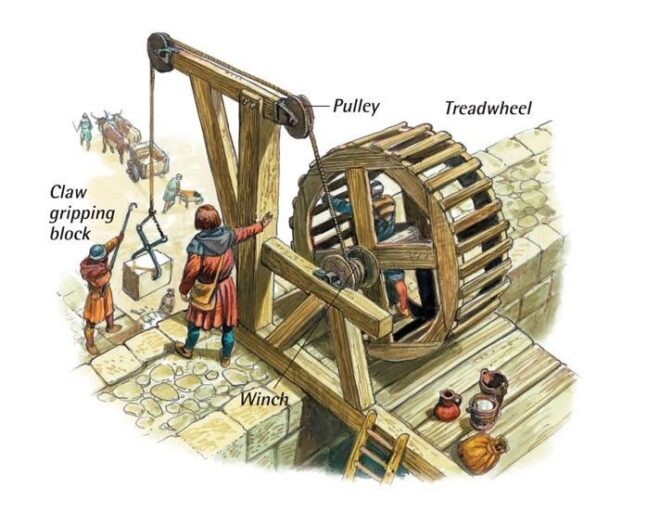
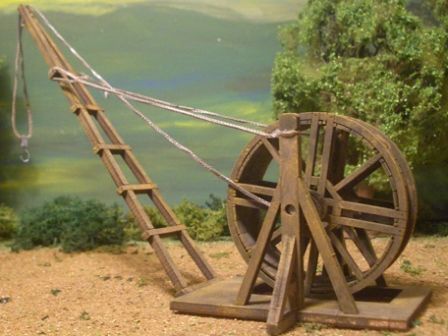
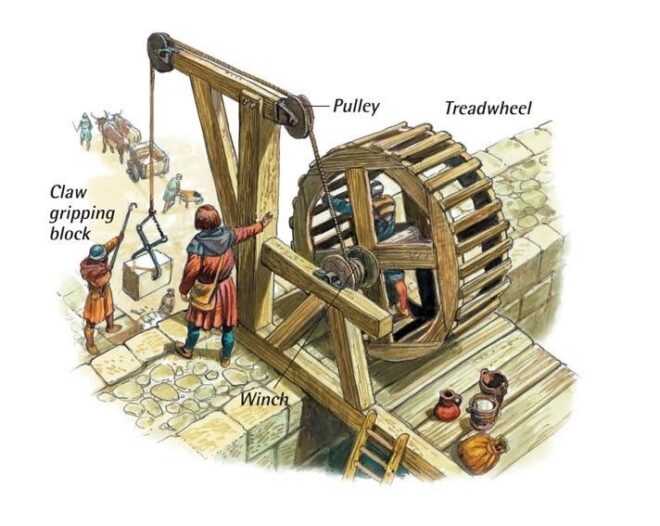
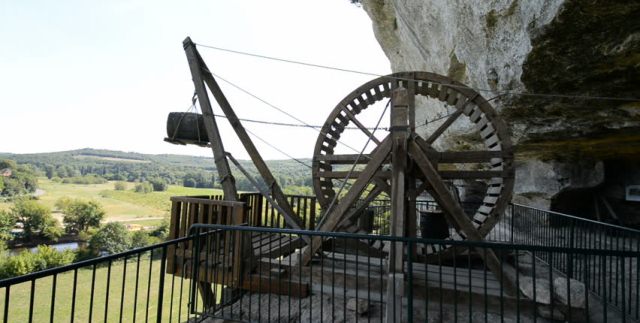
A wheel crane (Latin: Magna rota) is a wooden, human-powered crane. It was used mainly during the time of the Romans and the Middle Ages in the construction of castles and cathedrals.

The often heavy loads were elevated while an individual walked inside a cage-like wooden wheel. The rope connected to a pulley is wound on a spindle by the rotation of the wheel, thus allowing the device to lower or lower the platform with the load to be moved.

Old wooden crane

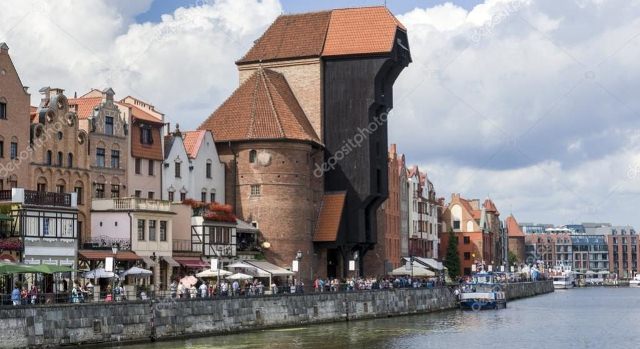
The Crane of Gdansk (Poland), a symbol of the city, was the largest crane in Europe in medieval times. The first mention of a wooden crane in this place is 1367.

In 1442 it was burned and from 1442 to 1444 the crane that is currently known was built in the Puerta del Espíritu Santo.

The door was one of the entrances to the citadel, and its brick towers were used to load and unload the merchandise of the ships.

In the middle of the two towers was placed the elevator with its wooden mechanism. The first crane lifted the goods up to 11 meters.

In the seventeenth century, the upper crane was built that lifted the goods up to 27 meters. In the nineteenth century, it ceased to be the freight crane of the port and was used to fix the masts of the ships.

Later it would be used to extract the stern of the motorboats and repair the rudders. In 1858 the last master who controlled the crane died and a shoe factory, a hairdressing salon, and other local companies were installed there.

During World War II, the wooden area burned as well as 60% of the towers.

From 1955 to 1962 it was rebuilt following the original plans and became dependent on the Central Maritime Museum along with the ship Soldek, the first ship built in Poland in the Gdansk shipyard in 1948.

Medieval crane Gdansk

Medieval crane of Poland: It has been used to celebrate the Red Bull Cliff Diving competition. The mechanism that allowed to unload merchandise, especially wheat and beer, works through the motive power of the feet of the workers.

It consists of two drums of two meters in diameter where the operators were introduced. These workers walked on some boards or steps that made the drum rotate.

The rotating drum raised or lowered the pulley. Thanks to this mechanism, four workers could lift two tons. At present, you can visit the inside of the “crane”, as they call it in Gdansk.

On this visit, you can see the interior of the mechanism as well as the reconstruction of a house of accounts of a merchant, the tax office of the port taxes and the house of a bourgeois. It also explains the life of stevedores, transporters, merchants, employers, candle makers, rope makers, etc …

Treadwheel crane

Styled like colossal human hamster wheels, these cranes allowed huge loads to be hoisted with ease.

The treadwheel crane was a wooden, human-powered lifting and lowering device invented in Ancient Rome. It was used in construction and industry for lifting all manner of materials and produce.

Its creation was a revelation at the time, granting a single person the ability to lift roughly 3,000 kilograms (6,600 pounds) of weight, rather than a completely manual 50 kilograms (110 pounds). As such, while it could take 50 workers to haul a 2.5-ton block of stone during the construction of Egypt’s pyramids, by using a treadwheel crane, the equivalent load could be lifted in Roman construction projects by just three.

Key to this was the huge mechanical advantage granted by the large-diameter treadwheel; it acted as a force amplifier, with the low force input of the treadwheel workers increased dramatically at the output end.

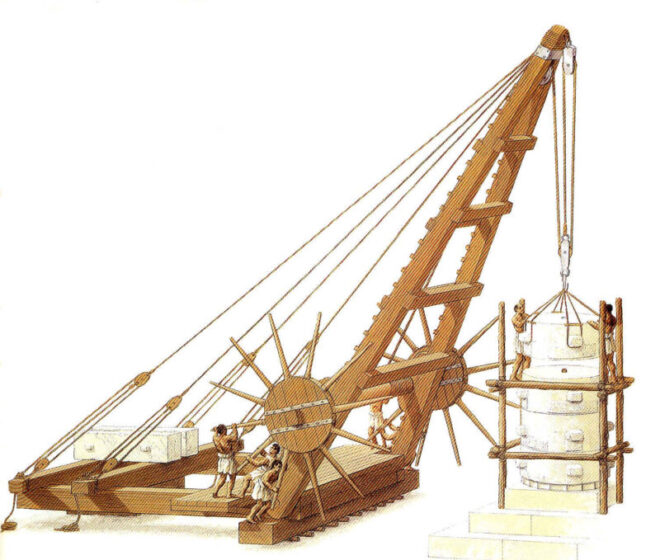
A typical system placed two peddlers side by side in a large, tracked wooden wheel, itself turning around a central shaft. As the wheel was set in motion by the pacing of the workers, it would rotate the central shaft, which in turn would draw in or let out a connected pulley.

The pulley extended out along the crane’s lifting bar and then down to the floor, where objects could be either loaded or unloaded.

Despite its fairly crude design, the treadwheel crane remained in widespread use right up to the end of the 18th century.

Hydraulic crane

When was the first hydraulic crane invented?

Ancient irrigation systems, like the aqueducts developed by the Romans, relied on simple hydraulic technology, like siphoning and hushing in hydraulic mining.
But it was not until the 15th century that Blaise Pascal studied fluid hydrodynamics and hydrostatics, ushering in a new understanding of hydraulic principles like fluid density, pressure, and incompressibility.

What is a mechanical crane?

A crane is a mechanical lifting device equipped with a winder, wire ropes and sheaves that can be used both to lift and lower materials and to move them horizontally. It uses one or more simple machines to create mechanical advantage and thus move loads beyond the normal capability of a human.

Who invented the crane?

The crane for lifting heavy loads was invented by the Ancient Greeks in the late 6th century BC. The archaeological record shows that no later than c. 515 BC distinctive cuttings for both lifting tongs and lewis irons begin to appear on stone blocks of Greek temples.

What is the world’s biggest crane?

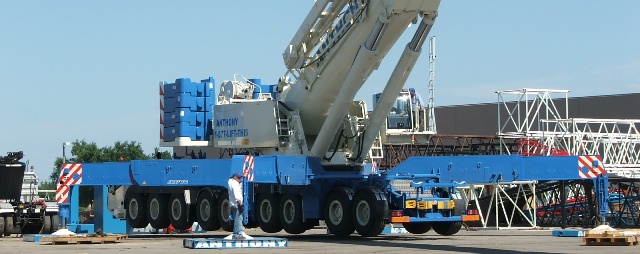
Liebherr Mobile Crane
Category: Mobile
Lifting Capacity: 1,200 metric tons
-The Liebherr LTM 11200-9.1, built by the German company Liebherr Group, is the most powerful mobile crane ever built.
-It also has the longest telescopic boom in the world, which extends fully to 100 meters.
-It’s set on a double cab truck and can lift 1200 metric tons – that’s nearly 700 automobiles.
-That’s real pound-for-pound power for its category, but ultimately not the strongest crane in the world when compared to stationary cranes.

The most read

What is a crane?

Who invented the crane? What are cranes used for? How does a crane work?
More on this story

Crane Manufacturers

Crane Manufacturers: Cranes brands, the recognized brands in the world of Liebherr, Caterpillar, Hiab, Palfinger, Terex, Komatsu construction cranes

Tower Crane Equipment

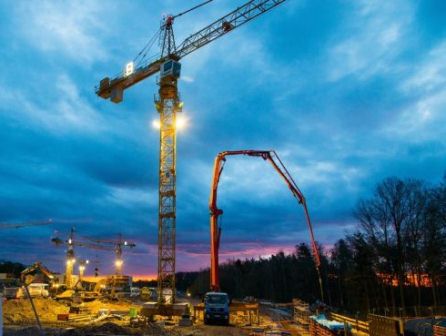
A tower crane is a construction machine designed to load and unload different materials. This load is distributed through the use of a hook that remains suspended thanks to the use of a cable.

What is a crane?

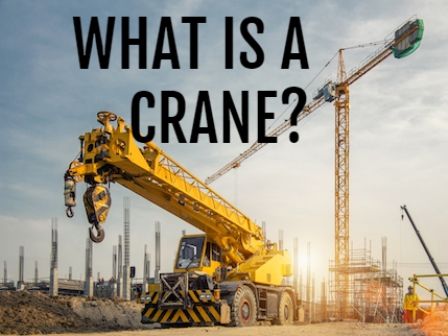
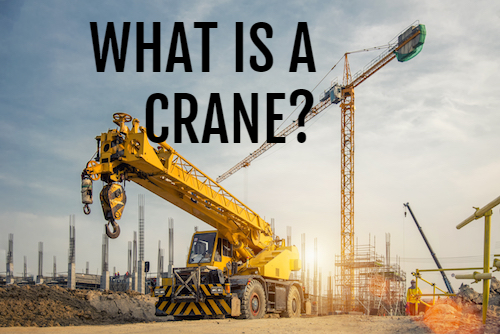
What is a crane? The crane is a mechanism that uses a series of simple machines to both raise and lower objects, and they also move horizontally.

They are always equipped with at least one coil, cables, ropes or chains, and pulleys.

What is a crane

Crane Driver

Crane operator job description:

Lifting loads: Cranes can use a combination of simple machines to gain a mechanical advantage and lift objects.

  • The first is the lever, which is used in the balance style crane. The beam of the crane is in balance at the point of support, which allows it to lift heavier objects with a lesser amount of force.
  • The second is a style arm crane, which uses pulleys to achieve a mechanical advantage (but note that all cranes use pulleys, in this case, the pulleys are the main source of mechanical advantage).
  • The third form of a crane can lift objects by using a hydraulic cylinder, either directly or in the feed of a balance or antenna.

Horizontal movement: The horizontal movement of a crane can be achieved in one of two ways.

  • The first is to mount the entire device on a rotating pivot, and simply rotate the load-bearing boom or beam around. This is very common in mobile cranes and fixed cranes also used in construction.
  • The second method is to roll the load back and forth on the tracks along the bar itself. This is very common in fixed cranes in ports and railway stations.

Balance: A final consideration in the way of working is the stability of the cranes. A crane is stable when the sum of all the movements on the base is equal to zero.

As a practical matter, this means that the nominal load size of the crane must be smaller than what would be necessary to tilt the crane.

In the United States, a mobile crane can only lift 85 percent of what it would take to tilt the crane. That margin is to realize the potential instability so the mobile crane happens to turn around.

How does a crane work?

Cranes have been part of the construction process since its invention in Greece.

The cranes are essentially for heavy construction work (although there are also workshop cranes that are smaller in scale) and for all types of lifting tasks.

Equipped with cables and pulleys and based on the application of fundamental mechanical principles, a crane can lift and lower loads that no human working capacity could.

Crane design has evolved to meet the demands of a wide variety of industrial needs, and modern cranes often coordinate simple systems to accomplish complex lifting jobs – sometimes in environments that would be dangerous for human workers.

What is a crane?

History of cranes

The crane is the “evolution” of the load prop that, since antiquity, has been used to perform various tasks.

There are ancient documents where the use of machines similar to cranes by the Sumerians and Chaldeans is evidenced, transmitting this knowledge to the Egyptians.

Ancient Greece: The first cranes were invented in ancient Greece, driven by men or animals. These cranes were used mainly for the construction of tall buildings. Subsequently, larger cranes were developed using pulleys to allow higher weight lifting.

Middle Ages: In the High Middle Ages it is used in ports and shipyards for the stowage and construction of ships. Some of them were built anchored to stone towers to give additional stability.

The first cranes were built of wood, but since the arrival of the industrial revolution, the most commonly used materials are cast iron and steel.

Mechanical crane

How does a crane work?

To operate efficiently and maintain its vital stability, all cranes must obey the laws of physics. The two most important considerations in this regard are that the crane must not move weights that exceed its capacity, and that any sudden movement that occurs above the supporter of the machine should be eliminated as it may be.

How does it work? A crane is capable of lifting objects because the load is compensated by the counterweight and results in the stabilization of the crane, which allows it to lift and move its load.

Motor crane

The cranes are generally powered by electric motors, hydraulic power or internal combustion engines, but the rapid technological development will allow us to see another type of food in the future.

Types of crane

Today’s construction is an important part of industrial culture, a manifestation of its diversity and complexity, and a measure of its mastery of natural forces, which can produce a wide variety of environments built to meet the diverse needs of society. Cranes are some of the most important equipment in the construction industry.

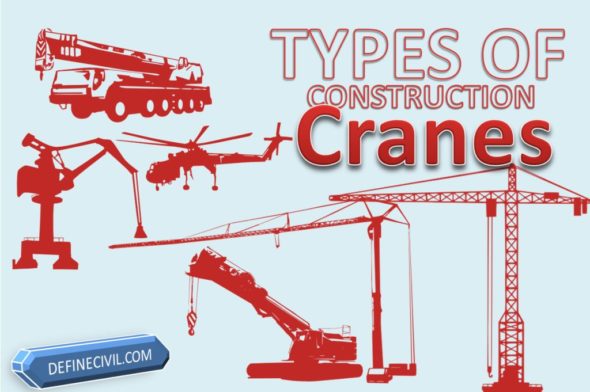
Modern construction machines include fixed tower cranes, huge shipyard gantry cranes, truck-mounted cranes, and more. The different types of cranes work in very different ways, so each construction crane adapts perfectly to the job for which it is designed.

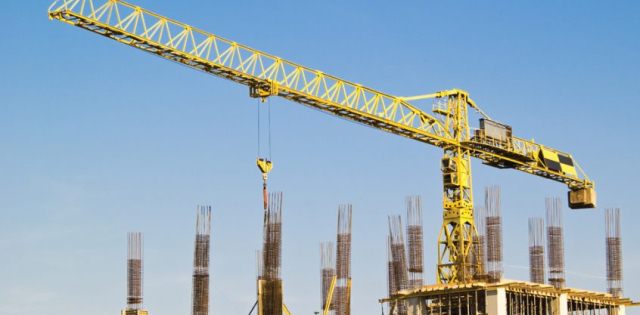
Tower crane

This type of crane is normally used in urban construction sites. This machine is anchored to the floor and provides an optimal mix of height and lift capacity which is commonly deployed in building construction.

Two horizontal arms emerge from a central tower, in which one is used to suspending the heavy loads that will be lifted and the other serves as a counterweight. A tower crane is controlled by a person who may be sitting on the top of the crane, or use a remote control system to operate the machine from the ground.

Mobile Crane

Mobile cranes are commonly found on vehicles, but cranes used for railroad work are adapted to move on rails, and several cranes can be attached to barges when used for construction work on waterway bridges.

The lifting arm is normally articulated to allow lifting and reduction as required. Normally this is achieved through a system of cables or hydraulic mechanisms, and the entire mobile structure can be coupled to a support to provide more stability during its operation.

Workshop crane

These types of cranes are used in daily activities and delicate tasks. Being extremely cost-effective, workshop cranes have a wide range of use in the manufacturing areas.

They are excellent for vehicle maintenance work, machinery loading and various types of tool change

Telescopic crane

Driven by a hydraulic mechanism, a telescopic crane features a set of concentric tubular arms that can be extended and retracted easily to alter the height of the crane.

It is usually mobile, these adaptable cranes are compact units that perform efficiently in tight spaces.

Static crane

The word “static” refers to the characteristic that the crane is installed in a certain place, instead of being transported. This is the most marked difference between this type of cranes and mobile cranes. In this category are several types of cranes such as the tower crane.

Bridge crane

This crane employs a strong gantry to maneuver and lift extremely heavy industrial loads. This type of crane is used in factories and shipyards where its robust characteristics make them essential elements.

Crawler crane

It is a special type of mobile crane that is coupled in caterpillar vehicles, this type of crane can be used in types of floors where common vehicles can not be moved. This crane is usually very stable due to its wide base that serves very well as a counterweight. They are very useful in buildings during the initial phase of buildings where their ability to move heavy loads in difficult soils is a challenge.

Aerial cranes

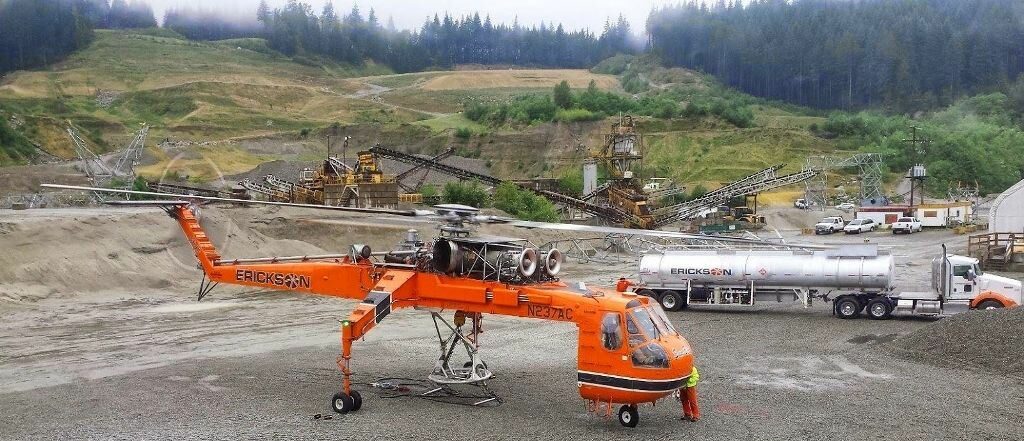
These types of cranes probably offer a higher range than any crane, since they are part of an aircraft. The cranes are attached to a helicopter with the lifting mechanism that is normally used to lift containers, pre-fabricated or temporary buildings, and wooden planks. These helicopters can operate in a wide range of scenarios, including areas where no other type of crane can be used “in-situ” and in areas that lack roads.

Hydraulic crane

Hydraulic cranes may be simple in design but can perform difficult tasks that would otherwise seem impossible.

In a matter of minutes, these machines are capable of assembling beams on the roads, lifting heavy equipment in factories and even building houses.

How does a hydraulic crane work?

A simple hydraulic system works when a piston pushes down on the oil, the oil transmits all the original force to a piston, which is driven upwards.

That is, when one piston is pushed down, another piston is pushed up.

A hydraulic pump creates the pressure that moves the pistons and the pressure in the hydraulic system is created by one of two types of hydraulic pumps:

  • Variable displacement pump
  • Gear pump.

Most cranes use gear pumps that have a pair of gears to press the hydraulic oil.

When the pressure must increase, the operator pushes the accelerator pedal to operate the pump faster.

In a gear pump, the only way to get high pressure is to run the engine at full power.

These pistons can be extended or reduced, and when these pistons are connected to a system of levers, the pistons can be used to lift surprisingly heavyweights, as do hydraulic cranes.

What Does It Do? Crane

Tall cranes tower above construction sites and line the edges of shipping ports. Readers will find out how different types of cranes are used to help build skyscrapers, load cargo ships, and much more.

In this hour long, thrill-packed adventure you’ll not only see more than 40 pieces of construction equipment on the job, but how they work together on actual construction sites.

These monster machines even talk! Bulldozers, cranes, dump trucks, asphalt pavers and drillers, bucket trucks, steam rollers, backhoes, concrete pumpers, forklifts, Mine drillers, blasting with dynamite and so much more.

Why do cranes not topple over?

Why do cranes not topple over?

The base of the crane is bolted into the ground and weighted down by giant blocks of concrete. The stiffness of the supporting structure also helps counteract bending caused by unbalanced loads.

How do tower cranes stay balanced?

Basically, a tower crane has a large load on the other side of the crane. It keeps it balanced like a scale. On other tower cranes, they use cables that relay the force of the lifting to other parts of the crane near the ground, again, providing a counterforce for the weight of the load it is lifting.

Why do cranes fall over?

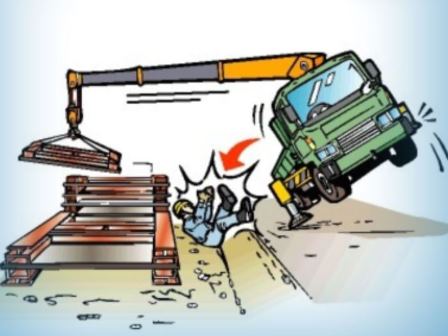
Because of oversize loads or mishaps during assembly. In general, mobile cranes tend to fall over because of overly heavy loads, while tower cranes usually collapse in the course of being assembled, taken apart, or extended.

Are tower cranes dangerous?

Towering cranes used on construction sites to lift and transport hefty loads can be extremely dangerous and often lethal when they fall over, or when parts or the entire crane collapse due to some structural failure. They’re usually local news unless you lose an entire crane.

Where are cranes used?

A crane is a piece of heavy machinery that is a tower or platform that is equipped with cables and pulleys. They are used to lift and lower materials. The most common use of cranes is in the construction industry and heavy equipment manufacturing.

Crane images

The most read

Who invented the crane?

The ancient cranes have been evolving from the load prop to perform various tasks.

More on this story

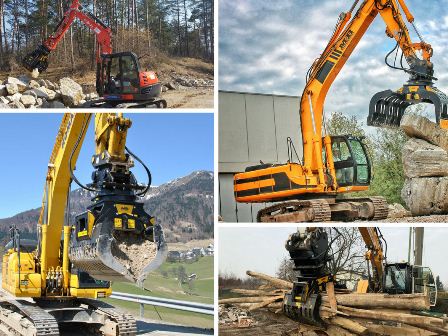
Heavy Duty equipment

The construction machines are those that allow performing different works in the field of land adaptation.

Risk Assessment for Lifting by Crane

A manual provides practical guidance for the safe operation of the crane, provided the crane is used in accordance with the manufacturer’s recommendations.

Crane Manufacturers

Crane Manufacturers: Cranes are very important machines not only for the construction industry but also for many other sectors of the industry. For that reason, there are many different types of crane brands available that can be used for different applications. In general, cranes consist of cables and pulleys that create a mechanical force that lifts and moves heavy loads.

Crane Manufacturers

Construction crane manufacturers

Like all crane manufacturers, they are always looking for lighter and more resistant materials. Weight is one of the main factors when designing new models, especially for end users, since the cranes are installed on trucks. They are forced, to develop continuously, cranes increasingly light and resistant to compete in the market of cranes.

The development of products focused on the customer encourages innovation.

Steel is used because it is the only type of material that is able to withstand the stress suffered by its cranes and at the same time it is lightweight and can be easily folded and welded.

Cranes manufacturers constantly face the need to design new items to take advantage of the properties of new products; an area that can be very helpful.

Crane manufacturers are among the few companies in the world able to provide the information we need for the development of new sections and to use the new materials effectively.

Crane Manufacturers

Industrial crane

Cranes are very important machines not only for the construction industry but also for many other sectors of the industry. For that reason, there are many different types of cranes available that can be used for different applications.

In general, cranes consist of cables and pulleys that create a mechanical force that lifts and moves heavy loads.

Some modern cranes use hydraulic systems and electric motors that provide higher power and lift capacities. The cranes can be fixed to the ground or they can be portable and mounted on a specific vehicle.

They are controlled by the operator in the cabin inside the crane or by radio controls. The use of cranes in the construction industry is important and very useful because these machines are capable of lifting and moving heavy loads vertically and horizontally.

Lifting with your hands requires more effort and time, and the whole process of lifting and moving heavy loads is not efficient at all.

Crane Manufacturers

Construction cranes

This means that cranes play a vital role in the construction industry.

But do you know which brands of cranes are the most popular in the world? If not, read on to find out:

Liebherr

Liebherr is a privately owned German company, famous all over the world for its high quality and durable cranes. Its range of products is very diverse, but its best segment is undoubtedly the production of cranes. As proof, Liebherr has won the “Crane of the Year” award four times and the last one was for his Liebherr MPT Crane. The first Liebherr product was the TK10, a 9m tower crane. Today, Liebherr produces a range of mobile cranes, marine cranes, tower cranes, crawler cranes and other models of cranes for sale.

Hitachi construction machinery

Hitachi Heavy Industries – HSC

The construction crane company Hitachi Heavy Industries, or little known as HSC, was established in 2002. HSC is one of the most popular crane’s brands in the world offering cranes on wheels and crawlers. Crawler cranes offer better results because they offer exceptional mobility and can be used for many applications. Since 2005, when HSC launched the UCX300, the all-terrain wheeled crane, the company recorded a significant increase in sales.

Manitowoc Machine

Manitowoc is another popular brand of cranes with a global presence in the market. It meets the requirements of all customers by producing four categories of cranes: mobile or telescopic cranes, boom truck cranes, tower cranes, and crawler cranes. Manitowoc offers an advanced and innovative range of cranes available all over the world. As one of the most popular crane brands in the world, Manitowoc also offers full customer service at all of its global headquarters.

Hiab crane

Hiab is a Swedish manufacturer known worldwide for many types of cranes. Owned by Cargotec Corporation, Hiab offers several lifting and handling solutions for transportation, distribution, forestry, and many other applications. Hiab cranes are used throughout the world and have the ability to significantly improve efficiency and productivity.

Top Crane Manufacturers

Construction equipment continues to be demanded around the world as the new infrastructure continues to shape many cities and urban areas in developed and developing countries.

These equipment are designed to withstand difficult working conditions and, in general, are equipped with parts of the highest manufacturing standards.

The best brands of cranes used in the construction industry are:

  1. Komatsu
  2. Caterpillar
  3. Hitachi
  4. Liebherr
  5. Sany
  6. Zommlion
  7. Terex
  8. John Deere
  9. Doosan
  10. JCB

Komatsu Ltd

This company based in Japan operates in several countries and supplies equipment used for mining, construction, and military applications. Apart from heavy machinery, they also manufacture machines used for industrial processes, such as generators. The company was established in 1921 and is currently ranked as the second-largest company in the manufacture of construction equipment.

Caterpillar

is an American company that specializes in the design, development, manufacture, and sale of machines and other engineering equipment. They are a leading manufacturer of equipment used in various construction and mining sites in the United States and throughout the world.

Hitachi Ltd.

Hitachi is another company based in Japan that manufactures first-class equipment used for a wide range of tasks, including the construction industry. Its range of machines is capable of handling light and heavy tasks, such as digging, loading, shredding and cutting. Its range of clients includes small-scale contractors, equipment rental companies and large mining companies.

Liebherr

The headquarters of this company is located in Switzerland. Liebherr is a German company composed of several divisions: mobile cranes, tower cranes, mining, transport systems, consumer appliances, and machines. Currently, Liebherr holds the record for the highest and most powerful crane in the world. Its range of equipment also includes excavators of various sizes, dump trucks, tractors, and loaders.

Sany Heavy Industry

Sany is currently ranked as the sixth manufacturer of heavy machinery in the world. It also operates nationally but is headquartered in China.

Zoomlion Crane

Zoomlion is another Chinese company on this list, and they produce sanitation equipment in addition to the standard machinery used in construction. They are the main manufacturers of construction equipment in China. A decade ago, they acquired CIFA, a European heavy equipment company that improved its reputation in the field of construction equipment manufacturing.

Terex Equipment

This US company also manufactures and supplies a variety of solutions for various industrial applications, such as construction, mining, transportation, energy, and energy production. Its main products are cranes, machines for the handling and transport of materials, construction platforms and materials processing machines.

John Deere

The last American company on this list is John Deere. They manufacture a wide range of agricultural machines, as well as machines used to cut and process wood. They specialize in equipment used for construction, as well as in small-scale items, such as lawnmowers.

Doosan Machine

This is the only South Korean company included in the list of the main manufacturers of cranes and other construction equipment. They are a promising company that is currently making a mark in manufacturing with a range of high-quality construction machines and equipment. They can compete with other recognized companies with decades of experience in the field by providing a diverse selection of multifunction machines suitable even for the harshest working conditions.

JCB Crane

Although JCB is proud to still be a family business based in Staffordshire (United Kingdom), its cranes are used on 6 continents and are manufactured in 22 locations in the United Kingdom, Brazil, Germany, China, North America, and India.
Therefore, it is not surprising that they are world leaders in the manufacture of construction equipment, such as backhoes and telescopic handlers

Crane manufacturers in USA

Overhead crane is a machine used to lift heavy loads that are equipped with parallel runways with a traveling bridge and a hoist and is operated manually. It is majorly used to carry out loading and unloading activities in various manufacturing and storage industries. Overhead crane is a machine used to lift, displace, and move heavy & bulky loads in the industrial environment. It is equipped with parallel runways with a traveling bridge and a hoist. The lifting component of a crane mounted on a beam moves in multiple directions.

The key factor that drives the growth of the global overhead cranes market is an increase in government investment for infrastructure development. Moreover, minimized labor cost and reduced product damage have boosted the demand for overhead cranes in various industrial applications. Furthermore, various industries are investing in the domestic manufacturing sector, which is anticipated to provide lucrative growth opportunities to small players in the market. In addition, overhead crane reduces the operational time and automated system used in overhead crane increases the precision of work, thereby increasing the demand for overhead cranes. However, the lack of skilled operators and high lead time in the supply chain are expected to hinder market growth.

Gorbel

Gorbel®, Inc. is one of the top industrial crane’s manufacturers in the industry. Our manufacturing experience allows us to continue developing new riveting technology. It’s impossible to compare others with Gorbel’s patented technology and driving force in the industry with GForce® & Easy Arm™ Intelligent Assist Devices, PIVOT PRO™, and Tarca® Systems.

Konecranes

The superior ruggedness, dependability & know-how Konecranes puts into their custom overhead cranes, rebuilds & mods means customers get highly engineered machines that outperform & outlast in even the toughest conditions. Built for your application, we offer single & double girder cranes, hoists, runway systems, crane components & installation. The lowest owning/operating cost of any overhead crane!

Engineered Material Handling 

We are a crane manufacturer you can trust. Engineered Material Handling has a long history of successful crane manufacturing and our teams can create solutions for a number of industries including shipbuilding, concrete processing, heavy equipment repair, metal service centers, galvanizing plants, power plants, plastic injection mold manufacturers, wastewater treatment services, automobile manufacturing, and much more.

Tri-State Overhead Crane

Tri-State Crane and Hoist is a leader in the design and manufacture of overhead bridge cranes. We have been providing bridge cranes for sale for over 50 years to the Midwest and beyond. We have shipped equipment to all 50 states and around the world. We design and manufacture our systems in the house at our 40,000 square feet facility located in Bridgeton, MO.

Biggest Crane in the World

Why did Caterpillar move to Chicago?

Caterpillar did not receive any incentives from the village of Deerfield or the state. The mining and construction equipment-maker announced in January that it would relocate its headquarters to the Chicago area, saying the move would make it easier to meet with its global customer base.

What products does John Deere make?

John Deere is the brand name of Deere & Company, an American corporation that manufactures agricultural, construction, and forestry machinery, diesel engines, drivetrains (axles, transmissions, gearboxes) used in heavy equipment, and lawn care equipment.

What is SANY Heavy Industry?

Today, it is the largest manufacturer of construction machinery in China and No. 5 in the world. SANY has 20 industrial parks in China and 5 industrial parks outside of China, respectively in the US, Germany, India, Brazil, Indonesia.

Who owns the biggest crane in the world?

To find the cranes that really stand out, we should also consider the nature of the work the crane is built to do. Let’s take a look at 4 contenders for most powerful crane in various categories. Four of the Baddest of Them All:

1. Liebherr Mobile Crane
Category: Mobile
Lifting Capacity: 1,200 metric tons
2. SSCV Thiaf
Category: Crane vessel
Lifting Capacity: 14,200 metric tonnes
3. Taisun Gantry Crane
Category: Gantry
Lifting capacity: 20,000 metric tons
4. Kockums “Tears of Malmö” Crane
Category: Gantry
Lifting Capacity: ???… unknown

What is the largest crane in the United States?

The Liebherr LTM 11200-9.1, built by the German company Liebherr Group, is the most powerful mobile crane ever built. It also has the longest telescopic boom in the world, which extends fully to 100 meters. It’s set on a double cab truck and can lift 1200 metric tons – that’s nearly 700 automobiles.

What are the different types of cranes?

The Different Types Of Cranes Used In Construction:
– Mobile Cranes.
– Telescopic Crane.
– Tower Crane.
– Truck Mounted Crane.
– Rough Terrain Crane.
– Loader Crane.
– Overhead Crane.

The most read

What is a crane?

How Cranes Work: What is a crane? history, types of cranes, hydraulic crane, telescopic, hydraulic system, titan truck, hoists. Crane Driver.

More on this story

What is a backhoe?

What is a backhoe loader? brands and models: caterpillar tractor, attachment, machine excavator, Tractor with loader and backhoe, Cat, Deere.

CAD Designer Job Description

Structural CAD Designer – Advanced Structural Design – CAD designer job description: Learn about the work responsibilities of a structural CAD technician. Find out what education and skills are needed in addition to job outlook and salary to decide if this is the right career for you.

Structural designers benefit from the highest salary, while electrical, Industrial and electronics drafters can expect the most positive career outlook in the coming decade.

Career Definition for a Structural CAD Technician

Structural CAD technicians produce drawings for projects, such as public works systems, residential and commercial buildings, and concrete and steel bridges.

CAD designer job description

Structural drafting

Advanced Structural Design: What is Structural Drafting?

Structural drafting is a plan or blueprint for how buildings or other structures are to be built. Instead of focusing on detailed drawings of floor plans, structural drafters focus on the building’s overall support system, which includes things like columns, beams, foundations, etc. Drafters used to create these drawings by hand, but with more advanced technology, CAD programs now complete these plans much quicker.

Software development engineer

Using computer-aided drafting and design (CADD) techniques and software, they create complex drawings and 2D and 3D renderings of structural components, including framework, foundations, roofs, and retaining walls.

They often assist engineers in outlining designs, gathering data, performing graphic imaging, drawing sketches of existing structures, and interpreting structural markups.

They may also perform administrative duties, produce documentation and progress reports, participate in meetings, and perform computations.

Project planning software

Structural CAD technicians are sometimes known as AutoCAD drafters and may work in offices, visit construction sites, or submit work from home via the Internet.

The U.S. Bureau of Labor Statistics (BLS) reports that 49% of all drafters work in the architectural and engineering sectors.

Advanced Structural Design

Drafting services

Educational Requirements

Structural CAD technicians generally have an Associate in Applied Science degree in industrial technology, engineering design, or a related field; however, some employers may prefer a B.S. in drafting technology.

Coursework should include instruction in CAD software, such as AutoCAD and MicroStation, 2D and 3D modeling, mechanical drawing, math, and science.

The American Drafting and Design Association (ADDA) website offers information about accredited drafting and design programs throughout the country, as well as voluntary certification, which may benefit job seekers.

Structural cad technician

Structural CAD technicians must have a solid understanding of drafting fundamentals, with the ability to use the latest drafting software as well as sketch freehand.

  • They must be analytical and have strong math aptitude combined with artistic ability and creativity.
  • Technicians should be familiar with CADD techniques, software, and principles specific to the industries in which they specialize, such as highway and city design, water and drainage systems, transportation infrastructure, construction, agriculture, or mining.
  • They must have good communication skills, with the ability to work independently and as part of a team.
  • In addition to expertise with drafting software, they must also be familiar with commonly used word processing and spreadsheet programs.
Advanced Structural Design

Structural cad technician jobs

Economic Forecast and Career Outlook: Advanced Structural Design

The BLS expects job increases for architectural and civil drafters to be about 8% for the 2016-2026 period, varying slightly depending on various areas of specialty.

  • As CAD software becomes more user-friendly, a wider variety of basic drafting functions can be performed by untrained personnel, tempering job growth somewhat.
  • Job prospects should be best for structural CAD technicians with the strongest technical skills.

In May 2018, median annual earnings for architectural and civil drafters ranged from less than $35,020 for the lowest-paid ten percent to more than $80,880 for the highest-paid ten percent. (Advanced Structural Design)

Structural cad designer jobs

Structural CAD Designer Jobs Description

A structural CAD designer is responsible for preparing the preliminary design, checking of designs and drawings, preparing specifications, conducting contract administration, structural inspection and preparing proposal and report.

The functions of a structural CAD designer include prefabrication, Shop Drawing, and Architectural Drawings.

  • A structural CAD designer should be very well conversant with AutoCAD, Microstation V8, J and Plan software, AutoCAD computer-aided design in 2D, versions of AutoCAD-12, 13, 14, 2000 and 2006.
  • A structural CAD designer should be very skilled at preparing all types of drawings in AutoCAD and Microstation. A structural CAD designer also performs scanning, conversion of Raster Images to Vector, MS-PowerPoint presentation with Microstation & AutoCAD Drawings.
  • A structural CAD designer creates PDF and images files with a scanner and also performs CAD troubleshooting.
  • A structural CAD designer should possess a bachelor’s degree in Civil or Structural Engineering and a diploma in AutoCAD for Designing and Architecture.
  • A structural CAD designer should be proficient with AutoCAD-R12 to 2006, Microstation J, V8, Photoshop, Corel Draw and Photo-Paint, MS office, Material Integrated Production System and PDMS Drafting.
Advanced Structural Design

Civil Engineering Technician

For those wanting to delve further into the actual creation of structural designs, becoming a civil engineering technician could be the right option: Structural CAD Designer.

  • These technicians examine drawings from drafters to verify measurement accuracy.
  • They also make site visits to determine if the design is being properly executed in addition to analyzing building materials and soil, developing cost estimations, and compiling project information into written reports.
  • Although a degree is not required to enter the profession, an associate degree in civil engineering technology may be appealing to some employers. (Advanced Structural Design)

According to BLS projections, civil engineering technicians are expected to experience 9% employment growth during the 2016-2026 decade. In 2018, these professionals earned a median wage of $52,580.

Architect or architectural designer

If utilizing CAD software to create building designs for government and private clients sounds intriguing, consider a career in architecture. (Structural CAD Designer)

  • Architects meet with clients to determine what the design vision should be and use their artistic skills to draw sketches and blueprints.
  • They also choose construction materials, create cost estimates and schedules, prepare construction contracts, oversee construction work pertaining to the design, and make sure clients are satisfied.

Aspiring architects must complete three stages before working in the field; earning a 5-year bachelor’s or master’s degree in architecture, working as an intern for at least 3 years, and receiving a passing score on the Architect Registration Exam.

Upon completion, an architect can obtain a required state license.

The BLS predicts that job opportunities will increase 4% for architects from 2016-2026, with about 5,500 new positions opening up during that time. As reported by the BLS in May of 2018, architects received a median yearly compensation of $79,380.

Advanced Structural Design

Autocad designer job description

AutoCAD designers require little formal education. Learn about the training options, job duties, and available certifications to see if this is the right career for you.

As an AutoCAD designer, you have myriad possibilities upon which you can direct your professional focus. Options include industrial designer, electrical drafter, civil drafter, and mechanical drafter, each with unique salary and outlook prospects.

Essential Information: Advanced Structural Design

As competition heats up, companies must ramp up productivity in design and manufacturing technologies. AutoCAD designers are widely used in the engineering, architecture and construction fields.

Advanced Structural Design

Autocad designer responsibilities

  • AutoCAD is a computer-aided design software program used in many industries, including architecture, engineering, construction, and interior design.
  • AutoCAD allows the user to create 2D and 3D drawings using visualization and technical documentation.
  • This software program increases productivity in manufacturing and design, replacing the need for manual drawings and designs.

Occupational Outlook: Advanced Structural Design

The U.S. Bureau of Labor Statistics (BLS) reported that employment of industrial designers was expected to grow 2% between 2014 and 2024, while drafters, in general, would actually see a three percent decrease, although that number varies by type of drafter.

The best opportunities should arise for drafters with experience and formal training using CAD (computer-aided design) technology.

In 2015, industrial and commercial designers earned an annual mean wage of $69,820. Electrical and electronics drafters earned an average salary of $62,890, while architectural and civil drafters earned an average salary of $53,470 the same year. Mechanical drafters took in an average annual salary of $56,610, stated the BLS.

Autocad price

When choosing to invest in CAD software, there are a number of factors to consider. One of the most important of these, of course, is cost. For this reason, demystifying the often complex pricing structures of CAD licenses is incredibly helpful. How much, for example, will an AutoCAD license really cost you?

It’s a simple question, surely? Well, not quite. Software manufacturers have shifted from offering perpetual licenses to subscriptions over the years, with the CAD industry proving no exception. As such, Autodesk stopped selling perpetual licenses for AutoCAD (alongside most of its other products) on August 1st, 2016.

The result of this shift is that, instead of paying a one-off fee to be able to use AutoCAD forever, users now pay for a rolling subscription to maintain access to AutoCAD. You can see the cost of an AutoCAD subscription direct from Autodesk in the table below.

Subscription length Price
Monthly $195.00
1 year $1,575.00
2 years  $2,992.50

Advanced Structural Design

Is CAD Drafting a Good Career?

CAD drafters specialize in the use of computer-aided design software to create schemes and technical drawings. Drafters are a key component required in both the manufacturing and building industries, but can also be found in electrical design where they map out electrical wiring diagrams.

What degree do you need to be a drafter?

Drafters generally need to complete postsecondary education in drafting. This is typically done through a 2-year associate’s degree from a technical institute or community college. Most 4-year colleges do not offer training in drafting, but they do offer classes in engineering, architecture, and mathematics

What’s drafting and design?

Inside Computer-Aided Drafting and Design Technology. CAD operators use computer programs to create drawings that are used in building or manufacturing. Drafters may be employed in the architectural and engineering fields, creating drawings that provide the technical specifications of buildings.

What is the difference between drawing drafting and design?

Drafting is used as a part of the design and fabrication processes. Drafting can be done by hand or using specially designed computer programs and mechanical drawings. It is a detailed technical drawing that can cover one segment of the mechanical device or structure or all of it.

What are the different types of technical drawings?

Parallel projections are subdivided into the following three categories: orthographic, oblique, and axonometric projections.

Orthographic projections are drawn as multi-view drawings that show the flat representations of principle views of the subject.
Oblique projections actually show the full size of one view and are of two varieties:
-cabinet projection (½ scale)
-cavalier projection (full scale)
Axonometric projections are three-dimensional drawings and are of three different varieties:
-isometric.
-dimetric.
-trimetric.

What is the difference between drafting and architecture?

Draftsmen, like architects, prepare CADD drawings. However, drafting can be applied to many other areas besides construction and architecture. Drafting can be used to create drawings of circuitry or mechanical designs. For example, architectural drafters produce drawings for new construction projects.

More on this story

Top EPC Companies

TOP EPC COMPANIES: EPC services company, EPC oil & gas multinational company, EPC company means, what is EPC company.

EPCM Companies

EPCM COMPANIES: What is an EPCM company? EPC and EPCM services, EPCM contract template, the difference between EPC and EPCM, resource management solutions, EPCM contractor

Lifting Operations Risk Assessment

Risk Assessment for Lifting by Crane – Lifting operations risk assessment:

While the information in hazard identification, risk assessment, and risk control measures are not exhaustive, the manual provides practical guidance for the safe operation of the crane, provided that the crane is used in accordance with the designers/manufacturer’s recommendation for which the crane is designed and manufactured.

risk Assessment for Lifting by Crane – lifting operations risk assessment

Lifting operations risk assessment

Risk Assessment for Lifting by Crane:

This report identifies all the pre-operational, operational and post-operational hazards and associated risk controls for all cranes in commercial service at the time of writing. In addition, hazards associated with attachments are also included together with the recommended risk controls.

This section lists the potential hazards and risks control precautions that should be observed when operating or maintaining cranes.

The points raised here must be fully understood and observed to work safely. Read and understand the operation and maintenance manuals.

Further precautions may be necessary due to the attachments in use or the site conditions. The user should continually re-evaluate the site conditions as the working environment has a major influence on the risk associated with the use of Pick & Carry cranes.

Risk Assessment for Lifting by Crane

Risk Assessment for Lifting by Crane

  • GENERAL HAZARDS
    • RISK CONTROLS & GENERAL PRECAUTIONS
  1. Unintended movement of the crane due to clothing getting caught or tangled in control levers and mechanical parts.
    • When driving or operating the machine, do not wear clothing with dangling parts, which might catch on control levers or mechanical parts. Wear appropriate personal protective equipment as necessary.
  2. Unintended movement of the crane from operating wrong controls or errors in judgment.
    • Do not operate the crane when you are excessively fatigued or unwell.
    • Read the Operators Manual & Risk Assessment (“this manual”) thoroughly, familiarizing yourself with all controls before you start operating the crane.
    • Follow instructions and warnings in this manual and on plates and stickers mounted on the machine.
    • If there is something you do not understand, have it explained to you. If the manual is lost, or a warning label is illegible, replace it.
  3. Fire and emergency response.
    • Carry a fire extinguisher and first aid kit in the crane.
    • Learn how to use the fire extinguisher before an actual emergency situation arises.
  4. Fire from handling chemicals.
    • Do not smoke or use fire near fuel, oil, antifreeze, batteries or other chemicals, which could ignite.
    • Extinguish all fires and potential sources of ignition when handling these flammable materials.
    • Before refueling the crane, switch off the engine and check that there are no fires or potential sources of ignition nearby.
    • After refueling securely fasten all fuel and oil caps and wipe off any spillage.
    • Refuel and change the oil in a well-ventilated work area.
Risk Assessment for Lifting by Crane

Risk assessment crane lifting operation

Risk Assessment for Lifting by Crane:

  • GENERAL HAZARDS WORKING PROCEDURES
    • RISK CONTROLS & GENERAL PRECAUTIONS
  1. Unfamiliarity with site conditions or scope of work
    • Plan for the crane operations as early as possible. Planning should involve inspection of the site, consultation with all persons involved in the work such as the principal contractor, crane hirer, energy suppliers, employer, dogman, spotter, site foreman and crane operator.
  2. Not observing instructions on warning labels could cause operation beyond the limitation of the crane.
    • Observe all instructions on the warning labels. Ensure that all warning labels are clean and legible. If the warning labels are damaged or illegible replace them.
  3. Collision with people or objects in the work area.
    • Before starting work, check the work area for the presence of roads, overhead powerlines, nearby structures, other cranes, aerial hazards and other obstructions.
    • Isolate the work area by using witches’ hats, temporary barriers or fencing.
    • People, vehicles, etc. should be prohibited from entering the isolated area.
    • Consult the principal contractor, site supervisor, the other crane operators and everyone involved with the work and prepare a safety plan for the job.
    • Always be aware of your surroundings and the hazards while you work.
Risk Assessment for Lifting by Crane

Mobile crane risk assessment example

  1. Collision with other cranes and structures.
    • When operating a crane, consider hazards such as overhead powerlines, nearby structures, other cranes, high obstructions and other mobile equipment within the crane working area.
  2. During articulating or reversing
    • When you need to articulate or reverse in areas of restricted visibility, place a guide or use a spotter and follow their instructions.
  3. From dirty windows and mirrors
    • Keep the cab windows, mirrors, wipers and working lamps clean.
  4. From poor lighting.
    • When working in areas with poor lighting switch on the lights. If required use additional illumination (mobile lighting can be hired from equipment hire places).
  5. From adverse weather conditions.
    • When visibility is bad due to fog, snow, rain, or other adverse weather conditions stop work and do not start again until conditions have improved.
Risk Assessment for Lifting by Crane

Safe work procedure for lifting operation using mobile crane

  • Collision with people or other vehicles when working on public roads
    • When working on public roads, position a guide and erect fences, witches hats, etc. Observe all the traffic rules and safety regulations and laws of the Country or State where the crane is being used.
  • Collision with objects and people working in the work area.
    • Discuss your requirements with the site supervisor. If you consider that the people and equipment in the area have to be removed before you operate the crane, discuss it with the site supervisor so the necessary arrangements can be made.
  • Electrocution from live overhead conductors. If you are working close to power cables you can also receive a shock even if the crane does not physically contact the cables.
    • Take the following precautions when working near power cables.
    • Contact the managing company in advance and arrange for electricity to be switched off (if possible), or arrange for cables to be fitted with protective devices.
    • Keep a safe distance between the machine and the power cables. Consult the electricity authorities on the location and voltage of cables on the site and the minimum isolation distance.
    • Use a spotter and follow their instructions.

Mobile crane lifting hazards in the workplace

  • Inadvertent operation of the cranes due to poor housekeeping.
    • Keep the area of the operator’s cabin and seat clean and tidy. Do not leave parts, tools or other objects in the area of the operator’s seat. These can cause unexpected accidents while you are working.
  • Stress and tiredness from poor sitting position and posture.
    • Adjust the operator’s seat so that you can sit comfortably with good posture, and all control levers are within easy reach without having to lean or strain your body. Check that you can reach the foot pedals comfortably with your back resting against the back of the seat.
  • Accidental operation of the cranes if operated by more than one operator. Passengers may collide with obstructions or be thrown off the machine, or they may cause a hazard by obstructing the operator’s field of view
    • Before and during work, nobody other than the operator should sit in the operator’s seat or climb onto the crane

Types of hazards in the workplace

  • Slips, trips, and falls when getting on or off the plant.
    • Take the following precautions when you get in and off the crane:
    • Check that all guards and covers on the machine are fastened correctly. Tighten any loose bolts or repair any damage.
    • Wipe off any mud, oil or snow on the steps before you start work.
    • Do not jump onto or off the machine.
    • Do not hold onto the seat, control box, control levers or anything other than the hand grips provided when you get on or off the machine.
    • Do not get on and off the machine while it is moving.
  • Dropping of load
    • Check safety devices. Pick & Carry cranes are fitted with various safety devices which should be checked before starting work.
  • Crane overload or tip over in adverse working configuration.
    • Check the operation of the crane computer / Load Moment Indicator (“LMI”) according to the pre-operational check procedure described in the Operators Manual (this manual should be kept in the crane cabin).
  • Failure of controls and/or mechanical parts of the crane.
    • Before operating the crane check the machine according to the pre-operational checking procedure detailed in this manual. Check the operation of the control levers while the crane is not carrying any load. Allow the crane to warm up before carrying a full load
  • Falling objects (during erecting and dismantling activities) could damage property and present a risk of injury to workers and members of the public.
    • Erect and maintain effective barricades around the mobile crane. Only allow persons who are directly involved Pick & Carry crane operations inside the area. Schedule the erecting and dismantling of the crane to occur when the movement of other persons and mobile plant at the workplace is at a minimum

PDF and ebooks for lifting operations risk assessment

The book provides readers with a toolbox of techniques that can be used to aid them in analyzing conceptual designs, completed designs, procedures, and operational risk.

It leads readers through a risk assessment and shows them the proper tools to be used at various steps in the process.

It is an important book for professionals that make risk-based decisions for their companies in various industries, including the insurance industry, loss control, forensics, all domains of safety, engineering and technical fields, management science, and decision analysis.

It is also an excellent standalone textbook for a risk assessment or a risk management course.

Risk Assessment: Tools, Techniques, and Their Applications 2nd Edition

What are the hazards in crane lifting?

What are the hazards in crane lifting?

The three most common hazards involving overhead cranes include electrical hazards, overloading, and materials falling/slipping from overhead hoists.

What is crane checklist?

The crane safety checklist covers: Verify visible damage, including cables, crane hooks, stabilizers. etc. Verification of the state of the machine, such as control, brakes, warning signs and more.

What is the operating radius of a crane?

The distance is measured from the center pin of the crane to the center of the load. Example: You need to lift a load of 15 tons (30,000 pounds) a distance of 25 feet.

Why is lifting equipment safety important?

Poor or no maintenance or machines may be used improperly through inexperience or lack of training. Parts of the equipment may fail and loads may drop. Before you start using any equipment you need to think about what risks may occur and how these can be managed.

The most read

Crane Risk Assessment

This General Guide provides information on how to manage the risks of cranes at a workplace.

Heavy Duty equipment

The construction machines are those that allow performing different works in the field of land adaptation.

More on this story

Heavy Equipment Safety Topics

Any person who operates, leases, rented, or borrowed heavy equipment must take many hours of safety training for each type of equipment.

Job safety analysis for loading and unloading

We can not get rid of danger completely however we can reduce the risk and control it by utilizing normal procedures and good work practices.

Robotic Crane Manufacturers

If there is something characteristic of places under construction, it is the gigantic cranes that dominate the place.

Often visible from afar, they dominate the stage of the works as orchestra conductors. They are in charge of supervising and participating in a good part of the movements of materials and equipment. They are the “control tower” that from a privileged point of view allows you to see everything that happens around you.

Now crane manufacturers are looking to give cranes more capacity for work by making them more “smart” and autonomous. This type of technology, which is already used in intelligent vehicles such as cars, trucks, and in many specialized robots, seeks to make jobs faster, more effective, and safer.

To achieve this, the crane manufacturers use technologies such as computer vision, machine learning, and deep learning.

Robotic crane in the world

More Efficiency and Safety

Part of the problem we are trying to solve is that current cranes are somewhat inefficient, due to their old age and due to the way in which operators work with them.

This causes cranes to cause most of the delays on many sites, especially ‘mega-projects’.

In addition to this, there is the risk that their movements with large and heavy objects cause accidents.

The new system uses cameras to analyze images from above and intelligently distinguish between building elements and people who are working in the same area.

The idea is that the combination of hardware and software that they have developed is integrated with the existing equipment. In other words: you don’t have to reinvent the crane but improve it.

To do this, new devices must be added that are simply plugged in, calibrated, and programmed before starting work.

Using the autonomous mode the crane can be used to move materials and building elements from one place to another in an optimal way.

In this way, time is saved and delays are avoided with optimization of 30%, as they have calculated.

Robotic Crane Manufacturers

Crane manufacturers

In the future, crane manufacturers, they explain, the works will be places where different vehicles and objects “talk to each other” using wireless communications.

Meanwhile, the crane can visually detect those objects, learn how to move them, and distinguish an excavator from a cement bucket. For now, behind the machines, there will always be a human operator for safety and as a supervisory element.

The autonomous mode will plan the optimal movements and you will be able to perform operations with greater precision. In any case, the person may interrupt you if they consider it necessary or something is wrong.

Similarly, if there is a person operating the crane, the artificial vision system can alert with an audible signal if it observes that any worker may be in danger due to the operations to be carried out.

Robotic Crane Manufacturers

Autonomous crane

An Autonomous Future

Crane manufacturers are developing a similar system, although in this case on a smaller scale. It is a system to detect and follow a humanoid robot with a crane as it walks through the laboratory.

The interesting thing is that the artificial vision algorithms used in these tasks can then be studied and adapted for other projects, such as for autonomous cranes.

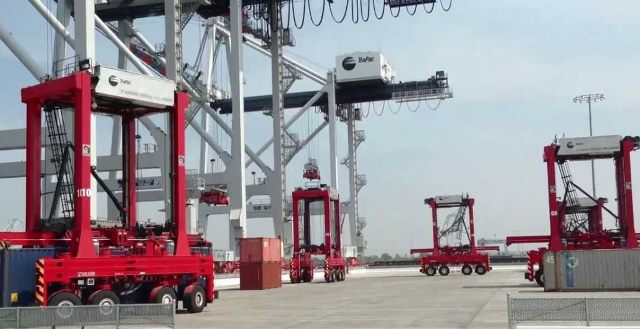
In China, it has also started using autonomous cranes for container transport.

These cranes move the gigantic metal blocks from ships to trucks – also autonomous – in the port of Yangshan.

They have the advantage of moving in a much more controlled and less “difficult” environment than a construction site, but the improvements they achieve in terms of efficiency are also notable.

Now, the companies that develop these autonomous cranes are seeking alliances with crane manufacturers to integrate their technology and renew all these equipment. The goal: build faster and safer.

More on this story

Mining equipment manufacturers

Construction and mining equipment cover a variety of machinery such as hydraulic excavators, wheel loaders, backhoe loaders, etc.

Crane Manufacturers

Crane Manufacturers: Cranes brands, the recognized brands in the world of Liebherr, Caterpillar, Hiab, Palfinger, Terex, Komatsu construction cranes