Category Archives: tower crane

Tower Crane Cab

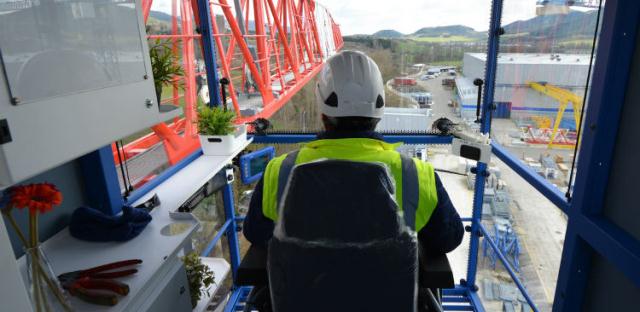
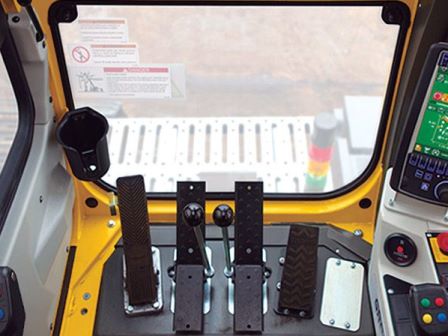
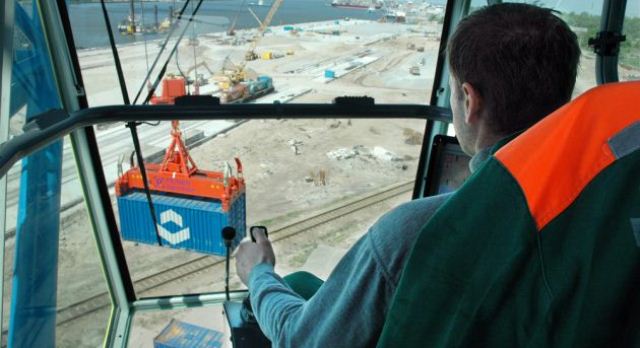
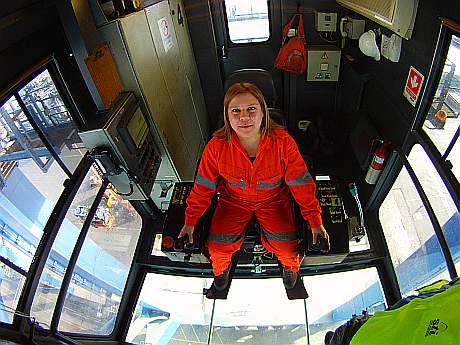
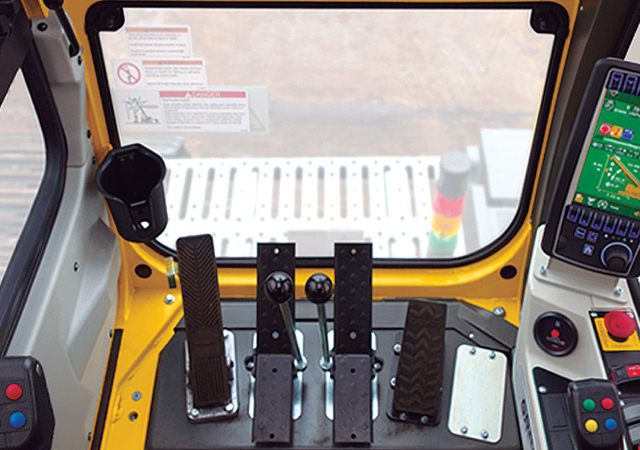
Tower Crane Cab: Cab features include improved seat position and access, a USB port, and optional Bluetooth. A user-friendly multifunction touch screen emits warning lights and sounds, as well as controls the interior temperature, interior, and exterior lighting, and other features. Sunblinds are provided for the side and front windows, and for the roof window on luffing jib cranes.

Tower Crane Cab

Cab cranes

Cranes with a horizontal or tilting boom, with a height under a hook equal to or greater than 35 m above the level of support, must have a cabin secured to the vertical rotating structure of the crane. (Except for cranes manufactured before 1990, which have a fixed cabin inside the structure).

Tower crane cab interior

Operator location:

The cabin must be designed so that the operator can control all the maneuvers from his work station, without having to place himself in a position of risk; The dimensions of this should be adequate to allow comfortable driving and correct visibility from the seat.

The interior height of the cabin must not be less than 1.90 m; the roof smooth and free of protruding elements. The windows must be constructed with glass or equivalent material, security. The front window must be equipped with a windshield wiper.

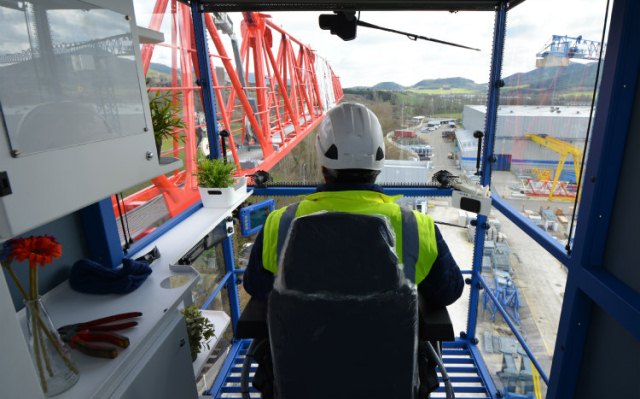
Tower Crane Cab

Cabin features

The cabins must comply with the ventilation requirements established in the current regulations. In the event that the crane is powered by an internal combustion engine, the necessary measures must be taken to prevent the exhaust gases from contaminating the cabin.

The control devices must remain visible in all circumstances. Exceptions are those cranes in which, for security reasons, it is advisable for the operator to be located in another place and the cranes commanded by remote control, from an operation station.

Cranes that are exempt from having a cabin, must have an operation position consisting of a platform, whose minimum dimensions are 1.50 max 1.50 m, also with a guardrail of 1 m minimum height.

The operation position can be located in the cabin, on the platform, or outside the crane, provided that it has good visibility, is easily accessible, is not reached by any mobile part of the crane, nor is there the possibility that it falls. Some elements from higher levels.

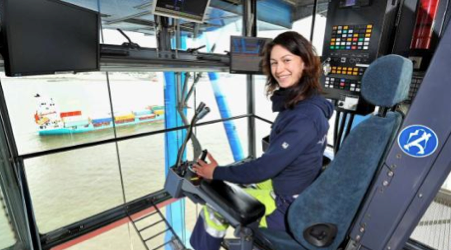
Tower Crane Cab

When the climatic conditions so advise, the cabin must be provided with an effective means of heating, which allows obtaining an interior temperature of comfort. The heating element must not present any risk to the personnel.

Crane driver

Access to the cabin:

The access to the cabin must meet the best possible safety conditions, especially in relation to the risk of falling to the vacuum, during the journey that the operator must travel normally to go up or down to the workplace.

When the accesses are constituted by scales, they must respect the manufacturer’s design. The scales must have broken so that each section has a length that does not exceed 12 m between breaks.

From a minimum height of 2 m above the starting point, the ladders must include safety backups, located at a distance, between arcs, of 0.70 m ± 0.05 m. When the section of the tower or the position of the ladders do not allow the installation of backs, the elements of the structure must grant equivalent protection.

The ladder must have a vertical safety cable that allows the personal protection equipment to be hooked against falls.

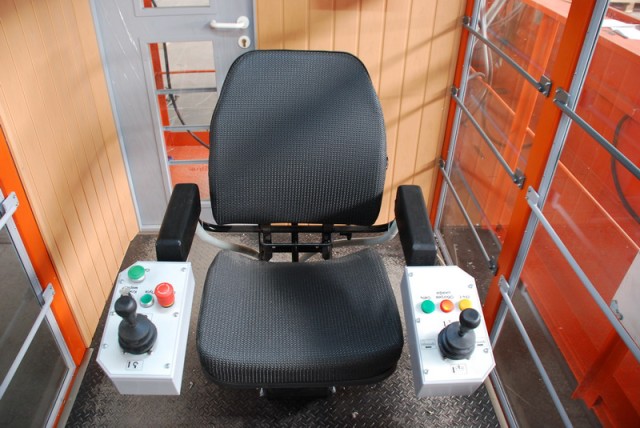
Tower Crane Cab

Tower crane operator

Walkways and service platforms:

The walkways and service platforms that are located more than 2 m above the ground must be metallic and non-slip; they must be equipped with a protective railing composed of the following elements:

  • A normal handrail, located 1 m from the floor
  • An intermediate balustrade 0.45 m from the floor
  • A skirting board of 0.15 m height, or any other device that ensures at least equivalent protection.

In the case of using perforated non-slip plates, diamond or any other material that does not constitute a smooth surface, the perforations or interstices must not allow the passage of a sphere of 20 mm in diameter, and its section cannot be more than 400 mm 2.

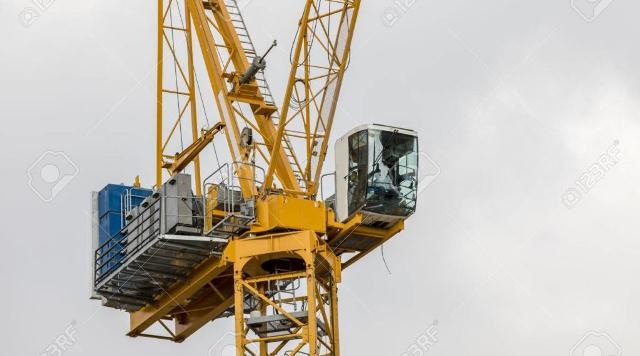
Tower Crane Cab

Indicators and informative signs

Tower cranes must be provided with an informative sign, 1 m wide and at least 1.5 m high, bolted to the most visible side of the central trunk and located at a height between 2 m and 3 m from the floor level of the tower. zero levels. The sign must provide, in Spanish language and legible and indelible characters, the following information:

  • brand and model of tower crane
  • The maximum length of the pen
  • maximum peak load
  • Maximum lifting load with its distance to the central axis of the crane
  • any other information that the manufacturer deems necessary to provide

The pens should have signs indicating the maximum load to be lifted at each specific point; the dimensions should be 0.30 max 050 m and black characters should be used on a white background.

The signs must be located so that they do not exert opposition to the wind that could harm the operation of the boom and must be perfectly visible to the operator and the signalman.

Information in the cabin

In all the cranes of tower cranes, there must be an information plate that indicates, by means of easily visible and indelible characters, the load diagram of the crane, in units of the International System, SI.

It is not allowed to add any type of sign to those specified by the manufacturer or change the original dimension or location of these. Only propaganda signs can be made by covering the faces of the counterweights of the counterweight, as long as said signs do not surpass the surface of those and are firmly secured.

Tower Crane Cab

Crane Brake

Tower cranes must be equipped with brakes or other similar mechanisms, which are capable of stopping and maintaining the arrest in any position and circumstance, especially when there is a cut in the power supply.

Tower Crane Cab

Safety regulations for cranes

Involves people, property and property, that is why it is essential to comply with certain safety regulations related mainly to the automatic safety systems that the crane has, with the correct maintenance of its parts, with the conditions of operation in the workplace and with the staff that works with them.

The most common accidents are caused by imprudent actions or ignorance of the people involved in its assembly, maintenance or operation.

Crane inspection

It is essential to have a program of inspections and preventive maintenance plan very rigid because any accident that occurs can strongly affect the productivity of the works where these cranes are used.

It is recommended that the inspections be carried out periodically by the crane operator or a supervisor, before beginning the workday. These must be carried out exhaustively and oriented to find faults in the most visible elements.

Tower crane safety devices

Safety devices in cranes:

The safety in the handling of a tower crane depends both on its installation and maintenance conditions and on the good use or handling of the same.

The safety mechanisms of a crane must be periodically checked and kept in optimal conditions, this will be the only way to preserve both the life of people and the machine.

The safety mechanisms that a crane must have are of three types:

Tower crane wind speed limit

Effort limiter. Limiter of maximum torque or maximum moment:

The purpose of this mechanism is to limit the high load as a function of the distance and the translation of the carriage as a function of the load; therefore, when activated by excess load, it automatically blocks the lifting and advancing of the carriage in the boom, leaving the opposing movements naturally operative, that is, carriage backward and descents of the hook.

In many tower cranes, it is located at the right angle of the turret; in other models, it is located in the boom tensioner, and in the suspension cable.

The calibration of this limiter is done with the nominal load (depending on the crane), plus 10% or 5% on the tip of the boom and its regulation is given by an electrical functioning microswitch.

It is important to note that this 5% or 10% does not mean that it can lift more load as is normally believed, but it is only to calibrate the crane; this cut off compensates for the dynamic effect of the start of the lifting of a load, which temporarily exceeds the maximum load to hoist, designed and calculated by the manufacturer.

Otherwise, the maximum load that the crane can hoist could not be lifted; that is, it would lift less.

By no means, the operator and/or mechanic of work can alter this calibration.

Tower Crane Cab

Maximum load limiter

The purpose of this safety device is to prevent the maximum load that has been calculated for the tower crane from being exceeded.

It acts directly on the lifting fork, due to the traction exerted by the cable, it limits, as in the previous case, the elevated load as a function of the distance and the translation of the trolley according to the load.

It is almost always located in the turret or in the pen; Its function is the same, it only changes its design

Speed ​​limiter

Your mission is to stop the movement. It generally acts on the pull of the lifting cable and its function is to prevent the crane from lifting a load greater than that determined for a certain lifting speed.

The automatic locking system of the trolley: This mechanism acts on the trolley of loads and its function is to lock it before the eventuality that its traction cable is cut; With this system, any load is prevented from sliding towards the tip or towards the trunk of the crane.

Limitation of translation travel of the crane: This limiter is only applicable to rolling cranes and prevents it from leaving the track due to an operation error or accident. Stops the movement of the crane when it reaches the ends of the road.

Flagging system or weather vane

It acts directly on the brake of the rotary Gearmotor, unblocking it so that the boom is oriented with the wind, when it is out of service, in order to resist the least possible resistance to the wind.

That is, it allows the pen to be oriented to the position of the wind. Nowadays modern cranes are automatically oriented with winds greater than or equal to 72 km/hr.

Automatic speed selection

It is an automatic speed control system that allows the sequential change of speeds, from the lowest to the highest speed, both up and down.

Translational stops: It is a mechanical system that must be located at both ends of the road, and its function is to prevent the crane from leaving it, due to wind or accident.

Deadman system: In the event that the operator suffers an invalidating accident, all movements are stopped immediately because the commands automatically return to zero position.

Warning Limiters

Alarm horn: Indicates the start-up of the crane. It is commanded directly by the operator of the crane, in the respective command, and is very useful to warn personnel about the approximation of the load to the workplace.

It is important to note ad emás, which works automatically with the limiter of torque or maximum moment and with the maximum load limiter, warning the operator when the crane has been disconnected due to overload.

Tower Crane Cab

How much can tower cranes lift?

How much can tower cranes lift?

The maximum load that the crane can lift is 18 metric tons (39,690 pounds), but the crane cannot lift that much weight if the load is positioned at the end of the jib. The closer the load is positioned to the mast, the more weight the crane can lift safely. The 300 tonne-meter rating tells you the relationship.

How much does it cost to rent a tower crane?

The typical fee for installation and disassembly runs around $60,000. This price includes shipping the crane to the site, renting the mobile crane used to assemble the tower crane, the cost of the crew that handles the assembly, etc.

What are tower cranes used for?

It is mainly used for lifting heavy things and transporting them to other places. A crane is a type of machine, generally equipped with a hoist rope, wire ropes or chains, and sheaves, that can be used both to lift and lower materials and to move them horizontally.

How do tower cranes stay balanced?

Basically, a tower crane has a large load on the OTHER SIDE of the crane. It keeps it balanced like a scale. On other tower cranes, they use cables that relay the force of the lifting to other parts of the crane near the ground, again, providing a counter force for the weight of the load it is lifting.

Why do cranes not topple over?

Incorrect ballast WILL cause a crane to fall over. The base of the crane is bolted into the ground and weighted down by giant blocks of concrete. The stiffness of the supporting structure also helps counteract bending caused by unbalanced loads.

Why do cranes fall over?

Because of oversize loads or mishaps during assembly. In general, mobile cranes tend to fall over because of overly heavy loads, while tower cranes usually collapse in the course of being assembled, taken apart, or extended.

What is the heaviest crane lift?

Taisun holds the world record for “heaviest weight lifted by crane”, set in Yantai on April 18, 2008 and set at 20,133 metric tonnes (44,385,667.25 lb) by lifting a barge, ballasted with water.

How much does a crane operator make?

In 2018, the Bureau of Labor Statistics indicated that the average, annual crane operator salary was $55,750. Experienced crane operators that are working on large-scale projects may make as much as $84,250.

More on this story

Tower Crane Installation

Assembly and disassembly of a crane construction tower of buildings and housing, maneuvers, crane operator, transport, maintenance
Tower crane Operator

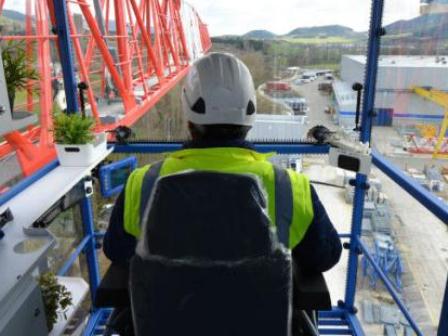
Tower Crane Operator: tower crane operator job description, a day in the Life of a Tower Crane Operator, Crane and Tower Operators.

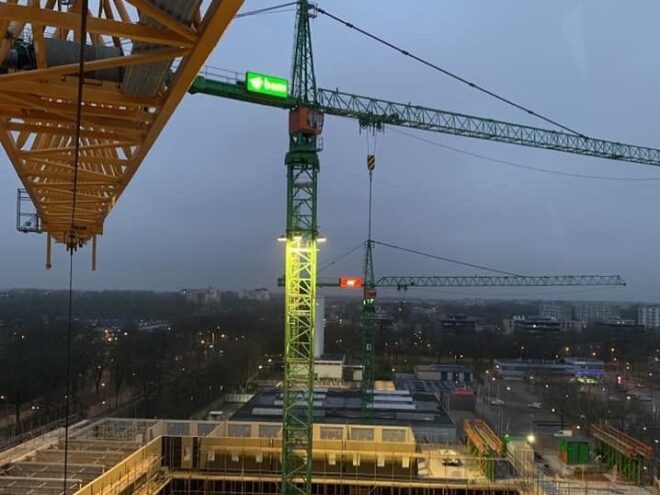
Tower Crane Operator Training

Tower crane operator training: The prevention of risks in the use of the tower crane must be carried out basically in the stages of transfer, assembly, operation, maintenance, disassembly, and storage…

What does Heavy Machinery Operator do?
What do you need to handle a crane?
What is the job of a heavy machine operator?

tower crane operator
Tower Crane Operator Training

Tower crane training

Tower crane operator training – Sky crane operator:

crane operator

A tower crane operator is going to maneuver all those heavy loads by shifting levers and pushing pedals. If you’re a fan of the manual transmission, think of it as (super) advanced driving.

Most construction sites are hotbeds for hazards, even on a good day. If you’re the one hovering hundreds of thousands of pounds over the heads of your friends, you can be sure safety is your only true friend.

In this bustling economy, full-time work is definitely available. In fact, you may even be able to score some nice, long shifts and hefty overtime payments.

Tower crane operator training

Construction crane operator training

Tower Crane Operator Training – Tower crane operator school:

When you’re ready to embark on this new journey, start with the National Commission for the Certification of Crane Operators (NCCCO). They’re going to be your mecca for information and the ones you want to seek out for tower crane certification.

Also, depending on the state you live in, you may be required to attain licensing as well. But, before you wade into NCCCO waters, you’ll need to have your high school diploma or GED at the ready.

Then, it’s time to get certified. While this is voluntary, we all know how your resume is going to stack up against the competition if you have a proud NCCCO stamp of approval on display.

Here’s a look at the NCCCO’s training. To be eligible, you must be 18 years or older. You’ll also be required to pass their physical exams and comply with their policy on substance abuse. ( Tower crane operator )

Next up, there’s a multiple-choice exam containing 55 questions that must be answered within 60 minutes. Finally, there’s a practice exam in which you’ll have to operate an actual tower crane.

All that hard work will earn you a certification that’s good for five full years. And be sure to double-check with the NCCCO because, in some states, this certification will fulfill state licensing requirements.

Tower Crane Installation

Tower Crane Operator Training: Assembly work must be very easy to perform, quickly and with the least number of sequences. The crane must carry all its preassembled main assemblies.

Transfer: The tower crane must be able to be transported in an appropriate number of trucks so that it can carry its components in the proper order for immediate assembly without the need for intermediate storage. ( Tower crane operator training )

Location: The location of the crane must be studied in such a way that it can not interfere with adjacent buildings and high-voltage cables, which also allows the assembly and disassembly operations to be carried out in safety conditions for people, equipment and the environment.

Tower crane operator training

Crane safety

The place of placement and its translation path, when appropriate, must be chosen in order to comply with the following:

There must be a minimum safety space between the different parts of the tower crane and the power line, this must be less than:

MINIMUM DISTANCES:

  • 3 m, when the voltage is less than or equal to 380 Volt 5 0 Hz.
  • 5 m, when the voltage is greater than 380 Volt 50 Hz and less than 13,600 Volt.
  • 7 m, when the voltage is equal to or greater than 13,600 Volt.

It must have a minimum free space of 0.60 m wide by 2.50 m high, to facilitate the movement of the personnel.

More than a crane: In the event that more than one tower crane must be installed, it must also comply that:

  • The minimum distance between the end of the boom of one and the trunk of another should be 2 m.
  • The vertical distance between the lowest element (hook in high position or aerial counterweight) of the highest crane and the highest element of the other tower crane capable of the collision, must be at least 3 m.
  • In the case of rolling cranes, there must be an appropriate system that prevents them from approaching a distance less than any of those indicated above.
Tower crane operator training

Electrical installation

The electrical installations must be designed and executed in accordance with current legal regulations.

Construction tower cranes of the rolling type, whose supply is provided with connections at various points of the route, must be fed with a single line of power supply.

Tower crane datasheet

Construction Tower crane – Technical data sheet: construction Crane Operator Training

The tower cranes mounted must have protective elements, which will be placed in a point near the power line, it is an automatic switch that disconnects the power to the system in case of electrical damage and a manual switch that can remain blocked in disconnection case.

All ducting, laying or electrical installation must be provided with a cover or coating that allows it to resist the action of external agents and especially the wear produced by traction, bending, twisting and friction caused by the use of the crane.

The minimum electrical equipment of a tower crane must include a switch whose sole function is to cut or connect the power supply or a single device that fulfills the two functions.

These devices must be built for industrial current, have the necessary capacity according to the manufacturer’s specifications of the tower crane and be located at an easily accessible point.

Any switch that only secures the electrical separation function must be capable of blocking the connection function when it is in the open or disconnected position.

The crane’s command system must be equipped with a pulse that has immediate and instantaneous action on the general cutting switch, typical of the tower crane.

Tower crane operator

Public network electric power

In the event that the tower crane is powered by domiciliary electric power, it must have omnipolar switches, one that works only in the function of the separation of the electrical source and another that works only in the function of cutting.

The masses, fixed or mobile, must be in solidarity with each other, through a connection and a conductor that ensures sufficient continuity of energy.

This connection is preferably carried out by means of a protective conductor that can be incorporated in the power cables, or be independent.

Tower crane operator

Tower crane electrical load

Tower crane operator training: safety topics

External electrical power: In the case of a tower crane powered by an external electrical source, the masses, and metal components must be connected to the general circuit of the service ground.

The sections of metal rails, of the railway type, must be electrically joined together and connected at their ends to the service ground of the work.

When copper conductors are used, the minimum cross-section of the conductor to the service earth must be 35 mm 2.

The power cables of the tower crane must consist of active conductors and protective conductors; The minimum section of the protective conductor must be determined in accordance with current legal regulations.

General recommendations:

  • Ensure that all structural sections are stored on sleepers.
  • Ensure that the base pins are fully adjusted.
  • Make sure all bolts are tight with their corresponding nuts.
  • When assembling the sections, make sure that they are correctly oriented, for example, the scales must coincide.
  • When adjusting the bolts of the tower, the counterweight of the boom must be aligned on the corner of the tower.
Tower crane operator

Tower crane ballast

The transmission of loads at each level must be done by means of frames calculated and manufactured in accordance with the instructions of the manufacturer of the tower crane.

The number of frames for fixing the braces or braces and the location thereof must correspond to the provisions of the assembly manual. The fixation calculations are the responsibility of the owner of the crane.

Once the crane has been assembled, the professional in charge should check in the presence of the user that all safety systems are working correctly; this must be included in a document signed by both, in which the user must also commit to not modify the regulations of all the mechanisms.

Tower crane safety devices

Safety measures for crane works – Operation of cranes: Tower Crane Operator Training

crane operator
  • Periodic inspections must be made to the tower crane, through a checklist, which contains the critical points of the machinery and thus prevents accidents in the use of it.
  • During its use, the tower cranes must be submitted to a periodic maintenance program, at least once a month, in order to verify the proper functioning of the safety mechanisms, cables, hooks, pulleys, etc.
  • These controls must be carried out in accordance with the instructions contained in the manufacturer’s manuals, must be carried out by qualified personnel and must be recorded on a document signed by the owner and the user, or their representative.
  • Every day, you must ask for the work plan or instruction and the order of the movements to be made with the crane with an estimated work schedule. Example:
    • concrete at 08.00 hrs.
    • movement of iron at 10.00 hrs.
    • unload trucks from 11.00 to 12.30 hrs.

Tower crane safety checklist

Tower crane operator training: Recommendations during maneuvers.

  • In the relays, the outgoing crane operator must indicate his impressions to the entrant about the state of the crane and write it down in a book of incidents that will be kept in the work.
  • The level of the crane in its chassis and its verticality or lead in its panels (trunks) will be visually checked.
  • Permanently check the condition of the straps and slings, and if any anomaly or defect is found, permanently disable them to prevent them from being used again due to error or omission.
  • If the crane has been stopped with the emergency stop button, it should not be started immediately. We must wait for the oscillations caused by it to decrease.
  • Verify if there is any air limitation. In the case of high voltage cables, these should be protected and marked with protective screens or PVC pipes of visible colors at a distance.

Safety signage on cranes

  • Remember that before high voltage cables, you should always work at a distance of 45 m. to avoid electric induction.
  • Plant sectorization of a building under construction. Example: if you have a lot it is divided into modules of 3 X3 and assigned a number (A1, B1, C1, A2, B2, C2, A3, B3, C3); then a task is assigned to each sector
    • A1 slab concrete
    • B2 concrete wall
    • C2 formwork
    • C1 iron
    • A2 slab concrete
    • B1 wall concrete

Safety regulations on cranes

  • The owner or operator of the crane must ensure that in the case of cranes on rails or fixed cranes, a safe distance is maintained when materials are gathered in the vicinity of the crane, said distance shall be at least 0.5 m from any mobile external point of the crane.

Operation radius of a crane

  • In 360º turn controls, due to an obstacle in its path, the pertinent control measures must be taken. (Limit boom sweeping area or change the height of the tower crane or change its location).
  • All cranes have a time device, which prevents the speeds from changing violently, the operator should check that the commands change the speeds smoothly.
  • Always look at the load and the possible obstacles that may be encountered in your journey.

Tower crane operator training

Tower crane operator training: Lifting with cranes – Safety procedures

crane operator
  • Do not carry out maneuvers with load, if you do not have a complete vision; otherwise, request a signalman to the work.
  • Do not lift loads that at a glance exceed the capacity of the crane.
  • Do not lift badly damaged loads and/or badly stowed. Always check that there are no loose materials that may come off and fall when stroking.
  • It is strictly forbidden to use strobe spells; as those who have cable press, etc.
  • It is recommended to always use shock absorbers or protectors, such as softwood or rubber, to protect the strobes and slings from the sharp edges of some load.
  • Never allow the load to go beyond the real reach of the crane pushed by the workers, because in these conditions, and because the movements are stopped, the load limiters do not operate and the maximum moment is increased.
  • Avoid that the loads move with abruptness and pendulum. If a pendulum or an oscillation occurs, do not make movements that could aggravate this phenomenon, stop turning causing the pendulum effect. Do not try to compensate for the dealer’s car. (Tower crane operator)
  • Do not lift loads that are attached to walls or the ground, in case of occurrence, it is very common that, begin to detach.
  • Avoid impacts caused by jerks when lifting and/or lowering loads. You should not break or move the load suddenly.
  • The loads must be deposited stably, before being unhooked. Make sure that the personnel is outside the discharge sector, while this operation is being carried out.
  • Never try to drag or push any load on the ground, or at any level of work.
  • The load before being hoisted must be correctly centered and tied. When lifting or lowering, use appropriate slings: never improvise with cables or non-standard chains.
Tower crane operator

Workplace safety topics

Tower crane operator training: Safety in lifting maneuvers

  • All hoisting equipment must have a warning system to alert whenever loading, moving or descending loads begin.
  • All the loads that present a large area, can get out of control, as a result of the wind. The signs placed on the pen, depending on their size, can cause problems in handling.
  • Never leave a suspended load when placing the crane out of service.
Tower crane operator training

Safety precautions

Tower crane operator training: Safety regulations on cranes.

  • Do not use safety devices or the stop button, to stop the normal movement.
  • Obey any arrest warrant, wherever it comes from because it can be a warning sign of danger.
  • Do not allow unauthorized persons to access the keypad, electrical panel or crane structures. They can be crashed or be the source of accidents.
  • Keep the cabin and access to it neat and clean, without looking good, without grease, without spare parts.

Safety topics

Safety systems in cranes: Tower Crane Operator Training

Tower crane operator
  • Always keep the ladder clean of grease and oil.
  • The operator and also the mechanics, should not use any type of loose clothing. In case you wear long hair, you must take it tied and collected inside the helmet.
  • The falling of objects from the mechanisms or superior structures by means of suitable devices must be prevented, especially when working with boxes or covers that can be opened, hanging mechanisms and in the case of the distributor cart, it is necessary to avoid that the rollers escape from the guide rail or that the fall of the car occurs.
  • Never climb up the supporting structure, except on a crane on the outside; always use the scales with their safety rings.
  • All mobile mechanisms, which may represent danger, must have protective elements.
  • Do not make jokes with the hook or the pen.
  • It is recommended to periodically check that the hooks are not broken or crushed.
Tower Crane Operator Training

Recommendations in public area

Tower crane operator:

  • If the crane is on track, its movement of translation must be with the boom parallel to the track.
  • During the entire operation of the cranes, the hooks must be kept high enough to avoid causing injury to people or damage to nearby structures or equipment.
  • Operators must be in radial (direct) contact when there is a danger of a collision between Tower Cranes.
Tower crane operator

Construction night work safety plan

Recommendations at night time:

Tower crane operator
  • When, for reasons of the work, the crane has to work at night, you must implement good lighting. In this case, it is necessary that two operators remain in work, in order to allow alternate rest of each one of them.
  • When several cranes occupy common areas, the company in charge of operating the crane or its authorized representative must determine the sequence of work in advance and must ensure that the crane operators can communicate their intentions with each other.
  • When a load is lifted by more than one crane at a time, the company in charge of the operation must determine the order of succession of movements in advance, and the work must be done in the presence of a supervisor appointed by the company.
  • At the end of the working day, or when the crane is out of service, the tower crane must be left in vane position, the car must be pushed back to the foot, and the hook lifted to a reasonable minimum height, in addition, the power must be disconnected electrical
Tower crane operator

Risks in tower cranes

Manual of safety in cranes and maneuvers, in summary, the main risks of accidents in the operation of a tower crane are:

Tower crane operator training: Out of standard conditions more frequent

  • Deficient consolidation of the structure of the building.
  • Location in places of little stability.
  • The poor state of safety devices.
  • Lack of connection to the ground.
  • A bad condition of cables, hooks, slings, winds or other accessories.
  • Lack of re-tightening in metal structures.
  • Poor lighting in night shifts.
  • The poor condition and/or absence of an emergency exit staircase.

Most frequent non-standard actions

  • Operate without authorization.
  • Operate without having rigorous training and training.
  • Bad cargo mooring.
  • Operate the crane, before the signalman indicates it.
  • Operate the equipment, when it is found personal in the trajectory of the pen.
  • Maneuver at a higher speed, when it is at the limit of its load capacity.
  • Maneuver without a signalman.
  • Operate in night shifts, without good lighting of the job.
  • Operate in shifts with a signalman without vests or reflective gloves.
  • No seatbelt use, in maintenance, assembly, and disassembly tasks.

What does a crane operator do?

Tower crane operator:

what does a crane operator do?

Crane operators control cranes or draglines to lift, move, position or place machinery, equipment and other large objects at construction or industrial sites, ports, railway yards, surface mines, and other similar locations. They are employed by construction, mining, shipbuilding, railway, and crane rental companies.

What is the maximum wind speed to operate a crane?

The maximum wind speed for safe vacuum lifter use is 18 miles per hour / 29 kilometers per hour / 8 meters per second.

Strong winds could cause the load sway violently or drop, potentially resulting in damage to the surroundings and injuries. Remember that wind speed increases with height, so high-level glazing and construction work in high winds is even more hazardous.

How much does a crane operator make?

In 2018, the Bureau of Labor Statistics indicated that the average, annual crane operator salary was $55,750. Experienced crane operators that are working on large-scale projects may make as much as $84,250.

How much does a tower crane operator make an hour?

A Crane or Tower Operator will usually earn a wage of around 40000 and 60000 based on education and experience. Crane and Tower Operators usually receive an average pay level of Fifty Thousand One Hundred dollars on a yearly basis.

Are Crane Operators in demand?

The overall job outlook for Crane or Tower Operator careers has been negative since 2004. Demand for Crane and Tower Operators is expected to go up, with an expected 1,390 new jobs filled by 2018. This represents an annual increase of 0.44 percent over the next few years.

How long is a crane operator apprenticeship?

Crane operator apprenticeship training programs vary in length depending on the equipment you will be operating. The programs range from one to three years in length and involve on-the-job training, technical training and a final certificate exam.

The most read

More on this story

Tower Crane Hand Signals

Every successful lifting operation is the result of planning and teamwork. The definition of teamwork is “a united effort by all to achieve the ultimate goal”.

Tower Crane safety

Tower Crane Safety: Construction safety meeting topics, tower crane safety training, crane operator training, construction tower crane lighting requirements.

Tower Crane Safety

Tower Crane Safety: Personnel who are in daily contact with a tower crane must have a basic knowledge of construction safety.

This knowledge must be even more finished, in those who work directly with them, that is, the people who will be in charge of the assembly, maintenance and operation of the crane itself.

Tower Crane Safety

Tower crane safety rules

In addition to this, the person who must operate the tower crane must meet a series of minimum requirements, which enable it to meet adequately the demands demanded by a position of such importance.

In addition, the personnel involved in each process must be provided with personal protection elements such as helmet, eyeglasses, safety shoes and gloves, safety harness, and reflective vest for the signalman.

Tower Crane Safety

Crane operator

The crane operator must be a person with a great sense of responsibility and who is perfectly informed of the mechanical and electrical parts of the crane such as safety in construction. The operator should rest periodically since the reflections are very important to properly handle the crane.

Special attention deserves the command posts, which from this perspective must respond to ergonomic designs, with the maximum range of accessories that allow the crane operator a comfortable and effective operation.

Tower Crane Safety

Tower crane operator

The operator whose function is to be the signalman must be identified quickly with a luminous breastplate, to be recognized by the operator of the crane.

The operator has to be guided only by him, through a signal code. The latter does not mean that the rest of the staff does not have the obligation to know the code in order to collaborate when an emergency occurs and in the operation itself.

The collaboration of a properly trained signalman makes the crane operator feel more secure in the maneuvers he must perform, improving work performance.

Tower Crane Safety

Tower crane safety rules

Health and safety plan – Tower crane safety rules:

When initiating a work, all signers must talk with the operator, to clearly know the work program that will be executed, evaluating their participation.

A signaller must be aware of the importance of his work, this forces him to inform himself about the risks of the operation and to handle with clarity, the possible solutions and safety measures recommended by the technique.

For this you must first of all, have a good knowledge of the load to raise, which is based mainly on having information about it, knowing:

Tower Crane Safety

Heavy load transport

The weight of the load is the most important antecedent since the lifting capacity depends technically on the stability and structural resistance of the lifting equipment.

There are several methods to know the weight of a load, the safest is to use a dynamometer, you can also respect the written record that indicates the tare or gross weight of the load or as a practical method of land performs a cubic loading.

Load volume

This antecedent is important for three reasons:

  • The load volume is constituted by the surfaces of their faces. A large lateral surface is very sensitive to wind, which can cause pendulum effects or a lateral deviation of the load.
  • Determines the minimum necessary space of the aerial evolution and support area of ​​the load.
  • In general, in large volume loads, it is difficult to secure the mooring elements to lift the load. The most advisable thing is that the manufacturer or the boss of assembly, order to place hooks of fixation or to draw externally the location of the flanges.

Freight and transport

The shape allows us to locate the centers of gravity of each load.

Type of load: Each load that rises presents risk conditions, due to fragility and/or due to its irregular or weak shape. The signer must have the ability to assess the risk presented by this fragility (glass), or weak packaging, which due to its complex shape when lifted, the load is deformed and deteriorated (cardboard boxes).

Degree of risk of the load: It is the additional intrinsic risk, which presents naturally dangerous loads, such as acids, explosive gases, flammable liquids or explosive charges. In each case, it is mandatory to use a complementary security procedure.

Cranes lifting capacity

This is an operation that the signalman must execute in the most careful way possible because this task is the one that presents the greatest possibility of error, which could have serious consequences for the machine, load, and environment. In this way, it is essential that the signalman has good training in knowledge and mastery of the techniques and use of auxiliary elements.

Tower Crane Safety

Flange type

At each opportunity, the most suitable type of flange must be selected, the doubt is always in deciding to use straps, slings, chains or rigging. This problem indicates that both operators and signalers must clearly know the techniques of cargo lashing, the advantages of each type of flange and auxiliary elements commonly used.

Construction crane security

Construction safety topics – What are the occupational safety risks in construction? 

Construction is an activity that involves exposure to a large number of occupational hazards, some of them serious. 

The singularity that construction represents, in relation to the rest of the activity sectors, is mainly due to the mobility, temporality and provisional nature of many of the processes, which make this activity have a different consideration in the field of risk prevention. professionals. 

There are risks in this sector, which due to their incidence and severity, have certain peculiarities, are derived from safety and that usually trigger most accidents. Let’s mention some of them. 

Construction crane safety rules

Construction safety meeting topics – Construction crane safety rules:

Order and cleaning: In any work activity, to achieve an acceptable degree of safety, It is important to ensure and maintain order and cleanliness. There are numerous accidents caused by bumps and falls as a result of a messy or dirty environment, slippery floors, materials placed out of place and accumulation of surplus or unusable material. 

Falls of different levels: The operator of the construction sector suffers accidents due to falls at different levels, mainly in the performance of work on roofs and roofs, exterior or interior hollows and scaffolding. 

Entrapment by or between objects: It is that situation that occurs when a person or part of his body is hooked or imprisoned by the mechanism of the machines or between objects, parts or materials. 

Entrapment by machine overturning: It is the situation that occurs when an operator or part of his body is imprisoned against the parts of machines or vehicles that, due to unsafe conditions, have lost their stability. 

Tower crane risk assessment

Fire Risk: Due to the peculiarity of the construction sector, regarding its state of continuous change and development, it is essential to combat the risk of fire to maintain order and cleanliness, in the different work areas and in the rest of the work. 

Explosion Risk: Abrupt release of a large amount of energy that produces a violent and rapid increase in pressure, with a displacement of heat, light, and gases, and may have its origin in different forms of transformation. 

Electrical Risk: The construction sector introduces some peculiarities in these facilities that make electrical installations appear as special singularity facilities:

  • These are temporary installations. 
  • They are to a greater or lesser extent subjected to weather conditions. 
  • They are composed of generally reusable material. 
  • Much of the installation is movable. 
  • The level of awareness of the user is lower than in other sectors.

What is the maximum wind speed to operate a crane?
Maximum wind speed: mini cranes. The maximum wind speed for safe compact crane use is 22 miles per hour/ 36 kilometers per hour / 10 meters per second.

crane operator

Construction site safety topics

Every day, at least one construction worker is injured on the job, somewhere in the world. It is a dangerous profession, but not so dangerous that everyone should wonder if any part of it is safe.

There are plenty of guidelines and regulations that need to be followed on construction sites, and almost all of them pertain to the safety of the people who work there.

  • Use Caution When Climbing On and Off Equipment
  • Stay Away from Operating Machinery
  • Use Caution Around Fall Hazards
  • Use the Proper Ladder Height
  • Keep an Updated First Aid Kit
  • Never Use Damaged Equipment
  • Never Unplug a Tool by the Cord
  • Be Aware of Surroundings at All Times

Tower Crane Safety

What wind speed Do cranes stop working?

wind speeds in UK, involving tower crane suppliers, major contractors, and the Health and Safety Executive, the industry recommended maximum wind speed at which tower cranes operating in the UK must be taken out of service is 38 mph (16.5 m/s, 60 kph).

What is the maximum wind speed for working at height?

There is a ‘rule of thumb’ that in the tower climbing industry it is recommended that climbers do not work at wind speeds greater than 20 knots (23 mph) at the working height.

How long is a crane operator apprenticeship?

Crane operator apprenticeship training programs vary in length depending on the equipment you will be operating. The programs range from one to three years in length and involve on-the-job training, technical training and a final certificate exam.

Should I become a crane operator?

Most crane operators get their experience through on-the-job training or apprenticeships. Apprenticeship candidates generally must be 18 years or older, have a school diploma or equivalent and be in fit physical condition.

How long does it take to become a crane operator?

No, of course, there are some prerequisites you need to attain to be a crane operator. The initial training is your initial step. You still have to go through rigorous apprenticeship training that usually lasts about 1 to 4 years, though you will be paid for doing the apprenticeship training.

How much does it cost to get Crane certified?

The tuition also varies depending on the comprehensiveness of the training course. But to give you a rough estimate of crane training prices, many schools offer complete courses for the cost ranging from $1,500 to $2500, depending on the type of crane you want to get certified in.

What Licence do I need to drive a crane?

To drive any kind of crane on the road the operator will need a drivers license. The type of mobile crane you can drive on the road is dictated by its weight. To drive a mobile crane weighing between 3.5 and 7.5 tonnes a Category C1 Driving Licence is required and a Category C Licence if the crane is over 7.5 tonnes.

The most read

More on this story

Types of Tower Cranes

Types of Tower Cranes: mobile, boom, features, technical specifications, technical sheet, how to install, fixed, hydraulic. Types of construction cranes

Tower crane Operator

Tower Crane Operator: tower crane operator job description, a day in the Life of a Tower Crane Operator, Crane and Tower Operators.

Tower Crane Rental

Tower Crane Rental: The economic benefits obtained at the end of a certain project are directly related to the planning and programming of costs that are made from the beginning include the rental of cranes and construction machinery.

These construction teams will ultimately determine whether there will be financial success or failure on a construction project.

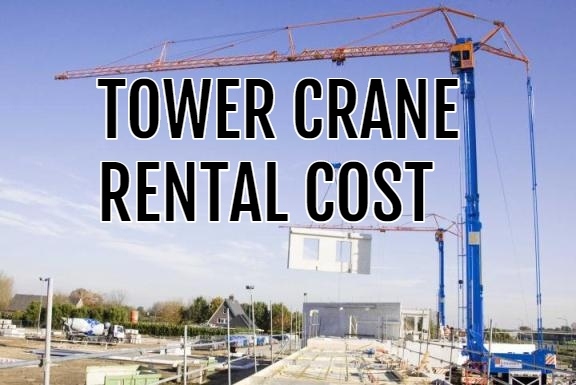
Tower Crane Rental cost

Tower crane rental cost

The global tower crane rental market has witnessed an upward surge in the past few years. This is attributed to the lesser costs associated with renting such equipment when compared with purchasing new equipment.

The overall purchasing cost of tower cranes is very high. This cost increases further owing to the maintenance cost of the equipment. Such costs cannot be termed as affordable for small and medium enterprises.

Tower crane rental companies

These enterprises can rent tower cranes easily according to their budget and requirement, which reduces the overall cost of the construction project. Moreover, this also helps them save the long-term maintenance costs of the equipment. This is the reason, why most enterprises are inclined towards renting the equipment instead of purchasing them.

Moreover, governments across the globe are focusing on developing their infrastructure and expanding the real estate sector. Additionally, the increasing investments in the construction industries along with the growing remodeling and renovation projects, across the globe, resulting in the growth in the construction of high-rise building projects.

This has led to an increased demand for tower crane rental on a global scale.

Construction crane rental

One of the main points to consider in planning is the rental of cranes and the choice of machinery to use.

Specifically, when we talk about a project at a high altitude, where an important point is to adequately solve the lifting needs, we must think carefully about the machine that will best respond to the requirements.

The machines that are considered in this case are the tower cranes, of which there is a wide variety in the market, the reason why the different existing alternatives must be carefully studied.

Tower Crane Rental

Tower crane cost per day

How much does the rent cost per day?

If the final decision of the project management team is to use a tower crane, it is also important to bear in mind that the rental of tower cranes has the following advantages:

  • Tower cranes have a distinct advantage with respect to platform lifts or crane trucks because the boom or jib rises over the construction site.
  • The boom of the crane can put its weight in any part of its operating radius, without interfering with the structure on which it is balanced.
  • In addition, the operator can be on the crane or remotely controlled using instrumentation located in the structure of the building, while enjoying an excellent view of the cargo and its surroundings at all times.

It is important to bear in mind that there are many types of tower cranes, which is why it is essential that the people involved in the management of the project handle accurate and accurate information on the different possibilities.

Tower crane cost per day

Tower crane specification

The best choice should undoubtedly be among those that result in a lower cost but that covers the maximum usable area since the price of renting tower cranes is related to its size.

It is also important to evaluate the number of tower cranes, which will be needed.

To know if more than one tower crane is necessary, the average lifting cycle must be determined, but also if the work area is quite extensive it may be necessary to have one or more tower cranes in the work.

Although the latter can also be solved by adding a rail to the crane that allows its movement, thus covering a larger area.

The programming of the work must ensure that while the crane is used in a certain area, other jobs are not interrupted.

In addition, one should think about the reprogramming of those activities, where the tower crane must be used during prolonged periods during the day, by night shifts.

Tower crane cost per day

How to calculate tower crane rental rates?

Tower crane installation

The factors that will ultimately determine the choice, are the lifting capacity, the reach of arrival, the height and location of the tower crane.

The tower crane can adopt different locations, among which is:

Inside a building

If the crane is to be located inside the building, temporary holes must be provided through the slab system, unless there is an elevator box located in the center, a scale box, or other opening large enough to accommodate the tower (with space). to allow oscillation.

How to calculate tower crane rental rates?

Tower crane location

The structural engineer of the project must evaluate and approve the location of these holes.

Preferably, the holes should be made should only be made through slabs, not beams or pillars, and will probably require additional reinforcement or other structural modifications.

Unless adjacent structures make it difficult for the crane to swing freely, it should initially be erected high enough to clear the first floors, then climb the building as it rises.

The climbing is carried out by lengthening the tower or lifting the tower from its foundation and holding it on the completed floors.
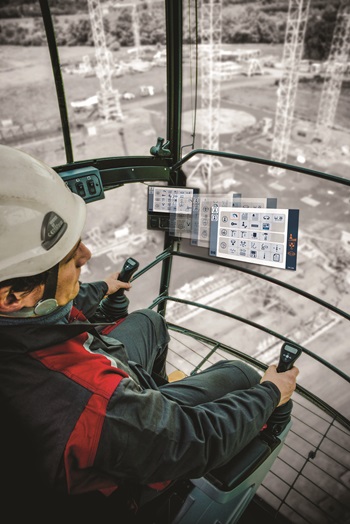
The last method requires additional reinforcement of the structural system by several floors (this must be consulted with the structural engineer) but allows the floors that the tower crane has passed to be finished.

The size of the foundation must be minimal, depending on how high the crane is erected in its initial position. As the crane is lifted it can be attached to the building, to prevent its overturning.

Tower crane foundation

Care must be taken not to interfere with the foundations of the building. If this happens, the foundation of the crane should be designed by a structural civil engineer, preferably one with experience in tower cranes.

If the foundation of the crane requires piles, the design will be completed well in advance so that these piles can be installed while the person carrying out the work is still on site.

A crane attached to the building requires, while lifting, foundation design for its weight and its highest final position as well as for its initial period when it is positioned free and subject to overturning.

In all cases, the foundation will be concreted with welded anchors to the first section of the trunk of the tower to ensure that it is completely vertical.

In addition, protection should be provided to the base of the crane tower to prevent any chance of something hitting them.

Outside the building

If the tower crane is to be located outside the building, it must be close enough, so that its structure is tied to the construction every two or three floors.

Technical specifications: The crane can be erected high enough to clear the first floors and then climb the building as it rises.
Mooring with the building prevents the use of self-deflecting wall moldings or flying deck moldings in the mooring positions, as well as delaying the final closure of the area immediately in front of the crane tower until the crane is removed.
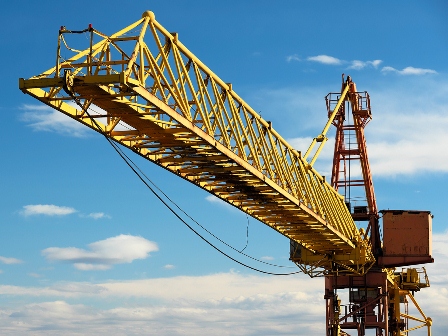
Contractors and engineers should exercise care in selecting the location to minimize the amount of work very close that could be delayed.

The position of the crane outside the building should avoid disturbing the existence of underground elements unless the plans say that they must be relocated.

The blueprints of the project must be studied for the projected worksite, such as public utility lines, and swimming pools to avoid a situation in which the foundation must be removed after the dismantling of the crane.

Foundation Crane Tower: The foundation of the tower crane in these cases is generally large (2-3 m2 and 1.7 m deep), requiring a design for its lifting and additional installation of larger anchors in the concrete.

Completely outside the building

This requires a crane whose boom length is greater than other options. Foundations must be designed for maximum final solicitation even when initially erected at a minimum height, the foundation must be equipped with escalation links.

The positioning should minimize or eliminate the possibility of blocking the wheel slab moldings.

Cranes on rails

A tower crane on rails allows covering a larger area. The crane must rest on a special car, wide enough and with a counterweight to prevent a rollover, and be equipped with bogies and motors to move.

Foundation: The placement of the rails must be based on concrete or compact gravel designed by a structural engineer and that reflects the ability to support the ground.

The rails can be curved according to the recommendation of the crane manufacturer.

A crane mounted in this way can use electricity from a variety of sources via cable, or it can supply its own power with a generator mounted on the rail.

Recommendations: The first installation of the crane at its maximum height without the use of winds, can save time in the long run, although initially, it positions its operator away from work.

Since each climbing takes several hours, this work can prevent a sequence of the floor by floor with its realization.

crane on rail

Night construction work

Performing this operation during the night shift, where local regulations and working conditions permit, can take the crane to the necessary height without interfering with daily activities.

Where two or more tower cranes are used, they can be positioned so that their booms can swing over a common area.

These arrangements require great care so that the cranes below can swing 360 degrees without hitting each other.

The length of the load cable for the crane must be adapted to reach from its maximum height to the lowest point, in which it will receive loads, in addition to the number of wraps needed in the drum.

As part of the decision, when using a tower crane, a plan is needed for the lifting of the crane, for its dismantling, and for its removal.

The access of lifting equipment must be evaluated and chosen carefully.

It is often necessary to reinforce the pavement of the street, secure the excavations to support the lifting equipment, and also obtain special permits.

Tower Crane Rental

Tower crane brand

The tower cranes with which we work are mainly:

  • Linden- Comansa
  • JASO
  • Liebherr
  • Potain
  • BPR Cadillon
  • Richier

They usually operate by entering into a lease agreement, which stipulates the general conditions of the process between the parties.

These conditions are fundamentally oriented to define the way in which collection will be made for the use of equipment, almost always establishing a basic lease.

That corresponds to a monthly charge considering the use of the equipment for a certain number of hours (usually 200 monthly hours).

It also defines what corresponds to the hourly rates: for the equipment, the rate results from dividing the basic monthly rent by the agreed number of hours.

Now for the operator, this rate corresponds to the value resulting from dividing the operator’s basic monthly rate by the agreed number of hours, in both cases the hourly rate is wound by hours.

If the equipment is used for a longer time than the agreed hours, an additional charge is made, corresponding to the value resulting from multiplying the number of hours in excess by the hourly rate.

Similarly, if the operator is used for a longer time than agreed, an additional charge will be made, which will be determined by multiplying the number of hours in excess by the operator’s hourly rate, recharging it by 50%.

Other conditions refer to charges that are made for operations such as assembly, disassembly, placement of bracings, in extraordinary working hours, here a surcharge is generally made of 50 % on the normal rate.

Tower crane hire prices

Customer responsibility: It also defines what will be the client’s responsibility and cost, such as:

  • Fabrication of bracing struts
  • Use of auxiliary support equipment for loading
  • Download, assembly, disassembly or other operation.
  • Protection of electric cables.
  • Supply and installation of rails for mobile cranes.
  • Have the permits and insurance of work required during the lease period and according to the requirements of the Works Directorate of the corresponding municipality.
  • Construction of the support foundations required for the assembly of the equipment.

It also establishes how the maintenance will be carried out by the company that is providing the leasing service, duly agreeing to the dates and times of the maintenance.

Construction Industry

Today tower cranes are a powerful tool in the construction industry, in medium and high-rise construction, as well as in any other activity where they can be used.

Thanks to them it is possible to transport all types of loads within a work, in a fast, safe and simple way.

There are several types of tower cranes. Each variety was developed to respond efficiently to the different working conditions that are presented in the works.

The classification that is made is based mainly on differences in terms of the form of support, a form of assembly, and the tower crane boom length.

Accident prevention

The high cost, risks of serious accidents, and high impact on the productivity of a work where a tower crane is used; they force to strictly comply with the safety measures that are recommended in the stages of the transfer of the parts, assembly, operation, and disassembly of the tower crane.

Special care must be taken in carrying out the maintenance of the crane; an inspection program and a very rigid preventive maintenance plan must be implemented.

This will allow the tower crane to remain in perfect conditions of operation and safety.

Tower crane hire prices

Crane operator

The personnel in contact with a tower crane must have basic knowledge about it, in terms of operation, operation and safety measures to be adopted in each case.

People who work directly with the tower crane, both in the installation, maintenance, and operation, must be specially qualified people.

The operator of a tower crane must meet certain physical and psychological requirements that enable it to perform a correct job.

It is also important to mention the work of the signalman, who often also guides the operator in certain conditions of poor vision.

It must carry out the strobing or slinging operations of the loads to be hoisted, which is why it must have adequate preparation for the importance of the handling of the loads.

Tower crane rental rates

Evolution is a process to which the tower cranes are not oblivious. Every day we work on finding the best solution for each new need, either by creating new models or improving existing ones.

Using new materials or incorporating new components, applying for all this, the highest technology available in the market.

The process of selecting the type of tower crane, which will be used in a specific project, must be carried out in a responsible manner by a team that manages adequate information on the different possibilities.

The final decision must correspond to that tower crane, which best suits the needs in terms of lifting capacity, reach, height, and location of the work, and that above all represents a good investment.

How much does it cost to rent a tower crane?

How much does it cost to rent a tower crane?

The typical fee for installation and disassembly runs around $60,000. This price includes shipping the crane to the site, renting the mobile crane used to assemble the tower crane, the cost of the crew that handles the assembly, etc.

How much does a crane operator make?

In 2018, the Bureau of Labor Statistics indicated that the average, annual crane operator salary was $55,750. Experienced crane operators that are working on large-scale projects may make as much as $84,250.

What skills do you need to be a crane operator?

Most operators learn primarily through on-the-job training rather than formal education. Other important skills for heavy machinery operators include alertness, hand-eye coordination, attention to detail, and the ability to follow instructions closely.

How do you become a crane operator in NYC?

To apply for a New York Crane Operators certification, applicants must have at least three years of experience within the five years prior to submitting the application under the supervision of a licensed Crane Operator.

How do you become a certified crane operator?

Candidates for tower crane operator certification must pass both a written and a practical exam; after which they will be certified for a five-year period. All exams must be completed within 12 months. The Tower Crane written exam consists of a single examination in Tower Crane operation.

What is the salary of a crane operator?

The average pay for a Crane Operator is $24.50 per hour.

More on this story

Self Erecting Crane Rental

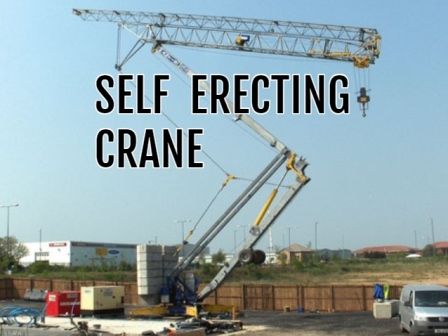
Self-erecting tower cranes have long been commonplace in Europe. Their versatility and reliability have made them a mainstay on the European Jobsite.

How much does a Tower Crane cost to Rent?

Is tower crane rental profitable?

The most read

How much do Tower Cranes Cost?

The cost of a tower crane can vary widely depending on several factors, including the type, size, and brand of the crane.

Building Construction Crane

Building Construction Crane: The world of construction cranes is very wide, and knowing what to do at all times, like a tower crane, is difficult. Find the tower crane and the amount that suits a construction project.

We are perplexed by the complexity of the theme and the different options, characteristics, classifications or types of machines used in the works, a theme in which not only tower cranes can be used.

This time we will cover all the instances of the installation and maneuvers of a tower crane.

Building Construction Crane

How are tower cranes erected

How to install a tower crane?

When we plan the work economically, (one of the first tasks that we must carry out), we must already know what is the exact number of tower cranes that we are going to use, and for how long and for this reason its location is important to know.

On the contrary, if we make mistakes in these decisions, we suffer for almost all the work and will suffer all participants in it that require this means of elevation.

To do this, we must take into account a number of factors, we will start by considering that we can place the crane where we are interested, and gradually we will adopt that location.

Building Construction Crane

They are detailed below in the form of Steps:

Tower crane assembly

Assembly of tower crane:

If we know our term (contractual term), we also know the execution term that we have for the realization of the structure, the experience helps us enormously, without the need to elaborate a Planning of Times, although this is always desirable (essential if you do not have a lot of experience) and in the majority of the constructors the Work Manager will be required.

Let’s say for example that I have 20,000 m² of the floor, they are calculations estimated in broad strokes, it is not necessary to be thorough at this time, it will be time to be a retailer … Let’s suppose that we have to build a building in 18 months (a usual term now). From the outset we already know that the structure (not the foundation) will take us from 4 to 6 months (this data is based on experience), we also know that we will overlap with the masonry from 2 to 3 months …

Climbing Tower crane

Equally the experience dictates the other necessary data: the m² of structure that can develop a tower crane, which is approximately 1,500 m² to 2,400 m², we should not be optimistic thinking that we will develop more, nor take the work in a relaxed way thinking that we will recover in other phases … The structure, being a long critical path, is very relevant when taking into account these data.

Construction crane

In the first calculation, I will take into account the most conservative data:

20,000 m² / (1,500 m² / Ud. Tower crane x 6 months term to execute the structure)> 2. If we are able to execute the critical path structure with the resulting number of cranes, we will be able therefore to execute the rest of the work, with this number of tower cranes.

And in any case, always in specific moments of greater accumulation of production of different units of work, I will be able to have other auxiliary means of support, which I will also have foreseen. The first data we get is greater than 2, if we do the calculations with 4 months, pressing the accelerator, we get something more than 3 units.

Therefore, since we will never give up trying to improve ourselves, we choose 3. If you’re not convinced, try comparing the cost of this extra crane (from 2 to 3 pcs) against the total indirect costs of two months of work execution (more rapid calculations), the IC of work represents 18% to 22% of the direct cost, approximately, of it) … Make the calculations. Of course, crane rental prices have dropped considerably, but even with the highest prices, the economic data speaks for itself …

Of course, in a work of smaller dimensions, such as a single-family home, does not apply … 3 is the number of tower cranes that we should consider at first in our example.

Building Construction Crane

Work area protection

Location: Since the second fact, that will determine the final number of tower cranes to install, will be the shape of the building to be built.

To do this and before proceeding to its location, in all cases we will try to fulfill the following steps, we have a variable in our favor, the length of the pen, if expanding it, we can not cover the whole work, we will make other decisions, of which We will talk later. Now let’s see what are the premises that each of our cranes must meet.

Download area

Each crane must access the truck unloading area corresponding to each crane, without needing the support of another crane, or other means of lifting. We must have clear access roads to our work, circulation areas, storage areas, etc … It is necessary to make some points here:

No tower crane should maneuver over pedestrians or other buildings. This usually does not affect its location, it turns out to be very strict in the instructions for the grower and crane monitoring.

Building Construction Crane: We will not let neighboring buildings fly over our work with their cranes.

The lower the boom they have better, the cheaper the rent, the shorter the route and the sweeping of the crane (it favors the security, the follow-up of the gruísta, the rapidity of unloading), the greater the load it will be able to bear in the tip to equal conditions …

Building Construction Crane

Under construction building

In a building, the installation of the crane will affect certain units of work, which can not be carried out and/or finished off by the existence of said crane and until the disassembly thereof. Therefore, we must install them by damaging areas whose units are the latest (in the beginning, and with the shortest execution time) in our Time Planning, such as, for example, urbanization areas, taking care not to intercept services, pipes, etc…

In many buildings, these urbanization areas are on garages (one, two or three floors, or even more …), in this case, the recommendation is to continue plying them there, but we will leave in the planned structure (in the perimeter of that hollow), in an easy way, the execution of that stretch of structure, when we have disassembled the crane, with armors waiting, and other systems such as metal profiles can be left waiting, etc …

That we provide above all the shoring, the formwork without affecting lower holes in the same lead, because in this way we can streamline and even run all the holes at once, without having to wait for a succession of stripping, which is what most time of execution will take us in the replacement of those sections of holes, we will devise a way of being able to form them all at once, in the event that we have affected more than one plant, yes, WITHOUT AGAINST SCAFFOLDS that are prohibited.

In the case of affecting buried garages, it is better that it be in areas of circulation that are not inside technical rooms, because of the work units that are going to be affected.

Building Construction Crane

Stages of construction

The important thing is to locate the tower crane outside of buildings in height, for the aforementioned, if we do not have urbanization, we will look for the light yard, setbacks areas, etc …

Tow cranes should NOT be installed on stairs of buildings in height (although we have more than one): the term that would take its execution, to cut access roads to the work, the incidence of the crane in the roof waterproofing, and from this in the entrance of water, the damages of said filtrations on all the floors of the building, in the areas adjacent to the staircase, we can imagine them and for that reason it is necessary to avoid it.

If there are stairs from the urbanization only to the garage not coincident with building in height, things change, and it is a possible location to analyze.

I do not recommend the installation of the crane on the elevator shaft, since the execution of the masonry of the same, we would only control the wall of the interior of the building, not the hole, leaving it full of burrs; the auxiliary means that we will need to cast this hole, the finishing touches on each floor of the received door, large burrs can vary the dimensions of the shaft, the damages produced by the crane when disassembling it, the possible leaks as in the case of the staircase , we can not control the work inside the hole when disassembling the sections of the crane, nor can we observe the state of welds and other components of the crane during execution.

Building Construction Crane

Isolated footing

Revision of the impact of the crane shoe on the projected foundation. It will be very difficult to avoid 100% and will depend on the characteristics of each Project. We will always try to avoid matching the tower crane shoe with another shoe of the foundation, but if it is impossible, we will try to make this incidence, on the smallest number of possible shoes.

Building Construction Crane… Of course, it will never prevent the construction of pillars and/or walls (nor their demolding) …

When we have coincidence, we will draw a shoe that absorbs one of the cranes and the one of the complete foundation, or that absorbs several if the incidence is on several. Imagine how important this point is because the crane’s shoe can end up being large, being also great singing, and being armed normally enough the cost skyrockets …

The crane’s shoe will be subjected to the structural calculation of course. Any engineering of the crane rental company will provide you with its dimensions and its assembly, but they must always be reviewed and approved by the Facultative Management beforehand.

Building Construction Crane: The shoe of the crane can be calculated for eccentric loads, that is, we can leave this step perfectly defined, and need to move the mast of the crane, not the shoe of the same, to meet the next step. This shoe will be calculated eccentric.

Structural calculations

When we have a proposal well analyzed, we will always present it, in all cases, to the Facultative Management so that they authorize:

  • the location (with and without incidents)
  • calculations of that crane shoe, which will have taken into account the incidence with other shoes.

Logically, Project Management should review this incidence and structural calculations for the importance they have, so … the sooner you start with all these efforts much better, if we do not want to delay the work.

Although our building construction crane shoe does not coincide with another foundation shoe, its proximity to the unloading areas of other shoes, we must also review it in terms of structural calculations, refers …

Beware of the incidence of the tower crane footing on slopes, retaining walls, piles, and other screens, it must be taken into account in the calculation of said shoe and said screen, that is, before the start of the work

We will make the necessary location corrections to meet this step.

Construction site crane

Once the location has been decided, we will check the incidence of the tower crane’s hollow with the structure, the time has come to be more detailed, we will have the data of the dimensions of the crane, including its mast; we will avoid incidents with girders, beams, and pillars that affect areas of the building …

… by this means that if we are interfering with a pillar of an urbanization pergola, it will have a minor consideration that we have explained above. (Building Construction Crane)

In no case, we can affect relevant elements of the structure.

Logically beams or some section of small slab (where your way of working is not changed) will be affected, and we will have foreseen the way to build this section, which will be quick and effective, once we remove the crane, and always from very concrete of the work, that is, urbanizations, garage …

We will also make sure that the areas adjacent to a said tower crane, or rather, the hollow produced by the tower crane, have their complete and adequate supporting structure …

Of course, and as I mentioned before, all this previously authorized by the Project Management of the work. We will make the necessary location corrections to meet this step.

Building Construction Crane

Minimum tolerances

We must also take into account the separation of the crane (from its mast) to slabs and facades.

The placement of the auxiliary means that we use in their construction, on the width of continuous formwork, on the bending zone of the beams, scaffolding, façade separation, safety separation, and the movement of the crane, which suffers greater displacements the greater its height…

Reading construction plans

We will make the necessary location corrections to meet this step.

It is time to observe the sweep of the cranes superimposing them on a plane … are there dead spaces of work where none of them is accessed ?, we must play with the possible combinations that give us the different boom lengths (taking into account that the last 1, 5 meters or 2 meters from the end of the boom, the car does not arrive, therefore, the load either), knowing that they go in sections of 5 in 5 m. This is a trial job, to try different possibilities.

Building construction

It is time to take into account the horizontal and vertical distances between cranes and from these to other buildings or emerging elements.

Finally, we must analyze not the height of existing buildings, but these plus the antenna and the lightning rod of both our building and buildings under sweep of our crane, if we do not meet this height (to take into account the up to 6 meters of slings or chains hanging from our crane), then we must separate horizontally the distance dictated by the regulations.

Calculation review: if after having made a great effort and having analyzed the possible scenarios, you still do not find solutions …, the initially stipulated number may have to be revised and the whole process restarted. But before that, let’s see other possibilities that perhaps interest us more:

Building Construction Crane

Coverage area

If the dead point (without crane sweep) is minimal, a corner, analyze which elevations, discharges, and work units are those that will be affected, because if it is a corner, we will have affected the concrete … (of course, in this type of works we pump, so this problem no longer exists …

Building Construction Crane: Be careful with the height of the building, if it is very high, the crane truck will not reach more than 26 m vertically, if there is also a horizontal section to be saved, the reach will be smaller,

… and the façade would be affected, in this case, and if it is only that, it would leave 3 cranes, and would make the forecast of another auxiliary means, such as truck crane, for specific cases, with short or very intermittent execution times … is a matter of analyzing costs and see what interests us more. Equal costs, we are interested in having the work as organized as possible, avoiding surprises (such as the delay in the service of a truck crane, etc …)

Building Construction Crane Cost

Cost analysis in construction.

If the area without sweeping is wider or affects many months of execution, it would be desirable to resort to another crane, or provide another means that covers this area. analyze costs.

We can raise the issue with another crane, from the first step. In our case 4, but yes, he observes that although with one more crane, if they do not all arrive to directly unload trucks, they do not develop more work than 3.

The explanation is simple, if a crane is subject to the support of another or another auxiliary means provided to cover another different area, we can mount a collapse in the area of ​​the first crane, since you will have to wait for the second time’s downtime or leave paralyzed its zone, although at first, we think that with an hour a day or two is enough and we will not cause too much disruption to the work.

If this is well carried and at full capacity, the disorder will be fat, and it will never be a good time … Bear in mind that in the phases of greatest use of the crane, each crane can get to download 2 to 4 trucks (or trailers) ), depending on the size of the work … and this takes time …

Building permit

We must bear in mind that in many cases cranes are mounted only for a specific phase of the work, with the expectation of disassembling them before normal … for example, if we arrive at an urbanization with several buildings under construction near our work, and We are the last builders, it is more than likely that we have many problems to place our cranes as they affect those of the neighboring existing builders.

To do this: o If there is a collaboration between them, it is possible to reduce the boom of the crane of the neighboring builder, or even height, provided that the second run at all costs and is outside normal production hours.

Analyze costs of the whole process, because it is clear that who arrived first … will not be running expenses.

Or, for needs it is decided to place cranes lower than normal (they will come to collide with our own building) that develop most of the work in structure, and when it is necessary to continue building up to the top they are dismantled, leaving these areas pending of others means (of higher cost) that we already have in the cost of our work. Analyze costs and also, note the importance of the development of the work, if it is a single volume building is clear …, but if it is a work with several blocks, it is essential to know the order of the work.

Surely you are thinking that you have to know many things and have them clear before starting a job if we have the experience, the lack of time we usually have is a problem, but if we also lack experience it is almost impossible …

Number of cranes

This task, to locate the cranes and decide their proper number, is a job that requires several scores, some time and creativity, so cheer up…What I assure you is that the time spent, as well as the headaches, will be rewarded throughout the work … The opposite will also be seen and will be suffered throughout the work .. All the participants in it, or most of them will also notice in their day to day this work of previous planning … The economy of the work will be directly affected … There are many reasons why these details should be taken care of, and of course, also your quality as a professional it will be splattered, both for good and for bad.

Permit to build

Needless to say, we must comply with and observe all current regulations. We must observe compliance with the regulations regarding the assembly, use, and disassembly of the tower crane.

Must be Legalized by the Ministry of Industry and the corresponding Town Hall. And of course comply with all the Health and Safety regulations in the work, special communication must be had with the operator of the tower crane, and therefore, its follow-up must also be constant.

Conclusions: And finally, at the time of rethinking, please, extreme caution, checks in accuracy and number, using a surveyor, if necessary, and even when it intervenes, my recommendation is to make the appropriate verification of stakeout.

Our efforts are useless if mistakes are made in the work, they occur, but the reviews detect and resolve them in time.

Building Construction Crane

How much does a tower crane operator make a year?

A Crane or Tower Operator will usually earn a wage of around 40000 and 60000 based on education and experience. Crane and Tower Operators usually receive an average pay level of Fifty Thousand One Hundred dollars on a yearly basis.

What is tower crane operator?

Tower crane operators are specialists in the construction industry who operate a specific piece of heavy machinery that lifts, transports and moves construction equipment and materials all over their construction site.

Our Crane Operators in demand?

The overall job outlook for Crane or Tower Operator careers has been negative since 2004. Demand for Crane and Tower Operators is expected to go up, with an expected 1,390 new jobs filled by 2018. This represents an annual increase of 0.44 percent over the next few years.

How do they get cranes on skyscrapers?

To assemble a tower crane initially, a construction crew will use a smaller mobile crane to assemble the jib and machinery. The tower rises from the base and builds itself one section at a time. A top climber or a climbing frame is used for this process. It fits between the top of the tower and the slewing unit.

Do cranes become elevator shafts?

For projects with limited space, cranes are placed in building shafts, but not elevator shafts. Once an elevator shaft is complete, contractors will begin using the elevator immediately for moving material and people, and the last thing they want in a newly completed elevator shaft, is a tower crane.

The most read

More on this story

Types of Tower Cranes

Mobile Tower Crane, Fixed Tower Crane, Stationary crane, hammerhead crane, self erecting, etc…

Tower Crane parts name

Tower Crane Parts: components, parts, technical specifications, construction tower crane parts, tower crane specifications.

Do cranes become elevator shafts

Are the Spaces Left by Tower Cranes for Elevator shafts?

Tower Crane Specifications

Tower Crane Specifications: The study of the tower crane will include knowing the structures that make it up, as well as knowing the elements that are part of this and that will allow the crane to perform the tasks for which it has been designed. A description will be made of the main elements that allow the operation and safety of the crane, and the first steps will be taken to design and select several of these elements, understanding that for a deeper design it would require much more complex studies.

Tower Crane Specifications

Industrial hooks

The lifting hooks must be of reflective striking color and must have a lock that prevents the accidental release of the load, have the embossed printing capacity and must not undergo permanent deformation when they are tested with a load of two. times higher than the nominal load capacity.

Tower Crane Specifications

Crane wire rope

Steel cables are normally used for lifting (lifting), pulling, lashing or fixing various elements and is the most important element of a Tower Crane, after the control and operation mechanisms, this element joins the load to the crane and actively participates in all the operations of the equipment.

Technical specifications of the cable: The choice of the characteristics of each cable, is made according to the efforts to which they are subjected, which corresponds to precise rules that must be observed and respected.

The steel cables consist of a set of strands and a central core. By combining the wires and strands properly, cable types are obtained from different constructions and for different uses.

Each steel cable must be adapted to the functions it fulfills in each equipment.

Normally, the constructors of the equipment recommend a certain type of cable, this must be strictly complied with.

Steel wire

When replacing a cable, one must be used that has identical characteristics to the initial cable, same diameter, same construction, equivalent resistance and identical type of wire with its similar protective coating.

If an inadequate cable is used, it can mean a sudden break or accelerated wear, with spectacular destruction.

These instructions are complemented with tips for uses for operators and mechanics and with a manual for the revision and control of cables for mechanics, assemblers, and mechanics of maintenance.

The cables of elevation and those of traction do not have to present splices or unions and work with a coefficient of utilization minimum of 6.

Ku = Cre / Q> 6

  • Cre: Is the effective breaking load of a new cable
  • Q: It is the static traction exerted on the cable
  • Ku: Coefficient of cable utilization

In the case of horizontal booms, the minimum effective breaking load of the traction cable, when new, must be at least equal to four and a half times the maximum effort applied to the cable by the traction mechanism, during the start and braking.

Tower Crane Specifications

Cable connectors

There are several techniques to join a cable:

  • By means of a temporary union, where 2 cables of the same diameter are placed in parallel, and a number of clamps determined by the norm are placed.
  • Eye to eye joint, where eyes are used in each cable and these are joined by hooks or hooks are attached directly.
  • By means of braid, basically, it consists of removing some strands of the cable and replacing them with the strands of the other cable and weaving the whole system.
  • The element that secures or fixes 2 cables is called saw – cable or clamp, there are different types, in our country the most used is the Crosby.

Crane cable

Uses of steel cables:

  • Elevation, which is an anti-rotation cable, very sensitive to the cavities and hernias, and subject to great traction efforts.
  • Carriage, which is a normal construction cable, subjected to drag and friction loads on smaller diameter pulleys; therefore subject to wear by rubbing.
  • Brake cable and other emergency types, it is a cable without special mechanical qualities, it is only a rigid cable of command.
  • Strobe cables, which are cables subjected to friction and deformation, but which are usually resistant to mistreatment, when they are built with suitable cables, when using anti-rotation cable it is necessary to take care of the inspection and retighten the shackles.
Tower Crane Specifications

When to change a steel cable

Inspection intervals: The standard on inspection instructions of a steel cable according to international standards establish maximum inspection periods, whose maximum interval must be strictly complied with.

  • 12 months for any cable.
  • 3 months for cables that raise personnel.
  • 2 months for Tower crane cables.
  • The cable of a crane must be severely inspected, before and after assembly.

In the latter case, it is necessary to review possible cracks or permanent deformations and should have a record of the person who made the review and the professional who controlled the inspection, this is the only way we could present ourselves before the authority, in the case of a serious accident.

Cable anti-rotation

When the outer and inner layers of the cable are in opposite directions, the tendency to rotate is counteracted with each other.

When the ends are not properly sized, the core can slip or come off at the other end of the cable or through an outer layer

Wire rope lubricant spray

Grease for steel cables:

Normally, the cables must remain greased because their construction needs it to avoid internal friction.

Normally, the manufacturer’s instructions must be respected, with regard to the lubricant to be used and the environment where the equipment is working.

They should always request instructions from the Chief Maintenance Engineer.

There are some cables that are never greased, such as those of tirfor, of strobes or another system that swallows cable.

Crane inspection

Visual control:

  • The cables must be inspected periodically to check their evolution and wear.
  • If a cable between one control and another, shows a major change, appear steel blades, cut wire, thins in one area, or one notices the soul or the pack of loose inner screws, the cable must be replaced.
  • The cable must be washed and then carefully revised, an easy way is to put on a glove and tighten the cable with a quantity of fine cloth, and start a route of the cable, in all the areas that the cable is entangled with the cloth, it is necessary to Note the reason, they are usually cut strands or deformations.
  • Then you have to re-lubricate the cable.

Critical areas:

Always in a crane cable, there are areas that present greater wear, than others, in this part of the cable it is necessary to maintain a special vigilance, especially when the cable starts to get “hairy”.

Abnormal Deformations:

In some cases, the cable starts to show a lot of brightness, irregular flattening, or unexpected thinning. In this case, you should always check:

  • Catalinas, which may be locked, derailing the cable or throat with damage.
  • Great crushing, the winding drum may be defective.
  • With a very rare waist, the cable has been stretched abnormally and it is likely that the central package or the soul has been released.
  • Very dry cable; check the inner friction because there may be played between the strands. Naturally, that is a lack of lubrication or poor quality of this.

Tower crane spare parts

Causes that force a replacement:

  • Rupture of more than one strand.
  • If there is a knot
  • Existence of a hernia.
  • Abnormal diameter reduction
  • throat formation
  • thinning of a section.
  • When the cable anywhere has decreased by 10% of its diameter
  • When there is more than 20% hairy surface (with wire strands) in an area less than one cable passage.
  • If a strand decreases 40% of the diameter and is released in two cable passages
  • When internally presents a high degree of oxidation.
  • When a cable has been strangled, by placing a Crosby shackle in a defective manner.

Pulleys and gears

The winding drums and the grooves of the different pulleys must have smooth surfaces, they must be provided with side discs or other elements that prevent the cable from coming out.

Technical specifications

The radius of the disk must exceed the last layer of cable in at least 2 times the diameter of the cable. Whatever the working position of the drum, they must remain at least three turns of wire.

The diameter of the drums (D), measured at the bottom of the throat, must be equal to or greater than 20 times the nominal diameter of the cable (d). If the drum is smooth D increases to 24.

The diameter of the pulleys, measured at the throat bottom, must be equal to or greater than 22 times the nominal diameter of the cable.

The effective diameter of the cable that is used on a slotted drum or a pulley with a throat must not be greater than the width of the grooves of the drum or the throat of the pulleys.

The struts that make up the lifting gear must be equipped with protection devices, which avoid inserting the hands between the cable and the throat of the pulleys.

Tensioners for steel cable

Fixing technique: The cable fixing system must comply with the provisions of the standards

The carrier cables of the distributor carriage must be anchored in the opposite direction on the winding drum.

The operation exclusively friction is not accepted (except for cranes in which the force used to move the car does not exceed 10 kN and cranes manufactured before 1990).

Drum for steel cable

Transfer of cable to drum: Manufacturers recommend transferring from above in the upper direction for the anti-rotation cables.

It is important to comply with this instruction by breaking the rope carrying drum so that the winding on the drum of the machine remains with relative tension.

The cable must not be dragged along the ground, because the lubricant picks up abrasive particles, which deteriorate the wire.

When transferring a cable from one reel to another or to the drum of a machine or equipment, the cable must pass from the top of one another, or from bottom to bottom.

Steel flange

When a load is lifted, it is usually necessary to use an auxiliary element, making a connection between the load and the hook of the crane. This element is called a flange.

Generally, this operation keeps a load suspended, which we can call a restricted airway. It is very important in this operation to take the necessary precautions, so as not to suffer an undesired accident, due to material fall.

There are different types of flanges, in most cases, prefabricated solutions are used, which can be constituted by one or more flanges which are usually constructed of:

  • Steel cables: strobes
  • Flat ribbons made of synthetic fibers: slings
  • Steel links: chains
  • Woven vegetable fibers: rope rigging
  • Woven synthetic fibers: rope rigging

These solutions are prefabricated and must comply with common safety standards valid for all, plus each must be complemented with the particular rules for each flange.

When using mixed flanges both must be complemented rigorously in each particular case.

Tower crane safety

  • You must always know exactly the weight of the material to hoist what is called: “maneuvering load”.
  • If this weight information is not available, it should be calculated immediately with some certainty.
  • The size of the item to be transported must be known.
  • In order to execute the maneuvers of transporting suspended loads without risks, the supervisors, the crane operator, and the signalman must know the basic rules of safe suspension techniques.
  • The lifting capacity of the mechanical equipment that will execute the maneuver must be known with certainty.
  • Know the speed of the mechanical lifting equipment, verify if it is adequate to the programmed maneuver.
  • The lifting techniques of loads must be known, according to the nature of the flanges that are being used. Especially it’s capacity and fragility.
  • The intrinsic risk of the material to be raised must be known. ÿ The fragility of the material to be raised must be known.
  • When starting the load lifting maneuver, the operator of the crane should check:
    • Balance and stability of the load, because poorly stowed loads can be released or unbalanced unexpectedly, which can create an increase in load due to dynamic blows or unexpected pendulum effects when changing positions unexpectedly.
    • Degree of fixation, you can not risk slippage of the load.
    • Maximum angle generated between the flanges located on the hook suspension

Lifting equipment

Tower Crane Specifications: Maneuvers loading and unloading

This safety coefficient determines the minimum resistance that the flanges must meet when they are with a suspended load. In the most common flanges, these coefficients are called maneuver loads.

The maneuvering load on the flanges used as a joining element cannot be subjected to more load than determined in the safety coefficients of each material.

The normal thing is to use safety coefficients between 6 and 4 depending on the vertical lifting equipment.

An example of the use of a safety coefficient. If a load of 6000 Kg is lifted, the safety factor is 1 and it is a critical load that will cause the flange to break. If a load of 2000 Kg is lifted, the safety factor is 4, it is a safe load.

  • When raising a load of 1000 Kg, the safety factor is 6.
  • When raising a load of 1200 Kg, the safety factor is 5.
  • Raising a load of 2000 Kg, the safety factor is 4.
  • Raising a load of 3000 kg, the safety factor is 3.
  • When raising a load of 4000 Kg, the safety factor is 2.
  • When raising a load of 6000 Kg, the safety factor is 1.

As the safety coefficient approaches 1, we are approaching the breaking coefficient of the flange, due to the dynamic overload when starting or stopping a lift maneuver.

The angle of separation of the flanges: Avoid angles greater than 90º, which accelerate the wear of the flange by deformation and rupture of it.

Flange types

Simple bridle: It is one that is formed by a single cable, whose ends end in an eye that can be braided.

Endless bridle: It is one that has its braided ends, joining them in a single section; Your fabric or braid must be 18 times the diameter of the cable.

The flange of several branches: Are those whose branches are attached, at one end, to a ring or ring and on the other to hooks. The accessories that are used for strobing, must also have strict control regarding their capacity

Strobes for cranes

The strobes are mechanical joining elements made of steel. They are flexible and easy to manipulate. Suitable for lifting light and heavy loads. They are very resistant but deteriorate due to lack of care or storage, the main care is to prevent the formation of cokes or kinks.

In each strobe must identify the maneuvering loads, which must be written in a clear and legible, it is advisable to place a ring or a molded plate at one end. (if you do not have the information you should use the formula F = 8 d 2, d = diameter of the cable in mm, F in kg).

All strobes must be provided at each end of an eye, which must comply with current regulations. Each eye must be closed by a woven and leaded joint.

The woven and leaded finish only decreases the tensile strength of the strobe by a percentage not exceeding approximately 6%, by safety calculation this ratio must be estimated at 15%.

Steel struts

Recommendations: It is not advisable to use cable termination, its decrease, estimating that these are correctly placed, it is not less than 20%, it is normal to consider 30% with what after a stroke, the state should be carefully inspected and placement of the cable press.

The interior of the eye must be protected with a thimble, the use of this implement is intended to prevent the steel cable from over-folding.

A fold of a steel cable means a deterioration in the strength and duration of the latter, due to deformation and loss of solidity between strands.

Whatever the diameter of the steel cable, always the thimble that is used must respect proportionally the diameter of the steel cable.

Cable quality

The quality and construction of a cable used in strobes should be advised by the manufacturer of steel cables because it depends basically on the construction, the tensile strength, flexibility, limits of fatigue to bending and resistance to bad treatment that has each steel cable

When more than one cable is used to suspend a load (supplementary loads), the angle formed at the top vertex must be respected for each pair of cables, in order to resist within the safety coefficients the greater traction generated by the resultant new triangle of forces.

Transportation and storage

The strobes are transported horizontally deposited without crushing them or forcing their normal curvature and avoiding friction between them.

The strobes are only cleaned with a slightly damp cloth with a degreasing liquid (detergent), taking care to avoid the penetration of liquid by dripping into the bundles of strands.

Crane sling

Slings are flexible elements, designed to lift and handle loads, constructed with tapes woven with the polyester of tenacity to 35 mm to 304 mm wide, with thickness from 3.5 mm to 12.6 mm.

There are slings of one layer (simple), two layers (double), and three layers (triple).

Chains for cranes

The chains are flanges constructed of metal links. They have limited use due to their weight and the fact that their links wear out or deform causing their breaking without warning. Care must be taken to avoid twisting or kinking the chain while it is under load, even if it is light, since the link may break or deform.

They are suitable for lifting heavy loads such as rails, beams, angled profiles, and pipes. For the use of chain flanges, the following must be kept in mind:

  • The links in the chain should be identical to be used in pairs.
  • You have to determine the maximum weight of the load you plan to lift with them.
  • You have to choose the appropriate chain to the load, considering the angle of work.
  • Determine the point of support of the main link that will hold the hook.
  • Select the components (ring, hook or both), and the way in which it is attached to the load.
  • The use of chain ties should be fixed with rings or hooks on each end or the combination of both.
  • Avoid using chain flanges at Tº below zero, as they become fragile
  • Tighten without pulling.
  • Check that all your links lie flat.
  • After being used, store away from moisture and corrosive.
  • Inspect the link weld.
  • No chain must be subjected to a tensile force that exceeds its safety factor, set to 1/5 of its safety factor.

The resistance of a chain is as low as the strength of the most used link, therefore it is necessary to discard any chain flange, even if it is a link that decreases its diameter by 5%, it is corroded, twisted, elongated, flattened, open or simply stuck.

Stainless steel cable ties

Working with simple and composite flanges: In the use of sliding knots, it is very dangerous for the strobe to pass through the eye without having a thimble.

The most frequent work done is to lift a load with a flange vertically, where its traction (F) will depend on the angle and if it is also made with a sliding knot.

With two simple flanges, forming a 90º angle, the traction to which it is subjected is 700 Kg per flange. The weight is still 1000 Kg, but the effort made by the flanges is 700 Kg each. F = 1400 Kg.

With two simple flanges, forming an angle of 120º, the traction to which it is subjected is 1000 Kg, but the effort made by the flanges is 1000 Kg each.

With a simple flange, we can form different angles, where the traction to which it is subjected is F. The weight is still 1000 Kg, but the effort made by the flanges is different. The increase in F is due exclusively to the angle formed by the sliding knot.

How much does it cost to hire a tower crane?

How much does it cost to hire a tower crane?

The typical fee for installation and disassembly runs around $60,000. This price includes shipping the crane to the site, renting the mobile crane used to assemble the tower crane, the cost of the crew that handles the assembly, etc.

How much does a tower crane operator make?

A Crane or Tower Operator will usually earn a wage of around 40000 and 60000 based on education and experience. Crane and Tower Operators usually receive an average pay level of Fifty Thousand One Hundred dollars on a yearly basis.

The most read

More on this story

Tower Crane Cab

Cab features include improved seat position and access, a USB port and optional Bluetooth. A user-friendly multifunction touch screen emits warning lights and sounds, as well as controls the interior temperature, interior, and exterior lighting and other features.

Remote Control Tower Crane

Radio remote controls are now standard equipment on most self-erecting tower cranes and are even becoming common in some parts of Europe for a flat-top tower crane.