Category Archives: tower crane

Luffing Tower Crane

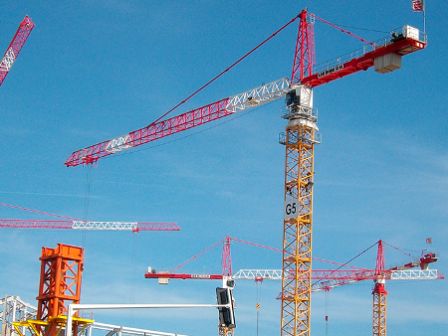
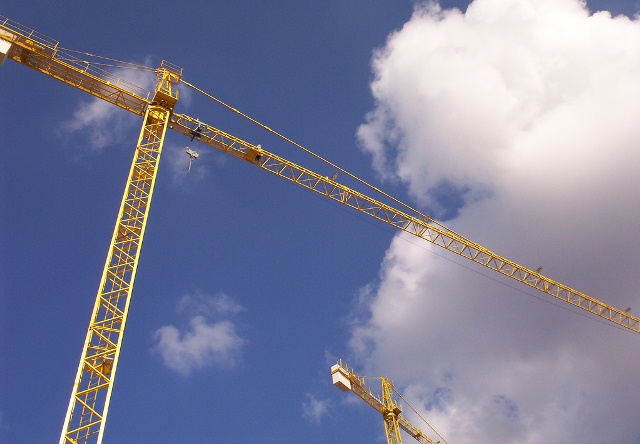
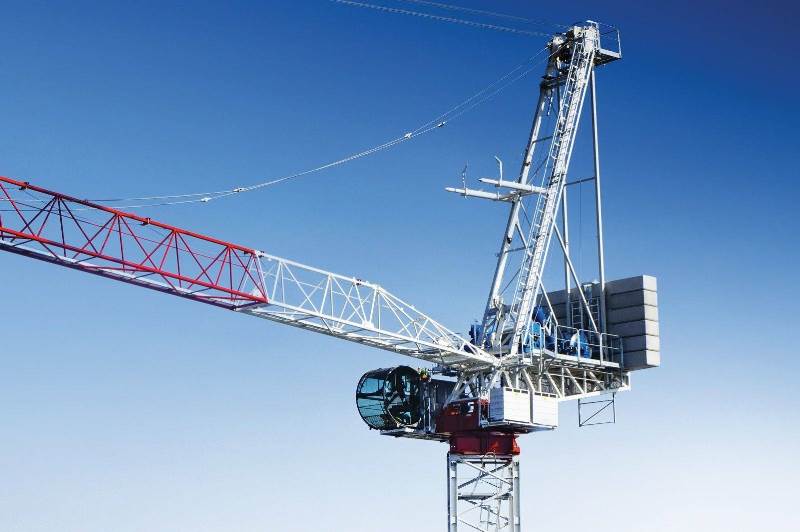
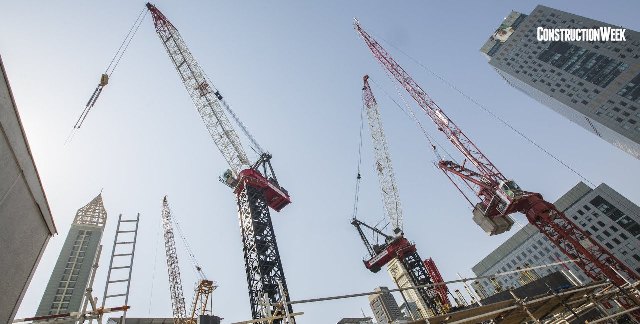
Luffing Tower cranes are especially demanded tall buildings on congested sites. They have a very short counter jib and a variable working radius, which permit high productivity in extremely narrow spaces.

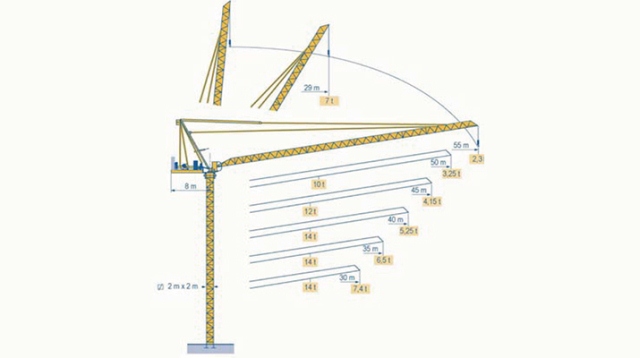
It’s common to have limited space and clearance when working with a tower crane in an urban metro area and downtown work sites. A luffing tower crane is ideal for building projects where there’s not much space on either side of the site and you need to work safely. A luffing crane is able to raise or lower its jib, and that allows it to reduce the slewing radius.

Luffing Tower Crane

Luffing jib crane

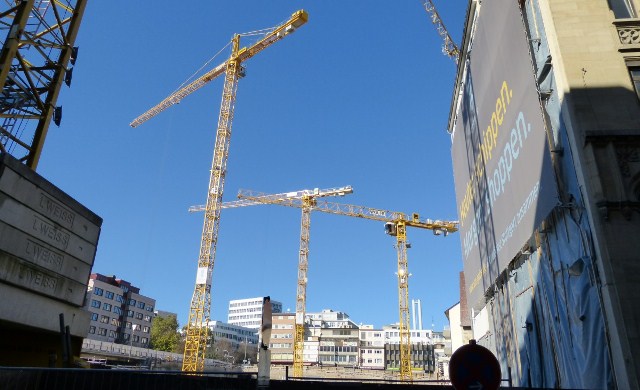
A luffing crane is also a good choice for work sites where two or more cranes are working at the same time. This is because the slewing radius is highly reduced in comparison to standard tower crane types. The luffing tower crane also has a higher lifting capacity because the weight is transferred from the crane’s jib much more effectively.

More and more countries are building wind turbine developments as an energy alternative. Typical luffing cranes do not have the free-standing height need to erect wind turbines. The luffing jib cranes specifically design to meet industry demands for higher hook heights for wind turbine erection.

Luffing Tower Crane

Luffing jib tower crane

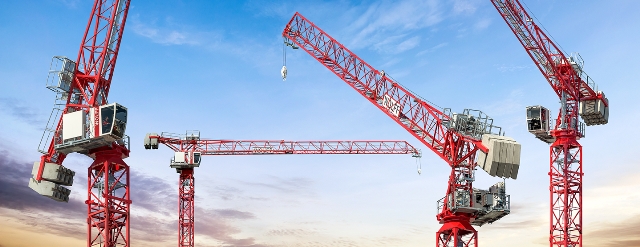
  • This kind of crane is frequently the best solution when several cranes are working on the same site, avoiding any kind of crash with other cranes or the surrounding buildings. With their variable working radius, they don’t interfere in the working area of the other cranes on-site and they can be parked with a very reduced radius.
  • Also, luffing-jib cranes can improve material handling cycles in the job site, using them like auxiliary cranes to the principal tower cranes,
    reducing the construction time.
  • Normally, the maximum load bigger than a tower crane.
  • In some places, local laws make luffing-jib cranes necessary. For instance, London doesn’t allow any crane to fly over the surrounding spaces when they are working on a job site, and luffing jib-cranes are very demanded because you can move the jib from the horizontal position up to the total vertical position.

Luffing crane vs hammerhead

Disadvantages for using a luffing jib crane

But there are some disadvantages of the ‘luffers’ when you compare them to a tower crane:

  • The price of the luffing-jib crane is much higher than a regular tower crane. The tower frames of a ‘luffer’ are stronger, and the luffing mechanisms are much bigger than the hoist system of a tower crane. Of course, the technology applied to move the jib, counterweights, etc is the highest.
  • The cost of assembling and disassembling are much higher too. Most of the structures are heavier, and it takes longer to erect a luffing-jib crane. Once again, to erect a luffer is more difficult due to the technology applied, etc.
  • The jib of a ‘luffer’ acts as a wall to the wind, and the ‘moment’ is much bigger. So the restrictions of the tower are higher.
  • Due to the luffers don´t have trolley motor (the movement is made by the total jib), the working process is slower than in a tower crane.

Luffing tower crane specifications

Luffing jib cranes have many benefits and are widely used in cities and congested areas. You are able to get multiple cranes onto sites and avoid over sail situations with neighboring properties. This means costly licenses would not be necessary.

Luffing jib cranes can be placed on fixing angles or ballast bases and can be erected and climbed to great heights. With our exclusive ‘park radius device’ our Jaso luffing jib cranes can all be parked at a vastly reduced radius when out of service.

This means that you could add another crane to a job to increase productivity where you might not otherwise be able to do so. Also perhaps cranes could be located outside a building, still avoiding over the sail and enabling you to achieve a watertight structure sooner.

Luffing cranes can be fitted with Zoning devices to electronically limit against over-sailing important or dangerous structures adjacent to the site. This can include schools, public area’s or main highways and they are usually mandatory next to the railway and electrical installations.

Luffing tower crane vs hammerhead

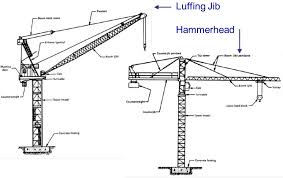
Luffing jib tower crane and level jib tower crane are two kinds of common models. Both models are widely used but they differ in their structure, operating principle, and application field.

Luffing jib tower crane is mainly used in large projects and industrial equipment installing fields where large lifting capacity, high perching accuracy, and high safety are required for lifting large members and equipment components.

The level jib tower crane is mainly used in the common civil building fields where fast lifting and inaccurate perching are required for lifting building materials. Both models have advantages and disadvantages in different application fields, therefore we can plan a key role in determining which model should be selected.

As the above comparison, luffing tower crane has a great advantage over level jib tower crane in the power station construction field, which has been confirmed by more than 100 power stations construction in china. The level jib tower crane is widely used in plant construction of power stations as an auxiliary tool while luffing jib tower crane definitely predominates in boiler lifting.

It is not the only choice to use luffing jib tower crane for boiler lifting, which can be achieved by cooperation between the large crawling crane, furnace handling crane, and large level jib tower crane but also economical efficiency, safety, and plane layout need to be carefully considered.

Luffing Tower Crane

Advantages of luffing tower crane

The following issues need to be carefully considered for large-level jib tower cranes.

Luffing Tower Crane: Whether the cooperative operation of two sets of the crane is needed in the present and future project?

Owing to the economic efficiency and shortage of cranes with the more large specification, the cooperative operation of two sets of cranes Is adopted widely. For cooperative operation, luffing jib tower crane has a great advantage while level jib tower crane is very dangerous to use for a structural limitation or even unavailable for interference between the crane and the building.

Luffing Tower Crane: Is local climate especially wind frequency and wind speed suitable for using level jib tower crane?

According to the safety code, the slewing and brake mechanism of the crane must be released in non-working conditions (i.e. free slewing conditions) to ensure that the boom can freely slew with the wind for reducing wind influence on the crane.

  • Take dodging into consideration, whether the boom of the level jib tower crane is allowed to freely slew with wind or not?
  • Luffing jib tower crane can simultaneously release slewing and brake mechanism and locate the boom in a small range for the purpose of extensively reducing wind influence to the crane and avoiding collision between the boom and other cranes and buildings when freely slewing in non-working condition.

Plane layout feasible or not?

The large project needs the simultaneous operation of many sets of cranes as it is very important for dodging cranes from each other and from buildings. Otherwise, it may possibly lead to very low efficiency in operation, high risk, and an unguaranteed time limit for a project.

But luffing jib tower crane is very flexible in boom range no matter, it is in working condition or nonworking condition for conveniently dodging the other cranes and buildings in the construction field while level jib tower crane can not do that either in working condition or non-working condition.

Luffing Tower Crane

Luffing Tower crane safety

Which country or area can your crane be used at present or in future?

The level jib tower crane is prohibited in many countries and many areas. And landowners in many countries are entitled to have command of the air at a limited height so that you can avoid a lawsuit if you do not let your crane breach other people’s sovereignty.

Most of the sites adopted luffing jib tower crane as the main lifting machinery that the customers can be benefited from scientifically choosing proper crane model.

The adoption of luffing jib tower crane has higher efficiency especially cooperated with auxiliary crawler crane, of which the plan can improve the economic benefits greatly by reducing the operating cost, assemble and disassemble cost, and foundation treatment cost as well as engineering construction cost.

Luffing Tower Crane

What is a luffing tower crane?

What is a luffing jib tower crane?

A luffing crane is able to raise or lower its jib, and that allows it to reduce the slewing radius. They developed the boom cranes specifically to meet the demands of the industry of greater heights, construction of buildings with little space, etc.

What is a tower crane?

The tower crane is a fixed Crane and has to be mounted On-Site. The Tower Crane presents itself like a vertical metallic structure having a horizontal boom that can turn over an angle up to 360°. From his particular setup, the Tower crane is ideal for all king of a high building or high structure Construction.

How does a level luffing tower crane work?

Usually, the description is only applied to those with a luffing jib that has some additional mechanism applied to keep the hook level when luffing. Level-luffing is most important when the careful movement of a load near ground level is required, such as in construction or shipbuilding.

What is a hammerhead tower crane?

A hammerhead tower crane is one of the most common types of cranes used around the world. They are especially reliable for the precise, accurate handling of a wide variety of heavy materials. The way they can be adapted to work well for any job site and any type or volume of material being transported is what makes a hammerhead tower crane such a versatile workhorse.

What type of crane is known as a conventional crane?

Mobile Cranes are the most standard and versatile type of crane used in construction today. The mobile hydraulic crane consists of a steel truss or telescopic boom mounted on a mobile platform, which could be a rail, wheeled, or even on a cat truck.

What is the difference between tower crane and mobile crane?

The biggest difference between mobile cranes and tower or fixed cranes is their mobility. As their names suggest, fixed cranes are fixed to a single spot once they have been set up. Whereas, mobile cranes can be moved as needed. The mobility of a mobile crane holds many advantages for any construction site.

The most read

More on this story

Hammerhead Tower Crane

A hammerhead tower crane is one of the most common types of cranes used around the world.

Remote Control Tower Crane

Radio remote controls are now standard equipment on most self-erecting tower cranes and are even becoming common in some parts of Europe for a flat-top tower crane.

Tower Crane Controls

Today, tower cranes are in widespread use on construction sites all around the world. An important issue that arises when operating these cranes is the oscillatory behavior that occurs during payload transportation, which can have severe effects on safety as well as the accuracy of payload delivery.

Due to the nonlinear nature of the rotating crane motion, controlling these oscillations is a complex task. Additionally, the lack of sensors on many cranes that are in use today requires extra effort to design effective control strategies.

While current research has made good progress on the subject of tower crane control, less attention has been given to the practical implications of applying these control methods to industrial tower cranes.

Construction crane

All around the world, cranes have played a dominant role in helping with the task of lifting and transporting heavy payloads. They are used in many different places such as shipyards, construction sites, and industrial workplaces.

Today, many different crane types exist, each type is specifically designed for the environment in which it is being used. One of the more common crane types is the tower crane, which is the type of crane that this thesis will focus on.

The tower crane is mainly used on construction sites and has proven its usefulness in the construction of very tall buildings. This type of crane has a small footprint but is still able to cover a very wide working area.

It basically consists of a high vertical mast on top of which a long horizontal movable jib is attached. One side of the jib is used to carry the heavy payload attached on a cable, while the other, shorter side of the jib (also called the counter jib) acts as a counterweight.

Tower crane components

A crane with such a configuration has three degrees of freedom. The first one is the rotational (slew) motion of the horizontal jib.

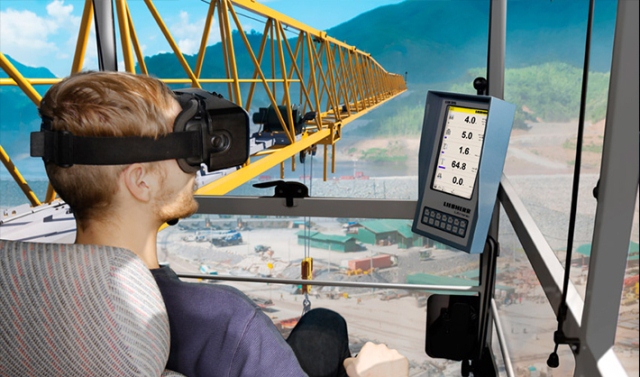
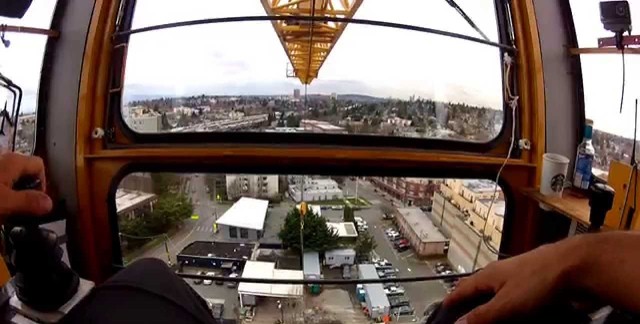
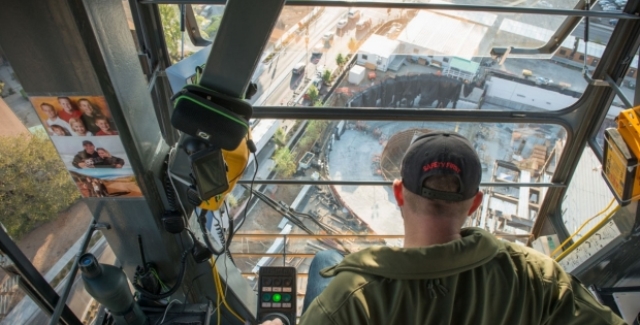
The other two are the horizontal movement of the cable base along the jib (trolley) and the vertical movement of the payload (hoist). The crane is controlled by a human operator, who is usually sitting in a cab at the top of the crane.

As the crane can be used to carry very heavy payloads, the necessary attention needs to go to assure the continued safety of all the people involved. When in motion, the payload and cable assembly will act as a pendulum and is therefore also susceptible to strong swinging.

It is the responsibility of a skilled crane operator to counteract these swinging motions, and at the same time maintain an adequate speed. A good operator is able to suppress the oscillations as much as possible, thereby improving the overall safety on the site as well as increasing the accuracy of the payload delivery.

Tower crane operator

Despite the high level of competence of skilled tower crane operators, it is practically impossible to completely remove payload oscillations in all possible circumstances.

External disturbances such as wind can easily initiate an oscillation. After a while, the oscillations can become larger, until the point is reached where the crane operations have to be stopped and the oscillation has to die out, which can take a very long time. Even without these disturbances, due to the complex effects of the rotary crane movements on the payload, oscillations are still hard to suppress.

Researchers have therefore tried to find different ways to control the movement of the crane in order to prevent or reduce this payload swinging, with varying levels of success.

This aims to further investigate the current state-of-the-art control concepts that have been found promising for operator-in-the-loop control of tower cranes. Additionally, the benefits of equipping existing tower cranes with complementary sensors will be investigated.

In the line of this, an attempt to answer the following research questions will be made:


• Can a tower crane control system be developed that enables the operator to move a payload at a requested speed with a certain minimal swing?

• What are the benefits of using additional sensors in tower crane control?
It is clear that the scope of these questions overlap, since control concepts that use different sensor configurations will also have different effects on the payload swing.

Tower crane specs

A conclusion from this paper is that it is hard to find a control strategy with good robustness properties, which also allows for operator flexibility. A lot of research effort is spent on crane automation strategies, while operator-in the-loop control methods are given less focus.

Much of the research on crane vibration reduction is focused on a gantry and overhead cranes, because of some important reasons. First of all, these types of cranes can move in one or two perpendicular horizontal directions, which results in some nice properties in the dynamics of the payload. The payload motion can be described by the equations for a planar pendulum, and for small pendulum angles, the motions in both directions become decoupled

For small pendulum angles, a linear model can then accurately represent the crane dynamics, enabling the use of the many existing linear control strategies. Gantry cranes are also often used to perform a repetitive task, repeating the same movements over and over. Therefore, optimal trajectory calculation strategies can be employed for this type of crane.

What is a jib on a tower crane?

What is a jib on a tower crane?

A jib crane is a type of crane where a horizontal member (jib or boom), supporting a moveable hoist, is fixed to a wall or to a floor-mounted pillar. Jib cranes are used in construction sites and industrial premises.

How much is a tower crane rental?

A typical monthly fee for a 150-foot-tall tower crane is approximately $15,000, with an additional charge to rent the climbing frame and extra mast sections.

How much weight can a tower crane lift?

The maximum load that the crane can lift is 18 metric tons (39,690 pounds), but the crane cannot lift that much weight if the load is positioned at the end of the jib. The closer the load is positioned to the mast, the more weight the crane can lift safely. The 300 tonne-meter rating tells you the relationship.

The most read

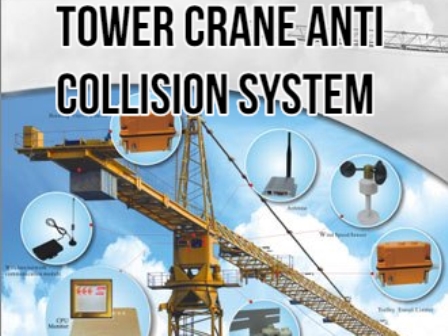
Tower Crane anti-collision System

How does an anti-collision device work in a tower crane?

More on this story

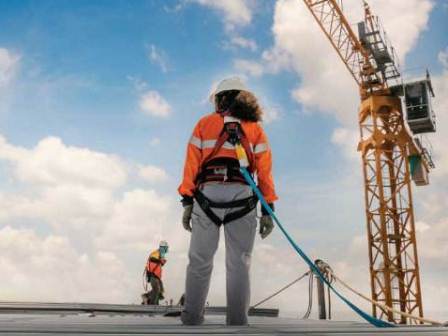
Tower Crane safety

What precautions should be taken on tower cranes?

Tower Crane Equipment

A tower crane is a construction machine designed to load and unload different materials. This load is distributed through the use of a hook that remains suspended thanks to the use of a cable. This heavy machine is essential in the work of modern construction.

In addition, it performs its corresponding displacement on a car and has rotating support that is usually mounted on top of a vertical tower.

A common modern engineering technique is to fix the crane to the liftshaft site – lifting it to higher elevations as the construction progresses – and ending the well once the crane has been dismantled.

The tower crane is often secured to the ground within the structure, where the space around the building is limited.

Tower crane specifications

  1. The crane has a base that is attached to the bottom of said tower.
  2. Uploads and downloads made with great frequency
  3. Make many transfers between various locations.
  4. Where the tower crane is most used are the construction works,
  5. They have the ability to reach great heights.

Tower crane mast

Tower Crane Parts – The tower crane is composed of several parts that are fundamental to perform the work in the construction of a work, these parts are:

It is a metal lattice structure with a normally square section, whose main mission is to provide the tower crane with sufficient height.

Normally it is formed by lattice modules that facilitate the transport of the crane. For assembly, these modules will be joined by screws, all of which will be connected to the projected height. Its shape and dimension vary according to the necessary characteristics of weight and height.

In the upper part of the mast is the rotating area that gives the crane a 360º horizontal movement. Also depending on the model, you can have a cabin for its operation by an operator.

Tower crane counterweight

They are structures of concrete prefabricated that are placed to stabilize the weight and inertia that occurs in the arrow of the crane. They must stabilize the crane both at rest and in operation. Both these blocks and those that form the ballast must have identified their weight legibly and indelibly.

Crane tower counterweight

Tower crane jib

It is a metal lattice structure of a normally triangular section, whose main mission is to provide the crane with the necessary radius or range. It is also called a jib. Like the mast, it usually has a modular structure to facilitate its transport.

To move the specialized personnel during the assembly, revision and maintenance work along the arrow, there will be a longitudinal element, a safety cable, to which the safety belt carabiner can be attached.

Tower crane counter jib

The length of the counterjib oscillates between 30 and 35% of the length of the pen. At the end of the counterjib, the counterweights are placed. It is attached to the mast in the area opposite the union with the arrow.

It is formed a robust base formed by several metal profiles, forming on them a kind of catwalk to facilitate the passage of personnel from the mast to the counterweights. The sections of the profiles will depend on the counterweights that will be placed.

Central ballast

It can be formed by a buried shoe or by several pieces of prefabricated concrete at the base of the crane.

Its mission is to stabilize the crane against its own weight, the weight it can transfer and the adverse environmental conditions

Crane trolley

It consists of a car that moves along the arrow through some lanes. This movement gives the necessary maneuverability in the tower crane. It is metallic so that it supports the weight to be lifted.

crane truck and electric hoist tower

Crane hook

Cables and hook: The lifting cable is one of the most delicate parts of the crane and, to give an adequate performance, it must be used and maintained correctly.

It must be perfectly tensioned and a periodic follow-up will be carried out so that, during its winding in the drum, it does not cross over, as it would cause crushing.

cables and tower crane hook

Tower crane motor specifications

The most generic tower crane consists of four electric motors:

  • Lifting motor: allows vertical movement of the load.
  • Distribution motor: gives the movement of the car along the jib.
  • Motor of orientation: it allows the rotation of 360º, in the horizontal plane, of the upper structure of the crane.
  • Translational motor: displacement of the crane, as a whole, on rails. To perform this movement it is necessary that the crane is at rest.

The tower of the crane can be embedded in the ground, immobilized without wheels or movable on straight or curved tracks. Assembly operations must be carried out by specialized personnel.

Likewise, the maintenance and conservation operations will be carried out in accordance with the standards given by the manufacturer.

Movable tower crane

Is one whose base is equipped with own means of translation on rails or other means and whose maximum height of assembly is such that without any additional anchoring means is stable both in service and out of service, for the solicitations to which it goes to be submitted

crane tower on rails

Fixed tower crane

Its base does not possess means of translation or, being possessed, they are not usable on the site. They are those in which the base is a foundation or any other fixed set.

Mobile tower crane

Removable single-body tower crane: Temporary installation designed for frequent assemblies, disassemblies, and transfers.

Self erecting tower crane

Tower crane whose tower is constituted by a single block and that does not require additional structural elements for its installation. It can be provided with wheels to facilitate its movement.

crane self-folding tower

Climbing tower crane

The climbing tower crane is an auxiliary means for lifting loads.

It is installed on the structure of work under construction and moves from bottom to top by its own means; to the rhythm and as the construction progresses.

crane operator

Tower crane operators use tower cranes to lift, move, position and place materials and equipment.

They calculate the lifting capacity of the crane and determine the weight of the load, participate in the configuration and disassembly of the crane and place and stabilize the crane before lifting.

They also perform regular inspections, and minor repairs and equipment maintenance

Tasks and work tasks for: “Crane and tower operator”.

  • Determine the load weights and compare them with the lifting capacities to avoid overloads.
  • directs direct aides dedicated to the placement of blocking and stabilization under the cranes.
  • Load and unload the packages from the trucks and move the containers to the storage containers.
  • Move the levers, press the pedals and turn the dials to operate electromagnets or other mobile equipment to lift, move and place loads.
  • Review daily work and delivery schedules to determine orders, delivery sequences, and special loading instructions.
  • Weigh the packages, using floor scales and record the weights for the company records.
  • It cleans, lubricates and maintains mechanisms such as cables, pulleys, and gripping devices, making the necessary repairs.
  • It directs the truck drivers who drive the vehicles back to the loading bays and secures the loads for delivery.
  • Inspect and adjust the mechanisms of the crane and lifting accessories to avoid breakdowns and damage.
  • Inspect the cargo packing to verify that it complies with the regulations and customer requirements.
  • Inspect the cables and gripping devices for wear, and install or replace the cables as necessary.

operator crane tower

How much can a tower crane lift?

How much can a tower crane lift?

The maximum load that the crane can lift is 18 metric tons, but the crane cannot lift that much weight if the load is positioned at the end of the jib. The closer the load is positioned to the mast, the more weight the crane can lift safely. The 300 tonne-meter rating tells you the relationship.

What are the parts of a tower crane?

Tower crane mast
Tower crane jib
Tower crane counter jib
Tower crane counterweight
Central ballast
Crane trolley
Crane hook
Motor crane

The base is bolted to a large concrete pad that supports the crane. The base connects to the mast (or tower), which gives the tower crane its height. Attached to the top of the mast is the slewing unit, the gear, and motor, that allows the crane to rotate.

What is the difference between tower crane and mobile crane?

The biggest difference between mobile cranes and tower or fixed cranes is their mobility. As their names suggest, fixed cranes are fixed to a single spot once they have been set up. Whereas, mobile cranes can be moved as needed. The mobility of a mobile crane holds many advantages for any construction site.

Why do tower cranes have lights on them?

When high-rise structures are being constructed temporary cranes are erected which quickly pose a hazard to airborne traffic.

What is tower crane safety?

Tower cranes are widely used for lifting operations in the construction industry. Statistics show that tower cranes contribute to quite a number of serious accidents. Property damage and bodily injuries can be avoided if they are properly used.

The most read

More on this story

Types of Tower Cranes

Types and designs of cranes for construction and industry: Flat Top, Hammerhead, Luffing crane, self-erecting, etc.

Tower Crane Specifications

The study of the tower crane will include knowing the structures that make it up, as well as knowing the elements that are part of this and that will allow the crane to perform the tasks for which it has been designed.

Tower Crane Companies

Tower Crane Companies: Cranes are designed to lift, lower, and move heavy loads using pulleys and cables. Cranes are used in the construction and logistics industries as well as in the manufacturing of heavy equipment.

Tower Crane Companies

Construction Tower crane companies

There are various types of cranes designed to operate under different circumstances. These include mobile cranes, telescopic cranes, tower cranes, and truck-mounted cranes, rough terrain cranes and all-terrain cranes among others.

Tower Crane Companies

Comansa tower crane

The COMANSA range of tower cranes is one of the most complete on the market, boasting a wide range of models and versions that adapt to all kinds of construction projects: residential, commercial, infrastructure, industrial, mining, energy, shipbuilding, etc. Comansa

Stafford crane

Stafford Crane Group is a worldwide provider of lifting services and equipment headquartered in Phoenix, Arizona. From depots in Phoenix, Denver, San Diego and Miami, SCG provides a complete range of services to meet all your lifting needs including sales and rentals, erection and dismantle, inspection, repair and consulting on tower cranes, mobile cranes, self-erecting cranes and overhead cranes

Morrow tower crane

As the exclusive distributor of Liebherr tower cranes in the United States, Canada, and Mexico, Morrow is able to offer the widest range of new and used cranes available. A motivated, highly trained sales and sales support staff, knowledgeable in the advantages of the tower crane, are in place to provide you with the best in customer services. Morrow tower crane

Tower crane manufacturers

  • Terex tower cranes
  • Liebherr tower crane
  • Potain tower crane
  • Manitowoc tower crane
  • Zoomlion tower crane
  • Raimondi tower crane

Terex tower cranes

Available in self-erecting, hammerhead, flat top and luffing jib varieties, each with a wide range of sizes and capacities, Terex tower cranes can be seen hard at work on some of the most formidable job sites around the world. Strong, yet quick to set up, their rugged construction and advanced technology provide reliable performance for many productive years to come. Terex Tower Crane

Liebherr tower crane

Liebherr’s tower crane program is unsurpassed in terms of versatility. It comprises machines of all systems and size categories, with the ideal lifting technology for any civil engineering task.

The efficient top-slewing cranes have proved their worth both in the construction of residential buildings and on large-scale industrial projects all over the world

Tower cranes are the main pivot point for the success of all types of sites. The important thing is to select the correct crane types, their quantity, positioning and dimensions. These are important factors for meeting deadlines and budget targets.

Potain tower crane

Potain has led the world in tower cranes. Self-erecting and top-slewing cranes have been produced since Potain’s inception in La Clayette, France, in 1928. More than 100,000 Potain cranes have been sold and installed on some of the most prestigious job sites around the world. The company offers more than 60 models in a variety of product ranges.

Tower Crane Companies

Manitowoc tower cranes

Simple, rapid and entirely autonomous, Self-erecting tower cranes (GMA cranes) are especially suited to construction sites which are of short duration, requiring frequent operations of transport, setting up, erection and dismantling. Manitowoc crane

Tower Crane Companies

Zoomlion tower crane

Zoomlion is a Chinese manufacturer of construction machinery and the sixth-largest construction machinery enterprise.

Raimondi tower crane

Raimondi Cranes prides itself on incorporating the latest in safety developments, paired with a high functioning and intelligently-designed technological edge. Fully designed and manufactured in our ancestral home of Legnano, Milan, Raimondi Cranes (Raimondi) has more than 150 years of history of the finest European craftsmanship. Raimondi tower crane

Tower Crane Companies

Tower Crane Companies

How much is a construction crane?

The typical fee for installation and disassembly runs around $60,000. This price includes shipping the crane to the site, renting the mobile crane used to assemble the tower crane, the cost of the crew that handles the assembly, etc.

What is a tower crane?

The tower crane is a fixed Crane and has to be mounted On-Site. The Tower Crane presents itself like a vertical metallic structure having a horizontal boom that can turn over an angle up to 360°. From his particular set up, the tower crane is ideal for all king of a high building or high structure Construction.

What is a spider crane?

A spider crane is a perfect tool if you require heavy lifting in between floors in a building, lifting anything from air conditioning units or wooden beams on to upper floors or dropping down lower levels. The LIFT-094 is the smallest and most compact spider crane in our range and highly effective in confined space.

How is a tower crane built?

Tower cranes arrive at the construction site on 10 to 12 tractor-trailer rigs. To rise to its maximum height, the crane grows itself one mast section at a time! The crew uses a top climber or climbing frame that fits between the slewing unit and the top of the mast.

The most read

More on this story

Remote Control Tower Crane

Radio remote controls are now standard equipment on most self-erecting tower cranes and are even becoming common in some parts of Europe for a flat-top tower crane.

Tower Crane Cab

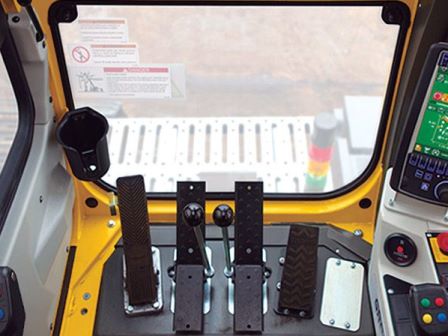
Cab features include improved seat position and access, a USB port and optional Bluetooth. A user-friendly multifunction touch screen emits warning lights and sounds, as well as controls the interior temperature, interior, and exterior lighting and other features.

Tower Crane Foundation

The tower cranes belong to essential building machines that are widely used for transport of the construction products from a storage area or vehicle to their final positions in the process of building-up of the constructions.

This article is concerned with the analysis of possibilities of the tower crane placing in the site, with risk identification for every single variant and recommendations on the design of tower crane positioning in case of several situations.

It also analysis the problem of mounting and dismounting of tower cranes and risks related to the design of a higher number of cranes. At the close, it defines a procedure on how to determine the optimum distance of the tower crane with folding jib and the building.

Tower Crane Foundation

Tower crane foundation engineering

Crane positioning outside the construction project floor plan

In terms of construction progress, it is better to place a tower crane outside the floor plan of the constructed structure. Such crane does not pose an obstacle to construction work progress and, if necessary, the date of its removal may be shifted with no negative impact on the construction process.

It also enables early crane installation prior to the first work on foundation structures. Crane positioning outside the floor plan of the constructed structure provides for simple crane supply with construction material and good view from the crane operator’s cabin on the transport means during material collection, which speeds up crane work and improves work safety.

However, in this type of crane positioning, complications may be caused by existing underground infrastructure services in front of the structure and their protection zones (high-pressure gas pipelines, sewage collectors, etc.), outlying the underground part of the structure or construction pit for basement complex of the structure.

Then, the tower crane needs to be moved away from the structure, to a distance posing no threat to underground infrastructure services or construction pit wall stability, possibly, special foundations have to be prepared for the crane, e.g. micro pilots, to avoid load on the construction pit wall.

A crane positioned outside the constructed structure may also call for the need to occupy larger sites and use more powerful and expensive installation mechanisms with a longer reach. Especially the limited special conditions within a site and the desire to minimize crane costs often require crane placement within the constructed structure.

Tower Crane Foundation

Tower crane foundation design

Crane positioning within the construction project floor plans

Should the crane be positioned within the constructed structure floor plan, it is often installed on the structure’s based structure, which is modified adequately. Part of the base structure, where the crane is to be anchored, may be constructed in advance, which speeds up the construction process.

Placement within the structure minimizes requirements for the horizontal reach of the crane. Therefore, its beam may be shorter, compared to crane installed outside the floor plan of the structure.

However, crane positioning within the structure complicates construction progress. In most cases, it requires the leaving of assembly holes in ceiling structures for the crane tower. The position of assembly holes is assessed statically.

The size of an assembly hole is designed 1.0 to 1.6 m larger than the size of the crane tower, which avoids tower collision with the ceiling slab due to the work-related swing. Assembly hole size also has to enable safe crane disassembly.

Tower Crane Foundation

Tower crane assembly

Assembly holes may be avoided by placing cranes e.g. into elevator shafts, which however need to be spacious enough not only for the crane tower and its assembly and disassembly but also formwork of the shaft walls. Therefore, elevator shafts are only rarely fit for the placement of cranes.

Inside the floor plan of a constructed structure, tower crane may also be positioned directly onto terrain and shifted to give way to further construction following the completion of a certain structure part.

This construction method is suitable in projects divided into various sections – usually in low-rise buildings. In this case, too, the crane may be installed prior to the first work on foundation structure and a shorter beam crane is sufficient.

Tower Crane Foundation

Tower crane footing

On the other hand, crane relocation is only possible following the installation of all heavy parts of the construction structure, which may slow down construction progress. There may also be a problem in the case of an underground water presence.

The said crane installation hinders the completion base structure and construction of the watertight basin. In the case of underground water presence, its level needs to be lowered by pumping for a relatively long period of time. (Tower crane footing)

Tower Crane Foundation

Skyscraper crane assembly

In the case of high-rises, adapted cranes may be used. Initially, these cranes are installed onto foundations. Later, however, they detach and climb up along with the building using its structure, to which they are attached.

They are positioned within the structure floor plan, usually inside elevator shafts. Disassembly is done from a helicopter, or via a light columnar support crane. These cranes are little used in the European Union.

They are especially known from abroad, e.g. the U.S.A, Dubai. According to informative calculations, they would be feasible for buildings above cca 250 m.

Cramped site conditions, as well as construction progress, may establish a situation, in which tower crane needs to be installed onto a completed ceiling structure. This solution is used, e.g. for the installation of support cranes speeding up construction, possibly to relocate tower crane at a later stage. Ceiling structure is assessed by a structural designer and reinforced or supported by struts if necessary.

Struts transfer crane to load onto several ceiling slabs under each other, possibly into the base structure. Crane may be installed onto the ceiling structure after the bearing structures reach the necessary strength, which impacts construction progress. Smaller and lighter tower cranes tend to be installed onto ceiling structures.

However, with sufficient support, even large and heavy cranes may be installed this way.

Tower Crane Foundation

Tower Crane installation

When drafting a tower cranes plan, crane installation and removal requirements may pose limiting conditions. Many tower cranes are composed of several parts assembled directly on-site using other assembly means, usually mobile crane.

It has to reach above the center of gravity of the beam, counter beam and above the tower of the assembled crane and sufficient bearing capacity in these places. Weight of the heaviest crane parts depends on the crane type and may reach from 3 to 12 t.

Crane assembly is not coupled with any problems since the site offers plenty of space in the initial phases and there is good access to the assembly site.

When removing a tower crane, the constructed structure establishes a new obstacle. This is a problem especially in the removal of cranes situated within the floor plan of a structure when the car mounted crane needs to reach the crane to be removed over the edge of the finished structure. Mobile cranes dispose of high carrying capacity. However, this carrying capacity drops significantly with the beam disengagement.

However, this carrying capacity drops by 94% with a horizontal overhang of 25 m. Therefore, tower crane may only be installed in a certain distance from the structure’s edge that is accessible for removal, where the mobile crane will have reach with the required carrying capacity

Tower Crane Foundation

Tower crane specifications

Tower Crane Height

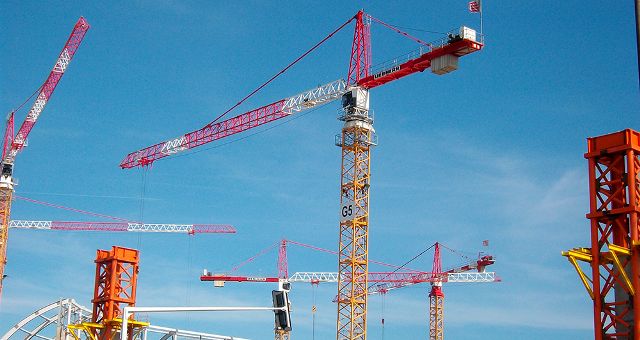
In larger projects, also with respect to the relatively short construction period, a larger number of tower cranes is usually planned. The plan of their arrangement needs to establish conditions for safe work to avoid their mutual collision (Hulinova, 2005). Therefore, respective cranes are planned with differing levels of beams.

Thereby, the distance between any structure of two neighboring cranes needs to represent a minimum of 1m, 2m is better. It is also necessary to consider, that to avoid crane tipping in a strong wind, the crane needs to be able to position its beam downwind, meaning, that it needs to be able to rotate freely 360°.

Therefore, when planning for several tower cranes, their height depends not only on building height but also on the height of the neighboring cranes. When using several cranes with partially overlapping reach, some of the cranes may need to be designed in big height.

Construction Tower Crane foundation design calculation example

How are tower cranes anchored?

The triangulated cross-members structure gives the mast the strength to remain upright. So these cranes are essentially bolted/anchored to the ground to ensure their stability. Tower cranes arrive at the construction site on 10 to 12 tractor-trailer rigs.

Are tower cranes safe?

Despite their seeming precariousness – and the catastrophic nature of the occasional accident – tower cranes are extremely stable and have good safety records overall. Nevertheless, the people who operate them are skittish about saying even that on the record. Tower cranes are very safe.

Why do tower cranes collapse?

Improper crane assembly. If the weight limits are exceeded, the crane can tip over or the boom could collapse. A major reason booms collapse is an improper assembly of the crane.

How does a tower crane stay balanced?

When a tower crane is erected the crane erectors then load test it with known weights to set the load limits so it cannot lift too much weight or trolley out too far with a heavy weight that might cause over-turning.

The most read

Tower Crane Foundation Design calculation example

What kind of footing do you need for a tower crane?

Tower Crane Cab

Cab features include improved seat position and access, a USB port and optional Bluetooth. A user-friendly multifunction touch screen emits warning lights and sounds, as well as controls the interior temperature, interior, and exterior lighting and other features.

More on this story

Remote Control Tower Crane

Radio remote controls are now standard equipment on most self-erecting tower cranes and are even becoming common in some parts of Europe for a flat-top tower crane.

Hammerhead Tower Crane

A hammerhead tower crane is one of the most common types of cranes used around the world. They are especially reliable for the precise, accurate handling of a wide variety of heavy materials.

The way they can be adapted to work well for any job site and any type or volume of material being transported is what makes a hammerhead tower crane such a versatile workhorse.

hammerhead tower crane

Construction crane

Designed for easy maintenance and reliable performance for excellent uptime, the hammerhead tower crane provides excellent maneuverability and load moment precision.

A hammerhead crane also allows you to “rack” the crane. This is moving the trolley in and out along the job with its load suspended but not altering the level of the load. The precise horizontal movement of the load is a significant benefit of using a hammerhead tower crane

Hammerhead tower crane specifications

Modular​ Designs: These modular designs promote safer, quicker, and more efficient erection, disassembly, and transportation of the crane. It also allows the hammerhead crane to be built in sections.

Ergonomic Operator Cab: Smart, ergonomic, and climate-controlled operator cabs with easy-to-read display panels, plus step-less motor operation of the trolley and hoist for more control when creeping the load.

High-Quality: High-quality, long-lasting parts sourced from original, premium-quality manufacturers that are strong, built to last, and weather resistant. These parts contribute to a long working life for your hammerhead crane.

Easy Maintenance Access & Built-In Safety Features: ​Impressive ease of maintenance design and built-in safety features including optional anti-collision and zoning systems and CCTV camera installation

Frequency Converter Motors: Economical frequency converter motors that reduce power requirements while operating the crane and give it a longer working life.

hammerhead tower crane

Tower crane specifications

Basic hammerhead tower specifications mean height, arm length, and the maximum lifting weight of the arm end. In addition to special conditions, maximum lifting weight won’t be taken into consideration.

According to the dimensions of length, width, and height of the construction building, you can make a preliminary determination of tower crane arm length. Arm length should be long enough to cover all projects and a slight margin is appropriate. The height of the hammerhead tower crane needs to be 10 to 15m above the maximum height of the building. Arm end lifting weight can be decided by the staff according to the weight of the object to be lifted.

Hammerhead tower crane is a kind of hoisting equipment, which is used for building construction. According to the national standard, the model of the tower crane is QT, Q means crane, T means tower. This type of tower crane is very general in our life, we can see it everywhere.

Hammerhead type tower crane

Rotary hydraulic jacking hammerhead type tower crane is currently the latest hoisting and conveying machinery, which adopts all kinds of technologies like group technology, combinatorial design technique, and finite element analysis technique.

This is an upper rotary hydraulic jacking crane with a horizontal boom and trolley mechanism. The maximum effective amplitude is 47m, and it is with the biggest amplitude of the same type in the country. The maximum lifting moment is 43.8t.m. When using the tower crane independently, the free-standing height is 29 meters and the attached lifting height is 120m.

The speed indicator of this tower crane is up to or surpasses the national standard. It is with features of advanced parameters, reliable performance, attractive appearance, high quality, and simple structure, what’s more, it is equipped with an advanced safety device, which is easy to maintain and safe to use. It is indeed an ideal choice for small and medium-sized construction enterprises.

It includes metal structure, mechanical transmission, hydraulic hoist, electric control, and safety protection device when the lifting height is lower than 29m, we adopt free-standing type, if higher than 29m, adopt the attached type.

hammerhead tower crane

Tower crane design

Advantages of hammerhead tower cranes

  • Reasonable design of the structure and beautiful appearance. We adopt a cone forward tilting hammerhead, rigid rod, and the driver’s cab is independent.
  • Advanced parameters and stable performance, fixed lifting capacity, maximum lifting moment and maximum working range can better conform real operation conditions.
  • The entity joint of jib cranes adopts mechanical processing after forging, it can achieve high matching accuracy; last quarter of the jib crane and force structure of the box body adopts high strength molding square pipe; support arm and main stress member adopt to strengthen the design.
  • The design of the jib crane achieves varies work ranges and base forms.

Hammerhead crane cost

The different engines can achieve different performance, and quality machine deserves a good price, which means if you want to get the best machine, you need to choose a brand machine or choose a machine with brand parts, and the price must be a little higher than other machines.

But, don’t you think that a perfect project is the truth? Just as an old saying goes, you get what you pay off. If the hammerhead tower crane will cost you much, you need to check whether your machine is equipped with brand parts and whether the hammerhead tower crane manufacturers adopt patent technology to ensure the quality of your machine.

Tower crane manufacturers

When you choose a manufacturer, what you need to note first is its comprehensive strength, there are several steps for you to choose a reliable manufacturer.

  • Search suppliers on the internet, enumerate top manufacturers.
  • Filter them from these aspects:
    • workshop scale
    • staff professionalism
    • technical skills
    • number of old customers
    • exporting country
    • the number of orders per year
  • Take service into serious consideration: pre-sale service, on-purchase service, and after-sales service.

According to the above tips, you must find professional tower crane suppliers.

hammerhead tower crane

Tower crane safety checklist

  • Safety checklist:
    • The weld of a metal structure shall not crack and shall not be plastic deformation;
    • Connect bolts and pin quality should be up to standard;
    • Ensure good lubrication of steel wire rope;
    • Keep the reducer, transmission system and oil tank from leakage;
    • Ensure the brake braking and limit insurance are sensitive and reliable;
    • The rope connector should neet the standard;
    • Keep the hydraulic system normal.
  • Change spare parts
    • Stop the hammerhead tower crane and change the spare parts;
    • If it is necessary to change important parts, should dismantle the tower crane.

Uses of hammerhead tower crane

Heavy load-lifting plays a vital role in any transporting operation. The mechanism should be fast and efficient and also should provide safety during operations.

Hammerhead Tower Crane is used to lift effortlessly heavy loads. To operate a machine a qualified person is required who has much knowledge in operating .since many accidents happens around crane lifting because of improper action.

There are two types of crane categories: stationary and portable, there are types of cranes of different sizes and shapes.

The most common crane used is a portable crane. A portable crane truck hires a mounted crane and it is also called a portable pickup truck crane. This crane truck hire has standard crane features that can carry loads ranging from 15 tons to even 1000 tons. This crane truck hire can transport cargo from one allocation to another by itself on the road. But this crane truck hire has a great improvement over the stationary cranes.

What is a hammerhead tower crane?

What is a hammerhead tower crane?

A hammerhead tower crane is one of the most common types of cranes used around the world. They are especially reliable for precise, accurate handling of a wide variety of heavy materials. The way they can be adapted to work well for any job site and any type or volume of material being transported is what makes a hammerhead tower crane such a versatile workhorse.

How does a tower crane balance?

The pull rod on the hammerhead connects the jib boom with a balance arm and form triangle support, which ensure the overall balance of the horizontal direction of the hammerhead tower crane for sale. The hammerhead connects the tower body and slewing bearing, which keep the balance of all the tower body. Therefore, when the machine turns, there will not be an excessive distortion of the mast section.

What is tower crane safety?

Tower cranes are widely used for lifting operations in the construction industry. Statistics show that tower cranes contribute to quite a number of serious accidents. Property damage and bodily injuries can be avoided if they are properly used.

How do tower cranes stay balanced?

A counterweight is added to the opposite end of the articulated jib to counteract the weight that the crane will be lifting. In such Cranes, the armrests on a thrust bearing over tower structure which takes up all the load. The arm is initially balanced by using the counterweights at the other end of the arm.

What is the maximum wind speed to operate a crane?

The maximum wind speed for safe compact crane use is 22 miles per hour/ 36 kilometers per hour / 10 meters per second

What wind speed Do cranes stop working?

The maximum value for this is generally 20 m/s (45 mph), but this amount can vary. A review of in-service wind speeds by the Tower Crane Interest Group concluded that the maximum recommended wind speed for towers in the UK should be 18.5 m/s

The most read

More on this story

Luffing Tower Crane

Luffing Tower cranes are especially demanded tall buildings on congested sites. They have a very short counter jib and a variable working radius, which permit high productivity in extremely narrow spaces.

Tower Crane safety

Construction safety meeting topics, tower crane safety training, crane operator training, construction tower crane lighting requirements.

Crane operator salary

A Crane operator or Tower Operator will usually earn a wage of around 40000 and 60000 based on education and experience.