All posts by Loganx

Professional Web Writer | Motor Enthusiast | Content Creator | Logan is a dedicated and skilled web writer, passionate about engines and machines and with a talent for creating engaging and informative content. She specializes in writing about a diverse range of topics including construction, forklifts, heavy equipment, excavators, etc. SEO Optimization: Proficient in SEO best practices, ensuring high visibility and engagement for all published content.

Tower Crane Specifications

Tower Crane Specifications: The study of the tower crane will include knowing the structures that make it up, as well as knowing the elements that are part of this and that will allow the crane to perform the tasks for which it has been designed. A description will be made of the main elements that allow the operation and safety of the crane, and the first steps will be taken to design and select several of these elements, understanding that for a deeper design it would require much more complex studies.

Tower Crane Specifications

Industrial hooks

The lifting hooks must be of reflective striking color and must have a lock that prevents the accidental release of the load, have the embossed printing capacity and must not undergo permanent deformation when they are tested with a load of two. times higher than the nominal load capacity.

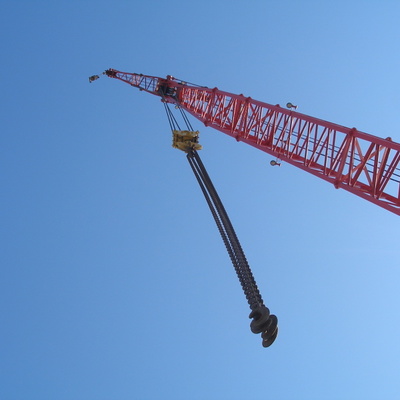
Tower Crane Specifications

Crane wire rope

Steel cables are normally used for lifting (lifting), pulling, lashing or fixing various elements and is the most important element of a Tower Crane, after the control and operation mechanisms, this element joins the load to the crane and actively participates in all the operations of the equipment.

Technical specifications of the cable: The choice of the characteristics of each cable, is made according to the efforts to which they are subjected, which corresponds to precise rules that must be observed and respected.

The steel cables consist of a set of strands and a central core. By combining the wires and strands properly, cable types are obtained from different constructions and for different uses.

Each steel cable must be adapted to the functions it fulfills in each equipment.

Normally, the constructors of the equipment recommend a certain type of cable, this must be strictly complied with.

Steel wire

When replacing a cable, one must be used that has identical characteristics to the initial cable, same diameter, same construction, equivalent resistance and identical type of wire with its similar protective coating.

If an inadequate cable is used, it can mean a sudden break or accelerated wear, with spectacular destruction.

These instructions are complemented with tips for uses for operators and mechanics and with a manual for the revision and control of cables for mechanics, assemblers, and mechanics of maintenance.

The cables of elevation and those of traction do not have to present splices or unions and work with a coefficient of utilization minimum of 6.

Ku = Cre / Q> 6

  • Cre: Is the effective breaking load of a new cable
  • Q: It is the static traction exerted on the cable
  • Ku: Coefficient of cable utilization

In the case of horizontal booms, the minimum effective breaking load of the traction cable, when new, must be at least equal to four and a half times the maximum effort applied to the cable by the traction mechanism, during the start and braking.

Tower Crane Specifications

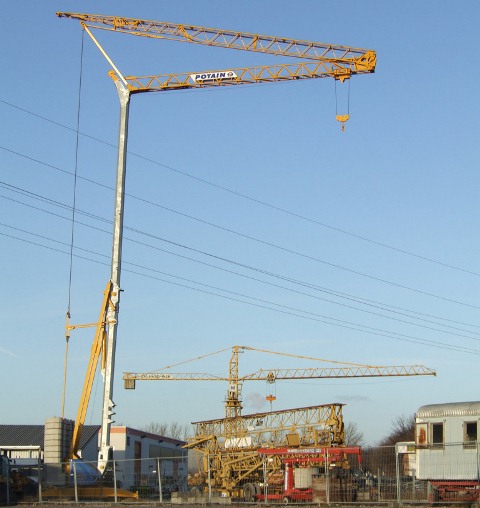
Cable connectors

There are several techniques to join a cable:

  • By means of a temporary union, where 2 cables of the same diameter are placed in parallel, and a number of clamps determined by the norm are placed.
  • Eye to eye joint, where eyes are used in each cable and these are joined by hooks or hooks are attached directly.
  • By means of braid, basically, it consists of removing some strands of the cable and replacing them with the strands of the other cable and weaving the whole system.
  • The element that secures or fixes 2 cables is called saw – cable or clamp, there are different types, in our country the most used is the Crosby.

Crane cable

Uses of steel cables:

  • Elevation, which is an anti-rotation cable, very sensitive to the cavities and hernias, and subject to great traction efforts.
  • Carriage, which is a normal construction cable, subjected to drag and friction loads on smaller diameter pulleys; therefore subject to wear by rubbing.
  • Brake cable and other emergency types, it is a cable without special mechanical qualities, it is only a rigid cable of command.
  • Strobe cables, which are cables subjected to friction and deformation, but which are usually resistant to mistreatment, when they are built with suitable cables, when using anti-rotation cable it is necessary to take care of the inspection and retighten the shackles.
Tower Crane Specifications

When to change a steel cable

Inspection intervals: The standard on inspection instructions of a steel cable according to international standards establish maximum inspection periods, whose maximum interval must be strictly complied with.

  • 12 months for any cable.
  • 3 months for cables that raise personnel.
  • 2 months for Tower crane cables.
  • The cable of a crane must be severely inspected, before and after assembly.

In the latter case, it is necessary to review possible cracks or permanent deformations and should have a record of the person who made the review and the professional who controlled the inspection, this is the only way we could present ourselves before the authority, in the case of a serious accident.

Cable anti-rotation

When the outer and inner layers of the cable are in opposite directions, the tendency to rotate is counteracted with each other.

When the ends are not properly sized, the core can slip or come off at the other end of the cable or through an outer layer

Wire rope lubricant spray

Grease for steel cables:

Normally, the cables must remain greased because their construction needs it to avoid internal friction.

Normally, the manufacturer’s instructions must be respected, with regard to the lubricant to be used and the environment where the equipment is working.

They should always request instructions from the Chief Maintenance Engineer.

There are some cables that are never greased, such as those of tirfor, of strobes or another system that swallows cable.

Crane inspection

Visual control:

  • The cables must be inspected periodically to check their evolution and wear.
  • If a cable between one control and another, shows a major change, appear steel blades, cut wire, thins in one area, or one notices the soul or the pack of loose inner screws, the cable must be replaced.
  • The cable must be washed and then carefully revised, an easy way is to put on a glove and tighten the cable with a quantity of fine cloth, and start a route of the cable, in all the areas that the cable is entangled with the cloth, it is necessary to Note the reason, they are usually cut strands or deformations.
  • Then you have to re-lubricate the cable.

Critical areas:

Always in a crane cable, there are areas that present greater wear, than others, in this part of the cable it is necessary to maintain a special vigilance, especially when the cable starts to get “hairy”.

Abnormal Deformations:

In some cases, the cable starts to show a lot of brightness, irregular flattening, or unexpected thinning. In this case, you should always check:

  • Catalinas, which may be locked, derailing the cable or throat with damage.
  • Great crushing, the winding drum may be defective.
  • With a very rare waist, the cable has been stretched abnormally and it is likely that the central package or the soul has been released.
  • Very dry cable; check the inner friction because there may be played between the strands. Naturally, that is a lack of lubrication or poor quality of this.

Tower crane spare parts

Causes that force a replacement:

  • Rupture of more than one strand.
  • If there is a knot
  • Existence of a hernia.
  • Abnormal diameter reduction
  • throat formation
  • thinning of a section.
  • When the cable anywhere has decreased by 10% of its diameter
  • When there is more than 20% hairy surface (with wire strands) in an area less than one cable passage.
  • If a strand decreases 40% of the diameter and is released in two cable passages
  • When internally presents a high degree of oxidation.
  • When a cable has been strangled, by placing a Crosby shackle in a defective manner.

Pulleys and gears

The winding drums and the grooves of the different pulleys must have smooth surfaces, they must be provided with side discs or other elements that prevent the cable from coming out.

Technical specifications

The radius of the disk must exceed the last layer of cable in at least 2 times the diameter of the cable. Whatever the working position of the drum, they must remain at least three turns of wire.

The diameter of the drums (D), measured at the bottom of the throat, must be equal to or greater than 20 times the nominal diameter of the cable (d). If the drum is smooth D increases to 24.

The diameter of the pulleys, measured at the throat bottom, must be equal to or greater than 22 times the nominal diameter of the cable.

The effective diameter of the cable that is used on a slotted drum or a pulley with a throat must not be greater than the width of the grooves of the drum or the throat of the pulleys.

The struts that make up the lifting gear must be equipped with protection devices, which avoid inserting the hands between the cable and the throat of the pulleys.

Tensioners for steel cable

Fixing technique: The cable fixing system must comply with the provisions of the standards

The carrier cables of the distributor carriage must be anchored in the opposite direction on the winding drum.

The operation exclusively friction is not accepted (except for cranes in which the force used to move the car does not exceed 10 kN and cranes manufactured before 1990).

Drum for steel cable

Transfer of cable to drum: Manufacturers recommend transferring from above in the upper direction for the anti-rotation cables.

It is important to comply with this instruction by breaking the rope carrying drum so that the winding on the drum of the machine remains with relative tension.

The cable must not be dragged along the ground, because the lubricant picks up abrasive particles, which deteriorate the wire.

When transferring a cable from one reel to another or to the drum of a machine or equipment, the cable must pass from the top of one another, or from bottom to bottom.

Steel flange

When a load is lifted, it is usually necessary to use an auxiliary element, making a connection between the load and the hook of the crane. This element is called a flange.

Generally, this operation keeps a load suspended, which we can call a restricted airway. It is very important in this operation to take the necessary precautions, so as not to suffer an undesired accident, due to material fall.

There are different types of flanges, in most cases, prefabricated solutions are used, which can be constituted by one or more flanges which are usually constructed of:

  • Steel cables: strobes
  • Flat ribbons made of synthetic fibers: slings
  • Steel links: chains
  • Woven vegetable fibers: rope rigging
  • Woven synthetic fibers: rope rigging

These solutions are prefabricated and must comply with common safety standards valid for all, plus each must be complemented with the particular rules for each flange.

When using mixed flanges both must be complemented rigorously in each particular case.

Tower crane safety

  • You must always know exactly the weight of the material to hoist what is called: “maneuvering load”.
  • If this weight information is not available, it should be calculated immediately with some certainty.
  • The size of the item to be transported must be known.
  • In order to execute the maneuvers of transporting suspended loads without risks, the supervisors, the crane operator, and the signalman must know the basic rules of safe suspension techniques.
  • The lifting capacity of the mechanical equipment that will execute the maneuver must be known with certainty.
  • Know the speed of the mechanical lifting equipment, verify if it is adequate to the programmed maneuver.
  • The lifting techniques of loads must be known, according to the nature of the flanges that are being used. Especially it’s capacity and fragility.
  • The intrinsic risk of the material to be raised must be known. ÿ The fragility of the material to be raised must be known.
  • When starting the load lifting maneuver, the operator of the crane should check:
    • Balance and stability of the load, because poorly stowed loads can be released or unbalanced unexpectedly, which can create an increase in load due to dynamic blows or unexpected pendulum effects when changing positions unexpectedly.
    • Degree of fixation, you can not risk slippage of the load.
    • Maximum angle generated between the flanges located on the hook suspension

Lifting equipment

Tower Crane Specifications: Maneuvers loading and unloading

This safety coefficient determines the minimum resistance that the flanges must meet when they are with a suspended load. In the most common flanges, these coefficients are called maneuver loads.

The maneuvering load on the flanges used as a joining element cannot be subjected to more load than determined in the safety coefficients of each material.

The normal thing is to use safety coefficients between 6 and 4 depending on the vertical lifting equipment.

An example of the use of a safety coefficient. If a load of 6000 Kg is lifted, the safety factor is 1 and it is a critical load that will cause the flange to break. If a load of 2000 Kg is lifted, the safety factor is 4, it is a safe load.

  • When raising a load of 1000 Kg, the safety factor is 6.
  • When raising a load of 1200 Kg, the safety factor is 5.
  • Raising a load of 2000 Kg, the safety factor is 4.
  • Raising a load of 3000 kg, the safety factor is 3.
  • When raising a load of 4000 Kg, the safety factor is 2.
  • When raising a load of 6000 Kg, the safety factor is 1.

As the safety coefficient approaches 1, we are approaching the breaking coefficient of the flange, due to the dynamic overload when starting or stopping a lift maneuver.

The angle of separation of the flanges: Avoid angles greater than 90º, which accelerate the wear of the flange by deformation and rupture of it.

Flange types

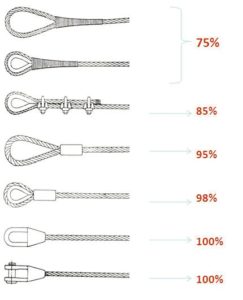
Simple bridle: It is one that is formed by a single cable, whose ends end in an eye that can be braided.

Endless bridle: It is one that has its braided ends, joining them in a single section; Your fabric or braid must be 18 times the diameter of the cable.

The flange of several branches: Are those whose branches are attached, at one end, to a ring or ring and on the other to hooks. The accessories that are used for strobing, must also have strict control regarding their capacity

Strobes for cranes

The strobes are mechanical joining elements made of steel. They are flexible and easy to manipulate. Suitable for lifting light and heavy loads. They are very resistant but deteriorate due to lack of care or storage, the main care is to prevent the formation of cokes or kinks.

In each strobe must identify the maneuvering loads, which must be written in a clear and legible, it is advisable to place a ring or a molded plate at one end. (if you do not have the information you should use the formula F = 8 d 2, d = diameter of the cable in mm, F in kg).

All strobes must be provided at each end of an eye, which must comply with current regulations. Each eye must be closed by a woven and leaded joint.

The woven and leaded finish only decreases the tensile strength of the strobe by a percentage not exceeding approximately 6%, by safety calculation this ratio must be estimated at 15%.

Steel struts

Recommendations: It is not advisable to use cable termination, its decrease, estimating that these are correctly placed, it is not less than 20%, it is normal to consider 30% with what after a stroke, the state should be carefully inspected and placement of the cable press.

The interior of the eye must be protected with a thimble, the use of this implement is intended to prevent the steel cable from over-folding.

A fold of a steel cable means a deterioration in the strength and duration of the latter, due to deformation and loss of solidity between strands.

Whatever the diameter of the steel cable, always the thimble that is used must respect proportionally the diameter of the steel cable.

Cable quality

The quality and construction of a cable used in strobes should be advised by the manufacturer of steel cables because it depends basically on the construction, the tensile strength, flexibility, limits of fatigue to bending and resistance to bad treatment that has each steel cable

When more than one cable is used to suspend a load (supplementary loads), the angle formed at the top vertex must be respected for each pair of cables, in order to resist within the safety coefficients the greater traction generated by the resultant new triangle of forces.

Transportation and storage

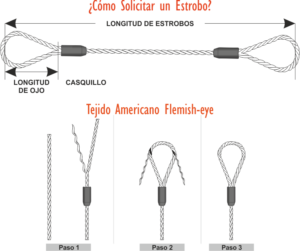
The strobes are transported horizontally deposited without crushing them or forcing their normal curvature and avoiding friction between them.

The strobes are only cleaned with a slightly damp cloth with a degreasing liquid (detergent), taking care to avoid the penetration of liquid by dripping into the bundles of strands.

Crane sling

Slings are flexible elements, designed to lift and handle loads, constructed with tapes woven with the polyester of tenacity to 35 mm to 304 mm wide, with thickness from 3.5 mm to 12.6 mm.

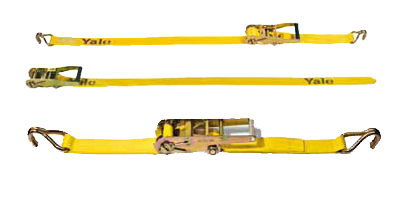
There are slings of one layer (simple), two layers (double), and three layers (triple).

Chains for cranes

The chains are flanges constructed of metal links. They have limited use due to their weight and the fact that their links wear out or deform causing their breaking without warning. Care must be taken to avoid twisting or kinking the chain while it is under load, even if it is light, since the link may break or deform.

They are suitable for lifting heavy loads such as rails, beams, angled profiles, and pipes. For the use of chain flanges, the following must be kept in mind:

  • The links in the chain should be identical to be used in pairs.
  • You have to determine the maximum weight of the load you plan to lift with them.
  • You have to choose the appropriate chain to the load, considering the angle of work.
  • Determine the point of support of the main link that will hold the hook.
  • Select the components (ring, hook or both), and the way in which it is attached to the load.
  • The use of chain ties should be fixed with rings or hooks on each end or the combination of both.
  • Avoid using chain flanges at Tº below zero, as they become fragile
  • Tighten without pulling.
  • Check that all your links lie flat.
  • After being used, store away from moisture and corrosive.
  • Inspect the link weld.
  • No chain must be subjected to a tensile force that exceeds its safety factor, set to 1/5 of its safety factor.

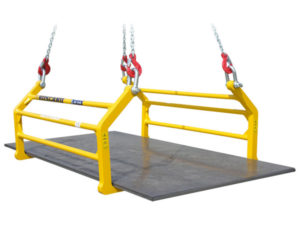
The resistance of a chain is as low as the strength of the most used link, therefore it is necessary to discard any chain flange, even if it is a link that decreases its diameter by 5%, it is corroded, twisted, elongated, flattened, open or simply stuck.

Stainless steel cable ties

Working with simple and composite flanges: In the use of sliding knots, it is very dangerous for the strobe to pass through the eye without having a thimble.

The most frequent work done is to lift a load with a flange vertically, where its traction (F) will depend on the angle and if it is also made with a sliding knot.

With two simple flanges, forming a 90º angle, the traction to which it is subjected is 700 Kg per flange. The weight is still 1000 Kg, but the effort made by the flanges is 700 Kg each. F = 1400 Kg.

With two simple flanges, forming an angle of 120º, the traction to which it is subjected is 1000 Kg, but the effort made by the flanges is 1000 Kg each.

With a simple flange, we can form different angles, where the traction to which it is subjected is F. The weight is still 1000 Kg, but the effort made by the flanges is different. The increase in F is due exclusively to the angle formed by the sliding knot.

How much does it cost to hire a tower crane?

How much does it cost to hire a tower crane?

The typical fee for installation and disassembly runs around $60,000. This price includes shipping the crane to the site, renting the mobile crane used to assemble the tower crane, the cost of the crew that handles the assembly, etc.

How much does a tower crane operator make?

A Crane or Tower Operator will usually earn a wage of around 40000 and 60000 based on education and experience. Crane and Tower Operators usually receive an average pay level of Fifty Thousand One Hundred dollars on a yearly basis.

The most read

More on this story

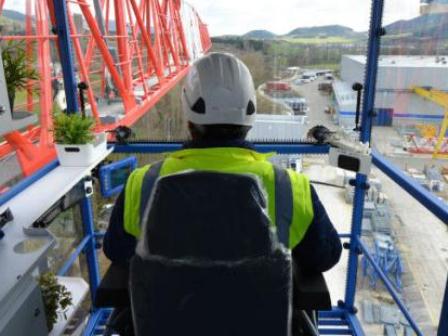
Tower Crane Cab

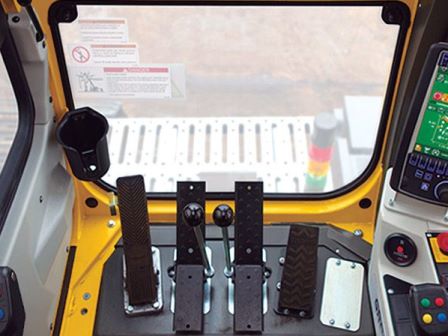
Cab features include improved seat position and access, a USB port and optional Bluetooth. A user-friendly multifunction touch screen emits warning lights and sounds, as well as controls the interior temperature, interior, and exterior lighting and other features.


Remote Control Tower Crane

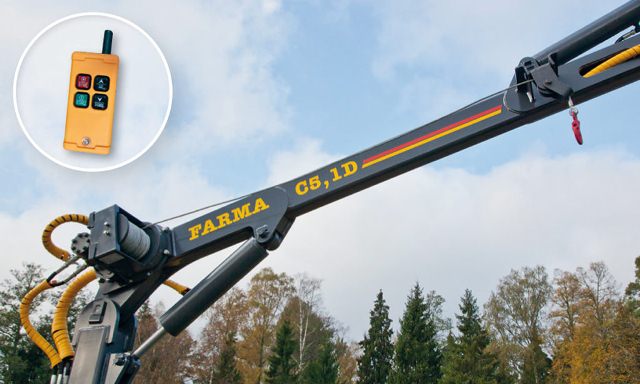
Radio remote controls are now standard equipment on most self-erecting tower cranes and are even becoming common in some parts of Europe for a flat-top tower crane.


Tower Crane Installation

When referring to cranes and maneuvers that are carried out to assemble, disassemble and hoist a tower crane must comply with the protection and safety manuals; adhering to strict control in each of the steps to be taken.

Crane tower assembly

Once the components of the tower crane have been unloaded on the construction site, it is assembled.

This process consists of erecting and mounting the crane on its site and foundations, in such a way that it can be able to provide the function for which it was designed.

Assembly required

The assembly and disassembly personnel must respect all the recommendations contained in the manufacturer’s manual, which must be complemented with the instructions given in writing by the professional responsible for the assembly (university professional or technician with experience in the assembly of tower cranes). Special care must be taken with prevailing weather conditions.

The written order emanating from the professional in charge must contain at least the following information about the crane:

  • Brand, type and model.
  • Mounting heights, initial and final, expressed in m.
  • Pen and counter-feather length expressed in m.
  • A number of elements, position, dimensions, and mass of the necessary air counterweight.
  • Characteristics of the initial and final weights (geometry, dimensions, mass, and ordering).
  • A number of branches of the lifting cable.
  • Supply voltage and a section of the conductors.
  • The bracing program, if applicable, in case the height of autonomy is exceeded.

How are cranes set up?

Stability Conditions:

With regard to the fact that the cranes and maneuvers need stability conditions, before starting the assembly of a tower crane, the following must be done:

A study of the soil mechanics of foundation.

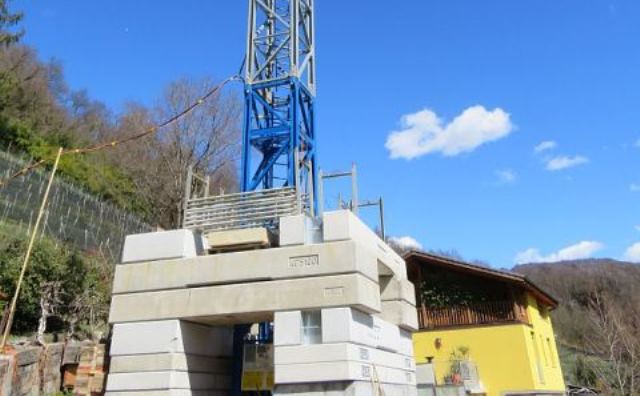
The construction of the basal ballasts and aerial counterweights according to the technical specifications of the assembly manual can be metallic, concrete or bulk materials, in which case they must be contained in a closed and sealed metallic box.

The counterweights and ballasts formed by blocks must bear a mark printed in easily legible and indelible characters, indicating the mass of the same. Each time the crane is assembled, the mass of the counterweight to be used must be verified, and these must always be secured to the structure of the tower crane.

The correct construction of the anchors and their consolidation.

The construction of foundations that adequately transmit maximum gas to the ground, these must be calculated and designed by competent university professionals.

The rails and other elements that are part of the road must be installed according to the provisions of the manufacturer, the fastening of rails must be appropriate to the materials of the structure that supports them.

Tower crane safety precautions

For the use of cranes and maneuvers, the tolerances admitted in the initial installation of the straight and horizontal roads will be the following:

Longitudinal leveling: The surface of translation of the same line of rails, must not present irregularities of a level higher than 1/1000 of the width of the track.

Transverse leveling: The difference of the height between the two lines of rails of the same track, should not be greater than 1/1000 of the width of the track.

How to build a tower crane?

Distance between axis:

The gauge and the tolerances must correspond to those specified in the manuals of the crane manufacturer, the head of each rail must be between two parallel vertical planes, whose separation is equal to the nominal width of the said head plus 5 mm.

  • The slope between rail joints: Must be 2 mm maximum
  • Separation of rail joints: Determined according to the dilatation calculation of the rail
  • Transverse leveling of the foot of each rail: It should be 3 / 1,000 maximum, with respect to a horizontal plane
  • State of the track of translation: The flat surface of the head of the rail, must be centered with respect to the plane of symmetry of the same.

Rolling tower cranes must have adequate means of immobilization to avoid any movement when exposed to the action of the wind. These means must be established according to the specifications contained in the manufacturer’s manuals.

Tower crane jacking process

Assembly Procedure:

In general, the process begins with the assembly of the base of the tower, then the first section is placed, with the diagonals that join it to the base and a part of the basal ballast, then the slide is installed on top of it. locate the tower head and the cabin.

Then the pen and counter jib are placed. The final counterweight is mounted and more basal ballast is added. New sections are installed with the help of the boom of the crane until reaching its final height.

Another way to increase the height is by means of a system in which the tower-cabin-head unit is smaller in section than the rest of the shaft. The new section that has an open side is superimposed on the tower surrounding the upper unit.

Then it goes up inside this new section, newly armed.

Steps for the assembly of a tower crane

  • After the assembly of the cart and the basal ballast, the climbing equipment is prepared.
  • The climbing equipment is mounted on the base section of the tower.
  • The rotating part is assembled, including turning track, cabin, tower head and climbing section, joining the assembly tower.
  • The counter jib is placed.
  • With the hook of the crane, the tower section is placed on the mounting crosspiece.
  • The elements of the climbing system. The assembly tower, the hydraulic equipment, and the support sleeper

The assembly systems have improved remarkably over time, in order to make it faster, more comfortable and simpler, thus reducing the cost of this operation.

The assembly of all the assemblies is done by means of quick joints that do not require the previous alignment.

In addition, the climbing is done by the hydraulic drive and the operators perform all their work from safe and robust platforms, making the whole process even in large capacity cranes very fast.

Operating conditions

Forms of Operation: There are basically three possibilities of operating a tower crane:

  • Through keypad
  • Joystick
  • Using joystick built into the command chair

The first two systems allow remote operation; that is to say; they allow the operator to move to the same point where the work is done, thus achieving greater security in a certain operation.

Usually, when visibility permits, it is operated directly from the command cabin, moving either the keypad or command box of it. And with the help of the signalman, it is possible to make the required movements.

The lever command systems indicated above have the following operating movements:

  • Start-up of the crane
  • Warning horn
  • Load upload (First, Second and Third speed)
  • Lowering of load (First, Second and Third speed)
  • Translating the distributor car forward (First and Second Speed)
  • Translation of the distributor car backward (First and Second speed)
  • Turn to the right (First and Second speed)
  • Turn to the left (First and Second speed)
  • Translation on rails forward
  • Translation on rails backward
  • Emergency stop

Crane operator

The operation of a tower crane must be carried out by a person who duly certifies his professional capacity. Requirements to be a crane operator:

The operator of a tower crane must have a basic knowledge of the assembly, operation, safety and maintenance conditions of a tower crane, as well as the knowledge necessary to interpret the manual and other technical documents provided by the manufacturer of the tower crane, to enable it :

  • interpret a load chart
  • know clearly the importance of the safety mechanisms of each crane
  • its function and its normal location
  • know the importance and behavior of steel cables and know how to put the crane into service correctly.

It is recommended that the handling of the crane is only entrusted to people over 18 years of age, who have a minimum level of schooling, who have passed a psychometric test, equivalent to the driver class A2, absence of diseases incompatible with work, have a high degree of vision and hearing, insensitivity to vertigo and good reflexes.

They must also attend a training course (in Operators and Requirements and responsibility, it was established that the operators that have more than one year of duly accredited professional experience, will be able to opt for the corresponding training or professional accreditation of 25 hours and the operators 25 that have been started after 1999 must attend a course of 150 hours, after which they will obtain a card) and undergo periodic medical examinations (worrying exams).

Crane operator responsibilities

At the beginning of the working day, the operator must make and record the following verifications:

  • Check that the rails are aligned and correctly secured.
  • See that the road is free of obstacles.
  • Control the consolidation and alignment of the basal ballast and the counterweights.
  • Observe possible oil leaks in the gearboxes.
  • Check the operation of the controls of the tower crane, operating it without load.
  • Check the good condition of the travel limiters of the carriage and the hook.
  • Check the condition of the steel cables.
  • Verify the proper functioning of the safety lock of the hook.
  • Verify that the handle of the straps has not suffered wear or deterioration in the weld
  • that the components of the closing of the gate of the mats work correctly, verifying especially, the absence of round fluted construction iron in any supporting element.
  • Verify that the flanges do not have cuts or other damages.
  • Inspect the metal structure to detect possible bends or deformations of its components.
  • You should worry about the order and cleanliness of the cabin, the walkways, the ladders, and the rails.

In case of any anomaly or damage, the crane operator must stop the tower crane and immediately inform his superior.

During the execution of the entire work, a daily report must be kept in which the time worked and the operational news is recorded.

Crane operation safety

When the conditions of vision are not optimal for the operator, he must obligatorily request a signalman to the work for the help of the cranes and maneuvers.

The signalman must know the international code of signals for the operation with tower cranes, which is based on indications with hands and arms.

The signals of this code are regulated by the Tower Cranes Standard. Operating conditions and to be directly understood with the operator of the tower crane.

This code is formed by simple signals, easy to execute and interpret and that also does not produce physical exhaustion since the movements are natural and logical.

Crane safety procedures

Signal Technique: When crane and maneuvers are used, the technique of these signals is mainly based on the following:

  • A hand on the waist indicates working at normal speeds, in any maneuver.
  • A hand on the chest indicates working at slow speed, in any maneuver.
  • The two hands up to indicate normal stopping.
  • The two hands on the sides mean stop immediately.
  • All signals must be executed calmly and safely, any doubt or acceleration of a signal will only confuse the operator.
  • The signalman must be careful to always be in sight of the operator of the crane.

Crane safety signs

The signals that are normally used are:

  • I take the command.
  • Upload normal.
  • Upload slowly.
  • Download normal.
  • Normal right turn.
  • Right turn slow
  • Truck on the right with normal speed.
  • Truck on the right with high speed.
  • Normal detention
  • Car on the left with normal speed.
  • Car on the left with high speed.
  • High of urgency.
  • Change of branch.
  • End of command.

In important works, it is also recommended to have a radio communication system, to complement the corresponding orders to the operator as far as the tasks to be done and their correlative order; in this way, the isolation is avoided when the operator works in the cabin.

Tower crane safety

Interruption of work: The cranes and maneuvers, are very sensitive to the wind and whenever this exceeds the speed of 64 km/hr, or even if the wind has a lower speed and loads of large surface are handled, the work must be paralyzed, leaving the pen in ” weathervane “, so that it does not resist the wind and, therefore, its overturning does not occur.

The work of the crane must be interrupted in the face of adverse weather conditions such as presence of frost, when it represents an overweight due to accumulation in the structure or hinders the descent of the hook when it is empty; also when there is no good visibility due to the presence of fog and the proximity of an electrical storm.

Reasons: The work of the crane must also be interrupted by anomalies in the installation or in the operation, such as:

  • A bad condition of the lifting cable or flanges.
  • The poor winding of the lifting cable in the drum.
  • Intermittent power supply and/or loss of phase symmetry.
  • Defects in the braking operations of some movement of the crane.
  • Loss of lead in the structure.
  • Lack of adequate lighting.

Tower crane maintenance

Maintenance work must always be carried out with the crane disconnected. Maintenance work that can not be carried out from the ground, must be done from scaffolding or appropriate platforms.

If the maintenance work can only be carried out with the crane in operation, it must be ensured that:

  • There is no risk of a person being trapped or falling.
  • The people who must carry out this work move away from elements through which the electric current passes.
  • These people can communicate with the crane operator by word or by means of signals.

Tower crane safety checklist

Verifications:

The cranes and maneuvers that are made with electrical energy must be verified by a specialist before the first putting into service or before being put back into service after having been subject to major modifications. Cranes with a load capacity greater than 1000 Kg must also be verified.

The verification prior to the initial commissioning of a new crane is not necessary if the crane has already been verified beforehand and is accompanied by the corresponding documentation.

According to their own characteristics and local circumstances, the cranes must be checked by a specialist at regular intervals, but at least once a year. In addition, tower cranes must be inspected by authorized persons whenever they are assembled or when their characteristics change.

Registration of verifications The results of the verifications according to the above must be recorded in a verification book that can be consulted at the request of the researcher.

Maintenance costs have always been a concern and progress is being made on a continuous basis in the reduction of lubrication points and in the placement of materials that allow space to be maximized in maintenance operations and incorporating components that do not require maintenance.

Tower crane disassembly

To start the dismantling of this crane we must first have the right personnel to carry out this work, that is to say, that each person has the relevant safety talks, safety elements, and work disposition.

Once the supervisor has checked the conditions of the ground, you can determine with what support crane you should proceed to do this work considering the height and the radius.

Once you have all the aforementioned, the first thing to do is to dismantle the tower crane the number of sections, which are necessary for the reach of the auxiliary crane.

With the lifting cable of the tower crane, the pass must be made that allows the aerial ballast to be removed. Depending on the length of the boom of the tower crane, a ballast is left or not in the counter boom.

Then the lifting and carriage cables are removed to leave the boom released from these elements, then the passes are made with the lifting cable between the boom and the turret.

Crane outrigger safety

Auxiliary crane:

With the cranes and maneuvers you must have an auxiliary crane, that the pen has to be locked in the points that allow the balance of this piece, when it is fully in the air it must be hoisted a bit with the auxiliary crane in such a way, that it releases a little the traction exerted by the piece due to weight effect.

Then with the lifting of the crane must be tensioned to remove the pins that join the strut of the pen with the turret, achieved this lowers the elevation until the strap is completely housed on the back of the pen, at that time you can remove the fastening pins.

So that the feather is totally in the air, ready to lower it to earth, and in this way make its subsequent disarming and loading on trucks.

Disarmament and carriage

Then the air ballast should be removed according to the length of the pen should be left, so that this serves as a counterweight before removing the pen, then removed the counter-feather, stroking this piece with the auxiliary crane stands up to remove the pins of the braces and then remove the pins of subjection of the counterjib, and take it to earth for its later disarming and loading.

After the turret was broken in the upper part, the connecting bolts of sections are removed and this piece is ready to take it to earth.

Next, the scaffolding and the hydraulic pump must be removed from the center of the tower, then the track seat or cabin section of the upper part must be damaged, the bolts must be removed, and this piece must be grounded. After this, the tower sections can be removed according to the need and capacity that is required at that moment.

Now we proceed to remove the basal weights, if the tower crane is in the simply supported version, then the diagonals are removed joined by a pin at each end, this way the basal section is left free, to remove this piece and able to carry out the dismantling of the chassis that is also joined by tower connection bolts.

Finally, the connection is made from the earth that is usually on one side of the crane chassis, an evaluation of the work is made and a report is finally drawn up for this work.

Applications of cranes and maneuvers

There are different systems and sizes of cranes and the technical requirements that these cranes must meet are not the same in all countries.

The most commonly used cranes are the quick application cranes that move as a compact unit and can be assembled without the need for other auxiliary means.

Tower crane manufacturers

Tower cranes in the world:

  • Europe and Germany represent the largest construction market.
  • In Southeast Asia and the Far East market, almost exclusively turntable cranes with needle boom or articulated boom are used almost exclusively.
  • In the construction of tall buildings, telescopic cranes are preferred, since in this field it is almost impossible to use a tower crane and its complicated assembly is not so relevant since labor is less expensive in this region.

How do you assemble a tower crane?

How do you assemble a tower crane?

When referring to cranes and maneuvers that are carried out to assemble, disassemble and hoist a tower crane must comply with the protection and safety manuals; adhering to strict control in each of the steps to be taken. Once the components of the tower crane have been unloaded on the construction site, it is assembled.
This process consists of erecting and mounting the crane on its site and foundations, in such a way that it can be able to provide the function for which it was designed.

What is the difference between tower crane and mobile crane?

The biggest difference between mobile cranes and tower or fixed cranes is their mobility. As their names suggest, fixed cranes are fixed to a single spot once they have been set up. Whereas, mobile cranes can be moved as needed. The mobility of a mobile crane holds many advantages for any construction site.

What is a tower crane?

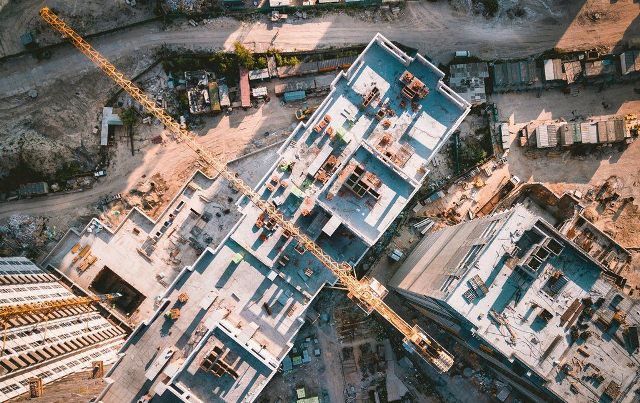
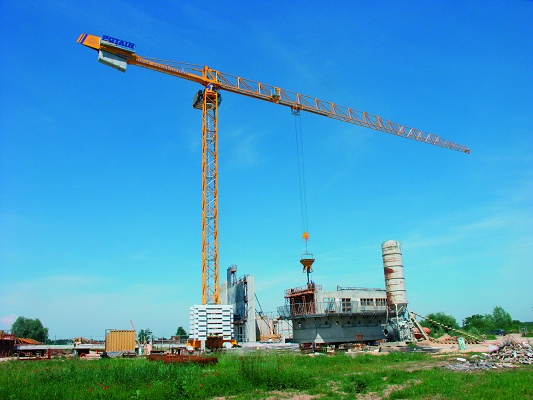
The tower crane is a fixed Crane and has to be mounted On-Site. The Tower Crane presents itself like a vertical metallic structure having a horizontal boom that can turn over an angle up to 360°.

How long does it take to become a crane operator?

There are some prerequisites you need to attain to be a crane operator. The initial training is your initial step. You still have to go through rigorous apprenticeship training that usually lasts about 1 to 4 years, though you will be paid for doing the apprenticeship training.

Should I become a crane operator?

Most crane operators get their experience through on-the-job training or apprenticeships. Apprenticeship candidates generally must be 18 years or older, have a school diploma or equivalent and be in fit physical condition.

The most read

More on this story

Remote Control Tower Crane

Radio remote controls are now standard equipment on most self-erecting tower cranes and are even becoming common in some parts of Europe for a flat-top tower crane.

Tower crane Operator

Tower Crane Operator: tower crane operator job description, a day in the Life of a Tower Crane Operator, Crane and Tower Operators.

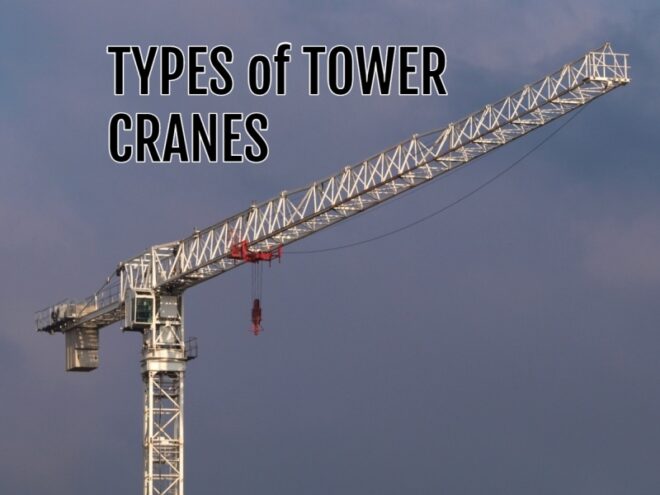
Types of Tower Cranes

In the distance, you can see these huge loading machines, very similar to each other and fulfilling the same function; be combined vertical and horizontal transport equipment, however, when looking at them carefully, it can be verified that in fact, the types of tower cranes are very different from each other.

Types of Tower Cranes

Types of construction cranes

Classification of tower cranes: How many types of tower cranes are there and what are they? Due to the reach and height, they can develop they are used a lot in the construction of tall structures. Tower cranes can be classified according to:

The way it is assembled

Automatic Crane

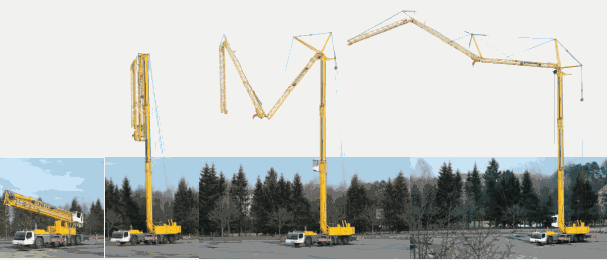
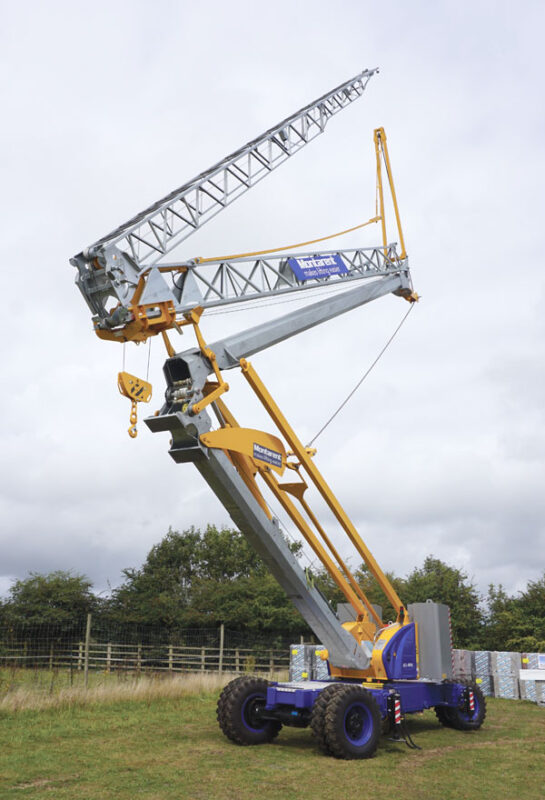
Automatic Crane (GA): It is the one that comes with its folded tower and boom, with the separated cable runs, with their counterweights generally placed. You just have to level it, deploy it and at the time it is armed, it can be calibrated.

Tower crane: It is one that is assembled by sections, helped in its first part by a motorcycle crane. Then we continue adding cloths through an assembly operation.

Mobile Tower Crane

It is the combination of the previous two and in addition, you can add some sections. The use of this type of cranes in the construction of small heights and open spaces has already become very popular.

Generally, small capacity models have been used. Nowadays, however, there is a wide range that includes cranes up to 140m / t.

These cranes are easily portable since they can be sent as compact units in a trailer, with their counterweights, even large capacity ones.

This type of cranes has incorporated the possibility of climbing to achieve greater heights of employment, so that the advantages of a rapid movement from one place to another, is added the possibility of using them in higher constructions.

The development trends of these cranes have been aimed at achieving greater possibilities of installation and assembly that can be summarized in the following:

  • Easily save obstacles such as antennas, chimneys, and adjacent buildings, by using the crane by raising the boom at an angle of 45º.
  • Reduce the radius of rotation of the base by modifying the design of the base and the counterweights.
  • Allow the assembly of them boom to be carried out in increasingly reduced spaces by means of joints and folding of the same.
  • Achieve higher heights through simple and fast climbing processes.

For the form of support of the crane

Rolling Tower

It is the crane model most used for the construction of blocks of apartments and in buildings of isolated towers, they allow to move the crane with a load on a previously studied and installed on-site road. Given the importance of the routes of translation for a good performance of these teams, it is convenient to respect all the security measures that are adopted in these cases.

Fixed Tower Crane

In this version, the crane is located static at a point, on a chassis and distributed in the circle area encompassed by the boom. The assembly of this lifting equipment on site can be through the following procedures:

The embedding of a concrete block of dimensions according to the resistance of the ground and the weight of the ballast. Normally this solution is used in those works where the crane chassis cannot be assembled, due to lack of space. In general, its height of autonomy decreases.

On the base chassis, without wheels, resting on a resistant slab, with convenient base ballast.

Bolted the base chassis to some slab or beams of adequate strength. In the case of cranes of climbing version, on their frames or rings conveniently fastened to the floors.

Crane climbing

It is a mounting system that allows the tower crane to increase in height by moving inside the building as it increases in height. All its horizontal and vertical loading efforts are transmitted to the building through supporting structures.

This type of system has a drawback in its disassembly, which is slower because it is done on the terrace of the building, which is generally of variable geometry, in this area you have to anchor the equipment necessary for disassembly, which must be calculated and designed in advance. Nowadays this type of fixed tower crane is little used.

Stationary crane

Crane Tower Anchored to the Building or Braced:

When a tower crane exceeds its rolling height determined by its stability, in work and out of service, exposed to excessive wind speed, it is necessary to secure it, anchor it, if the crane is close to a building, and braking it by means of winds if The crane is in a clear work.

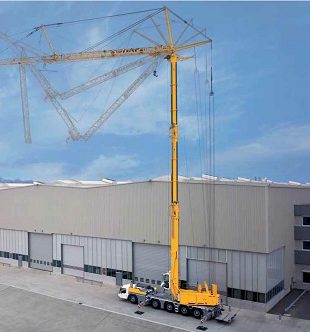
Tower crane truck

This type of crane, a combination of an automobile crane and a tower crane, represents a practical alternative to the conventional truck crane since the advantage of the higher starting height of the boom is added to the same speed of transfer between different work points. that has the incorporation of the crane.

By the shape of the Crane boom

Horizontal boom tower

Currently, tower cranes of 4000 m / t are available, which can operate with freestanding heights of up to 300 m. A crane of this size can lift 37 tons at a radius of 80 m and its maximum load is 80 tons. Even modern engineering allows installing a second auxiliary crane on the counter jib of these giant cranes.

Tower crane with articulated boom

This type of crane allows varying the geometry of the use of the boom, being able to be used in a horizontal position, obtuse angle, and straight.

This characteristic makes them especially suitable for certain constructions, such as cooling towers and TV towers. Its design allows maximum height and a smaller number of bracing for similar towers.

Tower crane with a folding boom

This type of crane is especially suitable for use in narrow areas and in areas where there can be no interference between installed cranes. The possibility of moving the jib between angles of 15º and 70º allows clearing the obstacles of its radius of action in a very simple way.

Concreting towers

As a variant of the use of interest, this application can be pointed out, since by eliminating the jib and the counter-feather from the standard models, there remains a rotating mobile tower in its upper part.

Adapting to this set a concrete pump, it is possible to unite for the distribution of the concrete, the advantages that concur in the two means employed. Even this variant of use is possible using the crane in the double application, as a tower crane, and as a support for the concrete pump.

City Crane

Crane city “City Crane”:

This type of cranes is being used especially for the construction work in places already built, such as in the renovation of buildings in the old areas of the cities, close blocks to each other, restoration of facades, timbered historic buildings.

Cranes are needed with a technology capable of solving the specific problems of this type of construction and for example are: little space between the building and the street with a very small sidewalk, very narrow streets, mounts to be made in courtyards, elevator shafts or opposite side of the street and this with additional difficulties such as traffic cannot be closed completely or for a very short time, floors with low capacity to support loads, etc.

These cranes are specially designed to be assembled with a very small number of sequences and must offer the following basic characteristics:

  • The base that occupies a small space and that is also capable of supporting the loads per corner to which they must be subjected. These bases usually have a cross shape and should be easily convertible into a cart to install on track.
  • Towers of the reduced and compact section to allow their installation in very small holes and to save transport space

By the way of Giro

Crane Tower of the basal turn

It is the one in which the turn occurs in the lower part. Its height is limited.

Tow crane Tower top

It is the most frequently used, its rotation occurs at the top and allows to achieve a greater height.

The constant demand for this type of cranes has produced a considerable advance in the techniques of drive and control. The application of display systems in relation to electronic function packages and system solutions has brought with it, new dimensions for performance and safety.

How do cranes get to the top of skyscrapers?

How do cranes get to the top of skyscrapers?

While that’s the most common method, there are actually three ways:

1) the external climbing method, in which the crane -the arm plus its tower- expands upward along the outside of the building.
2) the internal climbing method, in which the crane builds a few floors at a time from the inside and then “jumps” to a higher spot.
3) the “sky crane” method of airlifting in a crane on a helicopter. (Engineers at 1 WTC are using both of the first two methods.)

What is the difference between a crane and a derrick?

Cranes and derricks are hoisting machines used to lift and move heavy loads in such places as factories, shipyards and construction sites. Most derricks are stationary while most cranes can move from place to place under their own power. Engineers, however, sometimes use either name to describe the same machine.

what are the different types of tower cranes?

-Luffing tower crane. ​​
-A-frame tower crane.
-Flat top tower crane.
-Self-erecting tower crane.
-Portal tower crane.
-Remote control crane.

Who invented the tower crane?

Hans Liebherr. They invented the very first mobile tower crane, which was, as its name would suggest, a crane that construction companies could move around while still enjoying the benefits of the tower crane. Hans Liebherr helped develop the mobile tower crane in the late 1940s with the help of a team of design engineers.

How tall is a crane machine?

Tower crane, hoisting machine for lifting heavy loads and transferring them from one place to another, ordinarily over distances of not more than 200 ft (60 m). Cranes have a long reach and can lift loads to great heights.

How much can a crane lift?

The maximum load that the crane can lift is 18 metric tons (39,690 pounds), but the crane cannot lift that much weight if the load is positioned at the end of the jib. The closer the load is positioned to the mast, the more weight the crane can lift safely. The 300 tonne-meter rating tells you the relationship.

How tall is a crane?

Generally, when anchored to the ground, a tower crane can’t be much more than 265 feet tall. They can be much taller if they are secured to a building as the building rises. The maximum jib reach is approximately 230 feet, and the maximum weight it can lift is 19.8 tons or 18 metric tons.

Tower Crane Pictures

The most read

More on this story

Tower Crane Cab

Cab features include improved seat position and access, a USB port and optional Bluetooth.

Remote Control Tower Crane

Radio remote controls are now standard equipment on most self-erecting tower cranes and are even becoming common in some parts of Europe for a flat-top tower crane.

Tower Crane Parts and their functions

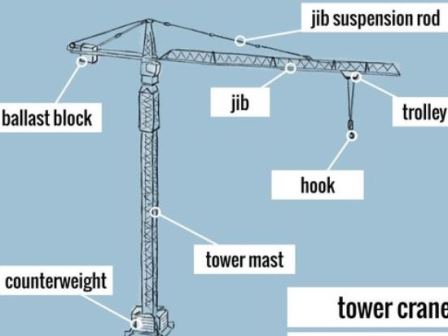
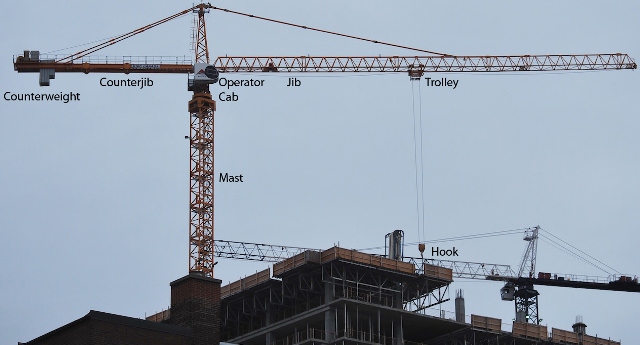
The tower crane is composed of several parts that are fundamental to perform the work in the construction of a work, these parts are:

Tower Crane Parts

Tower crane mast

It is a metal lattice structure with a normally square section, whose main mission is to provide the tower crane with sufficient height.

Normally it is formed by lattice modules that facilitate the transport of the crane. For assembly, these modules will be joined by screws, all of which will be connected to the projected height. Its shape and dimension vary according to the necessary characteristics of weight and height.

In the upper part of the mast is the rotating are which gives the crane a 360º horizontal movement. Also depending on the model, you can have a cabin for its operation by an operator.

Tower Crane Parts

Tower crane jib

It is a metal lattice structure of a normally triangular section, whose main mission is to provide the crane with the necessary radius or range. It is also called a jib. Like the mast, it usually has a modular structure to facilitate its transport.

To move the specialized personnel during the assembly, revision, and maintenance work along the jib, there will be a longitudinal element, a safety cable, to which the safety belt carabiner can be attached.


Tower crane jib

Tower crane counter jib

The length of the counter-jib oscillates between 30 and 35 of the length of the pen. At the end of the counter-jib, the counterweights are placed. It is attached to the mast in the area opposite the union with the jib.

It is formed a robust base formed by several metal profiles, forming on them a kind of catwalk to facilitate the passage of personnel from the mast to the counterweights. The sections of the profiles will depend on the counterweights that will be placed.

Tower Crane Parts

Tower crane counterweight

They are structures of concrete prefabricated that are placed to stabilize the weight and inertia that occurs in the jib of the crane. They must stabilize the crane both at rest and in operation. Both these blocks and those that form the ballast must have identified their weight legibly and indelibly.

Counterweight crane tower

Tower crane ballast

It can be formed by a buried shoe or by several pieces of prefabricated concrete at the base of the crane.

Its mission is to stabilize the crane against its weight, the weight it can transfer, and the adverse environmental conditions

parts of the equipment of a tower crane

Tower crane trolley

It consists of a car that moves along the jib through some lanes. This movement gives the necessary maneuverability in the tower crane. It is metallic so that it supports the weight to be lifted.


crane truck and electric hoist tower

Tower crane hook

The lifting cable is one of the most delicate parts of the crane and, to give an adequate performance, it must be used and maintained correctly.

It must be perfectly tensioned and a periodic follow-up will be carried out so that, during its winding in the drum, it does not cross over, as it would cause crushing.


cables and tower crane hook

Operator Cabin

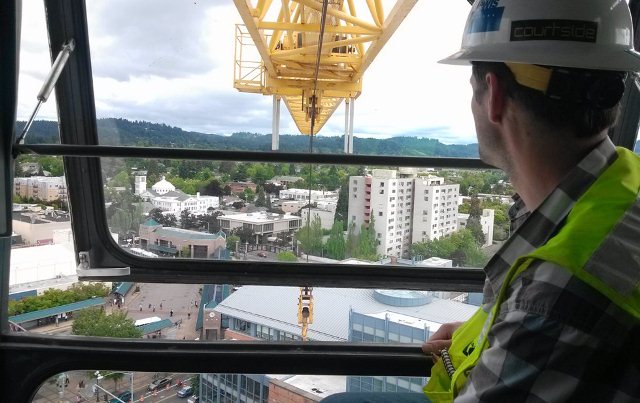
The movement of the crane is controlled from the operator’s cabin. Within the cabin, you’ll find the operator’s chair with joystick controls, electronic monitoring devices, and communication systems. Many cabins come with climate control to ensure a comfortable work environment. The operator cab is part of the slewing assembly.

Slewing Ring

The slew ring drives the rotational movement of the slewing unit (jib, counter-jib, cab, and tower top). Powered by the slewing gear drive, the slew ring is fixed to a ball track and is made up of several hundred precisely machined gear teeth. The slewing ring is capable of enormous torque, yet precise movement.

Tower crane erector

Top Climbing Unit

The top climbing unit is an essential piece of any tower crane. It enables tower crane sections to be inserted and connected to the tower. A large hydraulic jack then lifts the Slewing Assembly, Jib, and Counterjib one tower section higher. Another section can then be inserted. The top climbing unit adds tower sections to the tower crane; the bottom climbing unit keeps the tower at the same height but raises the whole crane up, repositioning it at a higher point inside the building.
Bottom Climbing Unit

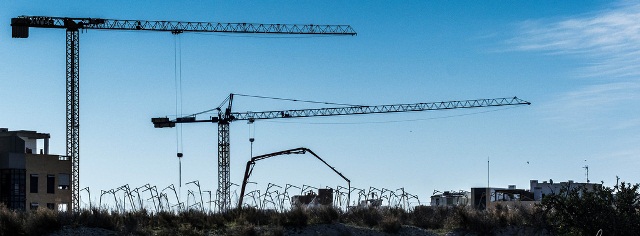
Climbing inside buildings is made possible by the bottom climbing unit. Climbing collars are used with a hydraulic power pack to lift the tower sections upward. The crane is completely supported by the structure of the building it is constructing. This leaves the lower levels of a building accessible for finishing work.

Bolts and Pins

Secure connections are an essential component of any tower crane. Anchor bolts must be of high tensile strength and pins and other bolts should be routinely re-torqued according to manufacturer specifications.

Tie-in

A tie-in secures the tower mast to a structure or framework and provides stability when the crane is under load or experiencing wind forces. The number of tie anchors is calculated by taking into account such factors as the type of crane, jib length, height under hook, and maximum out-of-service wind speed.

Tower crane spare parts

Parts of the tower crane that need spare parts and maintenance:

  • Fixing Angle For Tower Crane
  • High-Quality Tower Crane Spare Parts Anchorage Frame
  • Tower Crane Slewing Control Panel
  • Mast Section
  • Tower Crane Trolley Control Panel
  • Tower Crane Hoisting Control Panel
  • Crane Travelling Mechanism
  • Tower Crane Trolley Mechanism
  • Tower Crane Hoist Mechanism

Tower Crane Costs

Costs vs Savings: Tower cranes are expensive, but when used properly, they can save contractors 50% of their material-handling budget. When compared to mobile cranes, a popular alternative, tower cranes offer a significantly wider radius and easier, compact placement.

For contractors who cannot afford a tower crane, these cranes are also available to rent.

Tower Crane Safety

Operation & Safety: Tower cranes regularly come under scrutiny due to their large size, perch, and prominence in the construction field. This scrutiny is especially heightened after accidents and other incidences. Many of these situations typically involve equipment defects, and inadequately-trained crane service personnel or operators.

Scrutiny needs to be handled proactively through safe, and informed operational procedures, like having an extra man on hand to avoid tower crane collisions when more than one crane is present. Another preventative safety measure mandates crane service personnel to be properly trained to recognize defects, damage, and other hazardous potentialities.

Anchoring

Anchoring & Training

Most all cranes are heavy, but tower cranes are specifically top-heavy. This top-heavy structure requires precise, strong, and well-maintained anchoring to a steady foundation. In order to keep this anchoring secure, the crane operator must be well-trained and experienced, as jerk movements, side and shock loading, fast swinging, and abrupt stopping can all cause the crane, anchor, and concrete to prematurely wear due to stress.

Tower Crane Repair

Repair & Maintenance: Crane service maintenance and repair are often looked at as a troublesome expense when they should be considered a cost saver. If you’ve ever had a tower crane break down or been involved in an accident, then you understand why. Finding fully-trained technicians who know to spot defects before they happen, who know which tools to use, and who can properly inspect their welds, is much easier said than done

What are the Parts of a tower crane and their functions?

What are the different types of cranes?

The tower crane is the most common in buildings. This is attached to the ground (or to some attached structure). Due to the reach and height, they can develop they are used a lot in the construction of tall structures. The lattice horizontal beam is called a feather and the vertical pillar is called a tower. 

Telescopic cranes are another form of heavy cranes used to transport and maneuver objects from one place to another. The telescopic crane usually has the particularity, that distinguishes them from all others of owning a pen also called a “Jib” that inside carries more than one cylinder.

What is a tower crane operator?

Tower crane operators are specialists in the construction industry who operate a specific piece of heavy machinery that lifts, transports, and moves construction equipment and materials all over their construction site

How much do high-rise crane operators make?

In 2017, the Bureau of Labor Statistics indicated that the average, annual crane operator salary was $55,500. Experienced crane operators who are working on large-scale projects may make as much as $84,250. Most experience is gained at a construction site.

Is being a crane operator dangerous?

And even though crane accidents aren’t always caused by negligence, more often than not, they are preventable. While workers face many dangers on construction sites, crane operators are often at risk for catastrophic injuries.

Who is a crane operator?

A Crane Operator’s primary responsibility is moving objects from one place to another using one of many types of cranes. Crane Operators may be employed by a company or operate as independent contractors, using their equipment.

The most read

More on this story

Tower Crane Parts Diagram

A tower crane is a large piece of construction equipment used to lift and move heavy materials on construction sites

Tower Crane Accessories

Tower crane parts are one of the key products, and with our experience in producing mast sections, and counterbalance jibs, now we could provide the world with high-quality tower crane parts.

Remote Control Tower Crane

Radio remote controls are now standard equipment on most self-erecting tower cranes and are even becoming common in some parts of Europe for flat-top tower cranes.

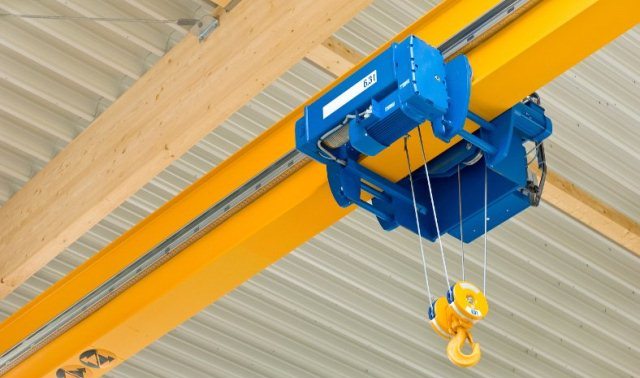
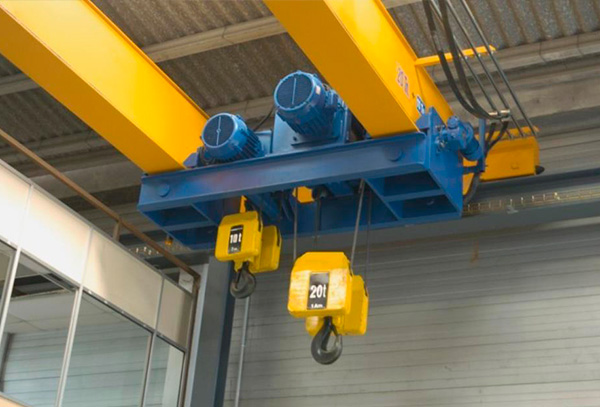
Overhead Crane Design

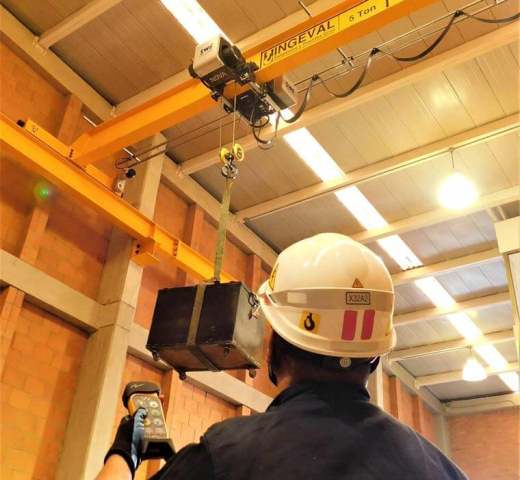
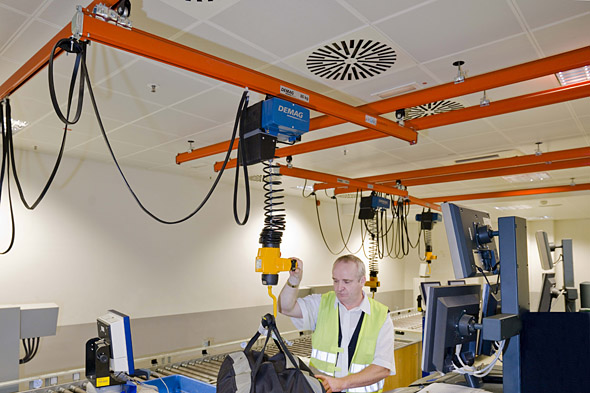
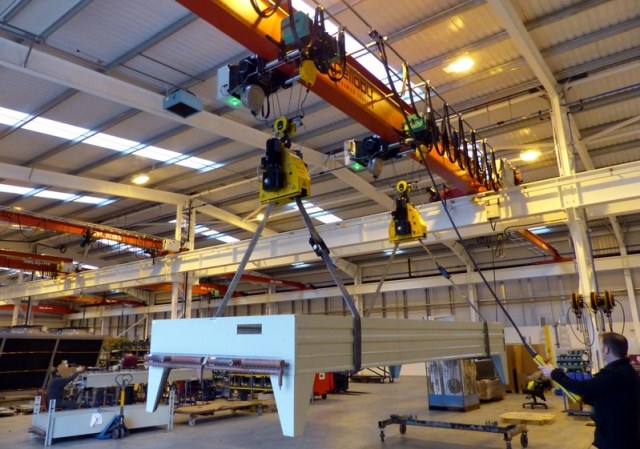
The overhead crane needs several components to lift loads, including the hoist. The design and loading of this equipment correspond to the needs of the job.

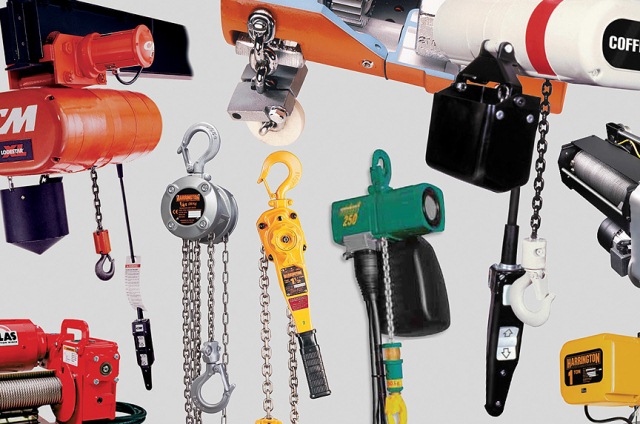
A hoist is a machine composed of a system of pulleys that allow lifting a load exerting a force less than the weight to be moved.

A hoist is a device used for lifting or lowering a load by means of a drum or lift wheel around which rope or chain wraps. It may be manually operated, electrically, or pneumatically driven and may use chain, fiber, or wire rope as its lifting medium. The most familiar form is an elevator, the car of which is raised and lowered by a hoist mechanism. Most hoists couple to their loads using a lifting hook.

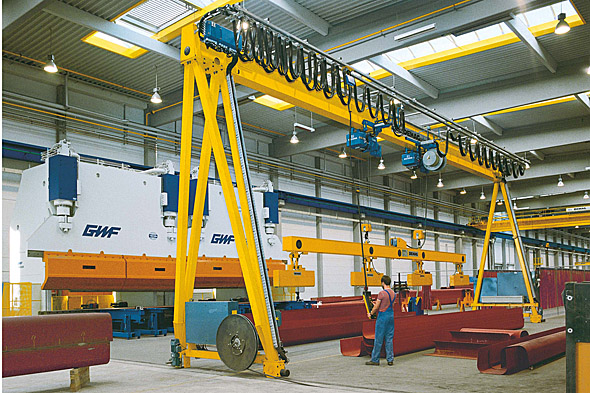
What is an overhead crane?

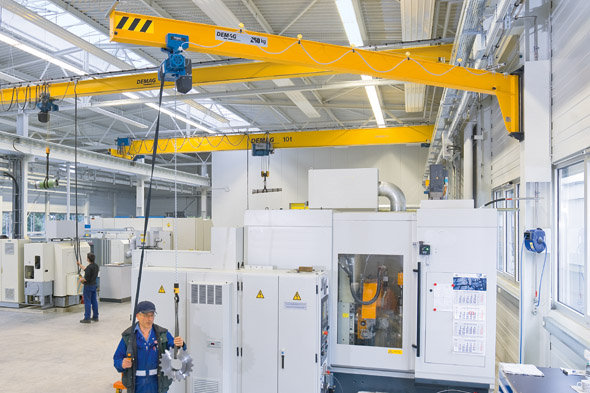
Overhead cranes are mobile tools designed to carry cargo from one place to another, they are suspended at high altitudes, generally above 15 yards. The displacement of the traveling cranes can be horizontal or vertical.

What is the hoist?

The hoist or rig is a machine composed of two or more pulleys and a rope, cable, or chain that alternately goes through the various throats of each of those. They allow lifting a load exerting a force less than the weight that must be moved.

How do hoists work?

The use of the pulleys minimizes the effort required to move the load. They can have different sizes or lifting powers.

The small ones are manipulated manually and the bigger ones have incorporated an electric motor to make them work.

Depending on the load to be loaded or unloaded there are many types of hoists.

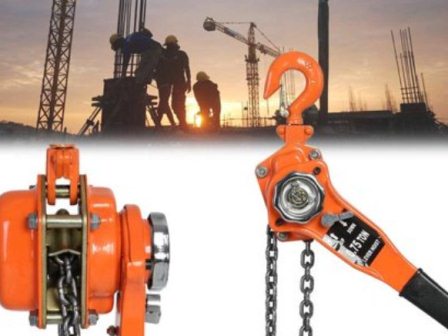
Some are electric, others use manual force or levers to exert their power with the help of chains, cables, branches, hooks, clamps, magnets, and other accessories with similar characteristics.

What is a hoist used for?

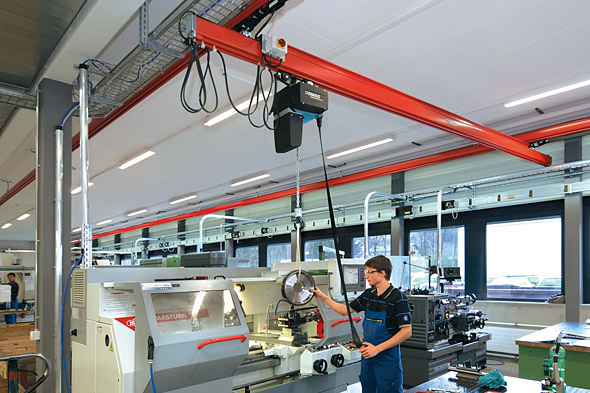
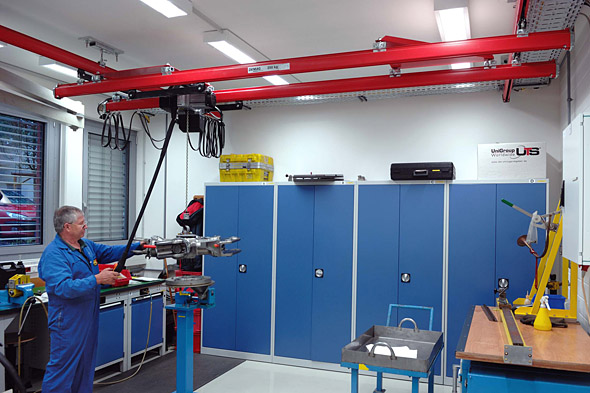
A hoist is a tool that is used in workshops to lift or move loads easily.

Its utility lies in the fact that it is hardly necessary to apply force to move a weight, for this reason, the hoists are usually attached to a rotating arm that is coupled to a machine or on the roof of the workshop, fulfilling different functions.

The hoist has a different lifting capacity depending on the load that can be lifted.

This capacity can be increased by increasing the number of branches. An example: a hoist with a branch that can lift 500 kilos can be extended with another branch to raise 1,000.

The hoist is controlled by a control panel that must be perfectly visible and easily understood by the operators:

  • Green or white button: On
  • Red button: Stop
  • There is usually another button for the emergency stop, red on a yellow background. The stop order has priority over the others.
hoist in overhead cranes

Lifting hoisting equipment

Where are the hoists used mainly? For lifting and moving heavy loads, hoists are usually used together with a crane in:

  • Mechanical workshops: in hobbies, hoists are used to lift heavy parts of vehicles, for example, the engine.
  • Metallurgical industry: the large containers in which the metal is cast are transported from one side to the other by means of hoists.
  • Warehouses: when packing products or merchandise in large quantities or very heavy concentrations, the hoists are used. Also at the time of classifying and inventorying.
  • Airports: hoists are used at airports to move luggage and to transport it from the warehouse to the plane and vice versa.
  • Maritime ports of embarkation and disembarkation: here its function is combined with that of the cranes. Hoists transport loads between ships or from one part of the ship to the other.
use in industry

Types of hoist

They can be classified according to these parameters:

According to your number of throats:

  • Simple rigging. When one of the pulleys has only one throat
  • The rest are called double rigging.

According to the way in which they multiply the force:

  • Factorial: the greater the number of moving pulleys, the greater the force applied.
  • Potential: multiply the force by 2 and raised the number of pulleys.
  • Differential: the force depends on the difference between the length of the radius of both pulleys.

According to the material of the branches:

  • Of rope.
  • Of cable.
  • Chain.

According to the power applied to the machine:

  • Manual.
  • Hydraulics
  • Electric

Industrial hoist

The correct use of a hoist: One of these frequent risks are falls or projections of objects, which can be caused by defects in the mechanism or by unforeseen circumstances. Therefore, it is essential to follow some safety tips:

  • Periodically check the elements responsible for lifting, to check that they are in perfect condition (for example, check that there are no breaks or signs of wear in the links of the chains). These elements must be made of strong and resistant material, mainly forged steel.
  • The chains or lifting elements will be placed on shafts or pulleys that have grooves, to prevent them from twisting when rolled.
  • You also have to monitor the hooks, since they are responsible for preventing the load from falling. They must also be wrought iron and incorporate some security elements, for example, latches that ensure the load.
hoist manipulation

Chain hoist safety practices

Precautions for using a hoist:

  • Check the maximum user load of the hoist and do not exceed it.
  • Make sure that the chains and metal cables have the proper lubrication.
  • Immediately replace any worn metal chain or wire. Label any defective chain or cable and keep it out of service.
  • There are hoists that can be driven in different directions but even so, it is preferable to pull as straight as possible. Lateral traction increases wear and can even be dangerous.
  • Follow the maintenance program recommended by the manufacturer.
  • Make sure there is no person around the load before lifting it.
  • Avoid tilting the load since it can become unstable.
  • Avoid lifting the load more than is really necessary.
  • Do not leave suspended loads unattended.

Overhead crane safety

General practices in the use of a hoist: When operating a hoist, there are certain practices that must be followed. When this tool is used, there is an operator and, in some cases, an assigned supervisor or a bookmark.

All persons involved must understand the procedures for the control and execution of maneuvers with the hoist.

The operator must be familiar with the characteristics of the equipment, as well as understand and follow all the safety rules.

hoist operator

Safety first

A hoist, crane, or forklift must never raise a load greater than the capacity for which they are designed. The only exception is for evaluation purposes.

If a hoist is used for standard lifts that require more than one person, there must be a marker.

This person must be at the lifting site throughout the operation. If only one person operates the hoist, she takes full responsibility.

The designation can be made in various ways, including detailed verbal instructions, written instructions and responsibilities that are clearly defined in the organizational structure of the team.

Supervisor responsibilities

The responsibility of the supervisor is to ensure that the people involved in the operations with the hoist understand the correct way to hoist.

This ensures that the weight of the load and the safe conditions of the site are determined in an appropriate manner.

The supervisor must ensure that the hoist is properly prepared, located, and operational. You must also assign a bookmark when necessary.

In addition, the supervisor is responsible for ensuring that all lifting operations are efficient and safe.

If any potential danger is identified, the supervisor must stop the operation. If an accident occurs, the supervisor is the person to turn to.

hoist supervision

Overhead operator

Pointer and operator practices: The leader directs the lift, and ensures that the load is balanced and secured before being raised more than a few centimeters.

It also checks the load path for possible obstructions.

The operator also has an important role. For example, before starting the lift, make sure there are no kinks in the chain or cables and that multiple lines are not rolled.

If there is no full stretch in the chain or cable, the operator of the hoist must adjust the line on the gear wheel, on the pulley, and so on until the loose part has disappeared.

Electric winch hoist

Differences between a winch and a hoist: the winch allows horizontal displacement of the load.

Probably these two computers have a similar appearance, however, they are manufactured for two different purposes. This equipment is designed to pull a heavy load horizontally on a slightly inclined or level surface, greater than 45 degrees.

The use of a winch or a hoist can make heavy lifting tasks easier.

How do the winches work?

Winches are devices used to wind a cable or rope in or out.

Most winch drums are made of steel, they consist of a rope or cable wound around a drum or cylinder. This equipment can move cars, boats and heavy parts much more complex.

How do the hoists work?

To lift heavy objects, such as a motor block or construction material, which requires lifting or lowering a load, a hoist must be used.

Hoists are typically made of motors. Powered hoists include all those that are driven by electricity, hydraulics, pneumatics, or manually operated.

Electric chain hoists are ideal for mechanical and chain hoists are recommended for lifting heavy materials in flammable environments.

Break system

The main difference between a winch and a hoist is in the braking system. The most offroad system is designed to automatically maintain the load. A dynamic brake uses the gears of the braking system. The winch cable could wear out slightly under a heavy load.

If a winch is used as a hoist, the load could fall, creating a risk of danger, or the lifting gears could use a mechanical braking system, which is a physical break that blocks the available reel mechanism in a hoist.

Some winches are specially designed to work like a hoist. In order to slow down and not have a free spool mechanism. Never use a winch like a hoist unless the manufacturer recommends it.

What is an overhead crane?

What are the principal parts of an overhead traveling crane?

The principal parts of overhead traveling cranes are bridge girders, end trucks, trolleys with hoisting mechanisms, and the operator’s cab or pendant control. Careful repair and maintenance are essential to safe crane operations.

Is overhead crane training required by OSHA?

While OSHA standards do not spell out overhead crane training requirements, the American Society of Mechanical Engineers does get much more specific in the ASME B30.2 standard. It further states that a company’s management is responsible for “providing training to persons who will operate a crane”

How many hours can a crane operator work?

The standard workweek for crane operators is 40 hours (8 hours a day, 5 days a week). As with many careers in construction, there are peak periods that will require you to work overtime.

Do you need a Licence to operate an overhead crane?

The majority of bridge or gantry cranes do not require a license to operate as they are both remote or pendant controlled and are limited to 3 or fewer powered motions (hoisting, traverse, and travel). The regulations do not define the extent of the powered operation.

What is an overhead crane?

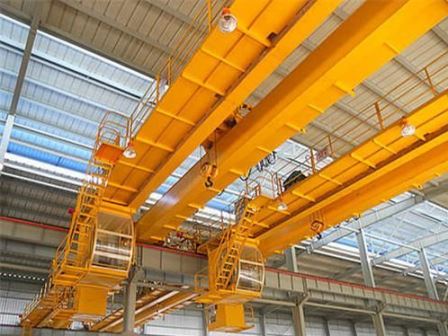
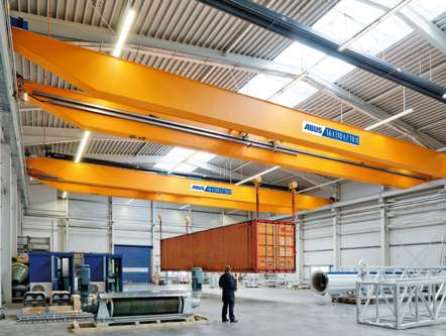
Overhead cranes are sometimes also called bridge cranes and are most often found in an industrial environment, and they consist of parallel runways with a traveling bridge spanning the gap.

More on this story

Overhead Cranes

  • What are the parts of an overhead crane?
  • What is the purpose of an overhead crane?
  • How much does an overhead crane cost?

Overhead Crane Test Questions and Answers

  • Crane operator interview questions and answers
  • Rigging test questions and answers

Overhead crane manufacturers in the USA

Some have wondered if in the United States they fix, manufacture, and elaborate parts, and components of overhead cranes.

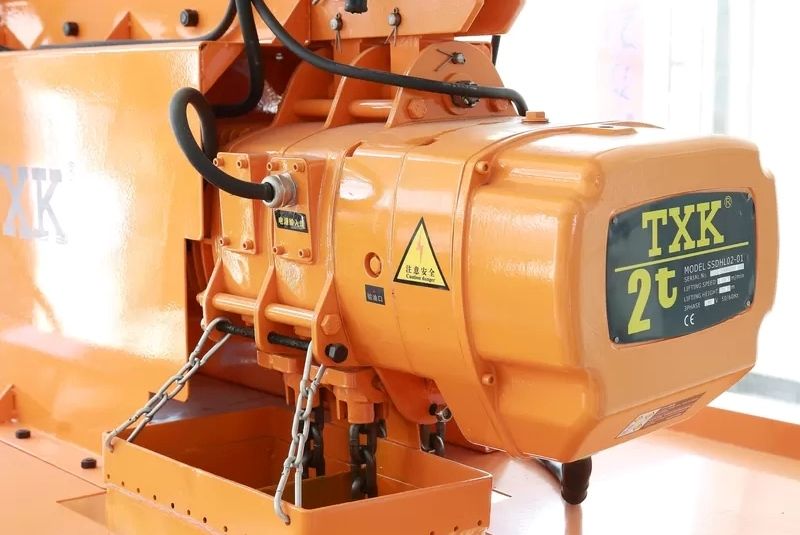
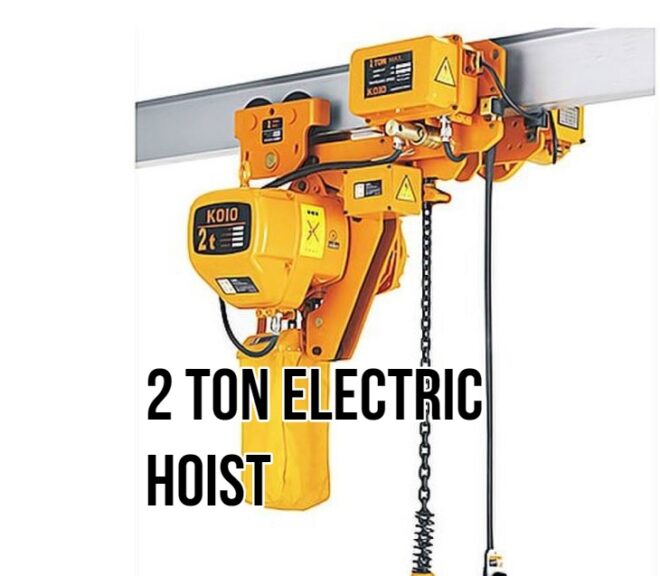
2 Ton Electric Chain Hoist

2 Ton Electric Chain Hoist: Whether you need to lift a load as light as 500 lb. or as heavy as 2 tons, you’ll find a manually operated chain hoist here that can help you handle it.

Army type hoists help you maneuver heavy loads in tight spaces. Lightweight compact hoists offer metric rating and universal wheel treads that can operate on flat or tapered beams. Low headroom chain hoists, including hurricane chain hoists, feature friction-reducing ball bearings and chain guides to help prevent jams.

2 Ton Electric Chain Hoist

Electric Hoist 2 Ton

Featuring a compact design, these low-headroom chain hoists are ideal for use in small facilities. They deliver smooth operation via friction-reducing rollers and ball bearings, along with jam-proof chain guides.

Carrying mechanical chain hoists are designed for commercial building sites, as well as various construction workplaces, such as warehousing, buildings, storage areas, and factories. (2 Ton Electric Chain Hoist)

Electric chain hoist 2 ton price

Find here Electric chain hoists, manufacturers, suppliers, and exporters of hoists. Get contact information and prices from companies that manufacture and sell hoists.

Torin chain hoist

2 Ton Electric Chain Hoist:

  • Easy to handle
  • Load sharing gears
  • Forged swivel hooks and latches
  • Rugged and compact
  • Lightweight and easy to handle

Toho chain hoist

2 Ton Electric Chain Hoist:

  • Available in 1/2 Ton, 1 Ton, 2 Ton and 3 Ton Capacity with 10 Ft. or 20 Ft. Lift Chain Lengths
  • Each piece is proof load tested at 150% of rated load. Conforms to ANSI B30.16, AS1418.2, EN13157
  • All the hoists have a 4:1 safety factor / PLI available – Products liability insurance available for all the hoist
  • Warranty – Three Years

Speedway 2 ton chain hoist

2 Ton Electric Chain Hoist:

This 2 Ton Chain Hoist is the perfect choice for any of your heavy-duty lifting needs. It has an incredible capacity of 2 Tons and drops forged hooks, capable of taking on any challenge.

  • Capacity: 2 tons
  • Drop forged hooks
  • Maximum Extension of 10′
  • Made in china

CM 2 ton electric chain hoist

The balanced, integrated, proven design of the Lodestar has made it the most popular electric chain hoist in the industry. The many features of the Lodestar have refined its reputation for high reliability, long life, and superior productivity.

  • Precision machined and hardened lift wheel with tempered chain guides for precise chain lift wheel fit, Gear train lifetime lubricated with non-oxidizing grease
  • Gear designed for exceptionally long life and quiet operation, H4 Duty Standard
  • Rugged control standard Thoroughly inspected and tested to 125% of rated capacity prior to shipment
  • Hoist duty motor, standard protector overload device and internal screw type limit switch
  • Lifetime Warranty, Made in USA, Meets ASME / ANSI B30.16
  • Load brake included
  • 15 feet of the power supply cord
  • 36 feet pendant drop

2 Ton Electric Chain Hoist: specifications

  • CM Lodestar R 3535UC Electric Chain Hoist
  • Three Phase
  • Hook Mount
  • 2 Ton Capacity
  • 40′ Lift
  • 8 fpm Max Lift Speed
  • 1 HP, 24-1/8″ Headroom
  • 1-5/16″ Hook Opening
  • 230/460V

Harrington 2 ton chain hoist

HARRINGTON CAPACITY OF 2 TON WITH A STANDARD LIFT (LB020-15)

  • Made in Japan
  • Excellent Quality

Electric chain hoist specification

2 Ton Electric Chain Hoist: Usage, specification & Application

  • Widely used in factory, storage, wind-power station, logistics, port, and construction field.
  • Used for lifting or loading or lifting heavy objects for working or reparation.
  • It can be controlled by a handle on the ground or wire(no-wire) remote control.
  • It can be suspended and fixed for using or matched with monorail electric trolley(as following pictures.)
2 Ton Electric Chain Hoist

2 Ton Electric Chain Hoist

How does a chain hoist work?

They feature lightweight construction for easy mounting but offer high weight load limits. Each chain hoist features a roller bearing in the bottom block, allowing you to turn the load without turning the load chain. They also feature cast forged steel hooks and heavy-duty safety latches. Zinc plating inside the chain hoist helps ensure corrosion protection.

How much can a hoist chain load?

These chain hoists feature through-hardened chains, along with heat-treated spur gearing for durability in demanding environments. Bearing-mounted pinions, along with lubricated roller bearings and bushings, help to facilitate smooth operation. Hand chains hang 2 ft. shorter than lift.

How are hoists designed?

These chain hoists are designed to offer exceptional durability. In addition to heat-treated alloy steel hooks, they feature die-cast aluminum bodies, as well as high-strength, heat-treated main pinion shafts and load gears for exceptional durability. Pre-lubricated ball bearings and precision-machined gears help to provide smooth lifting.

The most read

Electric Hoist Manufacturers

You’ll hear opinions about leading chain hoists brand names like Yale, Gorbel, Budget, Coffing, and Harrington. These hoist manufacturers have been in business for decades.

More on this story

Chain Pulley Hoist

The chain pulley hoist is excellent for general-purpose lifting and pulling applications.