Professional Web Writer | Motor Enthusiast | Content Creator | Logan is a dedicated and skilled web writer, passionate about engines and machines and with a talent for creating engaging and informative content.
She specializes in writing about a diverse range of topics including construction, forklifts, heavy equipment, excavators, etc. SEO Optimization: Proficient in SEO best practices, ensuring high visibility and engagement for all published content.
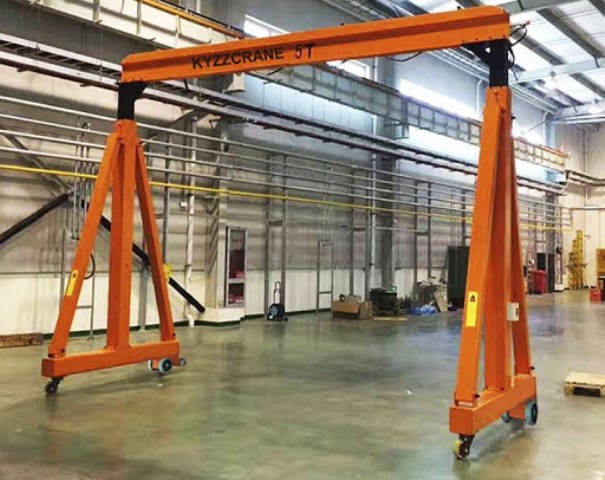
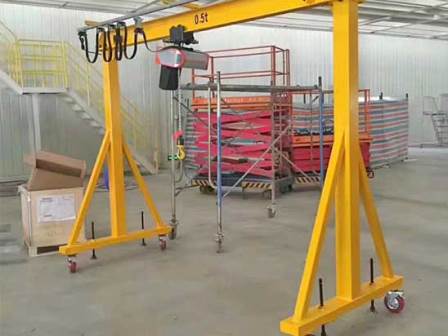
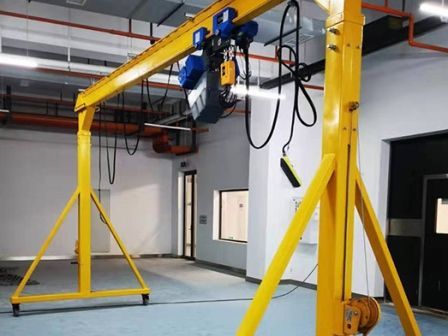
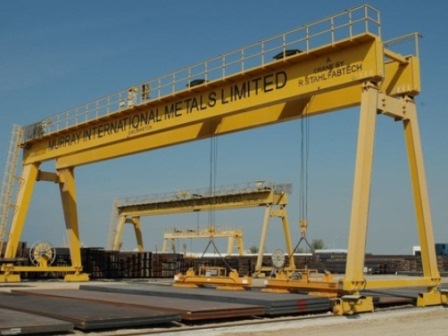
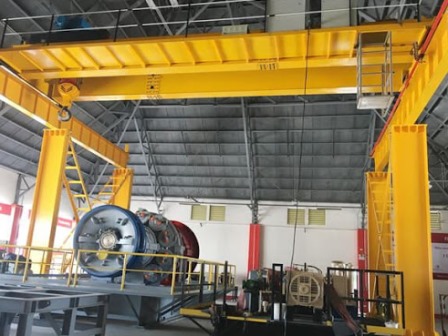
There are many different types of mobile gantry cranes, capacities, and spans for lifting, loading, and moving. The sale of gantry cranes specializes in different models, capacities, and uses
These are commonly found in workshops, fabrication warehouses, shipyards, and light manufacturing.
Mobile Gantry Cranes in freestanding, portable, fixed height, or adjustable height configurations that are ideal for your warehouse or workshop.
Mobile Gantry Crane for Sale
Gantry Crane Tons
Mobile gantry cranes range in capacity from 300 pounds with a 7-foot span to 10 tons with a 20-foot span.
Height-adjustable cranes range in capacity from 300 pounds with a 7-foot span to 5 tons with a 20-foot span.
Steel, stainless steel and aluminum options are available, as well as special coatings for outdoor applications.
There are also gantry crane kit solutions for sale including crane, hoist and trolley as a package, as well as accessories such as kits from festoon.
If you need more than 10 tons or a span longer than 20 feet, a special crane can be designed for your unique application.
The best selling mobile gantry cranes are the 1 ton and 3 ton adjustable crane, the aluminum gantry or the height adjustable gantry for industrial applications.
All mobile gantry cranes for sale are made in the USA. You can be sure that any gantry you buy will give you years of service.
Mobile Gantry Crane for Sale in USA
It is important to find the right company to partner with for your mobile gantry crane project. There are a couple of different resources you can use to research mobile gantry crane manufacturers, including references, industry events or trade shows, and use the Internet for research.
Request references:
Use Industry Connections to find out if other companies you know or work with have a mobile gantry crane on site.
Contact current customers, vendors or suppliers and find out if they use aerial lifting devices.
If so, find out who they worked with, if they were happy with the partnership, and ask if they would be willing to provide a contact or make a presentation on your behalf.
Gantry crane standards
Aattend industry fairs or events:
You may be lucky to find that a mobile gantry crane company that specializes in lifting equipment is already scheduled to exhibit at an industry fair that you are attending.
Please take a few minutes to visit the trade show website before the event and check the exhibitor list.
See if there are companies you would be interested in talking to; you may be able to reach out to them and schedule a quick presentation or consultation during the event.
Mobile Gantry Crane near me
Please use Google or other search engines to find local gantry crane manufacturers you can work with.
Adding a qualifier, such as a city or state you are in, will help return nearby businesses, transportation and installation is an additional price.
This could result in significant cost savings for coordinating travel and transportation when installation time comes.
Cost of a gantry crane
What factors affect the cost of a gantry crane?
When a mobile gantry crane manufacturer arrives on site for a consultation, they will attempt to identify your specific lifting challenges, as well as assess your installation to understand the building floor space, the supporting structures in place, and the size and capacity of the crane they will be building.
Before your individual visits, it may be helpful to prepare some notes or a cheat sheet on your overhead lift project.
This will remind you to ask the same questions of each company and also provide them with the same specifications for your project so that each company builds its quote from the same information.
Gantry crane amazon
Amazon is another place where you can find mobile gantry cranes for workshops or for work at home, there you can make a price comparison.
They are very similar in nature to bridge cranes; the only difference between the two configurations is the gantry crane’s mobility compared to bridge cranes.
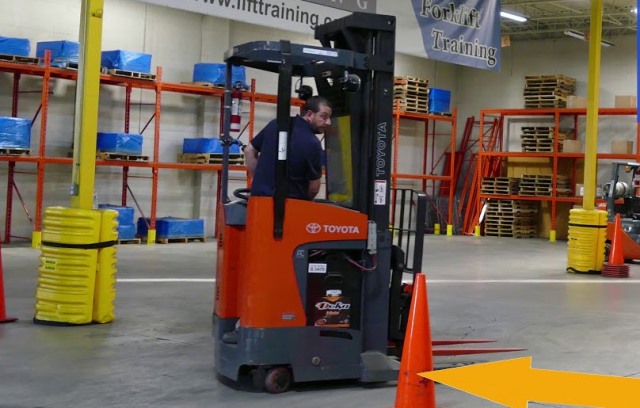
Stand up Forklift Operators must be trained Stand up Forklift Training:
An untrained operator of a stand-up forklift can be as dangerous as an unlicensed operator of a motor vehicle.
OSHA regulations require that the employer ensure that a forklift operator is competent to operate the forklift he or she is assigned to use.
The employer must document operator training and an evaluation of the operator’s performance while using the forklift.
Stand up Forklift Training
Stand-up forklift operator training
Training has three parts:
Formal instruction such as a lecture, discussion, interactive computer learning, videotape, and or written material (can be taken anywhere)
Practical training which includes hands-on demonstrations by the trainer and exercises by the trainee (on the model of forklift the worker will use); and
An evaluation of the effectiveness of the training by observing the operator’s performance while doing actual work using the forklift. This evaluation must be repeated at least once every three years (must be at a workplace).
Refresher training must be given if the operator has been involved in an accident, near miss, or unsafe operations.
Also, if an operator is assigned to a new type of stand-up forklift or if workplace conditions change that could affect safety, then refresher training is required.
Stand up forklift training class
The topics listed in the table below must be covered when training a forklift operator. If a specific topic does not apply to the forklift in the employer’s workplace, covering it is optional.
Stand up forklift safety Topics
Topics related to industrial stand-up forklift training:
Operating instructions
Warnings and precautions for the types of PIT the operator will be authorized to operate
Differences between the PIT and the automobile
PIT controls and instrumentation: Where they are located, what they do, and how they work
Engine or motor operation
Steering and maneuvering
Visibility (including restrictions due to loading)
Fork and attachment adaptation, operation, and use limitations
PIT capacity
PIT stability
Any PIT inspection and maintenance that the operator will be required to perform
Refueling
Charging and recharging of batteries
Operating limitations
Any other operating instructions, warnings, or precautions listed in the operator’s manual for the types of PIT that the employee is being trained to operate
Stand up forklift safety Topics in workplace
Topics related to your workplace
Surface conditions where the PIT will be operated
Composition of loads to be carried and load stability
Load manipulation, stacking, and un-stacking
Pedestrian traffic in areas where the PIT will be operated
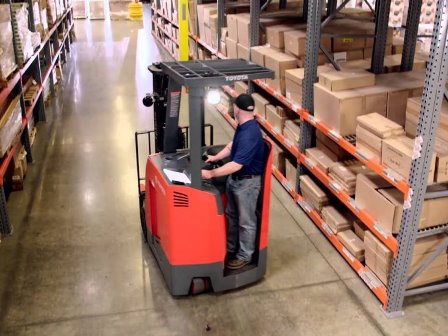
Narrow aisles and other restricted places where the PIT will be operated
Use of door opening and closing devices
Hazardous (classified) locations where the PIT will be operated
Ramps and other sloped surfaces that could affect the PITs stability
Closed environments and other areas where insufficient ventilation or poor PIT maintenance could cause a buildup of carbon monoxide or diesel exhaust
Other unique or potentially hazardous environmental conditions in the workplace that could affect safe operation
Qualified Trainers
The employer or any other person the employer chooses who has the knowledge, training, and experience to train and evaluate forklift operators can do this training and evaluation. The trainee can only operate the forklift when directly supervised by such a person and when this would not endanger anyone.
Documenting Training
If the operator had previous forklift training, the employer must document that the training covered the required topics described above. The operator must have been evaluated in the current work within the last three years.
Training and Evaluation Records
The employer must keep a record that shows that each stand-up forklift operator has been trained. The record includes the name of the operator, date of training, date of an evaluation, and the name of the person(s) giving the training and evaluation.
Stand up forklift how to operate?
Is driving a forklift hard? Driving a stand-up forklift is different than driving a car
In a car or truck, the front wheels steer the vehicle. A forklift has steering wheels in the rear.
The rear end of the forklift swings in a circle around the front wheels that support most of the load. The operator must check that there is room for the rear end to swing when making turns. This clearance can be maintained in your workplace by permanently marking aisles with painted lines or arranging storage racks in a way that creates obvious aisles for travel.
However, these marked aisles will only be effective if you keep them clear of stored materials, which can gradually encroach as space is needed.
A stand-up forklift is not as responsive as a car when turning the steering wheel. Rear steering makes it difficult to stop a forklift quickly or swerve and still maintain control. It is important, then not to drive a forklift fast or round corners quickly.
Forklift incline limits
Driving forklift with load: Driving with the load downhill can result in loss of the load and control of the forklift.
If you drive a forklift on an incline, you must keep the load on the uphill side. Otherwise, you may have no weight on the wheels that steer and can lose control! The load could also fall off or cause the forklift to tip.
Often a large forklift load obstructs the driver’s view in one direction. It may be necessary to travel long distances with the load to the rear (in reverse for most forklifts). Use extra caution when traveling in reverse.
Stand up Forklift safety features
An overhead guard prevents an object on the forks or on a high rack from falling onto the operator while picking or placing a load at elevation.
The guard is not designed to withstand the impact of a full load. It can be effective in deflecting small packages. It is required on all stand-up forklifts that can lift a load above the operator unless conditions such as clearances would not allow the forklift to be used.
Operator restraints will hold you in the seat if you strike an object or if the forklift overturns. Forklift manufacturers have been required to equip new forklifts with operator restraints such as seat belts. Many forklift manufacturers offer restraint systems that can be retrofitted on older forklifts.
If your forklift begins to overturn, you are safest when you stay in the seat, hold on firmly, and lean in the opposite direction of the fall rather than trying to jump.
Many fatal accidents happened when the operator tried to jump. As the forklift begins to tip, it will move slowly – tricking the operator into believing there is time to jump. Once the center of gravity is past the wheel line, the forklift will rapidly fall. The forklift’s overhead guard will quickly pin or crush an operator who jumps
If your forklift has a restraint such as a seat belt or a lap bar, you must use it.
Stand up Forklift load center chart
How to stand up forklifts safely carry and lift heavy loads?
A stand-up forklift works on the principle of a cantilever. A load on a beam (the forks) supported by a fulcrum (the front wheels) is counterbalanced by a weight o the other end of the beam (the forklift body and counterweight built into it).
Whether a forklift will safely carry a load or will tip forward can be determined by comparing the “moment” of each.
Moment equals the distance from the fulcrum to the center of gravity (the point where all the weight is concentrated) times the weight.
As the load is raised, it becomes possible for the stand-up forklift to fall to the side as well as tip forward. The operator must consider the center of gravity of the stan up forklift and load together. This combined center of gravity moves as the load is moved and as the forklift travels over surfaces that are rough or inclined.
Forklifts have a “stability triangle”. The sides of the triangle as shown in the illustration are formed by the center of each front wheel and the center of the rear wheel or at the center of the axle if there are two rear wheels.
A vertical line extending from the center of gravity of the vehicle-load combination must be inside of the stability triangle to prevent the forklift from tipping forward, falling sideways, or dropping its load.
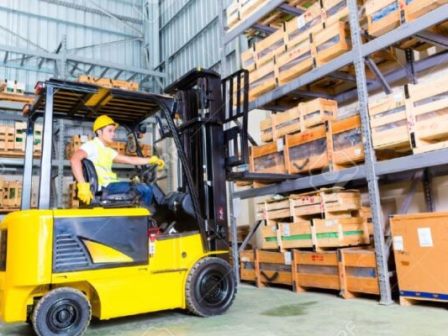
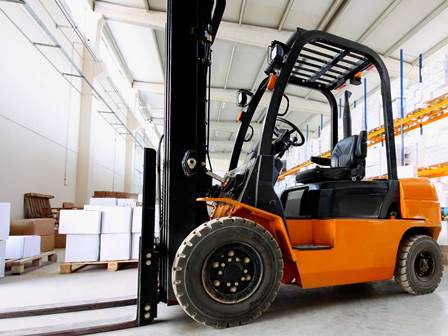
Stand-up forklifts (also known as stand-on and electric riders) are designed for applications where the operator must get on and off the lift truck frequently.
Forklifts are extremely useful workplace vehicles, as long as they are used safely and appropriately by operators who are appropriately trained and competent to use them.
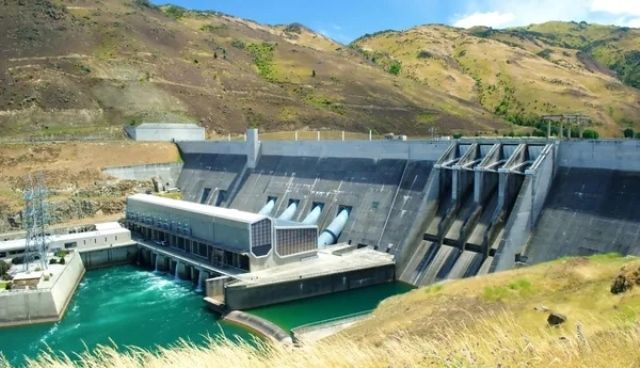
Surge tanks are applied in hydropower plants to reduce the pressure forces during acceleration of the water, and to enable speed governing of the turbines.
There are two main types of surge tanks; the open surge tank connected to atmospheric air, and the closed surge tank constructed as a closed volume filled with pressurized air.
However, numerous variants exist within the two main types. The different variants have different benefits and challenges, and the selection of design is dependent on site and project-specific factors.
A surge tank uses, with presentation and comparison of all the different types and variants of surge tanks, would enable hydropower engineers to make an easier and improved selection for new hydropower projects.
The surge tank is located between the almost horizontal or slightly inclined conduit and steeply sloping penstock and is designed as a chamber excavated in the mountain.
Surge tanks serve a threefold purpose:
Release excessive pressure.
Reduce overpressure due to water hammers.
Provide water supply to the turbines in case they start up.
What is the use of Surge Tank?
Use of surge tank in hydro power plant
Release excessive pressure
Upon the rapid closure of the turbine, water masses moving in the pressure tunnel and in the penstock are suddenly decelerated.
Owing to the inertia of moving masses, F = ma, high overpressures develop at the lower end of the penstock, which are propagating upwards in the penstock in the form of the pressure waves. The magnitude of the so-called water hammer, caused by the moving masses by closure, will depend upon the dimensions and elastic properties of the conduit.
The overpressure due to the water hammer travels along the closed conduit and is not relieved until a free water surface is reached.
An important function of the surge tank can be summarized like this. The turbines to the reservoir are practically interrupted by the surge tank to prevent the pressure wave due to the water hammer at the free water surface and to free the pressure tunnel from excessive pressures.
Reduce overpressure due to water hammer
The surge provides protection to the penstock against damage from the water hammer. The overpressure depends upon the length of the penstock (the closed conduit). The surge tank, by interrupting the closed system of the penstock and of the pressure tunnel, reduces the overpressure due to the water hammer.
Provide water supply to the turbines
The third purpose of the surge tank is to provide water supply to the turbines in case of starting up. The amount of water required during these changes in operating conditions is supplied by the surge tank installed in the conduit.
The capacity thereof should be selected to ensure the required water supply during the most unfavorable increase in demand until the water mass in the tunnel has attained the necessary velocity. Air should be prevented from entering the penstock even in case of the deepest down surge in the chamber.
The function of a surge tank is?
Where is the surge tank located in a hydroelectric power plant?
The height of the surge tank is governed by the highest possible water level that can be expected during operation. Variations in demand initiated by a rapid opening or closure of the valve or turbine are followed by a time lag by the water masses moving in the tunnel.
Upon the rapid and partial closure of the valve following a sudden load decrease, water masses in the penstock are suddenly decelerated, and one part of the continuous supply from the tunnel fills the surge tank. The water surface in the surge chamber will be raised to above static level.
In the case of rapid opening, the flow in the tunnel is smaller than the turbine’s demand to supply water to the turbine. The water surface in the chamber will start to drop below the steady-state level.
To establish steady-flow conditions, the water surface will again start to rise from the low point, but owing to the inertia of moving water, will again rise over the steady level. The cycle is repeated all over again with amplitudes reduced by friction, i.e. the oscillation is damped.
The phenomenon described is the water surface oscillation. The maximum amplitude of water surface oscillation can be observed when the water demand is suddenly stopped.
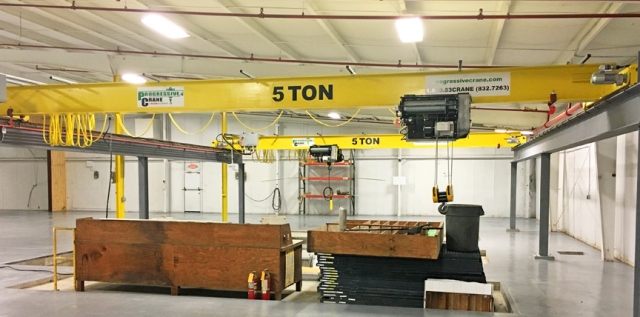
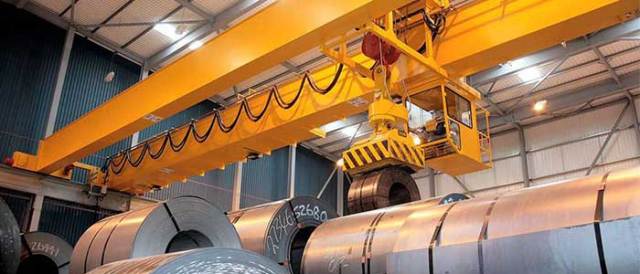
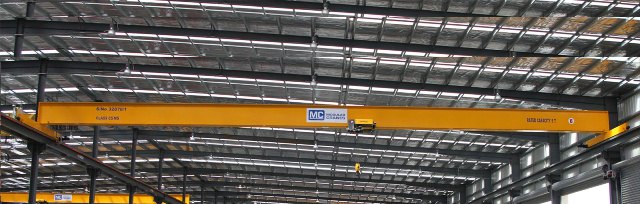
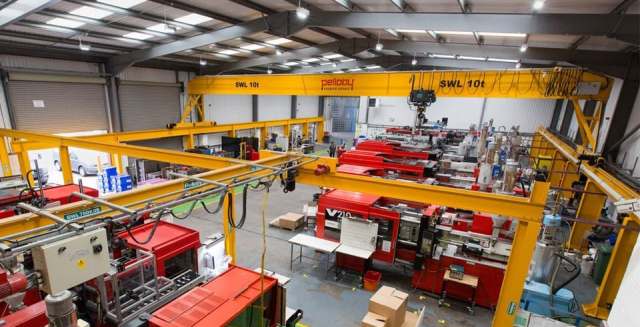
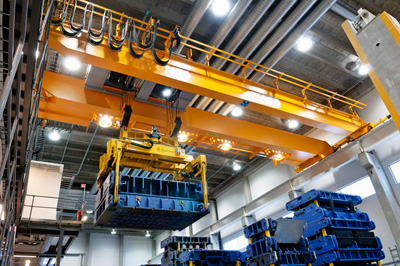
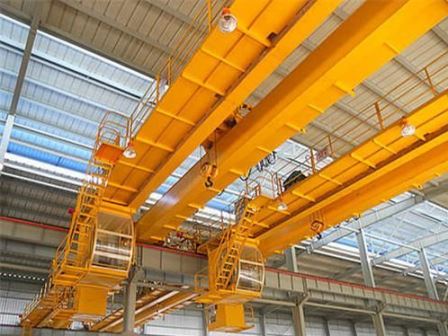
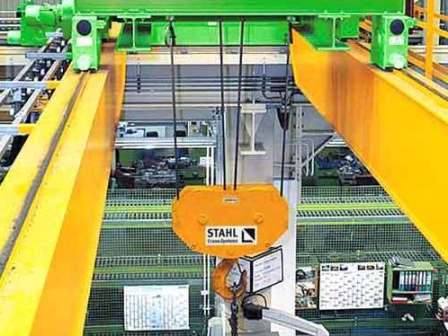
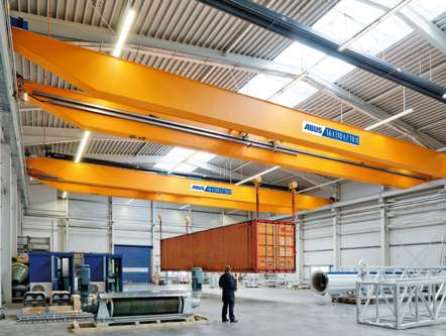
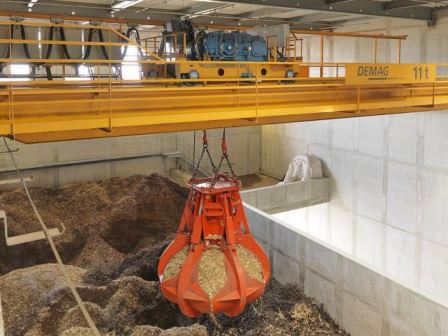
Overhead Crane Manufacturers: Also known as hoist cranes, overhead cranes operate from an overhead steel beam or pair of beams bridged between two structural supports; a trolley runs along these beams carrying a hoist, which is used to lift and reposition heavy loads. They are powered by hydraulics, internal combustion, or electric batteries.
Some have wondered if in the United States they fix, manufacture, elaborate parts, and components of overhead cranes.
Which are the most important crane manufacturers in the United States?
Who are the main suppliers of overhead cranes?
Who designs and manufactures cranes?
What are the main manufacturers of overhead cranes?
Overhead Crane Manufacturers
Top overhead crane manufacturers
Konecranes Inc
American Crane and equipment
Whiting Corporation
Brehob corporation
Gorbel cranes
Wolverine Crane
Engineered Material Handling
Demag cranes
Overhead Crane Manufacturers
Konecranes
Konecranes, Inc. the company provides innovative overhead cranes that are ideal for a number of industries and applications. It aims to give its clients a competitive advantage and the company has a track record to prove its ability to manufacture top-of-the-line solutions.
Konecranes has an outstanding reputation that is built on over 80 years of delivering premium products and outstanding customer service. From industrial cranes to lift trucks, Konecranes is one of the best in the lifting business. The company is the world’s largest supplier of industrial cranes and also the leader in crane service.
American Crane and equipment
American Crane & Equipment is an American-based company in manufactures different kinds of overhead cranes, either single type or double girder type or cranes employed in different types of industries, whose manufacturing capability is just like Ellsen crane machinery.
This is an American-based company, which is very convenient for clients to have crane needs from America.
Whiting Corporation
Whiting Corporation, located near Chicago, Illinois, is a major manufacturer of heavy-duty overhead cranes and railcar maintenance equipment. Whiting overhead cranes serve a variety of industries including steel mills, automotive plants, foundries, fossil fuel plants, metal service centers, refuse facilities, hydroelectric plants, and nuclear power plants.
Additionally, Whiting is a trusted name for railcar maintenance and lifting equipment for the freight and commuter railroad industries, municipal transit authorities, railcar builders, and independent maintenance shops.
Brehob corporation
What began as a business between longstanding friends and coworkers; has grown into a booming business including products such as electric hoists, air compressors, and overhead cranes.
With service available twenty-four hours a day, seven days a week; it’s easy to see why Brehob is a popular choice for electric hoists. Brehob has been providing top-of-the-line electric components for over fifty years.
With a rich history of continued innovation and technological advances, Brehob has the qualities of a company that many look for; making them an obvious choice in our industries.
Gorbel cranes
Gorbel®, Inc., an American crane machinery company, has over thirty years of experience providing overhead handling solutions to customers in a wide range of industries.
The company, just like Ellsen Crane Machinery, offers a comprehensive line of crane products, including overhead cranes, to make sure that all of the customers’ needs can be easily met.
Wolverine Crane
Design, fabrication & installation of overhead cranes, box girders, and structural runways. Crane inspections, 24/7 service & repair. Michigan.
Engineered Material Handling
Engineered Material Handling or EMH designs, sells, manufactures, installs, and services a complete line of overhead material handling the equipment. With a proven track record of helping businesses realize their potential with the latest innovative solutions, EMH stands apart in this industry.
Demag cranes
Demag is one of the world’s leading suppliers of crane technology with overhead cranes and components. Demag specializes in the development, design, and production of technically sophisticated cranes, hoists, and components, and the services for those products. They manufacture in 16 countries on five continents.
Overhead crane companies
Partnering with an overhead crane manufacturer is a big decision and one that shouldn’t be taken lightly. The design, manufacturing, and installation of an overhead crane is a big project and can be a substantial investment but, a necessary one if you want to improve your company’s efficiency and workflows.
If you’re looking to finance an overhead crane, your lender may even require you to receive multiple quotes on the purchase and installation of a new crane system. Even if you aren’t financing your new equipment, it’s still a good idea to bring in a few different overhead crane manufacturers to look at your facility and provide a scope of work and their expert opinion on the right crane system for your material handling needs.
Overhead crane inspection
Because cranes work with extremely heavy, dangerous loads, frequent inspections must be performed on overhead cranes for safety purposes.
Every day the operating mechanisms must be checked for maladjustment, the pneumatic and hydraulic parts for leakage, the hooks for deformation or cracks, and the hoist chains and end connections for wear, twist, or distortion.
The running rope and end connections should be checked on a monthly basis for wear, broken strands, and other problems.
Periodically, the overhead cranes should be checked for deformed, cracked or corroded components, loose bolts or rivets, cracked or worn sheaves and drums, other worn, cracked or distorted parts (e.g. bearings, gears, and rollers), and excessive wear on brake system parts, chain drive sprockets, and chains.
Other components to be inspected include electric or fossil-fuel motors, indicators, and electrical components such as pushbuttons and limit switches. OSHA has published a set of guidelines for the safe operation of overhead cranes.
Overhead Crane Manufacturers
Overhead crane manufacturers in USA
The CMAA (Crane Manufacturer’s Association of America) is an independent trade association founded in 1955. Companies striving for admission must undergo a thorough application and review process. Member companies represent leaders in the overhead crane industry.
CMAA member companies are concerned, with conscientious manufacturers who meet regularly to review and revise standards for the mechanical, structural, and electrical design of overhead cranes. CMAA members also formulate guidelines for the proper use, operation, and maintenance of those cranes
As a member of the CMAA, North American Industries, Inc:
meets high standards in engineering design, production, and related operations
maintains a position of technological advancement
Overhead Crane Manufacturers
Overhead crane design
What Does an Overhead Crane Manufacturer Make?
Overhead cranes are an excellent material handling solution that facilitates industrial activities. Consequently, manufacturers of an overhead crane aim to produce tools that serve as the perfect lifting solution for manufacturing and metal fabricating operations.
The systems are made using steel. The kind of steel used in producing an overhead crane and the crane design depends on the nature of the structure it will be used in as well as the weight it will need to lift and move.
For instance, carbon steel is the dominant substance used in manufacturing overhead cranes that are intended for structures that do not require very high strength. The amount of carbon present in carbon steel can vary anywhere from less than 0.015% to more than 0.5%. Carbon and iron consist of around 98% of the properties of carbon steel.
On the other hand, high-strength, low-alloy (HSLA) steels are used in manufacturing cranes that are intended for use in environments that require very high strength. Such machines are designed to lift heavier materials than those that are made from carbon steel. HSLA steels contain around 0.05% of carbon.
The steel also includes elements such as chromium, vanadium, nickel, molybdenum, niobium, and titanium, which are added to strengthen the system.
Their engineering intelligence allows overhead crane manufacturers to provide custom lifting solutions that fit with any facility and operation, all of which is done to facilitate lift activities and alleviate transport challenges.
Overhead Crane Manufacturers
Overhead Crane Manufacturers
How do overhead cranes work?
Overhead cranes cover a rectangular area, moving a load side to side and backward and forward. They typically incorporate a top running trolley hoist that moves along the top of the two bridge beams on its own set of wheels for increased headroom under the crane; also called a top running crane.
Broken Push Button Pendant or Cable?
Pendants are ergonomically designed to be easily held in one hand and are constructed of a durable thermoplastic material. The pendant cable has 2 steel wires built into the cable jacket for permanent strain relief.
Parts Availability Problems?
are components–bearings, contactors, gearboxes, motors, and electrical systems–are designed to industry standards, and most are readily available throughout the U.S. All motor nameplates and gearbox nameplates are clearly labeled with the original manufacturing information. And virtually every spare part for the crane (excluding the hoist) is in stock here in North America and can be shipped immediately.
Crane Travels Too Far Before Stopping?
If your crane coasts more than a few feet, then it is likely that it uses electric motor brakes and that, like most cranes, the brake pads haven’t been replaced (they require replacing or adjusting every 3 months).
What Does an Overhead Crane Manufacturer Make?
Overhead cranes are an excellent material handling solution that facilitates industrial activities. Consequently, manufacturers of an overhead cranes aim to produce tools that serve as the perfect lifting solution for manufacturing and metal fabricating operations.
For all types of hydraulic excavators. This manual takes operators through a typical day of operation, outlining accepted safety procedures for each critical step.
Its easy-to-follow, no-nonsense graphics and clearly stated safety warnings will help ensure operators come home safe and sound after a productive day in the field. This manual is not a substitute for the manufacturer’s manual(s).
Organized around the major categories of construction equipment, including both commercial and heavy civil examples, case studies, and exercises, this textbook will help operators develop independence in applying concepts to hands-on scenarios.
A companion website provides an instructor manual, solutions, additional examples, lecture slides, figures, and diagrams.
The knowledge, experience, and ability of the operator are the most important factors in the safe operation of the machine. it is therefore important that the operator has read and understood the instruction and has been trained.
Excavator operator qualified
The driving and operation of hydraulic excavators must be entrusted to specialize and trained operators in perfect psychophysical conditions. The operator must be aware of all hazards and safety measures associated with the operation of the excavator. The operator must therefore be authorized, trained, and sufficiently skilled to do so.
Familiarise yourself with the instructions and warnings
This manual and the plates and stickers on the machine give the information required for operating it safely and properly. The user must familiarise himself with this information; failure to do so may result in serious accidents. Do not leave anything to chance if you have failed to understand it. Your dealer is always pleased to give you any supplementary information you require. If you lose or damage the manual, the plates, or stickers, contact your dealer for new copies.
Health and safety
Take special care of your mental and physical health and note that the operator of a complicated machine should be physically fit. Never operate the machine under the influence of alcohol, medicines, or drugs of any kind.
Snug fit work clothes
Your work clothing must be snug, without lose sleeves, rings or other jewelry, as they may become trapped in moving parts. Before operating the excavator, clean all grease and mud off your boots. Always wear the necessary clothes and accessories, including helmet, safety gloves, visible clothing, safety boots, and ear defenders
Check your excavator
Before starting work, walk around and check the excavator and make sure that there are no persons or obstacles in the work area.
Never take anything for granted
Today, as you start work, do not assume that everything is OK, only because it was all OK yesterday evening. Before starting, carefully check the excavator for signs of wear and defects.
Make a work plan
Before starting work, carefully inspect the work area. If there are any obstacles or hazards, notify all affected persons of their presence. Avoid overlooking anything that may cause an accident. Prepare a work plan and procedures and inform your colleagues accordingly.
Be careful of public utility lines and pipes
Before starting work, inspect the work area. identify all gas, service, sewer, overhead, and underground electrical lines, and any other obstacles and hazards. The worksite supervisor is responsible for marking the locations of all underground utility lines to prevent accidents. If necessary, ask for the said lines to be closed or transferred.
Work area
ALWAYS, before starting work, carefully inspect the work area and identify any hazards. Do not operate the machine close to a drop. Given that the machine is not designed for use in explosive atmospheres, NEVER operate it inside a tunnel or explosive area to prevent the risk of explosion. The machine is not roadworthy and must be used only on the worksite; if necessary, it must be moved to other areas by truck
Keep your eyes open
Keep your eyes open before and during your work and especially when you slew the tools in crowded areas. In more complicated situations, we recommend using an assistant who can supervise the area and give signals; pay attention to his signals before operating the excavator.
Maintain good ventilation
Do not use the machine for indoor works. Take all precautions to vent exhaust gas externally before starting the engine if working in a hole in the ground, tunnel, or trench. In such a place, the air tends to stagnate.
Breathing exhaust gas is very dangerous. Note that exhaust gases are fatally poisonous. In case of excavations or earthworks involving noxious substances, the user must take all the necessary safety measures.
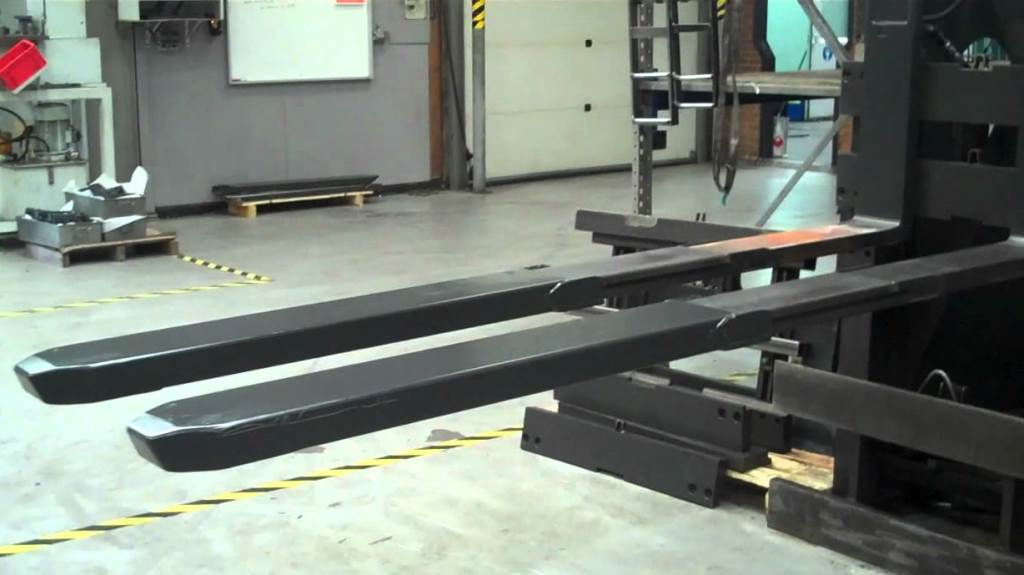
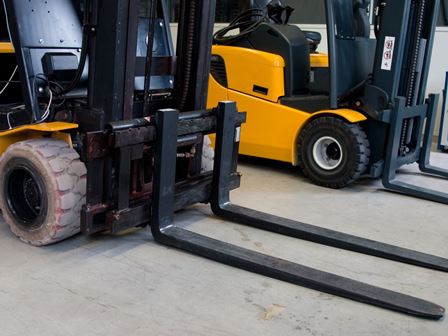
Forks are often overlooked on a forklift due to their simple way of operating. However, when you need a different size or the forks are no longer at their best. It can be difficult to know what you need to replace them. Here is a basic guide to getting you on your way.
when do you need to replace the forks?
You should check your forks for excessive wear with a wear gauge on a regular basis to ensure they are still capable of carrying their rated load.
Forks are considered worn beyond their load capacity once they reach 90% of their original thickness.
Each forklift is rated to handle a particular weight capacity.
And it’s important to make sure your forks are rated for at least what your forklift can handle.
For example, if your forklift is rated to lift 5,000 pounds, your forks must be rated to handle at least 5,000 pounds.
You can find the weight capacity rating of your truck on the data plate.
Next, use a forklift fork size chart to compare weight capacity to required fork dimensions (thickness and width).
What size fork extensions do I need?
If you are wondering “How long can my hairpin extensions last?” the answer is that they cannot have more than 150% of the length of their forks installed.
For example, if you use 48-inch forks, your fork extensions should be a maximum of 72 inches.
And just like with regular forks, fork extensions should reach at least 2/3 of the length of the load, but not all the way.