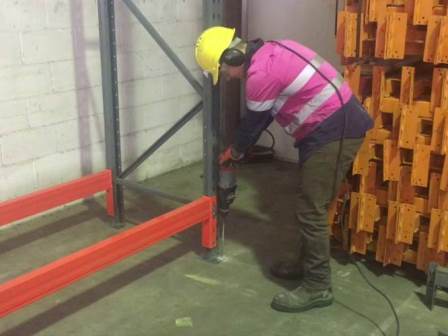
Pallet rack anchoring is an important safety measure to prevent racking from tipping or collapsing. It is important to follow the manufacturer’s instructions for anchoring pallet racks and make sure that the anchoring system is suitable for the type of floor and load capacity of the racks. Securing pallet racking is an essential step to ensure the safety and stability of the racks. Here are the steps for anchoring racks:
How to Anchor Pallet Racks to concrete?
Determine the type of flooring and the load capacity of the racks. This will help you choose the proper anchoring method and ensure the racks are securely anchored to the ground.
Place the pallet racks in the desired location and use a level to ensure they are level and plumb.
Mark the location of the anchors on the floor where the pallet rack uprights will be located. The number of anchors required will depend on the size and load capacity of the pallet racks.
Drill holes in the floor at the marked locations with a hammer drill using a masonry bit. The diameter of the holes must match the diameter of the anchor bolts.
Insert the anchor bolts into the holes and tighten with a torque wrench to the manufacturer’s recommended torque specification.
Install pallet shelves by attaching uprights to base plates with bolts and nuts.
Check the stability of the pallet racks after installation to ensure they are well anchored to the floor.
How to secure pallet racking?
Install end-of-aisle protectors: These are designed to protect the uprights from damage from forklifts and other equipment.
Use beam locks: Beam locks prevent beams from dislodging and causing the pallets to fall. They are easy to install and are available in various sizes to fit different types of racking systems.
Install pallet supports: These provide additional support for the pallets and prevent them from sagging or falling through the gaps between the beams.
Use wire mesh decking: This creates a solid surface for the pallets to sit on, preventing them from falling through the gaps and providing additional support for heavy loads.
Regularly inspect the racking system: Inspect the racks periodically to ensure that they are in good condition, free of damage and that all bolts and fittings are tight.
Train employees: Proper training for employees on how to load and unload pallets, how to operate forklifts and other equipment, and how to recognize potential hazards that can prevent accidents and ensure the safety of the racking system.
Pallet storage and pallet rack installation jobs require an experienced crew with the proper tools and equipment. Many people involved in pallet racking jobs don’t really know how to install a pallet rack.
With the continued growth and domination of e-commerce in the retail market, the demands on warehouses and distribution centers across the globe are also rising.
If you are considering moving inventory to a warehouse, you should be aware of the different types of racks in warehouses.
But to successfully transition to storage, you’ll need the right equipment. Storage requires a warehouse shelving system or special metal shelving that holds pallets or boxes of inventory.
Warehouse racking systems directly affect the efficiency of your warehouse management, the accuracy of your orders, the speed of fulfillment, and the safety of workers, so before you commit to a racking system, it is important that you do your research.
By understanding the different types of warehouse racks and the costs associated with each type, you’ll be able to find the best model for your warehouse the first time.
We take a closer look at warehouse shelving systems: what they are, why it’s important to choose the right ones, and the challenges of managing and maintaining warehouse shelving systems.
Different types of racks in warehouses
Warehouse pallet racking system
What is a warehouse racking system?
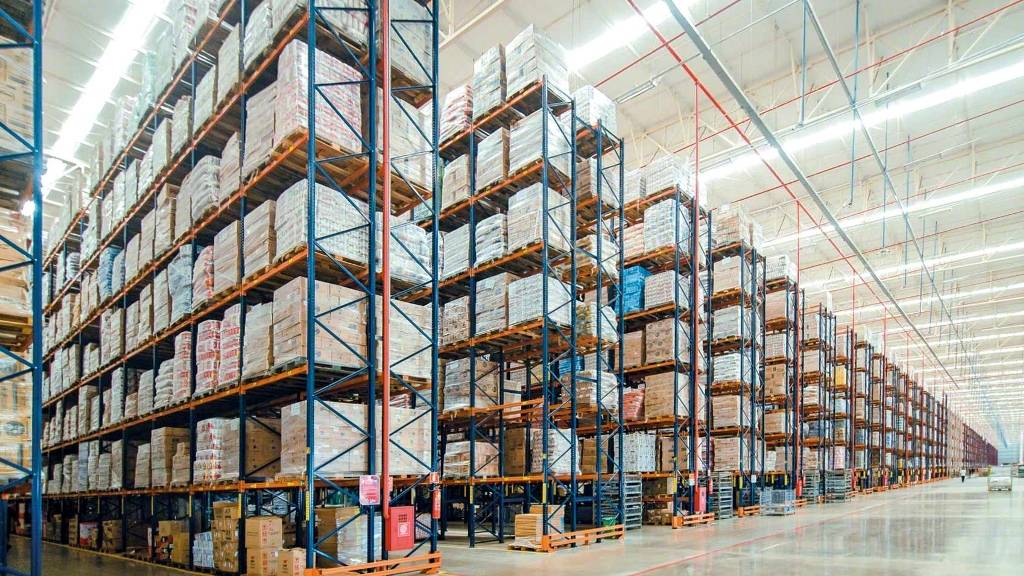
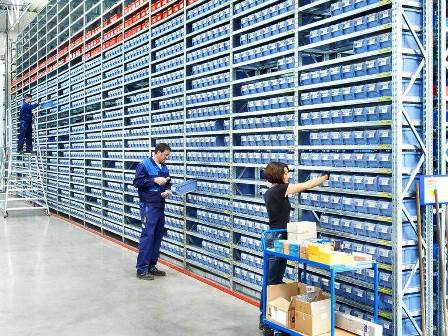
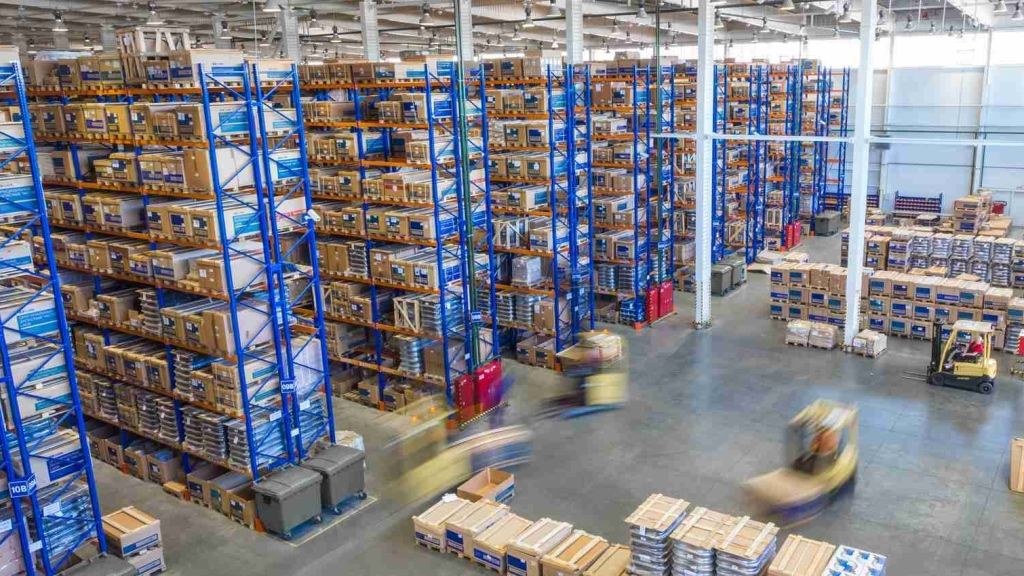
Warehouse racking systems (also called pallet racking systems) are storage systems used in most warehouses to hold inventory.
Warehouse shelving systems are made up of multiple warehouse racks, which are industrial metal shelving designed to store boxes or pallets in various levels of horizontal rows, stacked on top of each other.
Types of racking system in warehouse
What are racking systems used for in warehouses?
Companies use shelving systems to optimize the storage of their warehouses.
Shelving systems can double or triple your warehouse’s inventory holding capacity without increasing the square footage you pay for, making them a cost-effective solution for small businesses looking to maximize their storage space.
A shelving system also helps keep inventory organized by providing dedicated storage space for each SKU.
For fast-growing businesses moving away from cluttered garage storage, steel shelving with storage bins or pallets can improve inventory management and make it easier to find and select units.
Warehouse racking layout design
How to set up a warehouse racking system?
Once you decide what type of shelving system is best for your business, the next step is to carefully consider how to organize that system to maximize efficiency, manage inventory, avoid bottlenecks, and ensure warehouse safety.
Here are some aspects of warehouse shelving to plan for in your company’s warehouse.
Different types of racks in warehouses
Types of racking system and its uses
What are the main types of Pallet Racking?
The different types of pallet racking include the following systems:
Adjustable Pallet Racking
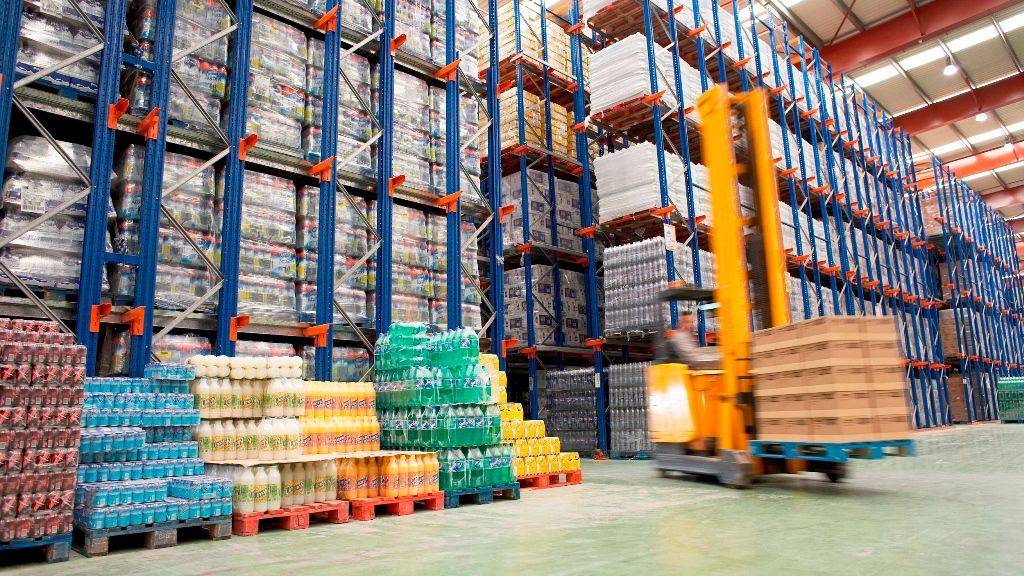
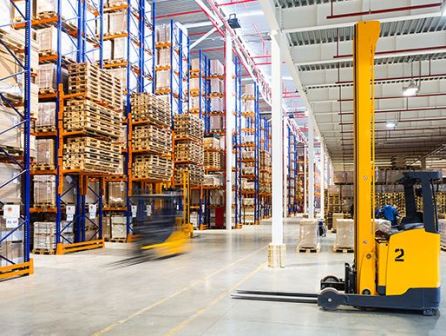
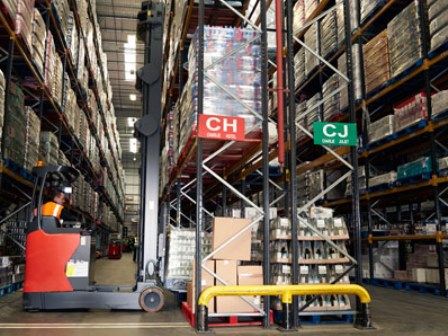
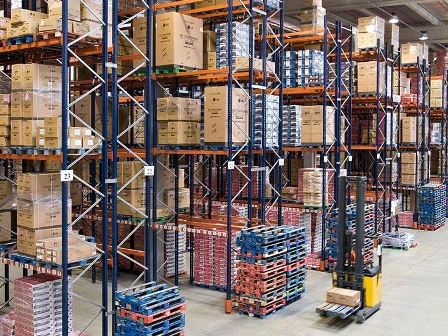
It is the most common and simplest pallet racking system and is designed to mechanically store pallets using forklifts that run parallel to the rows of racks.
It is not a compact system, so it requires a fairly large area for its installation. Its main advantage is direct and quick access to all stored load units, as well as its versatility and adaptability.
Very Narrow Aisle racking (VNA)
VNA pallet racking is an adaptation of the adjustable pallet racking system, but with better use of the available space in the warehouse. The width of the work aisles is reduced to reduce the surface area required for its installation, and direct access to all the stored pallets is maintained.
You need special narrow aisle forklifts to move and operate in the warehouse.
Drive-In and Drive-Through Compact Systems
Both Drive In and Drive Through Compact Racking are a type of racking system for high-density pallets that optimize the available space in the warehouse.
In this system, work aisles are eliminated and the forklift enters the racking structure for loading and unloading operations.
Drive-In racking works according to the LIFO system with a single entry and exit aisle for the forklift, while the Drive Through system works with the FIFO method and has an access aisle for loading and the opposite end for unloading pallets.
Racking is much more than just steel. Racking is the key to optimum throughput efficiency because the efficiency of the entire material flow is optimized only through the requirement-specific design of a racking system.
Pallet racking is a material handling storage rack system designed to store products and materials on pallets in horizontal rows and on multiple levels.
The warehouse process, as one of many logistics processes, currently holds an irreplaceable position in logistics systems in companies and in the supply chain. The proper function of warehouse operations depends on, among other things, the type of the used technology and its utilization.
This article is focused on the design of a warehouse system. The selection of a suitable warehouse system is a current research topic as the warehouse system has an impact on warehouse capacity and utilization and on the speed of storage activities.
The post presents a warehouse system design methodology that was designed applying the logistics principle-systematic (system) approach.
Warehouse operation process
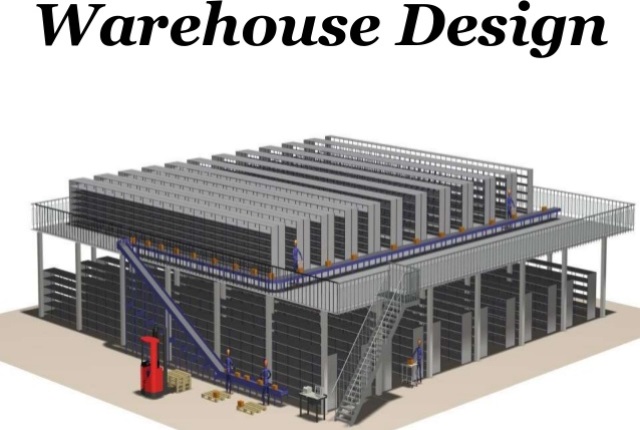
Simple warehouse design
The starting point for designing a warehouse system represents the process of designing logistics systems.
The design process consists of several phases: project identification, design process paradigm selection, system analysis, synthesis, and project evaluation.
This article’s contribution is the proposed methodology and design of the warehouse system for the specified conditions.
The methodology was implemented for the design of a warehouse system in a cold box, which is a part of a distribution warehouse.
The technology of pallet racking was chosen in the warehouse to store pallets. Pallets will be stored and removed by forklifts.
For the specified conditions, the warehouse system was designed for two alternatives of racking assemblies, which are served by forklifts.
Alternative 1: Standard pallet rack with wide aisles and
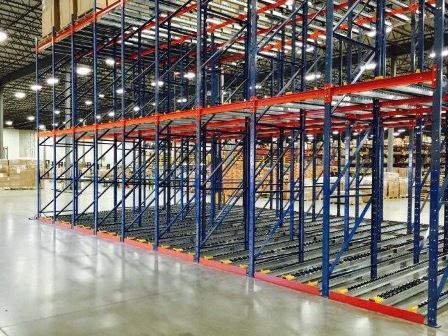
Alternative 2: Pallet dynamic flow rack.
Warehouse design systems
The proposed systems were compared on the basis of selected indicators:
Capacity: the number of pallet places in the system
Percentage ratio of storage area from the box area
Percentage ratio of handling aisles from the box area
Access to individual pallets by forklift
Warehouse operation process
Nowadays, thousands of tons of goods are transported from manufacturers to vendors and customers every day.
After freight is delivered to a vendor, it can be stored for a particular time in warehouses, where it waits for pick up. A warehouse is a place where multiple activities are carried out, depending on the warehouse function and position within a company’s logistics system or in its supply system.
Types of warehouse operations
Warehouses can be divided into two large types: distribution warehouses and production warehouses.
A production warehouse is used for the storage of raw materials, semi-finished products, and finished products in the production plant.
A distribution warehouse is a warehouse where products from different suppliers are collected (and sometimes assembled) for delivery to a number of customers.
Warehouse design requirements
Warehouse designing requirements result from their place and role in a logistics network. Warehouses are buffering (regulating) elements of supply chains, directing and transforming material flows. Apart from that, warehouses fulfill tasks, which add value to the products and increase their availability.
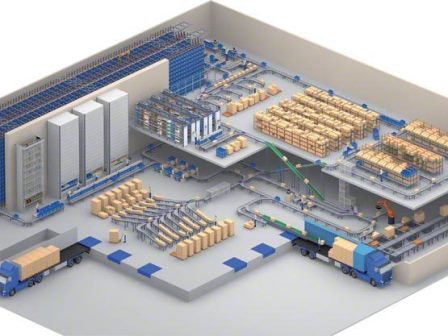
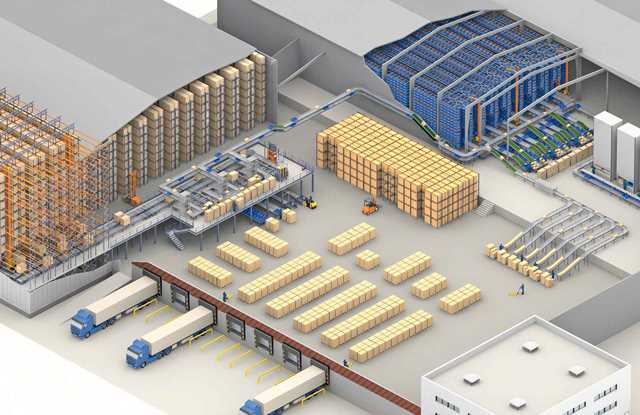
Warehouses also have a functional and technical side. The functional side is represented by the warehouse’s activities (the receiving of goods, control, storage, order-picking, accumulation and sorting, and shipping). The technical side consists of technical means ensuring material and information flow (racks, forklifts, hardware, software, etc.).
Warehouse design standards
The aim of this paper is to present one possibility of designing a warehouse system, where one of the principles of logistics is used: the system approach because the proposed warehouse system should be approached logically and systematically.
The systematic approach means that the processes and objects are visible and can be managed as a system.
The approach has been developed based on the experiences of a range of companies in a range of different business sectors.
Within the systematic approach, the warehouse system may be characterized as a part of the warehouse process.
Warehouse operation process
Warehouse system
The term warehouse system (WS) in this article means a system of two or more devices and means (storage and service equipment), forming a whole for the storage area, including their management.
The warehouse system’s composition depends on the chosen warehouse technology, and it consists of two basic parts: the racking assembly and the service equipment.
Choosing the right storage system is a topical research topic as it affects storage capacity and utilization, the speed of storage activities such as warehousing and removal, and operational safety.
The proposed methodology is a suitable tool for decision-making (e.g., for managers) in this area.
Pallet racking is a material handling storage rack system designed to store products and materials on pallets in horizontal rows and on multiple levels.
Selecting warehouse storage rack systems involves careful planning and appropriate system choices to ensure you get the most from your capital expenditures, reduce overhead, and respond quickly to distribution needs.
With the continued growth and domination of e-commerce in the retail market, the demands on warehouses and distribution centers across the globe are also rising.
Many projects require special anchor details that will be shown on the erection drawings.
The installer must follow these anchoring details. In the absence of such details, for standard pallet racks, it is recommended that one anchor bolt be used per column and that the anchor be ½ ”in diameter and provide 2-1 / 2” of nominal embedment in the floor.
Nominal embedment is defined as the amount of anchor that is below the floor surface before tightening.
If the base plate is a larger base plate with four holes, at least two anchors per column should be used at opposite corners of the base plates whenever possible.
Pallet rack assembly instructions
When installing anchor bolts, the builder should refer to the anchor bolt manufacturer’s anchor bolt instructions for torque values for the anchors.
The anchor bolt torque is less because overtightening the anchor bolt will fail the clamping device and possibly pull the anchor off the floor.
Although we recommend always anchoring, some codes suggest that anchors for short stable racks (8 feet in height or less) that are manually loaded and unloaded in low seismic areas can be omitted.
Installation of the remaining bays
Remaining bays can be installed making sure the rows are straight above the chalk line and subsequent frames remain plumb (within 1/4 ”for every 10 feet of height) in both the aisle and aisle directions. .
The rest of the row of shelves can be set up before anchoring. All footrests in the remaining bays should be anchored like the boot bays (see boot bay installation).
Never attempt to plumb a screen after fasteners have been tightened or use excessive force to plumb a screen.
This could bend or damage the frame members. Periodically check plumb bob as rack installation progresses.
It can be very difficult to connect multiple rack bays that have been installed outside of lead.
Pallet storage and pallet rack installation jobs require an experienced crew with the proper tools and equipment. Many people involved in pallet racking jobs don’t really know how to install a pallet rack.
Few warehouse operators have aggressive in-house rack inspection programs in place. Forklift accidents, collisions, dropped or misplaced loads, and other incidents that result in rack damage may or may not get promptly reported.
I have come across this situation many times before and have never had a problem with it.
Stock pickers are working under the shelves all the time to retrieve items from the back of the bays.
A shelving collapse will be catastrophic regardless of where a staff member is in the warehouse.
By providing mesh on the back and sides, it seems reasonable to add security.
There should be no unsecured loads stored on a high-rise pallet and a racking inspection and damage reporting scheme should ensure that the racks are stable.
Pallet Racks Safety Tips
Pallet rack beam capacities are pretty simple. They’re rated per pair for evenly distributed, properly-positioned loads. But upright capacities are more complex because their capacity is calculated on vertical beam spacing.
The largest vertical gap dictates the capacity, so be aware of tall loads, which can stress a rack more than a squat, heavy load because extra beams act as lateral support. Get these factors right, and your rack will be safe and stable.
Few warehouse operators have aggressive in-house rack inspection programs in place. Forklift accidents, collisions, dropped or misplaced loads, and other incidents that result in rack damage may or may not get promptly reported.
Warehouse layouts strategy, due to their influence on total warehousing costs, are of interest to the theory and practice of warehouse design.
While the layout problem of the unit-load storage area of conventional warehouses has quite a long history, the layout of conventional systems with manual order-picking from multiple aisles has been the topic of a number of research papers only in the previous decade.
The research has resulted, among other things, in various strategies for optimal layout design. Moreover, some new innovative layouts for storage areas have been proposed recently.
These layouts result in a reduced travel distance needed to store or retrieve a single pallet, thus improving the efficiency in the storage area.
Warehouse Layout Strategy
Warehouse layout optimization
However, the question of whether these layouts could perform better than traditional layouts in manual order-picking operations has remained unanswered.
This provides a short overview of optimal traditional layouts of the storage and order-picking area as well as new innovative storage area layouts, followed by results of the analysis of order-picking in these new innovative layouts and relevant conclusions.
The importance of the warehouse in the supply chain network is increasing. The competitiveness of a company is directly influenced by its ability to achieve efficiency in terms of a high rate of on-time deliveries without defects in its supply chain network.
Warehouse layout best practices
Supply chain efficiency and best practices are to a large extent determined in its nodes. In today’s business climate there is a trend towards more product variety and shorter response times.
This puts increasing pressure on warehouse performance in terms of storing articles and the ability to assemble customer orders. The warehouse performance is largely determined during the design phase of the warehouse layout.
It is acknowledged that warehouse layout design is a highly complex task primarily because the warehouse performance affects, and is affected by, other functions within a company’s ability to operate adequately as well as ensure the company’s competitiveness.
Warehouse Layout Strategy
Warehousing and storage services
For this reason, warehouse services have many stakeholders. Additionally, it may be the only view that end customers have of the company’s operational capabilities. Many aspects need to be considered when designing a warehouse both within the warehouse operations and the company’s supply chain network as a whole.
These aspects consider both the nature of the business in terms of customer requirements and demand patterns such as seasonality as well as the characteristics and requirements of the product.
The degree of complexity of warehouse design is largely determined by the number of activities and parallel processes that are performed in the warehouse.
Warehouse layout design example
Warehouse design is fixed in nature as it is often expensive to change after implementation.
Both due to high investment costs in new facilities, racks and equipment, and due to opportunity costs for downtime in operations.
A warehouse normally operates on an everyday basis. A redesign that requires shut down of departments in the warehouse is not an option for many companies.
High costs derived from lost sales, use of a third-party logistics provider or lost production rate can cost more than the warehouse investment itself.
For this reason, it is important for companies that are acting in volatile or fast-moving industries or for some other reason are expecting considerable changes in demand to consider flexibility in their design process.
Factors to consider in warehouse layout
This is to ensure a successful warehouse design solution that is aligned with the company strategy for the life span of the investment.
The requirements and expectations for the warehouses’ abilities are changing.
Is it old-fashioned to see storage as a non-value-adding activity?
Trends in supply chain management such as supply chain integration and supply chain postponement have led to that more value-adding activities are performed within warehouses.
Besides storing and distribution other activities such as repacking and final assembly of products have been introduced to the warehousing service portfolio.
Warehouse design considerations
To support the design process of warehouses, researchers have formed frameworks. Most frameworks reviewed are based on literature reviews and are yet to be tested in practice while others are developed with the help of experienced practitioners and relate loosely to academia.
The availability of frameworks covering the whole design process, from purpose identification to evaluation, is limited in current research and there is a need for further research that connects practice with theory.
However, problems related to warehouse layout design are seldom well-defined and cannot be reduced to multiple isolated sub-problems.
This means that warehouse designers need a mixture of creativity and analytical skills to handle the complex interactions between warehouse activities, future demand, and space requirements.
Questions to ask about warehouse operations
Designing a warehouse is an intricate process with many trade-off decisions to be made between conflicting objectives. The complexity of the process is further increased by the high number of feasible design solutions.
Warehouse design is fixed in nature as the investment cost for the redesign is considerable.
To ensure satisfying warehousing performance during the life span of the warehouse it is important to take the corporate strategy and growth expectations into consideration during the design phase.
The purpose of the study is to develop an aligned warehouse design solution for current and future operations considering a company’s growth expectations. The literature review made it evident that a method to generate a layout design that incorporates future operations in an adequate way is needed.
The following research questions are investigated and answered in the thesis:
What aspects should be considered when designing a warehouse layout to ensure that it is aligned with the company’s growth expectations?
How can a warehouse layout design be generated that ensures flexibility and ability to handle future warehouse operations?
Racking is much more than just steel. Racking is the key to optimum throughput efficiency because the efficiency of the entire material flow is optimized only through the requirement-specific design of a racking system.