All posts by Loganx

Professional Web Writer | Motor Enthusiast | Content Creator | Logan is a dedicated and skilled web writer, passionate about engines and machines and with a talent for creating engaging and informative content. She specializes in writing about a diverse range of topics including construction, forklifts, heavy equipment, excavators, etc. SEO Optimization: Proficient in SEO best practices, ensuring high visibility and engagement for all published content.

Surge Tank in Hydroelectric Power Plant

A compensation tank is a water storage device that is used as a pressure neutralizer, in the water conduction systems, of a hydroelectric plant, to cushion the variation of excess pressure.

In short, the surge tank mitigates pressure variations due to rapid changes in water velocity.

For hydropower uses, a surge tank is an additional storage space between the main storage reservoir and the powerhouse, as close to the powerhouse as possible.

The main functions of the surge tank are:

  1. When the load decreases, the water backs up and is stored in it.
  2. When the load increases, the surge tank will provide an additional supply of water.
Surge Tank in Hydroelectric Power Plant

Hydroelectric Power Plant is

The most common type of hydroelectric power plant is a reservoir facility.

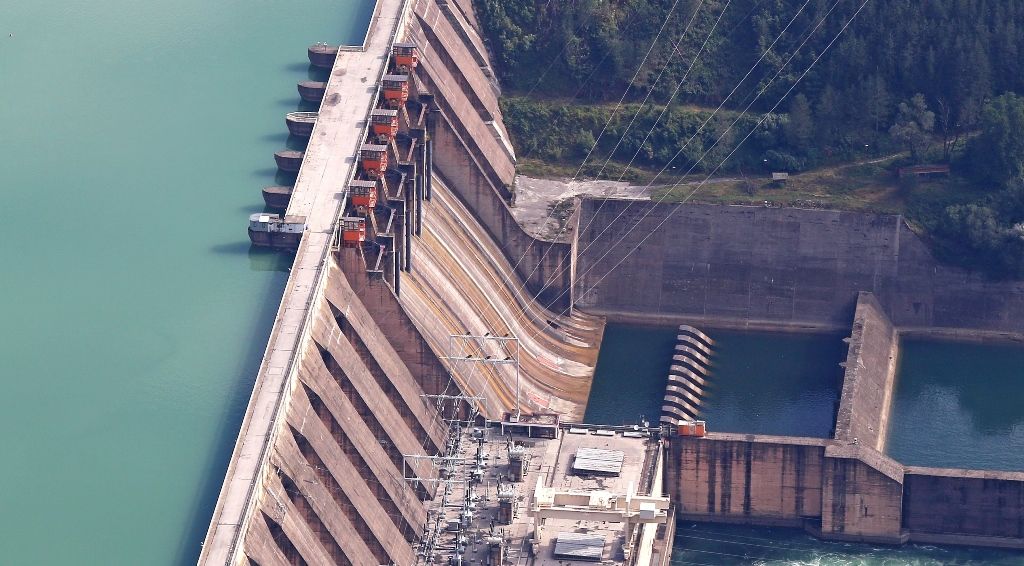
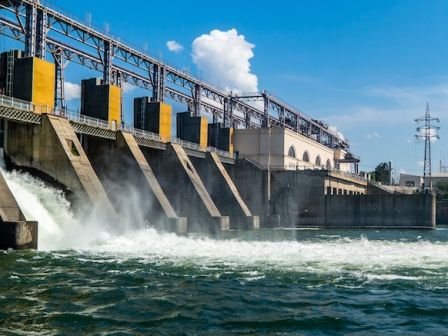
A reservoir facility, usually a large hydroelectric system, uses a dam to store river water in a reservoir.

The water released from the reservoir flows through a turbine, causing it to spin, which in turn activates a generator to produce electricity.

Water can be released to meet changing electricity needs.

The energy produced by the hydel power plant is

The electricity, a hydraulic turbine converts the energy of flowing water into mechanical energy. A hydroelectric generator converts this mechanical energy into electricity.

A turbine and generator produce the electricity

Electricity demand is not “flat” and constant. Demand goes up and down during the day, and at night there is less need for electricity in homes, businesses and other facilities.

For example, at 5:00 p.m. m. On a hot weekend day, there is a huge demand for electricity to run millions of air conditioners.

Pumped storage hydropower

Hydroelectric plants are more efficient at meeting peak energy demands for short periods than nuclear and fossil fuel plants, and one way of doing this is through “pumped storage,” which reuses the same water more than one time.

Pumped storage is a method of keeping water in reserve for peak period power demands, by pumping water that has already flowed through turbines back to a storage pool above the power plant. at a time when customer power demand is low, such as overnight.

The water is then allowed to flow back through the turbine generators at times when demand is high and a heavy load is placed on the system.

Hydroelectric energy renewable or nonrenewable

The main advantages of hydropower are that it is 100% renewable, can generate electricity at any time of the day or night, and is generally safe to operate.

However, it is a challenge to build hydroelectric plants because a river needs to be completely dammed. Not many utilities can afford this, and governments usually foot the bill for hydroelectric plants.

Interestingly, states with lots of hydroelectric plants tend to have cheaper electricity costs.

So if states are willing to pay the upfront costs to build hydroelectric plants, they can lower consumers’ electricity bills.

Solar power is a cheap source of renewable energy, but hydropower is more consistent as water runs through turbines 24/7 compared to the sun only shining during the day.

While wind power is also a very consistent form of renewable energy, wind turbines will have a higher maintenance cost than hydroelectric plants because the turbines are larger and constantly moving, which means they break down more easily.

When it comes to biofuels, hydropower is superior because once the plant is built and running, the environmental impacts are less.

With biofuels, you have to constantly cut down trees or plants that will be burned for fuel.

But with hydropower, water is plentiful and doesn’t emit CO2 when it powers the plant.

More on this story

Surge Tank in Hydro Power Plant

Surge tanks can provide a fundamental feature for the hydraulic design of hydropower projects
Bathymetric Survey

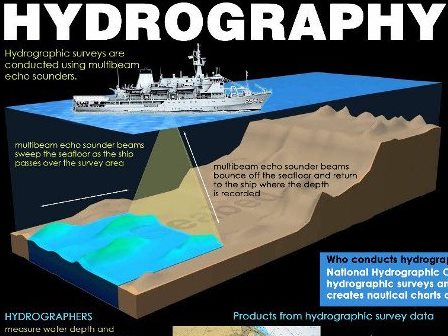
The variation in relief constitutes the morphology of the ocean floor. Charting of the ocean is very important for many reasons.
Topographic Survey Cost

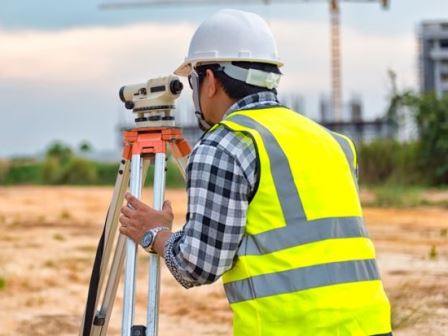
As a home or property owner, you may need to inspect your land. What is the cost of the topographic survey?

Overhead Crane Brands

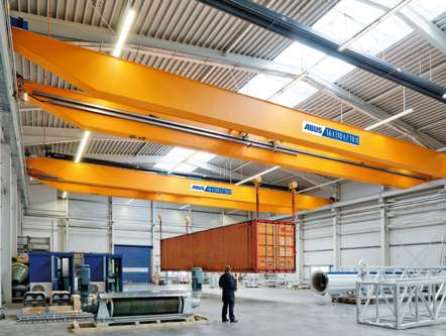
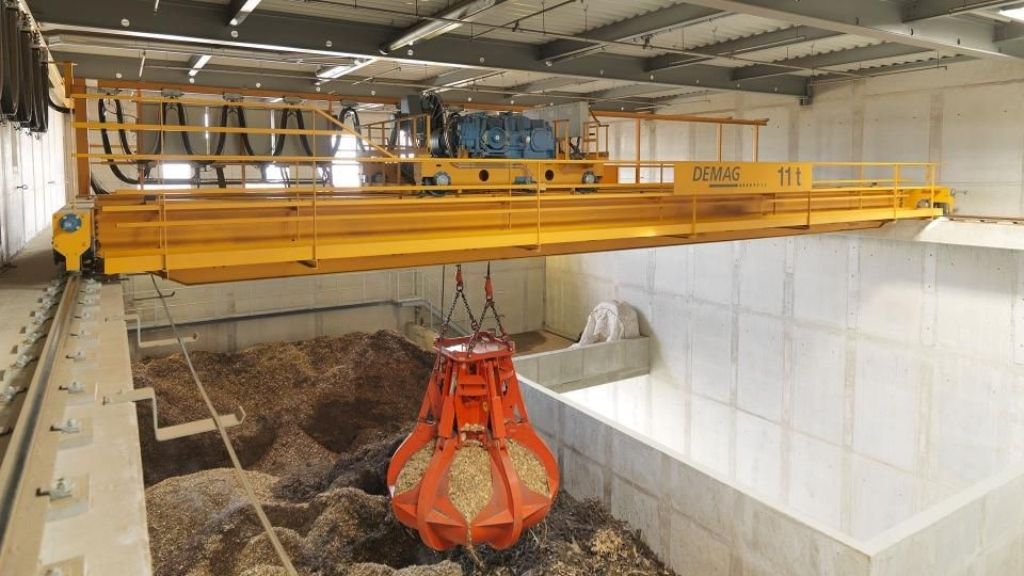
Overhead cranes, also called bridges or industrial cranes, are primarily used in factories to lift and shift heavy or bulky items. The best brands of overhead cranes manufacture single or double girder equipment.

It comprises a single or double girder system that allows a trolley and hoist to move.

The trolley can move from side to side, while the hoist can move up and down. In addition, overhead cranes are often used in metal and mining, aerospace, automotive, shipbuilding, and other industries.

The growth of the bridge crane market is driven by increasing demand for bridge cranes in manufacturing, transportation, and logistics, and in warehousing and storage facilities.

Overhead Crane Brands

Top overhead crane manufacturers

Private companies and government agencies are investing in infrastructure projects such as the construction of highways, dams, bridges, railways, waterways, and other road projects.

These projects require bridge cranes with high load capacity to lift and move heavy loads. Therefore, there is more need for overhead cranes in these areas of the industry.

The US has a large number of overhead crane companies, particularly in the areas surrounding its largest cities.

It’s understandable why overhead crane companies in the US range from leading crane manufacturers to local distributors.

Several overhead crane manufacturers have been in business for nearly 100 years. And many are full-service, offering design and fabrication services, repairs and parts, overhead crane modernizations, and operator training.

In addition, there are numerous overhead crane companies that adequately serve every state from the East Coast to the West.

The following list of overhead crane suppliers provides an overview of the types of companies that manufacture overhead cranes or sell the material lifting equipment as overhead crane dealers.

  • Konecranes
  • Gorbel
  • EMH, Inc.
  • Pacific Crane & Hoist
  • Capco Crane & Hoist
  • Dearborn cranes
  • American crane and hoist corporation
  • G.W. Becker Inc
  • Whiting Corporation
  • Zenar corporation

Overhead crane companies

High real estate and rental costs have prompted distribution, storage, and manufacturing facilities to focus on optimizing space and time for various activities.

The addition of overhead cranes can offer a significant boost for maximum profits, based on comparison to placement equipment such as forklifts.

Overhead lift cranes also allow for higher stacking as they are integrated into the ceilings, allowing for greater utilization of vertical space and thus optimizing the volumetric area of the storage facility.

Additionally, the elimination of floor-based transportation reduces industry floor traffic.

This, in turn, increases the total time required for the movement of goods. Such factors are anticipated to drive bridge crane market demand and growth.

Crane Manufacturers of America

The United States is one of the largest buyers of overhead cranes. It has a sophisticated sales and aftermarket with companies like Konecranes, Gorbel, American Equipment, and others.

The growing focus on oil and gas extraction is expected to increase demand for mobile cranes in both the US and Canada.

According to a report called Investment in the Canadian and US Oil and Gas Sectors, the US oil and gas industry has significantly increased production.

The bridge crane market is growing because the North American oil and gas industry is growing rapidly.

Overhead crane for sale

The size of the overhead crane market is forecast to reach USD 6.4 billion by 2030, with the top-selling cranes being:

By Boom Type: The global bridge crane market is segmented into single and double girder. The single beam is the largest contributor to the market and is estimated to grow at 5.4% during the forecast period.

By Business Type: The global overhead crane market is segmented into original equipment manufacturers (OEM) and aftermarket. The OEM segment is the largest contributor to the market and is estimated to grow at 4.7% during this period.

By End User: The Global Overhead Crane Market is segmented into Metal & Mining, Paper, Utilities, Automotive, Shipyards, and Aerospace. Automotive is the dominant segment and is estimated to grow 5% during the forecast period.

By Region: The global overhead crane market has been analyzed in North America, Europe, and Asia-Pacific. Asia-Pacific has the maximum market share.

More on this story

Overhead Crane Manufacturers

  • Who are the main suppliers of overhead cranes?
  • Who designs and manufactures cranes?

Overhead Crane Suppliers

A new report on “Overhead Crane Manufacturers and Suppliers Market to 2020” covers supply chain analysis.

Overhead crane companies

Looking to purchase your first overhead crane system and need to know where to start?

Forklift for Boats

The technical specifications of a boat forklift are of a proven design and rock solid construction, so mast lubrication provides easy access during maintenance, reducing service downtime.

Remote grease lines, pilot-operated hydraulic controls provide smooth, precise and more efficient operation, feature built-in negative and positive lift that reduces overall turning radius and load moment.

Heavy duty 2- or 4-stage masts offer stepped entry and exit for easy operator access from both sides of the machine.

Once in the cab, the operator enjoys front and side visibility, from the cab at the top.

Forklift for boat storage

The Boat Forklift Series offers premium features ideal for your marina and boat handling needs.

These standard features include galvanization, powder coating, and a three-step painting process for maximum corrosion protection; advanced rubber fork cover system, intuitive electronic joystick controls, deluxe air suspension seat, level compliant Cummins diesel engine, algae filtering system and remote technology vehicle management system.

Not only is the boat forklift series extremely attractive to the eye, it has been designed, refined and tested to meet and exceed current global regulations for stability, sound levels and safety.

Engineering personnel use the latest 3D solid modeling technology to develop the highest quality forklift in terms of performance, durability, operator safety, comfort, visibility and serviceability.

American made forklift use all of the same North American components throughout their product line to maintain a standard of service and make parts readily available 24 hours a day.

Boat forklift operator

To obtain maximum performance, an operator must have all the essential tools at their fingertips. Boat Forklifts are designed with advanced ergonomics for maximum comfort and productivity.

Standard features:

  • Complies with OSHA operator protection
  • Release control pedal
  • Intuitive electronic controls provide effortless operation; mimics the movement of the forks and carriage
  • Gauges and auxiliary controls located next to the operator’s seat. The display shows the hour meter, all engine functions, filter restrictions, low battery and remote technology functions.
  • Hydraulic controls are adjustable via the display and customization by the operator is possible, password protected.

forklift for lifting boats

  • Tilting steering column. Easy entry and exit
  • Directional and gear shift lever on steering column
  • Deluxe air suspension seat with retractable seat belts
  • Low, non-slip steps and handrails provide 3-point contact
  • Roof guard with top panel
  • Splash guard in front of operator platform
  • Optional wireless remote control available to operate boats off the operator platform.
  • Spring-loaded, hydraulically released parking brake
  • Enclosed cab (optional). Features available with enclosed cab include: heater and air conditioning unit, windshield wipers, front, rear, top wipers, tinted windows, and key lock doors
  • Rear crash sensor notifies operator with visual and audible warning of people or objects within a predetermined distance around the rear of the vehicle

Forklift dimensions and weight

Visibility

Boat forklifts are designed with a fully open mast and a unique low-profile counterweight to provide the operator with unobstructed views in all directions.

The two-stage wide-view mast is constructed with mast channels, lift cylinders, chains, and hoses positioned as far out as possible to provide the operator with the largest possible window of visibility.

forklift for moving boats

  • Superior tilt cylinders provide excellent stability and visibility.
  • Main rollers are lubricated and sealed with grease spots on each side of the mast. All mast lubrication can be done at ground level.
  • Main and side push rollers reduce friction; impact resistant.
  • Mast pivots constructed with wear resistant bronze bushings and hardened steel pins. The mast pivots can also be greased.
  • The accumulator in the lift circuit reduces shocks to the mast and the load.
  • Safety valves built into the base of the lift cylinders provide controlled lowering in the event of hose failure.
  • Forklift for Boats

More on this story

Marine Forklift

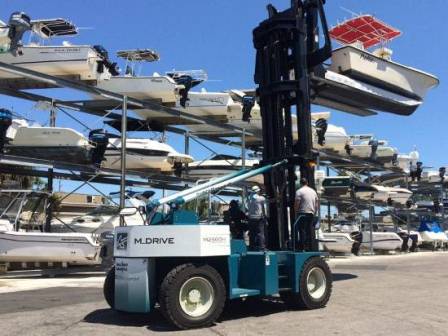
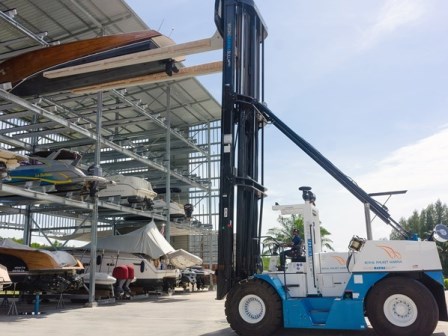
The marina forklift in the industry is used to dry-stack boats in storage racks, and lower/raise boats in/out of the water. Hoist’s lift truck is compact and extremely maneuverable to operate around any facility, yet strong and durable enough to lift/lower boats of various sizes and weights.

Boat Forklift for sale

If you want to buy a marine forklift for your facilities, here are some recommendations before you buy it.

Load Backrest Extension Forklift

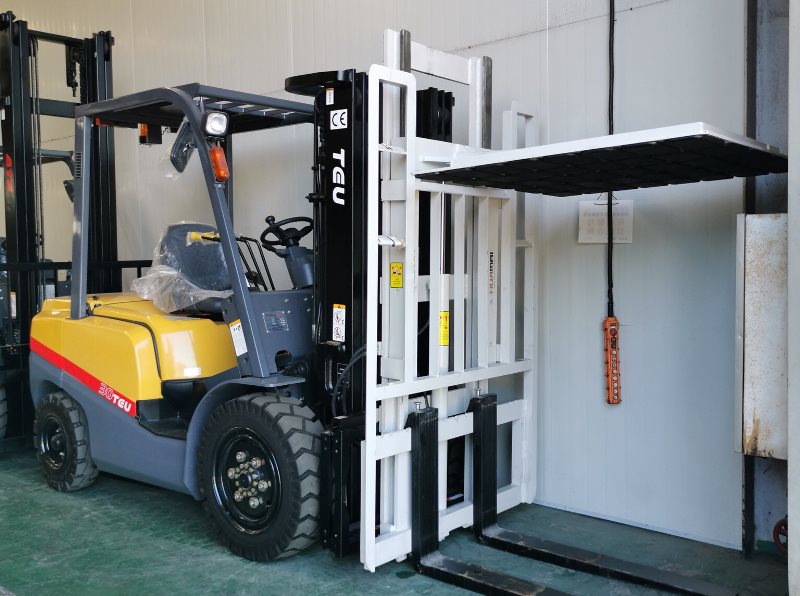
Forklifts handling small objects or units without bands are generally required to have a vertical load backrest of sufficient height, width, and strength to prevent the load or any part of it from falling towards the operator.

There are several solutions:

  • Collect less material.
  • Add extensions to the load backrest.

The forklift load back extension is part of the equipment that ensures that the materials do not fall on the driver, as it supports and supports the load against a flat steel frame that makes the loading and unloading operation safe, reducing the possibility of accidents and product damage.

Load Backrest Extension Forklift

Forklift load backrest Guards

Federal law allows extensions to be added to minimize the possibility of the load or part of it falling backwards. However, note that the customer or user should not make modifications that affect the capacity and safe operation of the forklift without the prior written approval of the manufacturer. Such a change may also require a new capacity plate.

A good practice is to contact the manufacturer and discuss the options with him. They may be able to provide you with extensions or a different load backrest that meets your needs.

Load backrest is subject to many debates whether the forklift needs it or not. One of those discussions I hear frequently is whether the forklift is originally equipped with a backrest.

Forklift load backrest for sale

While adding extensions can solve the problem of supporting your load, it has the potential to create another problem. The extra height of the extensions can increase the risk of striking high objects in the work environment, such as beams, steam pipes, ventilation pipes, etc.

Be careful whenever you are considering modifying any equipment and consider the possible benefits and consequences of the modification.

Forklift backrest for sale

Steel load backrests are designed to prevent cargo from falling onto the equipment driver. This allows the product to rest against a square, flat surface making loading and unloading safely.

These regulation-required backrests feature a steel grating area above the forks. The strong steel frame ensures fastening to the sides of the forklift truck.

All load backrests are bolt-on or slide-on style. Special backrests, such as notched center and power pallet truck backrests, are available upon request.

Load backrests are made to order based on certain specifications.

To view the spec sheet for forklift load backrests, review the tech specs for each forklift.

More on this story

Forklift Load Backrest

Steel Load backrests are designed to prevent the load from falling toward the equipment driver.

Forklift Safety Procedures

Forklifts are extremely useful workplace vehicles, as long as they are used safely and appropriately by operators who are appropriately trained and competent to use them.

Tower Crane Accessories

To lead in the purchase, sale, and distribution of tower cranes; It must have competitive advantages in the import and export of building materials, as well as complete sets of machinery and equipment, engineering, and project contracting.

The supply of construction machineries such as tower cranes, forklifts, suspended platforms, concrete formwork, road machinery such as excavators, pavers, backhoes, and spare parts for concrete pumps; packaging machinery such as cement paper bag machinery, shopping paper bag machinery, and industry-related machinery, also be the largest steel distributors.

Tower crane parts are one of the key products, and with the experience in producing mast sections, now we could provide the world with high-quality tower crane parts, including different types of mast section, anchor collar, and frame base for tower cranes of famous brands.

Intruder Alert Alarm System

Maintaining the safety of your crane is paramount to ensuring public safety and the smooth running of the project in question. A digital radio anti-climb detector system has been developed to complement the physical barrier systems on the market.

The system is based on Motorola’s highly durable telemetry platform and consists of two high-powered infrared beacons that are strategically mounted on the crane’s internal climbing tower, crossing to form an infrared array.

If an intruder climbs the crane without authorization, either internally or on the outside of the tower, the infrared array will break, automatically setting off an audible alarm for the radio system on the ground.

This radio will also receive an SMS, which is clearly visible on the radio screen and will indicate which crane has been breached.

A 10w loudspeaker is installed inside the crane tower, which will receive the voice transmission from the radio system on the ground, thus warning the intruder that it has been identified and that action has been taken. A simple upgrade will allow external text messaging, email alerts, and a recorded voice message, should external monitoring be required.

Ascent Deterrence Device

This device is a security measure designed to deter unauthorized climbers from the crane.

The hatch hatch located in the staircase denies any access through the stairway and the panels around the exterior of the tower section deny any access around the exterior.

Base Enclosure Ascent Deterrent

A security measure designed to deter unauthorized climbers or intruders around the base of the crane. Available at 3m or 4.5m in height with a lockable door system with key

More on this story

Tower Crane parts name

Components and main functions of a crane such as: the mast, the counterweight, the arrow, the cabin, the controls, lights or the anti-collision system.

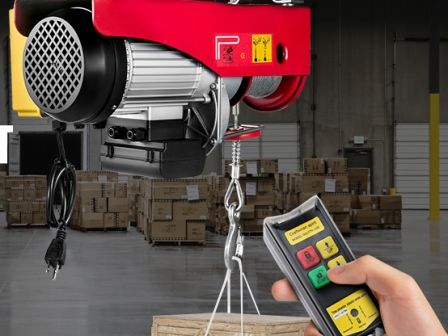
Small Electric Hoist with Remote Control

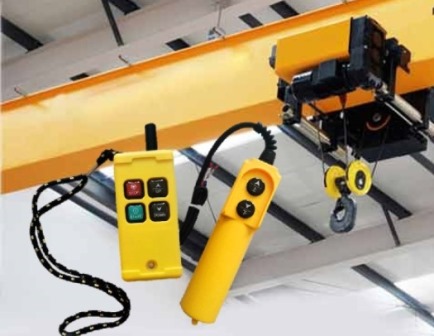
When operating equipment and machinery, there is always a safety risk. Radio remote controls serve as a value-added solution to this underlying problem.

Radio remote controls are widely used in the construction, manufacturing, and equipment industries. Having a remote control completely changes the way machines are operated; the operator can easily control the device from a safe distance saving valuable person-hours.

Small electric hoist with remote control

Electric hoist with remote control

With a radio remote control, an operator can get the best possible line of sight when transporting or handling equipment. They can even manage operations from a remote location, allowing for one-person operation of the equipment.

Traditional working conditions required tireless efforts and involved risk to execute machine operations.

But radio remote control systems increase productivity and reduce overhead.

Initially, the remote controls were connected with cables, which still meant that the operator remained close by. Over time, remote control devices have been configured to be wireless and effective with greater ability and authority to control equipment.

Radio remote control devices are built with industrial-grade quality to enable a diverse workforce to eliminate the physical cost of manual labor. With remote control, operators can now work longer with less fatigue and complete projects on time.

120V Electric Hoist with Wireless remote control

This 120v Electric Wire Rope Hoist is one of our most popular units for in-home or light use. This hoist has a compact lightweight body allowing you to conveniently move this hoist from place to place as needed. This product will give you the ability to lift those objects that were holding you back from completing your home projects.

The duty rating is a key factor in choosing the right unit. This electric wire rope hoist is suitable for infrequent handling, installation, and maintenance of heavy equipment, and for long standby periods between uses.

For uniformly distributed work periods, the hoist has a 12.5% max. operational time per hour and can handle up to 75 starts per hour.

When being used for infrequent work periods, the hoist can be operated for 15 minutes from a cold start with up to 100 starts per hour. Operational time ratings are calculated at a 65% load factor, as per ASME Standards.

Small electric hoist with remote control

It is mainly used in general lifting, loading, and unloading operations in machinery manufacturing workshops, warehouses, engine assembly, and maintenance.

Compact size

The obvious benefit of using a remote control is that it offers excellent maneuverability for complex operations. Moving your fingers across the controller would be like playing a video game; all vibrations are disabled to provide operators with a smooth control piece of equipment.

Built as a user-centric device, it is easy to install and in a very short time, the user can get used to the controls and perform the necessary operational functions.

emergency stop button

As an essential measure to avoid endangering the workplace or the surrounding area, a kill switch comes in handy.

There are cases where there are machine failures or things can go unplanned. To prevent the situation from escalating further, an emergency stop button acts as a safety mechanism. It helps keep the operation under control and stops all operations instantly in an emergency.

Improves operator safety

A radio remote control safely positions the operator at a safe distance from equipment or moving parts, falling dust, or debris, giving them the best vantage point.

Unrestricted operator mobility

With the remote control, the operator can change locations to get used to the working conditions and avoid losing sight of the machine. They can control the lifting and traveling functions and manipulate the movements of the hoist and the speed at which processes occur.

More on this story

Electric Hoist with Wireless Remote Control

The remote-controlled electric hoist, as the name suggests, is controlled by a wired or wireless keyboard.

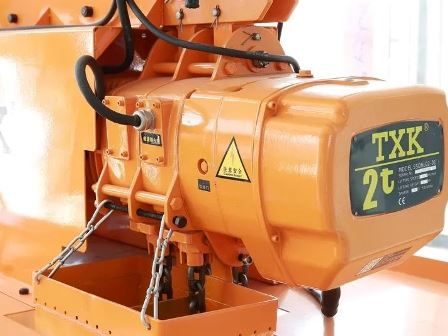
2 Ton Electric Chain Hoist

Whether you need to lift a load as light as 500 lbs. or as heavy as 2 tons, you’ll find a manually operated chain hoist here.

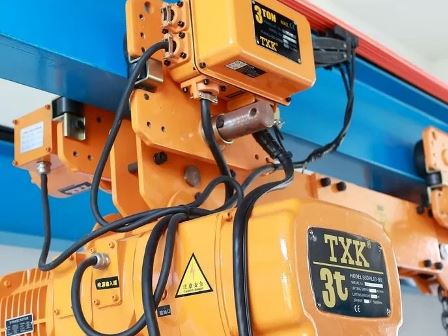
3 Ton Electric Chain Hoist

Electric chain hoists of 3-ton capacity can be used for many different applications.

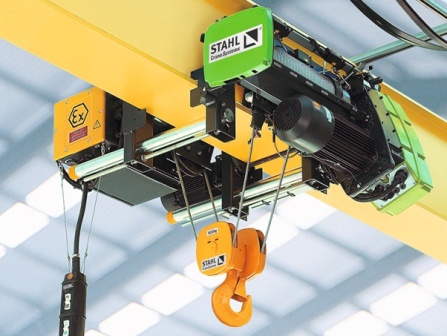
Electric Hoist Trolley

Powered trolley hoists come in different types, including air and electric capacities.

Wireless Remote Control Switch

One safety measure that is now widely adopted is the use of a wireless remote control system with a switch to control the electric hoist rather than using pendant or cab controls.