Professional Web Writer | Motor Enthusiast | Content Creator | Logan is a dedicated and skilled web writer, passionate about engines and machines and with a talent for creating engaging and informative content.
She specializes in writing about a diverse range of topics including construction, forklifts, heavy equipment, excavators, etc. SEO Optimization: Proficient in SEO best practices, ensuring high visibility and engagement for all published content.
The new tower cranes feature new technologies that raise performance to a new height. Precise work with high-lift cranes depends on precision and speed, while lifting for general construction work demands reliable safety and a sufficient work area.
The versatile tower crane meets all of these requirements in one rugged unit. Its powerful lift booms can easily handle precise and continuous jobs, while the new hydraulic system, working in combination with a large drum capacity, offers ultra-smooth operation.
Of course, tower cranes are known for their productivity-boosting technical advancements, backed by extensive use in the construction machinery field.
How long is the boom on a tower crane?
The maximum reach distance of a tower crane is determined by the weight to be lifted, to calculate this distance, is the table of capacities of each crane. The boom length of each tower crane determines its maximum capacity.
Elevation range
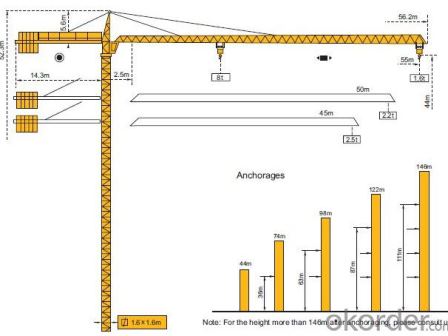
Just as important as lift capacity is lift range. For that, a range diagram is usually included in each graph that illustrates how much boom length is needed to lift and lift a load both from distance and height.
Example: You need to lift a load 25 feet and lift it to the top of a five-story building. Referring to the reach diagram, 69 feet of boom are required to perform the lift.
Tower Crane Boom Length
The tower crane exemplifies this engineering excellence, offering dependable durability, excellent lifting performance, economical transport, smooth control functions, and a wide range of safety features.
In short, it can handle all types of crane jobs, ensuring maximum customer satisfaction.
Designed for easy maintenance and reliable performance for excellent uptime, the Hammerhead Tower Crane Series provides excellent maneuverability and load moment precision.
Equipped with a comfortable ergonomic cab, high-performance load diagram, and built-in safety features, time-tested, reputable design quality and components are designed to deliver safe, reliable, and cost-effective performance over long hours of operation.
The lifting capacity of the crane depends on several factors. The limitation for lifting weight begins at the base of the tower crane. Each and every component of the crane affects the lifting capacity of the load.
The mechanism used to raise and lower heavy loads to the desired height with comparatively little effort is called a lifting mechanism.
It is mainly operated with a system of pulleys and gears (either manually or mechanically) using electric power or fuel.
How does the hoist mechanism work?
They are generally used for loading and unloading very heavy materials that cannot be handled by one person and must be placed on transport trucks, ships, fixed spaces and many other places.
Hoist Mechanism
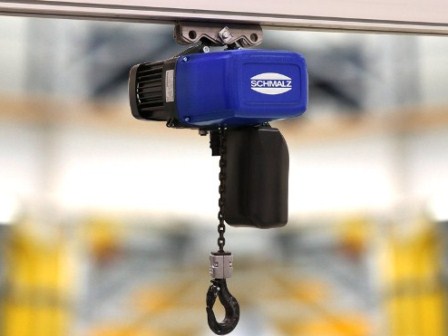
Chain block mechanism
The ability to move the load relies on the system of pulleys and cables, which can be fixed or mobile. This system varies the forces and the speed, needing to apply a force less than the load to be moved. The effort is also less than what we would need if the load were lifted freehand or with small hoists.
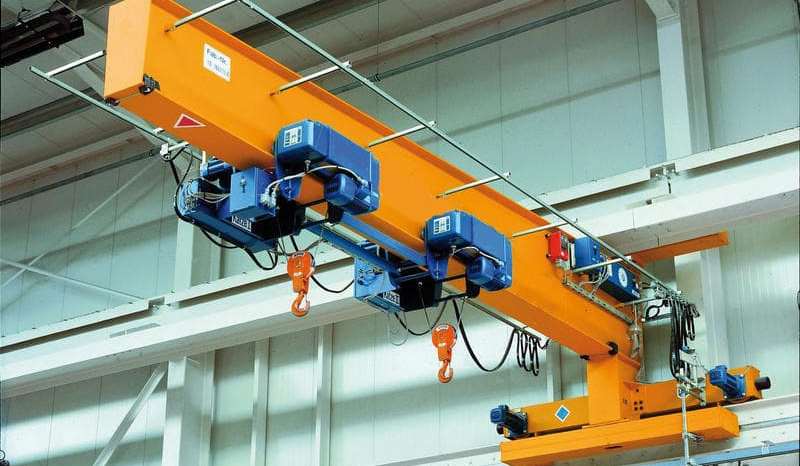
A specific overhead hoist configuration is generally defined by the lifting medium, operation, and suspension.
Hoist is the type of component used to transmit and cause vertical movement and includes cable, chain or synthetic strap, or rope.
Operation defines the type of power used to operate the lifting motion and includes manual power, electrical power, hydraulic power, or pneumatic power.
Suspension defines the type of mounting method used to suspend the hoist and includes hook, clevis, lug, trolley, platform, base, wall, or ceiling.
How to calculate hoist load capacity?
Determination of the required capacity
When selecting a manual, chain, or electric hoist, the rated capacity should be at least as high as the weight of the heaviest load to be lifted and no higher than the rated capacity of the bracket, monorail system, or another overhead structure from which the hoist will be raised.
In addition to the factors listed above for manual hoists, when determining the capacity requirement for an electric or air hoist, we must not only consider the weight of the heaviest load to be lifted, but also determine the average effective load.
Suspension kit for hoisting
Chain hoists can be suspended in a fixed location or can be mounted to a trolley by means of a top hook or mounting lug.
The cars can be rigid or articulated. Trolley travel can be simple (push type), manual geared or motor driven. See below for examples of typical chain hoist suspension types.
How does the lift system work?
When the corresponding button or joystick on the pendant or radio is activated, the hook moves vertically as long as certain conditions are met.
The product has a variety of built-in automatic safety features that, for example, prevent lifting overload, limit travel movements, or prevent all movements if the emergency stop button is activated.
Additionally, there may be operational limits (set by the owner or operator) that also limit movements under certain conditions.
Complete suspension kit for hoist
When a joystick or lift button is activated on the controller, a command is sent to the electrical panel.
The direction (up or down) of the hoist depends on which button or joystick is pressed. The speed of the hoist depends on the step that is activated.
The electrical panel controls the brake and the motor according to operator inputs, along with signals from sensors and safety devices.
When the motor is not being driven, the brake holds the motor in place, preventing it from turning inadvertently and the load from slipping down.
When a signal is transmitted from the controller, the electrical panel powers the motor and releases the brake.
The motor drives the lifting mechanism which drives the lifting drum.
The hoist mechanism reduces rotational speed and increases torque to lift the load.
The wire rope winds or unwinds when the hoist drum rotates.
The cable guide guides the steel cable to the correct groove on the drum.
One end of the cable is fixed to the lifting drum with a cable clamp.
The other end of the rope connects to the rope anchor.
The cable passes around the cable pulleys to the cable anchor.
The hook block raises and lowers as the cable is spooled on or off the hoist drum.
In normal use, when the raise or lower control on the controller is released, the control closes the main brake and brings the hoist to a gradual and controlled stop.
In emergency situations, the emergency stop button on the controller can be activated. This causes an instant stop of all movements by cutting power to the motors and applying the brakes.
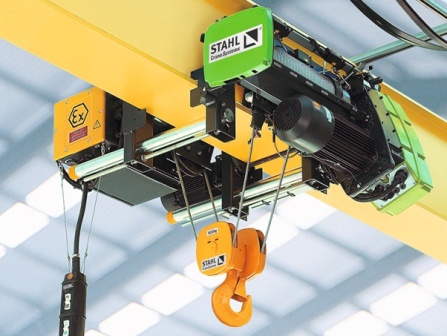
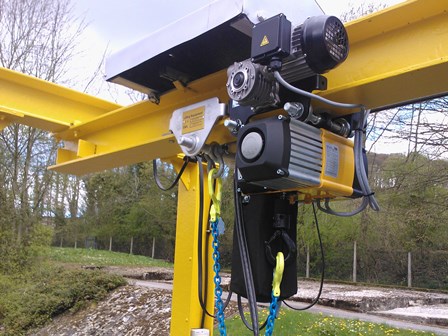
Electric Hoist trolley provides the ability for a simple hoist to become a laterally traversing versatile piece of equipment. Powered trolley hoists come in different types, including air and electric and capacities.
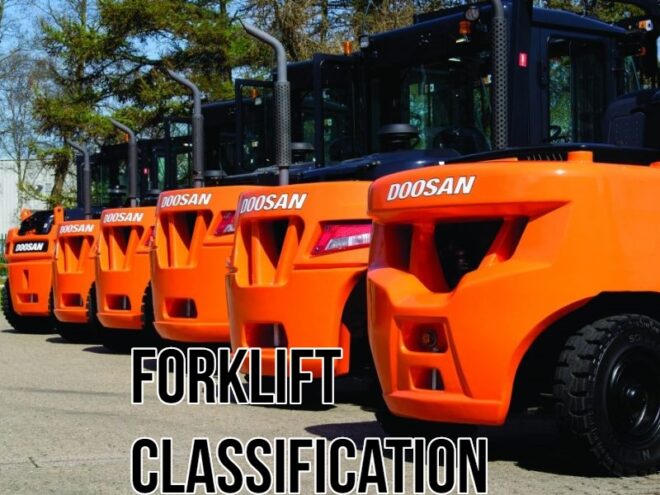
Forklift Classification Chart: Forklifts are one of the most powerful vehicles for builders. Whether you need to move heavy loads in a warehouse or construction field, forklifts can safely lift objects humans cannot, making them indispensable on any job site.
Since there is a wide selection of styles and models, it can be difficult to select a forklift. Whether you’re looking to rent a forklift for your next project or purchase one, our guide covers the different forklift types, the benefits of each equipment, and popular forklift models to help choose the right forklift for your needs.
Forklift Classification Chart
Forklift classifications
What are the different Forklift types?
Productivity and efficiency can be increased in the workplace if one chooses the correct equipment for his or her needs. Today, warehouse operators and fleet managers have a wide array of material handling equipment to choose from. Some of the popular options include aerial lifts, electric forklifts, LPG forklifts, pallet jacks, side loaders, and even automated guided vehicles (or AGVs). (Forklift Classification Chart)
Forklift Classification Chart
If you are looking to get new equipment to accomplish key tasks more efficiently, it is recommended that you familiarize yourself with the forklift classifications set by OSHA (Occupational Safety and Health Administration). Below is a detailed look at forklift classifications Classes I through VII, including their key features and benefits:
Class I: Electric motor rider trucks
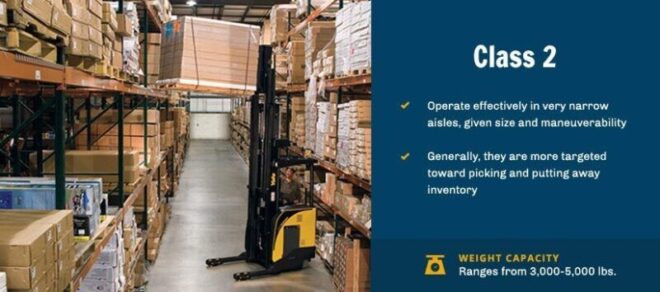
Class II: Electric motor narrow aisle trucks
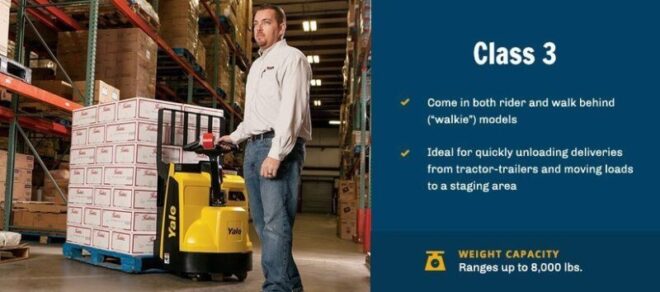
Class III: Electric pallet jack
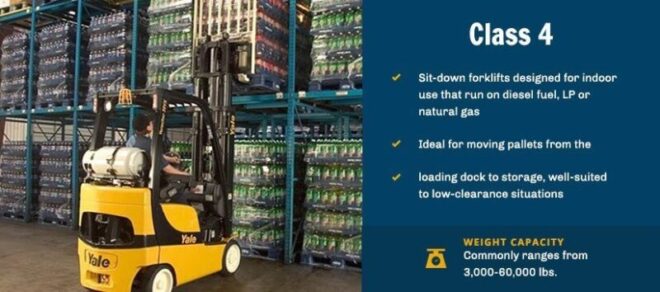
Class IV: Cushion tire forklift
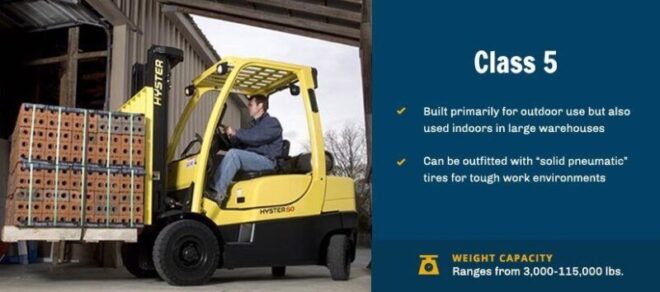
Class V: Solid pneumatic tires
Class VI: Electric forklift truck
Class VII: Rough Terrain Forklifts
Electric motor rider trucks
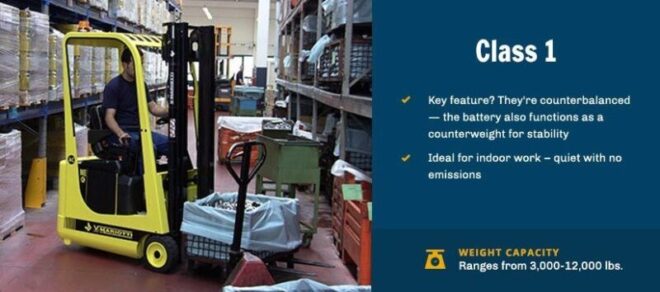
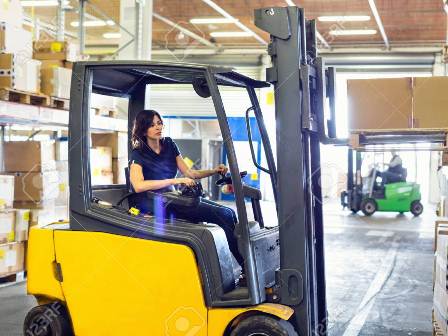
Class I Forklift Classification Chart are electric motor riders. These electric-powered forklifts are ideal for loading and unloading tractor-trailers, handling pallets, and a number of other applications in industries ranging from food storage and retail to factory and general warehousing.
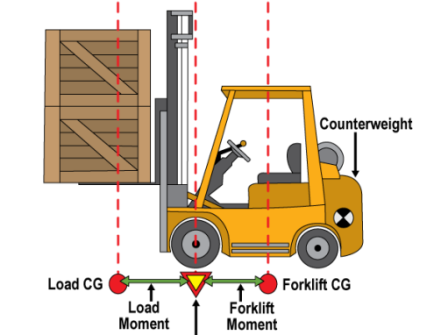
Because they are powered by an electric battery, Class I forklifts are much quieter and create no emissions, making them a popular choice for indoor applications. Batteries on Class I forklifts also function as part of the counterweight to help maintain lifting capacity.
Forklift Classification Chart
Electric motor narrow aisle trucks
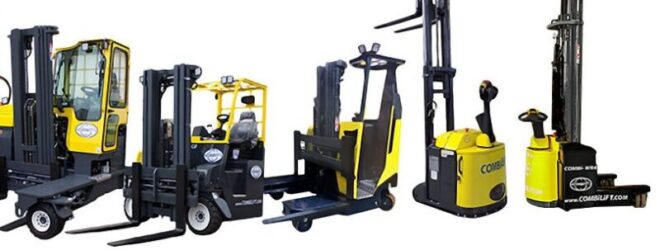
Class II Forklift Classification Chart is electric, narrow aisle models. As the name suggests, Class II forklifts are designed with maneuverability that allows them to operate in tight spaces and narrow aisles. This class of forklifts is perfect for picking and putting away inventory, and these trucks provide users the ability to increase racking space without expanding their current warehouse.
Toyota offers two Class II forklift models, and you can explore the unique features of each by clicking on the model name from the list below.
Forklift Classification Chart
Electric pallet jack
Class III Forklift Classification Chart equipment includes electric pallet jacks, stackers, and tow tractors. This class of equipment comes in both rider and walk behind (“walkie”) models, perfect for unloading deliveries and moving loads to a staging area where they can be handled by other types of forklifts.
Toyota offers 10 Class III models, including three different stackers that are ideal for food and beverage storage industries, among others. Click on each forklift model below to learn more.
Forklift Classification Chart
Cushion tire forklift
Class IV Forklift Classification Chart are internal combustion engine cushion tire trucks. This class of sit-down forklifts is designed for indoor use. Class IV forklifts are powered by internal combustion (IC) engines that run on diesel fuel, LP gas, gasoline, or compressed natural gas. Their solid, cushioned tires provide a smooth ride on indoor surfaces and they’re puncture-proof since they are not air-filled.
These forklifts offer users outstanding versatility for warehousing, distribution, retail, and automotive applications.
Forklift Classification Chart
Solid pneumatic tires
Class V Forklift Classification Chart are internal combustion engine pneumatic tire trucks. Forklifts in this class are similar to those in Class IV but are designed primarily for outdoor use. These forklifts are highly durable and are ideal for lumberyards, construction sites, and other outdoor applications.
Forklift Classification Chart
Electric forklift truck
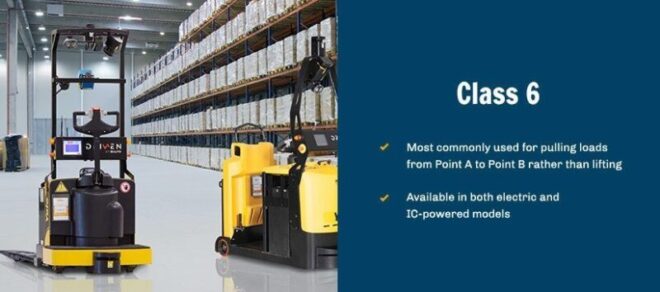
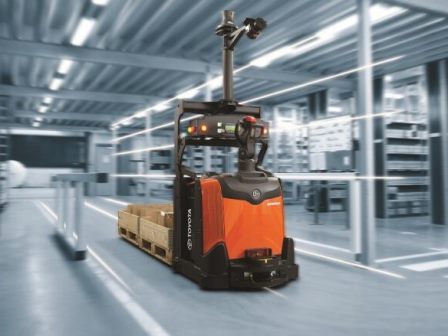
Class VI Forklift Classification Chart equipment includes electric and internal combustion engine tow tractors. These machines are most commonly used for towing loads rather than lifting. Trucks in this class are ideal for use at airports but are also commonly used in assembly line areas.
Forklift Classification Chart
Rough Terrain Forklifts
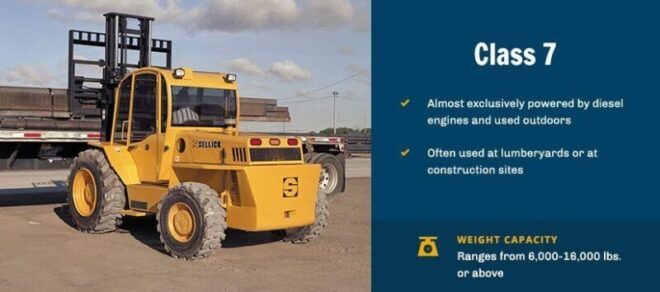
Class VII forklifts are rough terrain trucks. Trucks in this class feature large, tractor-style tires and are powered almost exclusively by diesel engines for outdoor use in rugged terrain. Class VII trucks are most commonly used at lumberyards or construction sites to lift building materials to elevated work sites.
Forklift Classification Chart
Forklift Classification Chart
How to Choose A Forklift: Forklift Classification Chart
To choose a forklift from all the different types, you’ll need to think about how the machinery will be used. Here are general criteria to reference when choosing a forklift to make sure your selected equipment performs efficiently and safely:
Determine the capacity. How much weight do you need to lift?
Calculate the weight of your job site. Can the ground sustain the forklift?
Measure the height of the space. Can your forklift pass through openings?
Select the correct fuel type. Do you need battery power or gas?
Analyze the terrain. Is the surface smooth or uneven?
Forklift types vary in several aspects, from their fuel type and tire composition to their lift capacity and height. It’s important to consider these different factors when selecting a forklift. With their ability to lift and transport things of various sizes, forklifts are valuable players on any job site.
Hoisting and Rigging
Forklift Classification Chart
Hoisting and rigging (H&R) refers to the lifting and moving of loads using mechanical devices. The objectives of the hoisting and rigging program are to protect personnel from injury, the environment from harm, and equipment and property from damage; specifically, to protect load operators and others in the work area, scientific equipment, other government property, and the hoisting and rigging equipment itself.
Hoisting and rigging is a complicated topic and can have significant safety consequences if not performed correctly. Fundamental to the H&R program, and consistent with Your Company’s integrated safety and environment management system, is the expectation that organizations involved in hoisting and rigging activities take responsibility to understand the hoisting and rigging requirements and apply them to their operations.
Forklift classification types
What are the different types of forklifts?
The most popular forklift types on the market today are: -Warehouse Forklift. -Side Loader. -Counterbalance Forklift. -Telehandler. -Industrial Forklift. -Rough Terrain Forklift. -Pallet Jack. -Walkie Stacker.
What is the most common type of forklift?
Stand-up Reach forklifts are the most common variety and are mostly used when dispatching single loads into one bay. Alternatively, you can use a double-deep reach forklift, whose longer forks allow you to access bays with multiple pallet loads, as they will reach all the way to the back of the bay.
What are forklifts used for?
A forklift (also called lift truck, jitney, fork truck, fork hoist, and forklift truck) is a powered industrial truck used to lift and move materials over short distances.
What kind of fuel do forklifts use?
Internal combustion engine used in a forklift. Forklifts powered by internal combustion engines run on a variety of fuels, including gasoline, diesel fuel, liquid petroleum gas (LPG), and compressed natural gas.
The capacity factor is important in your selection regardless of whether you are buying the truck with the attachment or are adding the attachment to a truck yourself.
Forklifts are extremely useful workplace vehicles, as long as they are used safely and appropriately by operators who are appropriately trained and competent to use them.
Assembling a self-erecting tower crane involves several steps, and it’s important to follow the manufacturer’s instructions and guidelines for the specific model you are working with. Here is a general guide on how to assemble a self-erecting tower crane:
This is a general overview, and the specific steps may vary based on the crane model. Always refer to the manufacturer’s documentation for precise instructions. Additionally, assembling a tower crane should be done by qualified personnel with proper training and experience.
Site Preparation:
Ensure the site is level and stable.
Set up the crane on a solid foundation, following the manufacturer’s recommendations.
Transport and Unloading:
Transport crane components to the site safely.
Unload components using appropriate equipment.
Base Installation:
Assemble the base section according to the manufacturer’s specifications.
Secure the base to the foundation.
Tower Erection:
Attach the tower sections vertically, following the assembly sequence specified by the manufacturer.
Use appropriate tools and equipment to secure the tower sections together.
Ensure that all bolts and connections are tightened to the specified torque.
Mast and Slewing Unit:
Install the mast and slewing unit on top of the tower.
Connect the slewing unit to the tower and secure it in place.
Ensure proper alignment and levelness.
Boom Assembly:
Assemble the boom sections according to the manufacturer’s guidelines.
Connect the boom to the slewing unit.
Install the counterweight as required.
Electrical and Control System:
Install the electrical components and control system according to the manufacturer’s instructions.
Connect power sources securely.
Test the control system to ensure proper functionality.
Testing and Commissioning:
Perform a pre-operational inspection of all components.
Conduct functional tests to ensure that all movements are smooth and controlled.
Verify the crane’s load capacity and safety features.
Operator Training:
Ensure that operators are trained and certified to operate the specific crane model.
Provide information on safety procedures and emergency protocols.
Documentation:
Keep comprehensive records of the assembly process, inspections, and tests.
Compact self-erecting tower crane
A self-erecting tower crane is compact, easy to erect and operate, and has several transport options. Wireless remote controls, quiet and efficient electric motors, state-of-the-art variable frequency motor drives, and overload protection systems are standard.
Contractors in the US cut the construction time of new homes by three weeks by using one self-erecting crane that could reach the entire job site.
By erecting a crane with a footprint of just 15 sqft between both builds which could lift most materials and reach the whole site with 80 ft of jib radius, the contractor had no requirement for additional mobile cranes or forklifts.
The remote-controlled self-erecting tower crane helped in all stages of the building process by lifting and placing floor joists, wall segments, and roof trusses.
In construction, the self-erecting crane helps you stay ahead of schedule by two to three weeks.
It helps to save a lot of time because it is very fast and easy to operate. They use it to lay floors, walls, and roof trusses, among other tasks.
By placing self-erecting tower cranes between houses where multiple units are being built, contractors can increase construction efficiency by building two or more houses at the same time.
Using the crane is useful and easy. It works easily after you get it quickly.
With the remote control, you don’t have to sit on the lift. It just gives you a better idea of what you are doing at work because you can move around and see things for yourself.
Crane building itself
The Self-erect portable tower cranes represent a new type of technology, which is increasingly utilized in Europe to construct and service low to mid-rise buildings.
Despite the similar name, self-erecting tower cranes are not assembled or operated as traditional high-rise tower cranes. Self-erecting tower cranes are driven to the job site and can be set up in under an hour by unfolding in a controlled sequence.
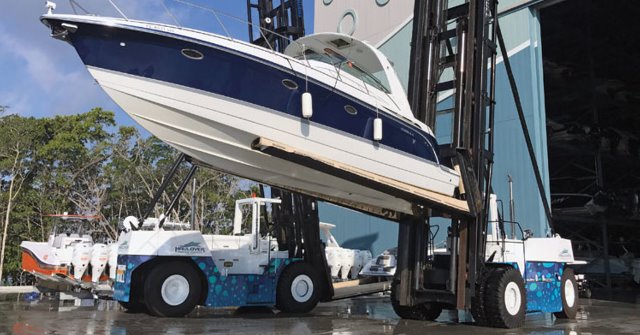
If you are looking to buy a marina forklift, boat handling equipment, market knowledge, and pricing save you money and time, or you want to sell equipment, here we will review what the marine forklift market has to offer.
Sell new and used marine equipment.
We will discuss how to negotiate the purchase of hydraulic boat trailers, marine forklifts: sling lifts, boat trailers, tugboats, towing vehicles, cranes and other miscellaneous marine equipment that customers want to sell.
Sale of equipment for marinas and shipyards
Establishing a relationship with suppliers allows them to find the best prices on all products, all products, including hydraulic trailers and new tail lifts, also boat stands and trailers.
Also replacement forks and pad covers for forklifts, showroom dollies, engine installers, boat jacks, and shop service equipment.
In general, if you are looking for shipyard equipment and accessories, all at the best price.
Marine forklift for Sale
Marine equipment for sale
To request additional information on new or used marine or shipyard equipment, you must complete an information request form or call the call center and they will gladly assist your requirements.
The goal is to build a special relationship with clients to understand and satisfy their needs in order to design and execute the best technical solution.
The challenge is to develop innovative projects using updated technologies to obtain the best results in terms of safety and reliability.
The technical teams are experts in the nautical market, combining knowledge with extensive technical-commercial experience in the design and supply of mechanical constructions and lifting equipment combined with a high degree of specialization in the nautical and industrial sector.
Used boat equipment for sale
Whether you need a reach stacker to move empty containers quickly and efficiently, one to stack loaded cans, or a reach stacker capable of heavy industrial handling, there are options for you.
The range of reach stackers includes options from 10 tons to 150 tons, not all of them are for boats, some are for industrial use, to move containers.
Reach stackers are available for a variety of applications including empty boats, barge handling, industrial handling, and more.
Forklifts are known throughout the world for the quality of the equipment of whoever makes them.
It is at the forefront of technology with some of the best equipped machines on the market. They also offer reach stackers with low emission engines to help you comply with local regulations and reduce your fuel costs. They even have a hybrid stacker.
In addition to a wide range of marine forklifts, there are accessories for almost all applications.
In addition, you have to evaluate the after-sales service you will get, it needs to be fast and reliable; not only get a machine that can withstand continuous work, but also have a dedicated and hardworking team to support you in after-sales service.
A forklift is designed to work in warehouse spaces where there are narrow aisles. Each forklift has outer legs that distribute the weight of the load.
This is done to improve your comfort and control when working in tight areas.
While they are primarily used outdoors, they can be used on flat floors inside the warehouse.
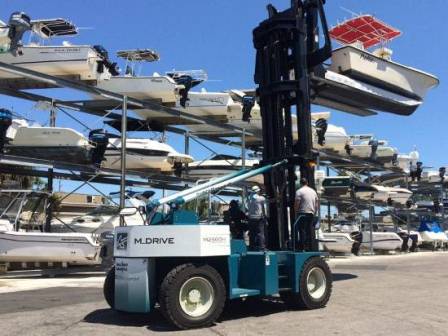
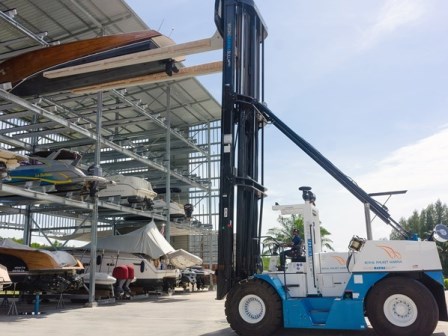
Hoist lift truck is compact and extremely maneuverable to operate around any facility, yet strong and durable enough to lift/lower boats of various sizes and weights.
C-MAP, a leader in digital marine charting and cloud-based mapping, announced the next generation of C-MAP Contour charts, preloaded on sounders and plotters.
The new charts provide even more data with a significant increase in lake contours (over 15,000 US lakes and 9,400 Canadian lakes) in addition to other enhancements, including updated depth contours and depth shadings.
Covering inland and near-shore coastal areas of the U.S. In addition to Hawaii, Bermuda, and Canada, the C-MAP Contour charts include custom depth shading on all lakes, high-resolution bathymetry on more than 15,000 lakes in US and 9,400 Canadian lakes, fishing POIs and standard navigation data, including tides and currents for coastal areas.
Released in June 2020 as a significantly improved preloaded mapping solution for new displays, C-MAP Contour, now with even more graphics data and a larger file size, will not be available via a downloadable software update.
Displays are programmed to be preloaded with the Contour + graphic at the factory beginning March 1, 2021.
Current registered customers can purchase the Contour + Map Card for a nominal fee of $ 35, beginning February 1 through April 1, 2021.
Additionally, customers who purchase an HDS LIVE display between February 1 and April 1, 2021 will be eligible for a free upgraded C-MAP Contour + card through online rebate.
C Map Charts
Cmap vs navionics
Having hydrographic maps is very convenient for fishermen.
It is important to know where the best depth is and what shallow areas to avoid.
To access this information, you will need to obtain specific graphics.
Both CMap and Navionics are very popular and offer some great features.
Of course, there are also some differences, and each fisherman must choose according to his personal needs.
C-map marine charts
Lowrance-owned CMap offers high-quality hydrographic charts for fishing.
Charts are available for inland and coastal waters, making them ideal for all anglers.
When it comes to coverage, CMap covers most of the world, especially popular fishing spots.
The graphics are very detailed and you can choose from many options.
CMap will allow you to see the seabed in detail. From structures and reefs to holes and ledges, these bathymetric images will amaze you.
This option is ideal for fishermen, as well as divers, as it provides information on tides, currents, marine parks, and the like. You can also add layers like satellite images and depth shading.
Boating enthusiasts and fishermen will enjoy the marina’s large database.
Continental charts are available to freshwater fishermen. These maps have a great coverage, it gives you a high detail view.
Most importantly, CMap is compatible with major fish finder brands such as Lowrance, Simrand and B&G. You can even check the compatibility table on the official website.
For saltwater anglers, there are wide and local charts, which include all the premium features such as bathymetric imagery, custom depth shading, satellite view, and 3D. Both local and wide graphics are equally detailed, only varying in coverage area.
These two also include CMap Genesis, which allows you to create your custom maps.
US users will be delighted to know that there are charts covering lakes in the US Unfortunately this option is not available for the rest of the world.
Navionics marine charts
Navionics is a similar navigation tool that provides hydrographic charts for fishermen.
It has worldwide coverage and offers detailed maps of the interior and the coast.
It is owned by Garmin and is compatible with all major fish finder manufacturers.
Navionics has one cool feature, and it’s the fish attractors.
It shows more than 10,000 sunken structures, made to attract fish, and that is valuable to fishermen, especially when fishing in an unfamiliar area.
The enhanced version provides shading, 3D photos, and panoramas.
Chart customization such as contour density and shallow area highlighting are part of Navionics. This is a great feature for knowing which places to avoid with a boat, and also for knowing where certain depths are where you can find target fish species.
There is also a SonarChart live option, which allows you to create maps with the latest bathymetry. Similar to CMAp, you can upload your data and add it to data created by other users.
It also offers community editions, where you can find information provided by local fishermen, mainly related to buoys, boat ramps, and similar changes.
C Map Charts
How do nautical chart data providers work?
How do you get the graphics corrections?
Vendors that provide chart data are constantly working on improvements, fixes, and updates to their entire chart portfolio like C-MAP.
This can be done by conducting surveys on the ground, through private partners or through Hydrographic Services.
This is ongoing work and requires substantial resources for these investigations and verifications.
In this case, a special effort will be made in these regions, so that there is a greater possibility that everything will be corrected, but once again, this is not a certainty if you have not had enough information beforehand.
It is impossible for anyone to be aware of every sailing change or new marina around the world comprehensively and at the same time.
There are still some nautical charts that haven’t been updated in a couple of years. It does not mean that C-map is using an old chart, this is impossible.
The same is true for navigational charts and this update delay is certainly more prominent with Hydrographic Offices, as the frequency of their chart updates is quite slow.
In fact, they are less reactive when it comes to the integration of new marinas. Editions and revision dates are generally older.
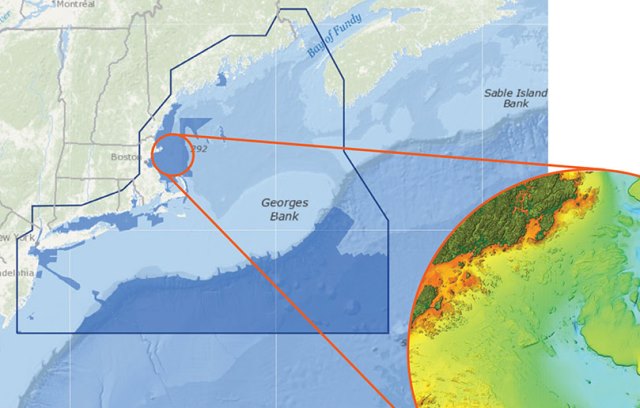
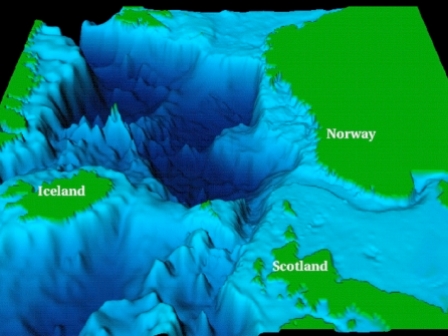
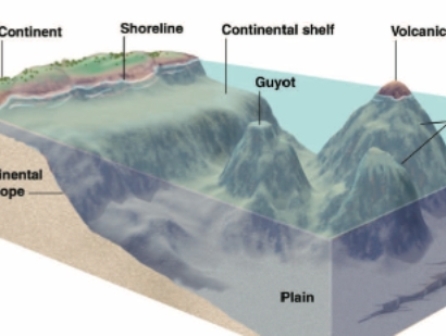
The variation in relief constitutes the morphology of the ocean floor. Charting of the ocean is very important for many reasons: it affects circulation, a potential site for living and non-living resources, submarine navigation, geophysical exploration, etc.
Topographic maps of the seafloor. Detailed depth contours provide the size, shape, and distribution of underwater features. The map serves as a tool for performing scientific, engineering, marine geophysical and environmental studies, that are required in the development of energy and marine resources.