All posts by Loganx

Professional Web Writer | Motor Enthusiast | Content Creator | Logan is a dedicated and skilled web writer, passionate about engines and machines and with a talent for creating engaging and informative content. She specializes in writing about a diverse range of topics including construction, forklifts, heavy equipment, excavators, etc. SEO Optimization: Proficient in SEO best practices, ensuring high visibility and engagement for all published content.

Luffing Tower Crane

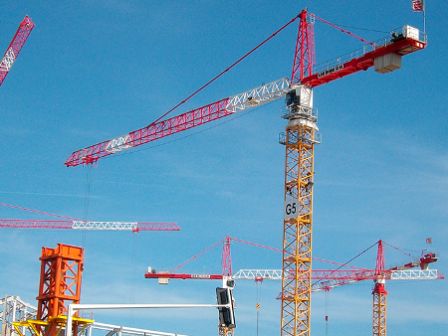
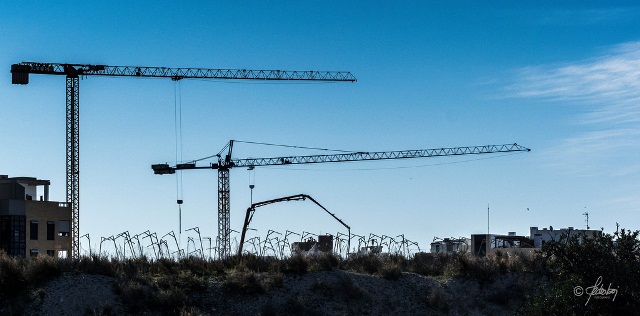
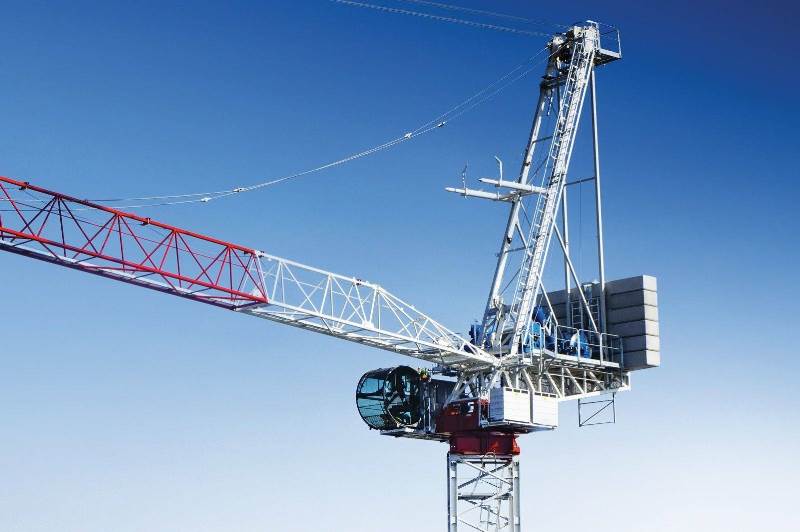
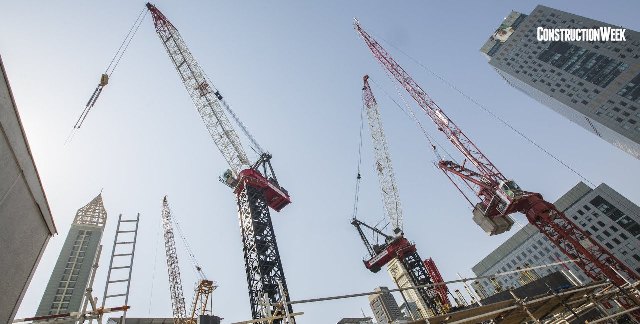
Luffing Tower cranes are especially demanded tall buildings on congested sites. They have a very short counter jib and a variable working radius, which permit high productivity in extremely narrow spaces.

It’s common to have limited space and clearance when working with a tower crane in an urban metro area and downtown work sites. A luffing tower crane is ideal for building projects where there’s not much space on either side of the site and you need to work safely. A luffing crane is able to raise or lower its jib, and that allows it to reduce the slewing radius.

Luffing Tower Crane

Luffing jib crane

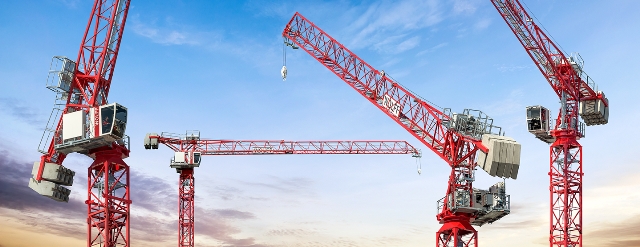
A luffing crane is also a good choice for work sites where two or more cranes are working at the same time. This is because the slewing radius is highly reduced in comparison to standard tower crane types. The luffing tower crane also has a higher lifting capacity because the weight is transferred from the crane’s jib much more effectively.

More and more countries are building wind turbine developments as an energy alternative. Typical luffing cranes do not have the free-standing height need to erect wind turbines. The luffing jib cranes specifically design to meet industry demands for higher hook heights for wind turbine erection.

Luffing Tower Crane

Luffing jib tower crane

  • This kind of crane is frequently the best solution when several cranes are working on the same site, avoiding any kind of crash with other cranes or the surrounding buildings. With their variable working radius, they don’t interfere in the working area of the other cranes on-site and they can be parked with a very reduced radius.
  • Also, luffing-jib cranes can improve material handling cycles in the job site, using them like auxiliary cranes to the principal tower cranes,
    reducing the construction time.
  • Normally, the maximum load bigger than a tower crane.
  • In some places, local laws make luffing-jib cranes necessary. For instance, London doesn’t allow any crane to fly over the surrounding spaces when they are working on a job site, and luffing jib-cranes are very demanded because you can move the jib from the horizontal position up to the total vertical position.

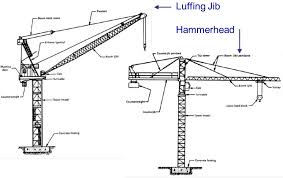
Luffing crane vs hammerhead

Disadvantages for using a luffing jib crane

But there are some disadvantages of the ‘luffers’ when you compare them to a tower crane:

  • The price of the luffing-jib crane is much higher than a regular tower crane. The tower frames of a ‘luffer’ are stronger, and the luffing mechanisms are much bigger than the hoist system of a tower crane. Of course, the technology applied to move the jib, counterweights, etc is the highest.
  • The cost of assembling and disassembling are much higher too. Most of the structures are heavier, and it takes longer to erect a luffing-jib crane. Once again, to erect a luffer is more difficult due to the technology applied, etc.
  • The jib of a ‘luffer’ acts as a wall to the wind, and the ‘moment’ is much bigger. So the restrictions of the tower are higher.
  • Due to the luffers don´t have trolley motor (the movement is made by the total jib), the working process is slower than in a tower crane.

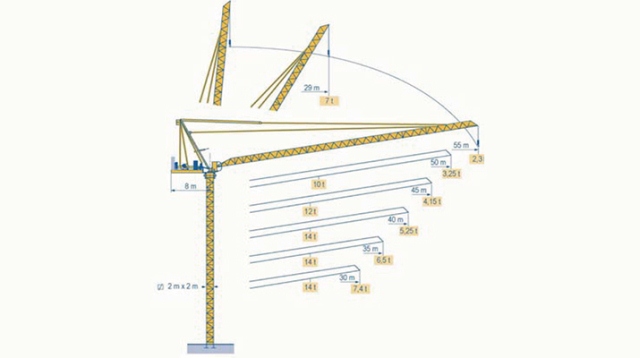
Luffing tower crane specifications

Luffing jib cranes have many benefits and are widely used in cities and congested areas. You are able to get multiple cranes onto sites and avoid over sail situations with neighboring properties. This means costly licenses would not be necessary.

Luffing jib cranes can be placed on fixing angles or ballast bases and can be erected and climbed to great heights. With our exclusive ‘park radius device’ our Jaso luffing jib cranes can all be parked at a vastly reduced radius when out of service.

This means that you could add another crane to a job to increase productivity where you might not otherwise be able to do so. Also perhaps cranes could be located outside a building, still avoiding over the sail and enabling you to achieve a watertight structure sooner.

Luffing cranes can be fitted with Zoning devices to electronically limit against over-sailing important or dangerous structures adjacent to the site. This can include schools, public area’s or main highways and they are usually mandatory next to the railway and electrical installations.

Luffing tower crane vs hammerhead

Luffing jib tower crane and level jib tower crane are two kinds of common models. Both models are widely used but they differ in their structure, operating principle, and application field.

Luffing jib tower crane is mainly used in large projects and industrial equipment installing fields where large lifting capacity, high perching accuracy, and high safety are required for lifting large members and equipment components.

The level jib tower crane is mainly used in the common civil building fields where fast lifting and inaccurate perching are required for lifting building materials. Both models have advantages and disadvantages in different application fields, therefore we can plan a key role in determining which model should be selected.

As the above comparison, luffing tower crane has a great advantage over level jib tower crane in the power station construction field, which has been confirmed by more than 100 power stations construction in china. The level jib tower crane is widely used in plant construction of power stations as an auxiliary tool while luffing jib tower crane definitely predominates in boiler lifting.

It is not the only choice to use luffing jib tower crane for boiler lifting, which can be achieved by cooperation between the large crawling crane, furnace handling crane, and large level jib tower crane but also economical efficiency, safety, and plane layout need to be carefully considered.

Luffing Tower Crane

Advantages of luffing tower crane

The following issues need to be carefully considered for large-level jib tower cranes.

Luffing Tower Crane: Whether the cooperative operation of two sets of the crane is needed in the present and future project?

Owing to the economic efficiency and shortage of cranes with the more large specification, the cooperative operation of two sets of cranes Is adopted widely. For cooperative operation, luffing jib tower crane has a great advantage while level jib tower crane is very dangerous to use for a structural limitation or even unavailable for interference between the crane and the building.

Luffing Tower Crane: Is local climate especially wind frequency and wind speed suitable for using level jib tower crane?

According to the safety code, the slewing and brake mechanism of the crane must be released in non-working conditions (i.e. free slewing conditions) to ensure that the boom can freely slew with the wind for reducing wind influence on the crane.

  • Take dodging into consideration, whether the boom of the level jib tower crane is allowed to freely slew with wind or not?
  • Luffing jib tower crane can simultaneously release slewing and brake mechanism and locate the boom in a small range for the purpose of extensively reducing wind influence to the crane and avoiding collision between the boom and other cranes and buildings when freely slewing in non-working condition.

Plane layout feasible or not?

The large project needs the simultaneous operation of many sets of cranes as it is very important for dodging cranes from each other and from buildings. Otherwise, it may possibly lead to very low efficiency in operation, high risk, and an unguaranteed time limit for a project.

But luffing jib tower crane is very flexible in boom range no matter, it is in working condition or nonworking condition for conveniently dodging the other cranes and buildings in the construction field while level jib tower crane can not do that either in working condition or non-working condition.

Luffing Tower Crane

Luffing Tower crane safety

Which country or area can your crane be used at present or in future?

The level jib tower crane is prohibited in many countries and many areas. And landowners in many countries are entitled to have command of the air at a limited height so that you can avoid a lawsuit if you do not let your crane breach other people’s sovereignty.

Most of the sites adopted luffing jib tower crane as the main lifting machinery that the customers can be benefited from scientifically choosing proper crane model.

The adoption of luffing jib tower crane has higher efficiency especially cooperated with auxiliary crawler crane, of which the plan can improve the economic benefits greatly by reducing the operating cost, assemble and disassemble cost, and foundation treatment cost as well as engineering construction cost.

Luffing Tower Crane

What is a luffing tower crane?

What is a luffing jib tower crane?

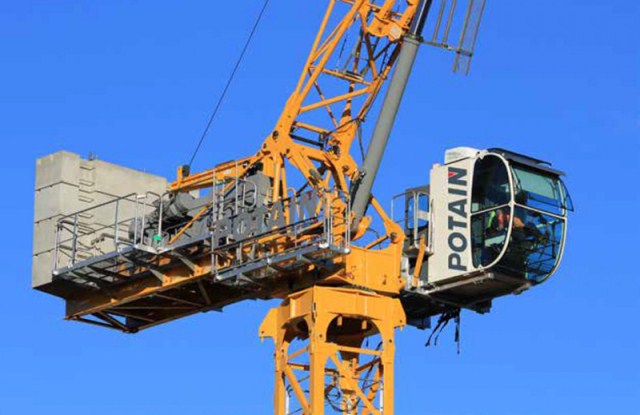
A luffing crane is able to raise or lower its jib, and that allows it to reduce the slewing radius. They developed the boom cranes specifically to meet the demands of the industry of greater heights, construction of buildings with little space, etc.

What is a tower crane?

The tower crane is a fixed Crane and has to be mounted On-Site. The Tower Crane presents itself like a vertical metallic structure having a horizontal boom that can turn over an angle up to 360°. From his particular setup, the Tower crane is ideal for all king of a high building or high structure Construction.

How does a level luffing tower crane work?

Usually, the description is only applied to those with a luffing jib that has some additional mechanism applied to keep the hook level when luffing. Level-luffing is most important when the careful movement of a load near ground level is required, such as in construction or shipbuilding.

What is a hammerhead tower crane?

A hammerhead tower crane is one of the most common types of cranes used around the world. They are especially reliable for the precise, accurate handling of a wide variety of heavy materials. The way they can be adapted to work well for any job site and any type or volume of material being transported is what makes a hammerhead tower crane such a versatile workhorse.

What type of crane is known as a conventional crane?

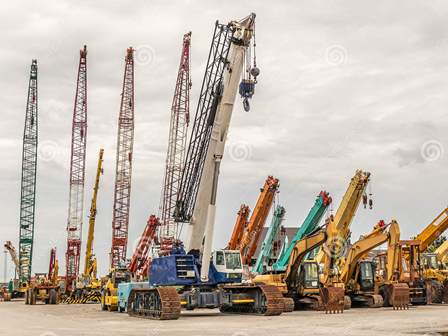
Mobile Cranes are the most standard and versatile type of crane used in construction today. The mobile hydraulic crane consists of a steel truss or telescopic boom mounted on a mobile platform, which could be a rail, wheeled, or even on a cat truck.

What is the difference between tower crane and mobile crane?

The biggest difference between mobile cranes and tower or fixed cranes is their mobility. As their names suggest, fixed cranes are fixed to a single spot once they have been set up. Whereas, mobile cranes can be moved as needed. The mobility of a mobile crane holds many advantages for any construction site.

The most read

More on this story

Hammerhead Tower Crane

A hammerhead tower crane is one of the most common types of cranes used around the world.

Remote Control Tower Crane

Radio remote controls are now standard equipment on most self-erecting tower cranes and are even becoming common in some parts of Europe for a flat-top tower crane.

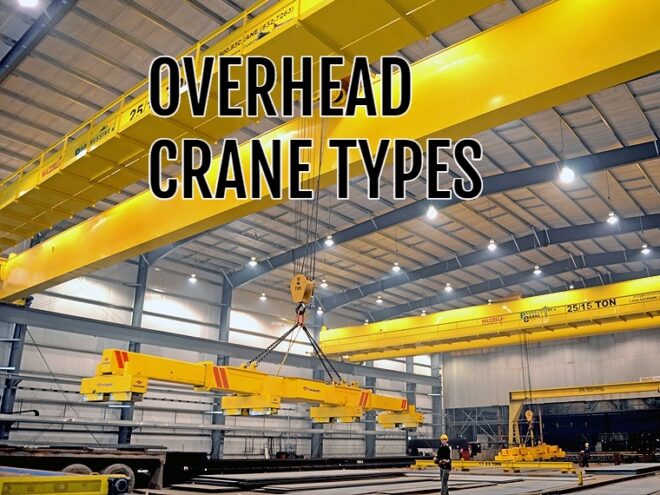
Overhead Crane Types

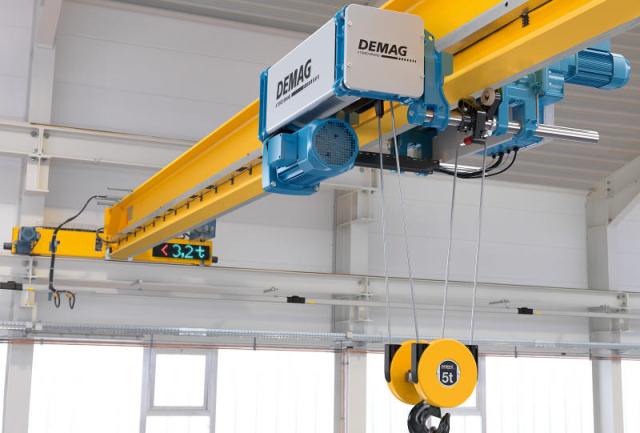
Overhead Crane Types: Overhead travelling cranes, designed for handling loads up to 120 tonnes, are the ideal solution for heavy lifting and wide spans. The overhead travelling crane range includes four series designed for different applications and operating conditions: single girder, double girder, underslung and single girder wall travelling cranes.

Overhead Crane Types

Electric overhead travelling crane

EOT crane types:

Overhead crane types: Material handling is a vital component of any manufacturing system and the material handling industry is consequently active, dynamic, and competitive.

A crane is a mechanical lifting device equipped with a rope drum, wire rope, and sheaves that are used both to lift and lower materials and to move them horizontally.

It uses simple machines to create mechanical advantage which helps to move loads beyond the normal capability of a human. Cranes are commonly used in the transport industry, in the construction industry, and in the manufacturing industry.

The overhead cranes handle and transfer heavy loads from one position to another. Electric overhead traveling cranes are widely used in many industries for lifting the safe working load.

The escalating price of structural material is a global problem. Many small scale industries purchase the existing electric overhead cranes from bigger industries and make the required modification to suit their requirement.

Overhead Crane Types

Types of overhead cranes

Overhead crane types:

Various types of overhead cranes are used in industries with many being highly specialized. Various types of overhead cranes are single girder cranes, double girder cranes, gantry cranes, and monorails.

Single Girder Crane

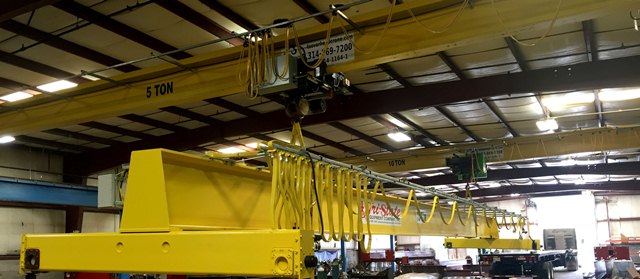
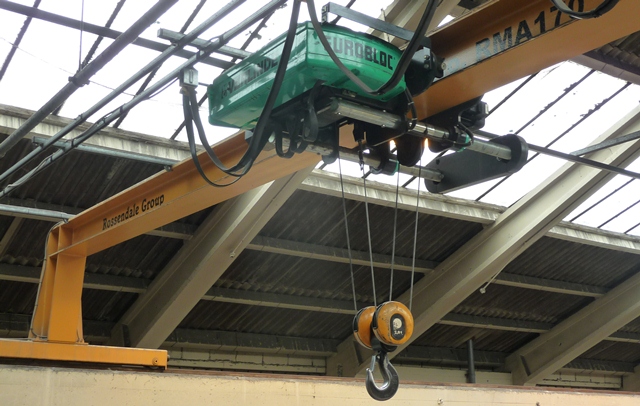
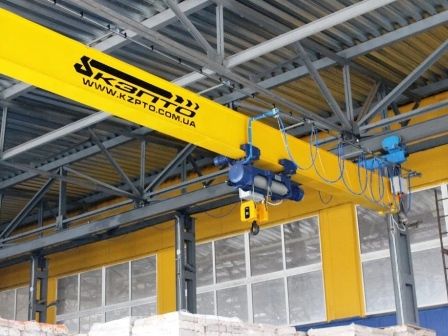
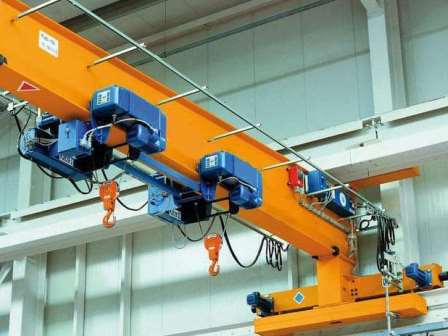
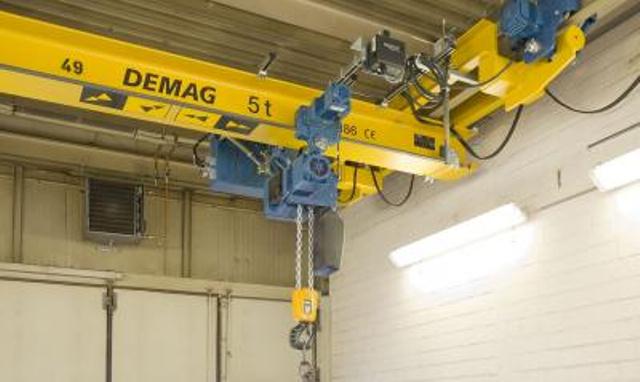
The crane consists of a single bridge girder supported on two end trucks. It has a trolley hoist mechanism that runs on the bottom flange of the bridge girder.

Double Girder Crane

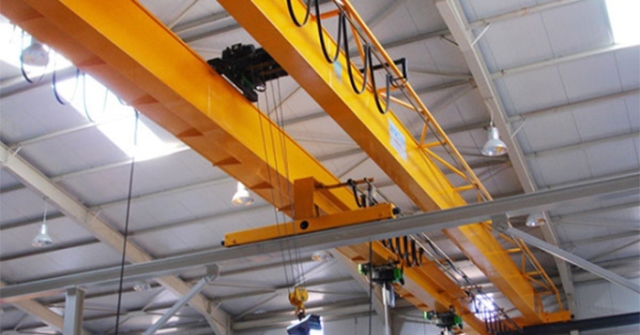
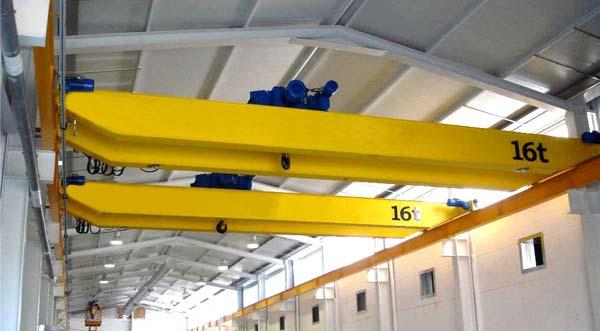
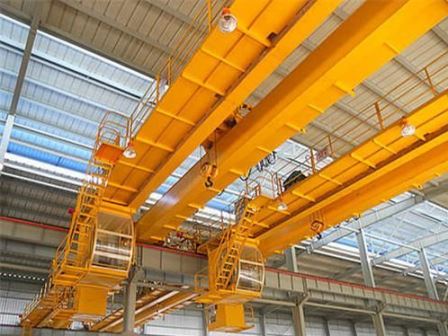
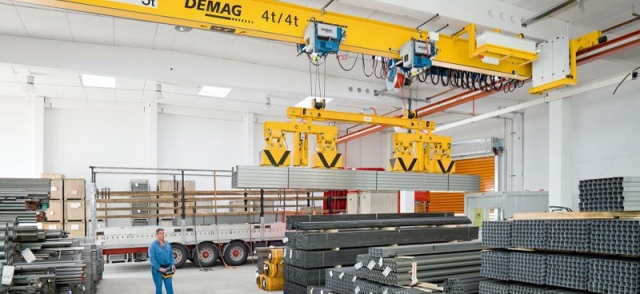
The crane consists of two bridge girders supported on two end trucks (end carriages). The trolley runs on rails on the top of the bridge girders. Double girder electric overhead cranes are widely used in the industries because they can carry more loads with more span than any other type of crane. In this project, we are concentrating mainly on double girder electric overhead cranes.

Overhead crane types

Gantry Cranes

These cranes are essentially the same as the regular overhead cranes except that the bridge for carrying the trollies or trolleys is rigidly supported on two or more legs running on fixed rails or other runways. These “legs” eliminate the supporting runway and column system and connect to end trucks which run on a rail either embedded in or laid on top of, the floor.

Monorail cranes

For some applications such as production assembly lines or service lines, only a trolley hoist is required. The hoisting mechanism is similar to a single girder crane with a difference that the crane doesn’t have a movable bridge and the hoisting trolley runs on a fixed girder. Monorailbeams are usually I-beams (tapered beam flanges).

Monorail or repair trolley cranes are used for maintenance purpose.

For maintenance of any single or double girder crane, the crane which is to be taken for maintenance is brought under the repaired trolley (monorail) crane so that it can lift the components of the crane for repair or replacement.

EOT Crane

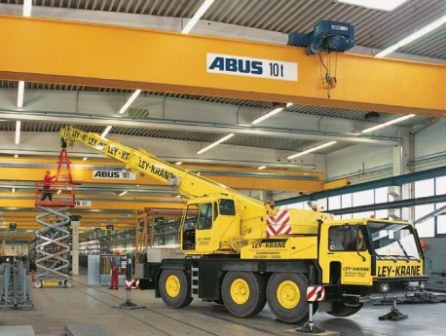
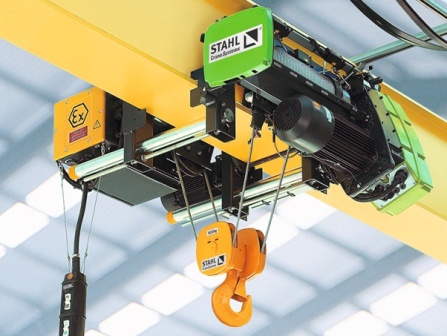
The EOT in EOT Cranes stands for “Electric Overhead Travelling”. These types of overhead cranes are stationary and allow for lateral movement across two planes. Not only do they move backward and forwards but they can also move up and down with the load. These cranes are perfect for indoor work.

Factories, assembly lines, big warehouses, mining corporations, etc. can make good use of EOT cranes. Low maintenance and easy to operate make these cranes a good investment, especially if you have trained operators and experience the frequent need for heavy load lifting. The only thing to keep in mind is that they are not to be used in explosive and corrosive environments.

HOT Crane

Here, the HOT in HOT Cranes stands for Hoist One Track. HOTs are a stationary overhead crane and allow for lateral movement across two planes as well. They are less common as compared to EOT cranes as they do not allow for as much movement as the EOT cranes.

They are more commonly used for maintenance purposes. They have a hoist attached to the bridge which can be operated using an electric pendant. They are low maintenance and a sound investment if you frequently need a lot of maintenance and repair in your enterprise.

Bridge Cranes

Overhead bridge cranes are the most common models on the market. A bridge crane has two overhead runway beams that are linked to the support structure of the building. This crane comes in two configurations; single and double girder. The strength of a double and single girder bridge crane is almost the same. However, a double girder allows you to hoist a load higher than a single girder crane. Because a single girder is simpler, it is easier to install and cheaper than a double girder.

Gantry Cranes

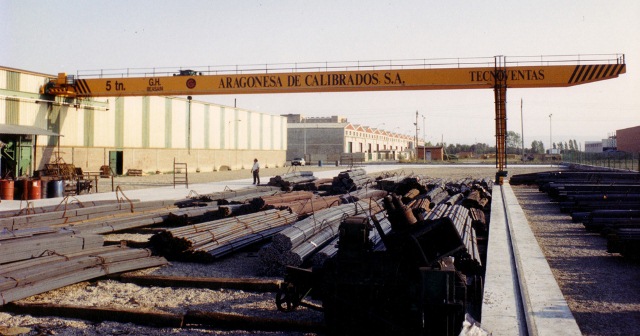
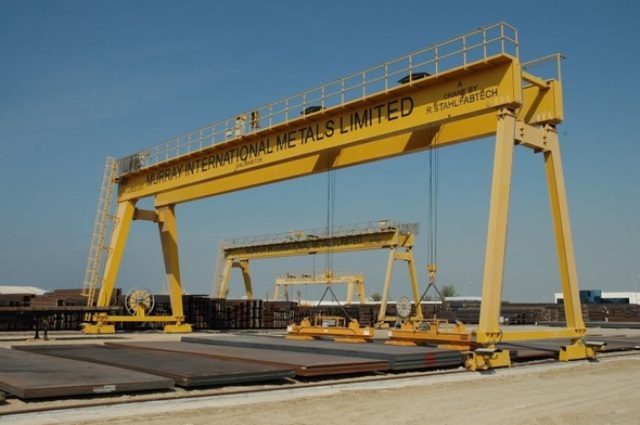
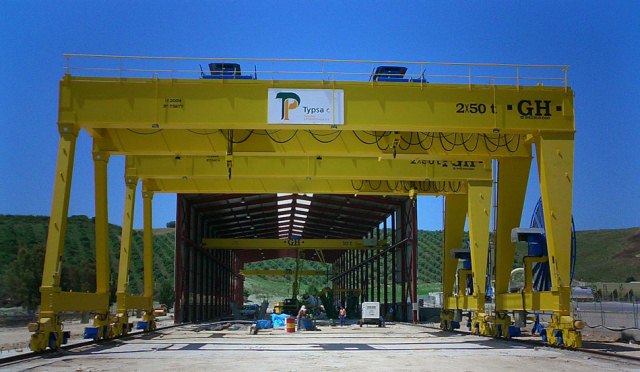
In a gantry crane, the girder stands on legs as opposed to being suspended on a support beam. The legs can be fitted underground or on the surface. Gantry cranes are suitable for outdoor use because they don’t require the girder to connect to a building’s support structure. If you need a crane in a shipyard, a gantry is the right kind of system.

Workstation cranes

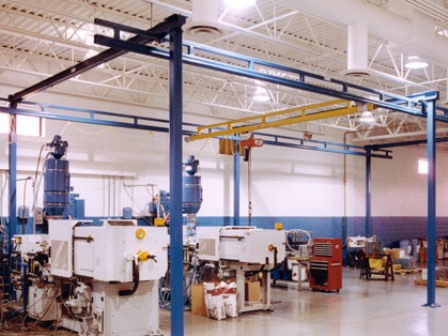
A workstation crane is built for lightweight use in areas with space constraints. It’s a simple design that can lift between 150 pounds to 2 tons of material. Workstation overhead cranes are perfect for repetitive duties like moving packaged boxes in a warehouse. They are ergonomically-designed for regular use. (Overhead Crane Types)

Overhead crane types

Warehouse crane types

Overhead crane types: Top running vs. under running cranes

When it comes to defining clear differences between bridge cranes, you will want to consider if you require a top running or under the running crane.

On a top running crane, the bridge runs on rails along the top of the runway beams.

On an under-running, or underhung crane, the bridges are supported by the bottom of the runway beams and the wheels run along the bottom of the lower beam flange. (overhead crane types)

overhead crane types

Top Running Crane

These cranes have no limiting capacity, meaning they can be built to go from small capacities to very large capacities. They include a rail installed on top of each runway, and the bridge wheels move on the rail instead of the bottom flange of the runway beam. These cranes are supported by the building structure or runway support columns, or sister columns, and are ideal for moving extremely heavy loads.

Under Running Crane

Often called “underhung,” because the crane wheels are supported by the bottom flange of the crane runway beams acting as the crane rail. These types of cranes can allow you to maximize your facility’s floor space for the production and storage of material because they are supported by the ceiling trusses or the roof structure. Or, they can be designed to utilize an existing support structure (if adequate), or run on a newly-engineered support structure.

Electric overhead traveling crane

Overhead crane types: Electric overhead crane comparison:

  • Based on Safe Working Load: Double girder cranes can lift the loads up to 500Tcapacity. Single girder cranes are suitable for the low-safe working load. Because of the extra girder in double girder cranes load is distributed in two girders and hence double girder cranes can carry a safer working load than single girder cranes.
  • Based on Span: For a longer span, double girder cranes are used whereas single girder cranes are useful for a smaller span.
  • Based on Application: Double girder cranes are efficient for intensive use. Because of the rigidity of the structure, they are used in extreme conditions like lifting molten metals. Single girder cranes are used for irregular and light use. They are used in small workshops, storage areas, etc.
  • Based on Long Travel Speed: The single girder cranes are suitable for lower long travel speed whereas the double girder cranes can run with higher long travel speed.
  • Based on Cost: In general, single girder cranes are less costly than double girder cranes. Double girder cranes consist of more walkways and other accessories that add to the cost. Single girder cranes cost less in many ways, only one cross girder is required, the trolley is simpler and installation is quicker.

Different types of overhead cranes

What is an overhead crane?

To move extremely heavy or bulky loads through the overhead space in a facility, instead of through aisles or on the floor, an overhead crane (also called an industrial crane, crane, or overhead traveling crane is a machine that lifts, lowers, and moves a load horizontally.

how does an overhead crane work?

Overhead Crane Working Principle system consists of three working movements: crane hook up and down lifting, trolley lateral movement, and crane long traveling longitudinal motion.

What is the difference between a gantry crane and an overhead crane?

A gantry crane is slightly different from a bridge crane. The general premise is the same, but the operation is different. Some gantry cranes ride along a track installed on the floor or use a V-groove caster to keep moving in a straight line. Gantry cranes are usually less expensive than an overhead bridge crane.

What is an EOT crane?

EOT (Electronic overhead traveling) crane is essential industrial equipment involved in the material handling job. Overhead EOT single girder cranes are used to lift the objects by a hoist fitted in a trolley. It comes under standard crane types.

How to operate an overhead crane?

Overhead Travelling Cranes, Gantry Cranes, Jib Cranes, and Monorail Hoists are used widely for material handling. The safe operation of such cranes requires operators to have the knowledge and competence to avoid an accident. The purpose is to raise awareness of the hazards in lifting operations and to provide the basic knowledge in the safe operation of overhead traveling cranes, gantry cranes, jib cranes, and hoists.

The most read

More on this story

Overhead Cranes

What are the parts of an overhead crane? What is the purpose of an overhead crane? How much does an overhead crane cost?

Electric Overhead Crane

EOT Crane stands for Electric Overhead traveling cranes. This is the most commonly preferred EOT crane that is usually used in load lifting and shifting.

Workstation Crane

Workstation Cranes are a proven way to improve productivity, increase quality, and provide a safer work environment.

Single Girder Overhead Crane

The single girder traveling crane is our flexible crane for almost any application.

Types of Hoisting Equipment in Construction

Types of Hoisting Equipment in Construction: The hoisting is the lifting of the material against gravity and maybe done with a wide range of equipment from the small hand-operated simple screw or hydraulic-jack to modern high powered cranes and elevators. Hoisting is lifting a weight from one location and moving it to another location which is at a reasonable distance.

Big projects such as the construction of dams, industrial buildings, etc. require hoisting equipment.

Hoisting equipment includes jacks, winches, chain hoists, and cranes.

Crane is the only single machine which, as a single piece, is capable of providing three- dimensional movement of the weight.

Types of Hoisting Equipment in Construction

Hoisting equipment in construction

Types of Hoisting Equipment in Construction: The common equipment used are as follows

  • Pulley and sheave block
  • Chain hoists
  • Mobile cranes
  • Winch
  • Jack
  • Shear leg
  • Tower cranes
  • Whirler cranes
  • Derrick cranes
  • Gantry cranes
Types of Hoisting Equipment in Construction

Movable pulley

A pulley is a wheel on an axle or shaft that is designed to support movement and change of direction of a cable or belt along its circumference. Pulleys are used in a variety of ways to lift loads, apply forces, and to transmit power. In nautical contexts, the assembly of the wheel, axle, and supporting shell is referred to as a “block.”

A pulley may also be called a sheave or drum and may have a groove between two flanges around its circumference. The drive element of a pulley system can be a rope, cable, belt, or chain that runs over the pulley inside the groove.

Rope and pulley

The pulley and sheave blocks suitable for lifting rough surfaces and heavy loads. For this purpose, the chains and wire ropes are used. The alloy chains are best suited for hoisting operation. The weakest component of this system is the load hook. The hook fails by straightening. Once the hook gets elongated or straightened, it should be replaced. A typical sheave and pulley block is shown in fig.

Chain hoist

The chain hoists are the popular mechanism for lifting loads of upto tones. The system consists of two sets of chains, namely the hand and load chain. The hand chains are particularly useful for the isolated location, where an electric motor or other types of mechanical equipments are not available. The pull applied through the hand chain is transmitted to the load chain with a multiplication factor of over 20.

The load to be lifted is held by a load hook while another hook(called support hook) at the top, support the mechanism. The two hooks, however, should not be interchanged as the support hook is made much stronger than the load hook.  There are four types of hand-operated chain hoists are in use:

  • Differential
  • Screw geared
  • Spur geared
  • Pull lift
Types of Hoisting Equipment in Construction

Mobile crane

Mobile crane is used in big construction projects for lifting heavy loads. It is used for loading and unloading for material in coal mines. Loading and unloading of ships. To take the load from ground level and place it into the trucks.

Electric winch

A winch is a mechanism in the shape of a cylinder or drum, over which rope or chain is wound. If a winch is used only for raising and lowering, it is sometimes referred to as hoist. The winches are of two types:

  • hand winches
  • power winches
Types of Hoisting Equipment in Construction

Tower crane

These are the crane of swing job type and are mounted on high steel towers. The height of the tower maybe 25 to 30 m and these cranes are found to be suitable in the construction of tall buildings in congested areas. The ground area required for such cranes is very small.

This crane is a combination of stationary and mobile units. This combines the advantages of a log boom of derrick crane and mobility of the mobile crane. The rotating structure has an outer framework. The boom is attached to the front end of this framework. The counterweight is provided at the rear end. On the diagonally opposite corners of the base, two separate motors are provided, which give movement to the central shaft

Types of Hoisting Equipment in Construction

Derrick crane

The derrick cranes are of two types, namely:

  • Guy derrick and
  • Stiff leg derrick

The guy derrick consists of a vertical mast. This mast is supported by the number of guys and can revolve through 360°. ‬ While revolving, the radius of revolution should be such that the revolving structure is not obstructed by the guy wires. The power is supplied by a diesel engine or by an electric motor.

A typical derrick crane is illustrated in fig. This derrick can be constructed up to 200 tonnes capacity. In stiff leg type derricks, the guy wires are replaced by trussed structure. This type of derricks is suitable for loads from 10 to 50 tonnes.

Overhead gantry crane

The Gantry cranes or overhead cranes are the indispensable machines in factories and workshops. In large workshops, there are separate machines for fabrications or repairs of the machine parts. The machine or the components, which are to be repaired, can be transferred to the place of fabrication or assembly with the help of Gantry cranes.

Hoisting equipment assists in the lifting and positioning of large, heavy loads in a variety of industries, including:

  • Automotive
  • Chemicals
  • Commercial printing
  • Manufacturing
  • Newspaper
  • Paper
  • Steel
  • Warehousing and distribution

Hoisting equipment provides a variety of benefits:

  • Customizable – Hoisting equipment can be customized with below the hook attachments, end effectors or specialized tooling to handle a diverse variety of products and loads
  • Ergonomics – By doing the heavy lifting, hoisting equipment takes the strain off operators, reducing fatigue and lowering the risk of injury
  • Flexible – Hoisting equipment can be easily re-fitted for longer lifting capability

what is the meaning of hoist?

To hoist is to raise up or lift as a crane or forklift would. You can hoist yourself up onto the roof to get a better view or hoist your teammate onto your shoulders after she scores the winning goal.

This word is generally used to describe heavier lifting, like the hoisting of a fallen tree onto the bed of a truck or hoisting the Super Bowl trophy over your head after the big game. In nautical terms, where it comes up often, hoist refers to a group of flags that are raised all at once to communicate a signal.

What is the synonym of a hoist? boost, crane, elevate, heave, heft, heighten, hike, jack (up), lift, perk (up), pick up, raise, take up, up, uphold, uplift, upraise. Words Related to hoist. ascend, mount, rise.

Types of Hoisting Equipment in Construction

What is a hoist in construction?

A hoist is a device used for lifting or lowering a load by means of a drum or lift-wheel around which rope or chain wraps. It may be manually operated, electrically or pneumatically driven and may use chain, fiber or wire rope as its lifting medium.

What is classed as lifting equipment?

Lifting equipment is any work equipment for lifting and lowering loads and includes any accessories used in doing so (such as attachments to support, fix or anchor the equipment). Examples of lifting equipment include overhead cranes and their supporting runways.

What is rigging in construction?

Rigging is a process used to secure materials to be moved by cranes, hoists or other lifting equipment. There are many factors to consider when applying slings and chains to secure a load.

What is a hoist beam?

a hoist is simply a machine that is used for the lifting and lowering of heavy loads. A hook or lug can be used to permanently mount a hoist in one location, or affix it to a trolley. A trolley is a vehicle that travels on an overhead rail or beam, normally used to move the hoist and it’s load from place to place.

What is the difference between a hoist and a lift?

As verbs the difference between lift and hoist is that lift is (intransitive) to raise or rise while hoist is to raise; to lift; to elevate; especially, to raise or lift to a desired elevation, by means of tackle or pulley, as a sail, a flag, a heavy package or weight.

What is a hoist?

A hoist is a device used for lifting or lowering a load by means of a drum or lift-wheel around which rope or chain wraps. It may be manually operated, electrically or pneumatically driven and may use chain, fiber or wire rope as its lifting medium.

What is a chain fall?

How does a chain fall work? A Chain Block (also known as a hand chain hoist) is a mechanism used to lift and lower heavy loads using a chain. Chain blocks contain two wheels in which the chain is wound around. When the chain is pulled, it winds around the wheels and begins to lift the item that is attached to the rope or chain via a hook.

The most read

Electric Hoist Manufacturers

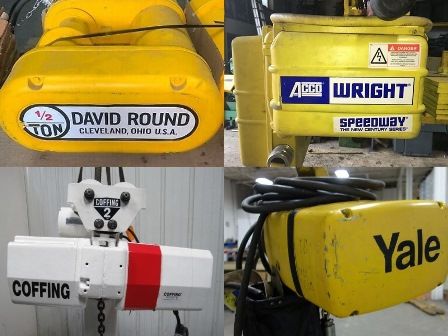
You’ll hear opinions about leading chain hoists brand names like Yale, Gorbel, Budget, Coffing, and Harrington.

More on this story

Types of Hoisting Equipment

The hoisting is the lifting of the material against gravity and maybe done with a wide range of equipment from the small hand-operated simple screw.

Hoist Mechanism

The mechanism used to raise and lower heavy loads to the desired height with comparatively little effort is called a lifting mechanism.

Forklift Yard Ramp

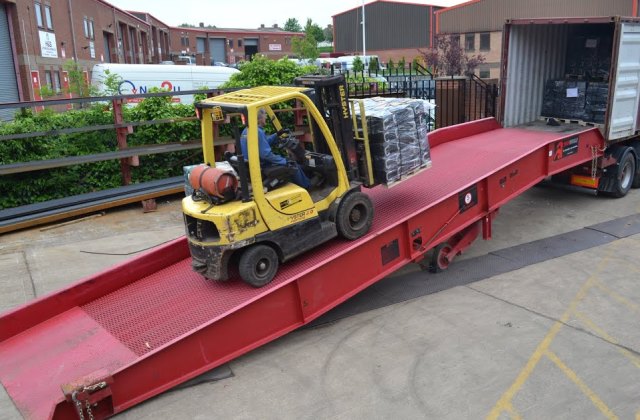
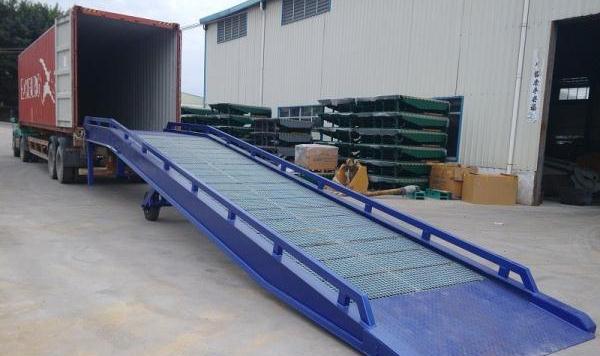
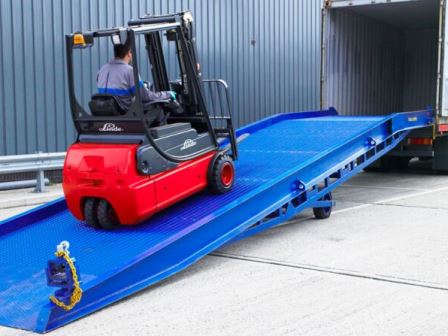
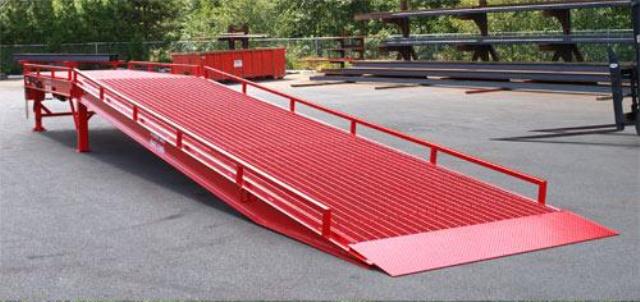
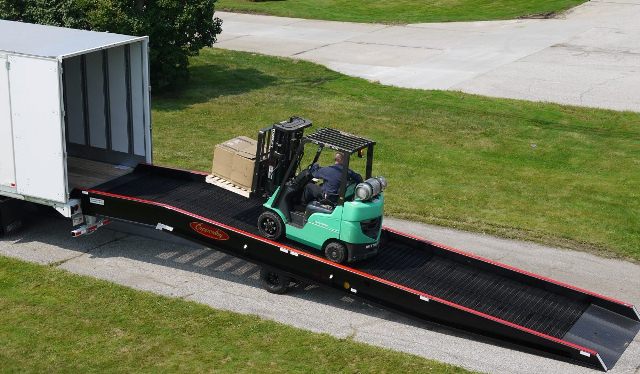
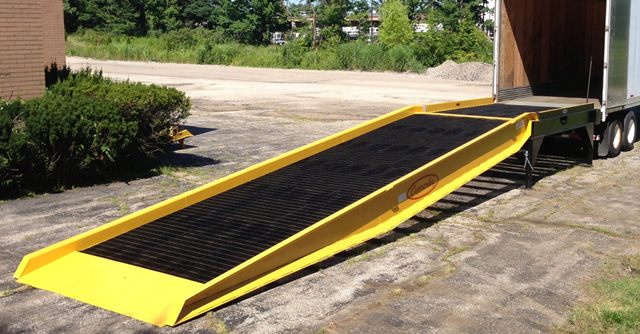
Forklift Ramps for Containers – Forklift Yard Ramp: A yard ramp is a portable loading dock. It is a ramp that can be moved anywhere in the shipping and receiving yard to give forklift access to a shipping container or semi-trailer at a loading dock level.

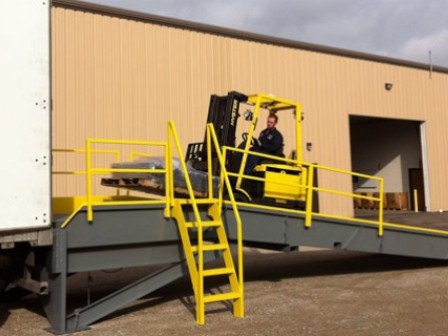
Yard ramps fulfill an important niche as a productivity tool, enabling the user to move heavy equipment via forklift from ground level to loading dock level. The chief purpose of a yard ramp is to facilitate the loading and unloading of semi-trailer trucks at locations that lack a loading dock. Alternatively, a yard ramp can be used to allow vehicles to enter a warehouse through a loading dock door.

Forklift ramps for containers

Portable steel yard ramp

The yard ramp allows for traffic to move from the dock level down to the ground or from the ground up into the back of a truck, which helps loading/unloading flow smoothly. The 18” industrial solid rubber pneumatic tires allow for easy movement of the ramp around your shipping yard to have you ready in minutes to begin loading/unloading. The hydraulic adjustment system permits fast reliable height adjustment of the yard ramp with virtually any trailer bed height.

Portable Steel Yard Ramp Highlights

  • All steel welded construction
  • Capacities from 16,000 to 60,000 pounds
  • Wide range of capacities and sizes available
  • Solid rubber tires standard, pneumatic tires optional
  • Steel serrated grating
  • Double-action hydraulic pump
Forklift Yard Ramp

Portable yard ramps

Forklift Yard Ramp features

  • Versatility is Paramount in a Yard Ramp: The standard heavy-duty axle assembly with 18” industrial solid rubber pneumatic tires provide excellent mobility for positioning. In addition, the axle assembly can be removed or raised for permanent dock ramp installations.
  • Heavy Duty Structure: Structure consists of heavy-duty formed steel side girders fully welded to high strength steel joists. (Picture shows the underside of ramp.)
  • Tow Clamp: The “tow clamp” connects between the ramp pocket and the tow hitch of your fork truck and permits easy transportation of the ramp over longer distances.
Forklift Yard Ramp

Portable forklift ramps

Forklift Yard Ramp:

Portable forklift loading ramp: When you need to unload a truck, trailer or railcar and dock space aren’t available, our heavy-duty 22,000 lb capacity steel yard ramp is the solution to your problem.

Easily movable on solid rubber wheels, each yard ramp includes a dual cylinder hydraulic pump to raise or lower the ramp to the proper loading height.

Two steel ramps ensure a smooth transition from the ground to the ramp. This steelyard ramp is designed for loading and unloading a truck, trailer, or railcar when dock space isn’t available.

The surface of the ramp includes a middle diamond plated strip that is surrounded by serrated steel grating, which allows for snow, dirt, and debris to fall through, preventing dangerous build-up on the ramp (please note, the grated surface of this ramp is not designed for forklift turning maneuvers).

Additional safety features include 8” tall side rails on either side to prevent forklifts from driving over the edges, and two 60” safety chains to hold the ramp secure to the loading surface.

The chains can be attached to a semi-truck trailer’s ICC bumper to prevent the ramp from kicking out. This yard ramp also includes a dual-action hydraulic pump for smooth raising and lowering of the yard ramp.

To use the pump, simply push the lever forward or back to raise the front and open the release valve to safely lower the ramp into position. The pump is conveniently stored internally for safety and protection.

Forklift Yard Ramp

Forklift ramp slope

Forklift Yard ramp design

Some yard ramps are constructed from aluminum, but although this has weight advantages, their cost is typically much higher than their steel equivalents; most yard ramps are therefore constructed from welded steel unless the weather conditions are such that aluminum needs to be used, i.e. in climates with temperatures well below freezing.

There are a variety of choices for the decking material as it is required to be both tough and non-slip in a range of operating conditions. Most manufacturers use some form of open grill sheeting supported on a rugged base structure.

The basic layout of a yard ramp is an inclined section of about 9 m (29’6″) in length and 2.25 m (7’5″) in width, followed by a flat approach section of about 2.5 m (8’3″) in length at the top, with a lip to enter the container or truck being loaded or unloaded.

Both sides of the ramp usually have safety rails to prevent forklifts from accidentally driving over the edges. Standard height should be at 7″ and 4″ thick. The yard ramp is supported on an undercarriage, or adjustable legs, fitted with wheels which are used to transport the yard ramps around.

The undercarriage/legs are adjustable so that the height of the ramp can be raised whilst the truck is put into position, and then the yard ramp is lowered so that the front lip supports the weight of the yard ramp on the container or truck floor. It is then vitally important that the yard ramp is allowed to float up and down with the vehicle as it raises/lowers on its suspension.

Forklift Yard Ramp

OSHA forklift ramp requirements

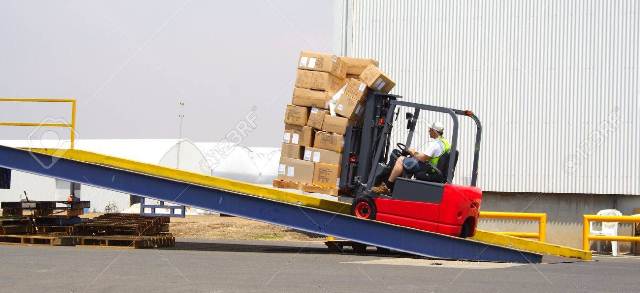
  • 1910.178(n)(7)(i) When ascending or descending grades in excess of 10 percent, loaded trucks shall be driven with the load upgrade.
  • 1910.178(n)(ii) On all grades the load and load engaging means shall be tilted back if applicable, and raised only as far as necessary to clear the road surface.

Forklift gradeability

Gradeability ratings apply to a particular make and model of the machine and are legitimately supplied only by the manufacturer. The ratings identify on which grade a machine is capable of climbing and stopping with a full capacity load. For example, a Toyota 8FBCU25 forklift is rated at approximately 20% which is only 12 degrees. However, some 4-wheel drive rough terrain forklifts have as much as a 30-40% gradeability rating.

OSHA loading ramp requirements

Climbing excessive grades can have a negative effect on battery cycle time, fuel consumption, component temperature, longevity and reliability of the machine. While the ability to reliably climb a ramp is important, safely descending a ramp when carrying heavy loads is equally concerning. The forklift must be able to safely stop on the required grade. Operators should be trained to follow specific travel rules for their own safety.

Forklift Yard Ramp

Forklift ramps for containers

Forklift ramps for containers: The perfect answer for loading and unloading freight from shipping containers

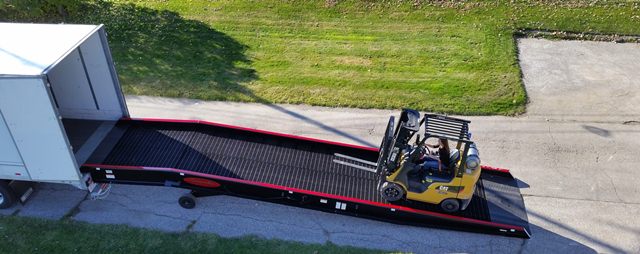
The Shipping Container Ramp is used to load and unload cargo from shipping containers with a forklift. It allows you to safely navigate the transition from the ground to the bed of the shipping container.

Container Ramps are built tough to withstand heavy use. They are built to last.

These Shipping Container Ramps feature a full-width stiffener to provide strength and to bump up against the container. Locking chains with a specially designed keeper allow you to easily lock it into the holes in the container. After the keepers are in place, taking up the slack in the chain is simple and quick with the sturdy grab notch bracket welded to the sides of the Container Ramp. The result is a safe, sturdy loading ramp locked firmly to the shipping container. You can now load and unload your container safely.

Forklift Yard Ramp

What is a good slope for a ramp?

For commercial use when somebody is sitting in the wheelchair or scooter while it climbs the ramp, ADA recommends a 1:12 slope, which means that every 1″ of vertical rise requires at least 1′ (12″) of ramp length (5 degrees of incline). Example: A 24″ rise requires a minimum ramp length of 24′ (288″) (24 divided by 1).

what is a forklift ramp for containers?

The Shipping Container Ramp is used to load and unload cargo from shipping containers with a forklift. It allows you to safely navigate the transition from the ground to the bed of the shipping container. Container Ramps are built tough to withstand heavy use.

How do you calculate the slope of a ramp?

Slope percentage is calculated in much the same way as the gradient. Convert the rise and run to the same units and then divide the rise by the run. Multiply this number by 100 and you have the percentage slope. For instance, 3″ rise divided by 36″ run = .083 x 100 = an 8.3% slope.

What is a yard ramp?

A yard ramp, sometimes called mobile yard ramp or container ramp, is a movable metal ramp for loading and unloading of shipping containers and vehicle trailers, without the need for permanent docking bays.

When driving a forklift the forks should be at what height?

When the forks are too low, it could scrape the floor surface. It is also dangerous when you reach an incline or slope, that is why when traveling in slope, drive the forklift in reverse. In a typical warehouse set up with an even floor surface, the forks should be above the ground at a height of 5 to 10 centimeters.

The most read

Forklift Container Ramps for Sale

  • What kind of forklift ramps are there?
  • How much does a container ramp cost?

More on this story

Forklift Dock Ramp

Loading docks perform a critical function in the logistics system infrastructure. They form the link between manufacturing and transportation, and between transportation and storage functions.

Types of Hoist

Types of Hoist: A hoist is basically construction and material handling equipment that is used to move the materials from the building’s ground to the top floor. It works when your mind sticks to the ideas of manual working that costs more than any machine.

Types of Hoist

Different types of hoists

Hoists are used anywhere lifting and moving a load is required, not restricted to industrial applications. Hoists have a wide range of applications including lifting cargo, construction materials, engines, and warehouse stock.

  • Chain hoist
  • Electric Chain Hoist
  • Wire rope hoist
  • Hoist trolley
  • Electric Hoist
  • Flame proof hoist
  • Manual hoist
  • Travel hoist

Chain hoist

This hoist lifts loads up to 10 feet high thanks to its sturdy, hardened steel chain. The 2000 lbs. capacity chain hoist is equipped with a mechanical load brake to give the operator more control when lifting or spotting.

Types of Hoist

Electric Chain Hoist

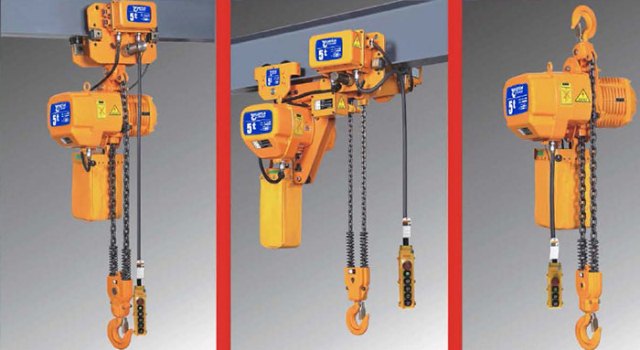
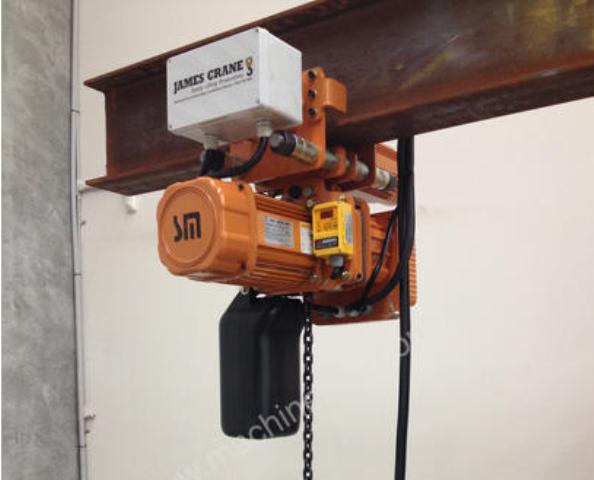
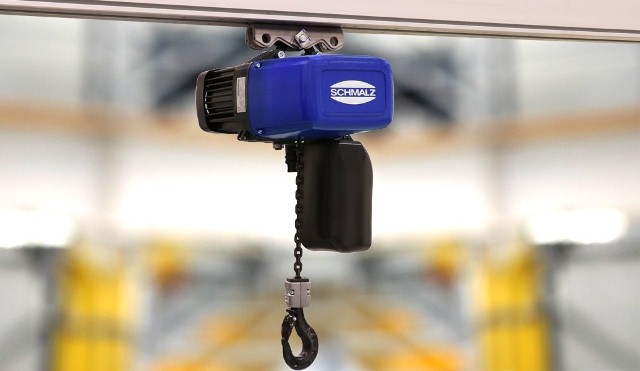
Electric chain hoists are used for lifting or lowering material. An electric motor and controller are utilized to lift, lower and accelerate or decelerate the speed of the hoist. Electric hoists are ideal for use in industrial production lines and small machine shops where more frequent and faster lifting is required.

Types of Hoist

Wire rope hoist

Wire rope hoists lift loads by wrapping a cable around a grooved drum. For 10 tons and above, wire rope hoists are the optimal choice on the market. This category of hoists is generally known to offer a wider variety of options with very fast lifting speeds.

Wire ropes are the preferred choice for frequent use as chain hoists are more susceptible to wear and tear over time. Wire ropes, however, move loads very slightly laterally because the wire rope is wrapped around a grooved drum.

Types of Hoist

Hoist trolley

This is a hoist specifically geared towards load shifting rather than cross-motion. Usually, they have a load-bearing capacity of up to 3 tonnes. This type of hoist is perfect for warehouses and storage facilities.

Types of Hoist

Electric Hoist

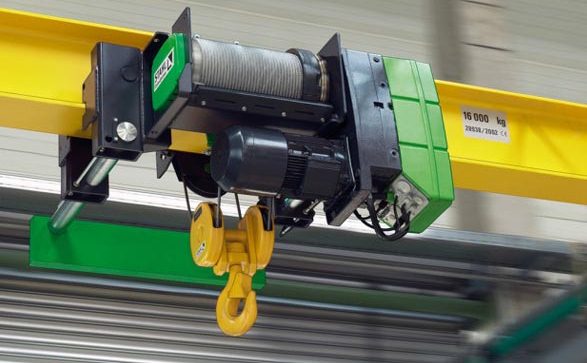
Electric hoists can be designed to use chain or wire rope, and use an electric motor to turn gears located inside the hoist that lift or lower the load. Electric hoists are controlled by pushbutton pendant or radio controls. Electric hoists are typically hard-wired into the crane’s electrification system and utilize 220v/440v or 230v/460v. Light duty electric hoists can utilize 110v and plug directly into a standard outlet.

Electric hoists can be used in a variety of applications and come in numerous types and configurations, but are limited by duty cycle and can’t run continuously. The electric motor in the hoist requires a cooling-off period in between uses to ensure that the motor doesn’t overheat

Types of Hoist

Flame proof hoist

As the name describes, this is a hoist specifically designed for environments where fires are a known hazard. Oil refineries and chemical plants are the major businesses in need of this hoist. In all other aspects, it is a regular hoist, electrically operated using a hand-held pendant.

Manual hoist

A manual chain hoist is a pretty simple device considering a large amount of weight such a tool can lift. Chain hoists are made from durable, high-grade steel to ensure safety and reliability when lifting a couple of tons of heavy loads. Manual chain hoist can be separated into three different parts categories: lifting chains, lifting mechanisms, and hooks.

Travel hoist

Power Travel Wire Hoist: A heavy-duty electric hoist ideal for rough environments. It is one of the fastest moving hoists. Using an electric motor and dual rails, it can carry up to 20 tons but is not limited to that. Specific power travel wire hoists can be designed for a heavier load-bearing capacity. Not just a flashy moniker, this hoist truly delivers the power and efficiency required in chemical plants, foundries, and steel mills.

Hoist specification

Operating time, frequency of usage and load all factor into the life of the hoist. These factors, as well as travel distance and speed, will also affect the lifetime of the trolley, where applicable. Using equipment above recommended parameters will lower the product lifetime.

  • The required effort to operate a manual hoist (a lever or hand-operated) should be within the limits of the operator.
  • The lifting capacity of the hoist should not be higher than the weight capacity of the structure that will support the hoist.
  • For most applications requiring regular lifting of 2 tons or more, a motorized trolley is recommended.
  • Structural components such as the load block or hook add to the overall weight being lifted, keep this in mind when assessing lifting needs.
  • Specialty or custom hoists are often available from certain manufacturers

What is a hoist?

Types of hoisting equipment in construction: what is a hoist?

Hoists are mechanical or electro-mechanical lifting devices that rely on mechanical advantage to move objects vertically and support hanging loads.

Mechanical hoist equipment distributes weight by using pulleys or gears to transfer low force over long distances into larger forces applied over shorter distances.

The chain or rope is wound around a barrel/drum or wheel and further wound around other gears or pulleys with different radii, some of which can be in the load block.

This configuration is called the reeving and determines how the force of a load will be distributed or transferred. Hoists are used in fixed or mobile applications and can be used for general purpose lifting or designed for special purposes, such as removing an engine from a car.

Hoists typically incorporate a hook at the fixed end that connects to a crane or trolley and a hook at the moveable end which engages the load.

Types of Hoist

what is a chain hoist?

A Chain Block (also known as a hand chain hoist) is a mechanism used to lift and lower heavy loads using a chain. Chain blocks contain two wheels in which the chain is wound around. Chain Blocks can also be attached to lifting slings or chain bags to lift the load more evenly.

what is an electric chain hoist?

Electric chain hoists are used for lifting or lowering material. An electric motor and controller are utilized to lift, lower and accelerate or decelerate the speed of the hoist. All chain hoists provide true vertical lift, meaning the load does not vary from the hoist centerline during hoisting or lowering.

what is wire rope hoist?

Wire rope hoist is a complex mechanical device that has many moving parts all working in tandem to help support and move an object or load. In the lifting and rigging industries, wire rope is attached to a crane or hoist and fitted with swivels, shackles or hooks to attach to a load and move it in a controlled matter.

what is electric hoists?

Electric hoist consists of an induction motor with a brake to hold the load lifted on it. It’s an electrical panel board and the motor with pulley coupled to the hoist, with a pendant operating station hanging with the help of a steel wire rope at a height of the operator-friendly use.

The most read

Electric Hoist Trolley

Electric Hoist trolley provides the ability for a simple hoist to become a laterally traversing versatile piece of equipment. Powered trolley hoists come in different types, including air and electric and capacities.

More on this story

Types of Hoisting Equipment in Construction

The hoisting is the lifting of the material against gravity and maybe done with a wide range of equipment from the small hand-operated simple screw.

Hoist Mechanism

The mechanism used to raise and lower heavy loads to the desired height with comparatively little effort is called a lifting mechanism.

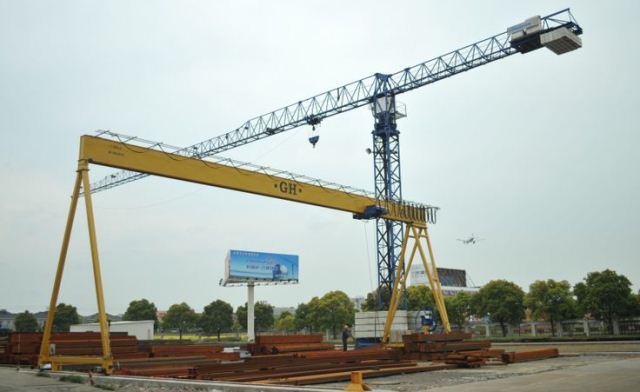
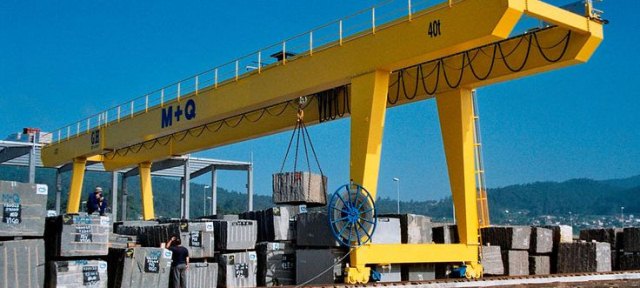
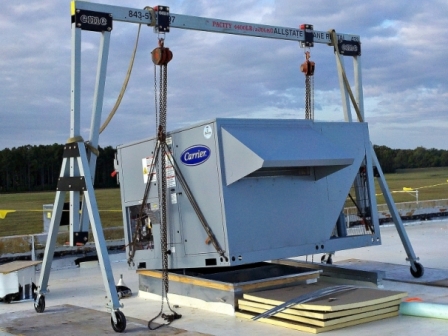
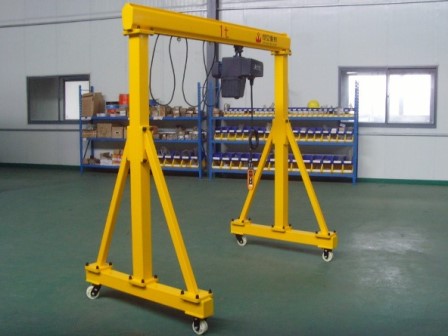
Gantry Crane Design

As a special series of lifting equipment, there are different types of gantry cranes. The classification of the gantry cranes can be listed according to several factors:

Fixed crane

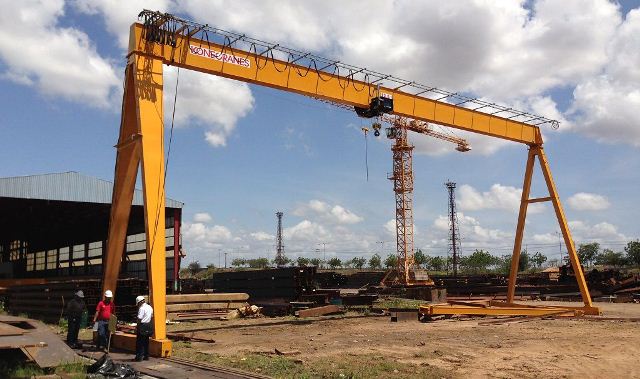
Semi gantry crane: One articulated support and the other recessed to the beam:

The union of the beam with each of the two supports is done differently. In support, an articulated joint is executed, without transmission of moments between both elements.

In the remaining support, an embedment materializes, in such a way that the transmission of moments is guaranteed.

With this provision, the structure is a mechanism if we look at its internal constitution. However, globally the structure is isostatic due to the fact that in the union of the supports with the rails, fixed supports are obtained.

The main advantage of this configuration is that the section needed for the articulated support is smaller since it only works under axial force.

Mobile crane: Both brackets are embedded in the beam:

In this case, the union of both supports with the beam is executed as an embedment, obtaining a hyperstatic constitution structure.

The main advantage of this configuration is that the arrow on the beam is smaller compared to the articulated-recessed system.

Mobile Gantry Crane

Fixed gantry

In this case, the gantry does not move from its position, so it can only move loads along its light

Mobile gantry

With this arrangement, the gantry crane can be moved to cover more work surface. The displacement can be unidirectional along rails or in any direction if it is an automotive gantry crane on pneumatic wheels

Gantry crane structure

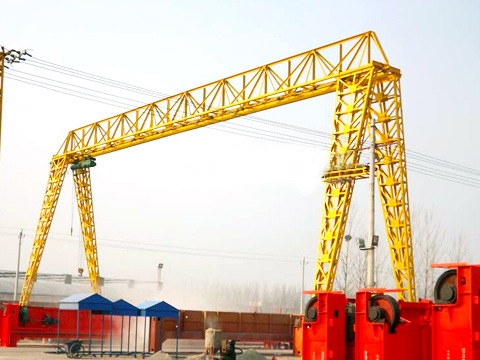
Lattice crane

Both the beam and the supports are made up of lattice profiles, either flat or spatial. The main advantage of this solution is that it is more economical when trying to save large lights.

In addition, the surface exposed to the wind is noticeably smaller compared to the porticos formed by box beams.

However, its limitation is given by its maximum load capacity, which is less than what can be achieved with box beams.

Steel gantry crane

The cranes based on hot-rolled profiles of full core type IPE, IPN or HE are used when the lights to be saved are reduced and the loads to be handled are light. Its main advantage lies in its simplicity and economy of construction.

Crane gantry girder

Drawer beam type:

With this configuration, the beam is constituted by an armed profile based on welded plates.

You can get practically any type of section that is needed. Generally, the sections have a rectangular hollow shape (with or without external flanges), well suited to withstand the bending and shearing stresses prevailing in the beam.

This morphology is the most used in the construction of gantry cranes from a certain size. With it, you can reach load capacities over 1000 tons and lights over 100 m.

Types of cranes

Classes and types of cranes (forms):

Single girder gantry crane

It is the basic configuration of a gantry crane and in it, the car is supported by a single beam. It is a suitable solution to support low loads. Starting at 20 t, the use of a double girder configuration is usually preferable.

Double girder gantry crane

When the loads to be moved are high and/or the light to be saved is important, a double-row configuration is used. With it, the load is distributed between two beams, with which the necessary profiles can be of the smaller sections.

Portable gantry crane design

While a gantry crane is flexible in its design because it doesn’t rely on building supports and can be designed to be mobile, there are some things you’ll need to consider if you want to utilize a gantry crane in your facility.

Gantry crane design standards

Nearby Foot or Motor Traffic

Most people will choose to go with a gantry crane if they’re going to be running a lot of traffic, forklifts, and carts in and out of an area where they need to utilize their crane. A larger gantry system will allow forklifts in to pick up materials and allow you to bring trucks in and out for loading. That’s probably, the bigger ones that we’ve done have been for that reason.
  • Support columns, like you, have with bridge cranes, take up valuable floor space and are also obstructions for workers moving about the facility.
  • If you can eliminate those support columns, it makes it much easier for your workers to maneuver around in that area.
  • However, with any type of gantry system, you need to consider what equipment or personnel are operating nearby.
  • With a gantry that’s moving down the rail or track—or even a portable gantry that’s being maneuvered through different areas of a facility—you want to be aware of any possible obstructions that the crane could possibly collide with.
  • Any type of impact could cause damage to electrical panels, end trucks, controls, gearboxes, or any other components mounted to the legs of the crane.
  • Manufacturers can get creative in positioning the controls, gearboxes, and panels on the legs to minimize exposure to impact.

Steel gantry design

Indoor/Outdoor Use

If your gantry crane system will be operating outdoors, you’ll want to consider the type of paint or finish is applied—as well as the material itself. Since the crane is being used outdoors, you’ll want material like stainless steel or galvanized steel that can withstand corrosion and hold up to UV exposure, saltwater, moisture, and extreme heat or cold.

You’ll also want to consider additional features like motor heaters and insulated electrical panels to withstand the elements. You can even add on a “dog house” or covered area to protect the trolley and hoist. These can actually travel over the top of the hoist the whole time or can be a designated parking station at the end of the crane.
While a gantry crane is flexible in its design because it doesn’t rely on building supports and can be designed to be mobile, there are some things you’ll need to consider if you want to utilize a gantry crane in your facility.

Powered gantry crane

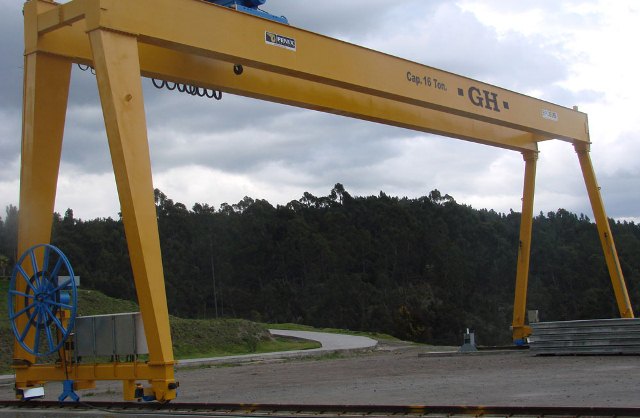
For large outdoor gantry systems, cable reel is a common electrification option. Cable reels utilize a simple design that’s either spring-loaded or motor-driven to release, retrieve, and store conductor cable for crane equipment. They can be mounted stationary or on a swivel base to allow the cable to payout in multiple angles and directions.

The disadvantage of a cable reel is the sag factor you may experience in the cable when you stretch one out 50’, 100’, or longer. If that cable is sagging or laying on the ground because of a long track system, you’ve now negated the advantage of allowing motorized traffic to run underneath the gantry system.

Overhead crane manufacturers can work with you to design an electrification system using lightweight beams or a series of poles to keep your electrification off the ground. Or, portable gantry cranes can be designed with long extension cords to accommodate power supplies that may not be as close to the work area that the crane is moved to.

Crane lifting speed

Gantry cranes should be used in applications where speed is not a concern. You can run a bridge crane at a pretty high speed, but on gantry cranes, the load is typically moved at a slower crawling speed.

Lifting gantry design

Especially on outdoor gantry systems, you may want to consider upgrading to rotating axle end trucks instead of standard fixed axle end trucks. Fixed axle end trucks have the gears and bearings contained within and in an outdoor environment, these can get dirt, dust, and debris inside the gears. Over time, this debris can seize up the gears and burn up the motors.

Rotating axle end trucks are designed to be a little more heavy-duty and robust and typically have fewer parts, so they’re lower maintenance. The gears are enclosed in a continuous oil bath that keeps all debris out—even in dirty, dusty, and outdoor environments.
Even the style of the gears on the drive can make a difference. A helical or bevel gear drive can be advantageous compared to a worm gear drive. A helical or bevel gear drive can roll back on itself in the event of an impact—causing less torque to the gears themselves. On a worm gear drive, the gears could break apart in the event of an impact because they aren’t designed to operate in reverse.

What does an industrial designer do?

What does an industrial designer do?

Industrial designers develop concepts and designs for manufactured products. They typically specialize in one product category, such as automobiles, machinery or cranes.

What is A-crane?

A-crane is a major type of construction machine that is used to move the loads horizontally. Equipped with a hoist rope, wire ropes, and sheaves, it can be used to lift heavy loads or transport them to other places. The mechanical advantages created by several components on the crane can produce powerful strength.

What is structure in design?

Structural design is essential to the design of a complete structural system which must be safe to carry and transfer the intended loads, generally to the ground on which the structure is supported. The structural analysis is based on different theories of Physics or experimental analysis and properties of materials.

What are the requirements of structural design?

The objectives of structural design are to design the structure for stability, strength, and serviceability. It must also be economical and aesthetic.

What is a structural design pattern?

In software engineering, structural design patterns are design patterns that ease the design by identifying a simple way to realize relationships among entities. Examples of Structural Patterns include Adapter pattern: ‘adapts’ one interface for a class into one that a client expects.

What is structural design and analysis?

Structural analysis is a tool to analyze any configuration of the structure, while the structural design is the method design different that particular member for the calculated internal forces.

What is the difference between structural design and structural analysis?

Structural Analysis: It is the process by which we find out how a structure or a member of a structure behaves under applied loads. That is means finding out internal forces (axial force, shear force, moment), stress, strain, deflection, etc. We need these data for the structural design.
Structural Design: It is the process by which we find out safe and economical specifications of a structure or a member of the structure. That is means finding out member steel section, cross-sectional dimension, amount of reinforcement, etc. to withstand the internal forces that we have got from structural analysis.

The most read

Aluminum Gantry Crane

Made from lightweight extruded materials, the components of the adjustable height aluminum gantry crane are easily lifted by one person.

More on this story

Harbor Freight Gantry Crane

A gantry crane is a serious purchase. Not only are they expensive, but they are relied upon to lift seriously heavy objects. It is not worth it to try and save a few bucks on a crane of inferior quality.

Small Gantry Crane for Sale

Small gantry cranes are the perfect solution when heavy-duty lifting equipment that is versatile and easy to set up and use is required.

Gantry Crane Price

When buying one of this equipment, use and load considerations are necessary, whether they are for work at home or for a workshop.