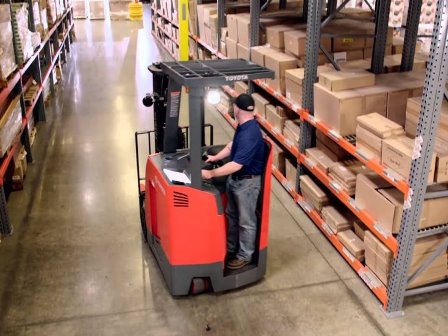
Category Archives: forklift

Straight Mast Forklift

Straight Mast Forklift: Don’t see the specific model you need? Straight mast forklifts are the upright vertical assembly on the front of the machine, raising and lowering the load. All forklifts of this nature work through hydraulic displacement for lifting, and gravity for lowering, but there are different mast types with various benefits.

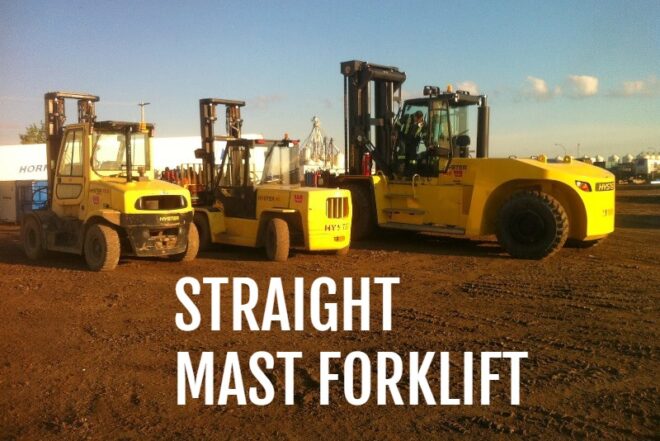
Straight Mast Forklift

Straight mast forklift

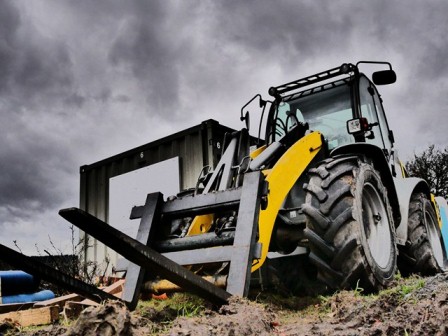
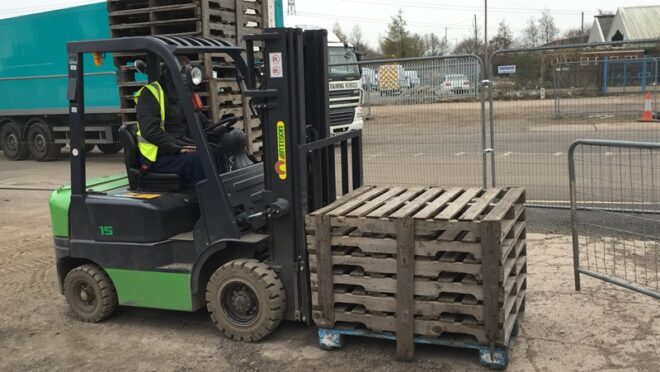
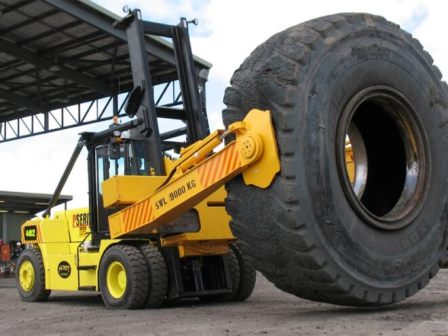
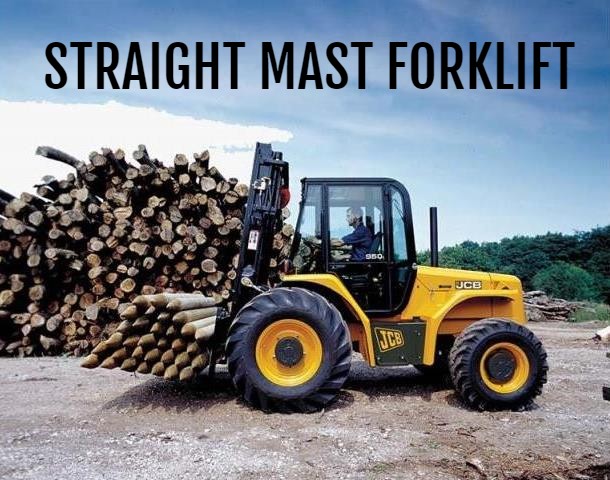
Rough terrain straight mast forklift:

A rough terrain forklift is considered a Class 7 forklift according to OSHA classifications. These rugged machines are designed to be driven over uneven and rocky surfaces, while still transporting a heavy load. Due to size, tires, and weight capacity, a rough terrain lift is primarily used outdoors.

Rough terrain forklifts (RTFLs) are a reliable, versatile and easy-to-use solution. Perfect for virtually any rehandling environment from docks to yards, special events, timber forestry, construction sites, farms, and builders’ merchants, the RTFLs is designed for high mobility and superb productivity in rough terrain areas.

The Rough terrain forklifts have a range of operating weights, lift capacities and dimensions to suit, and they’re all powered by a world-renowned efficient engine.

Straight Mast Forklift

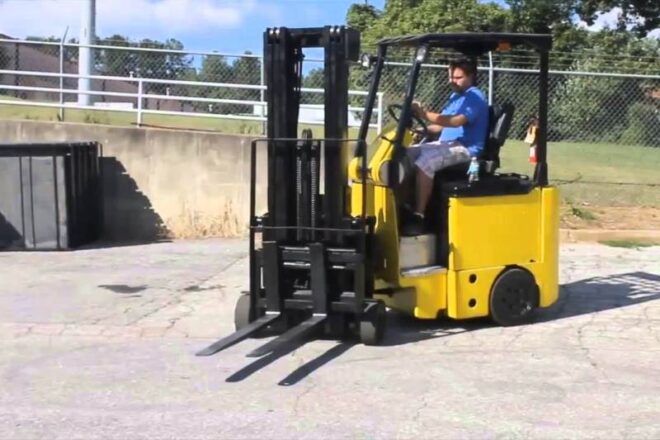
Swing mast forklift

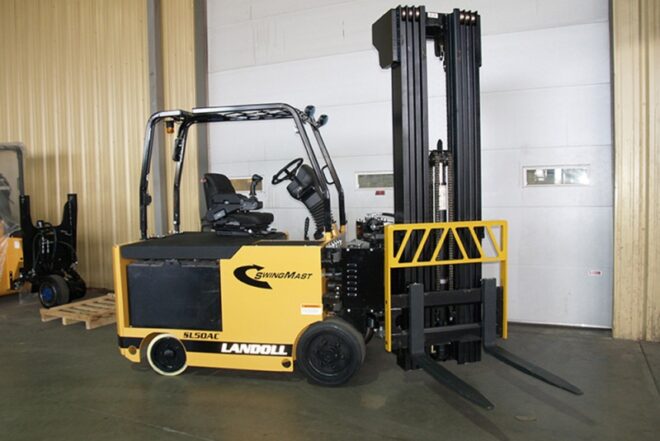
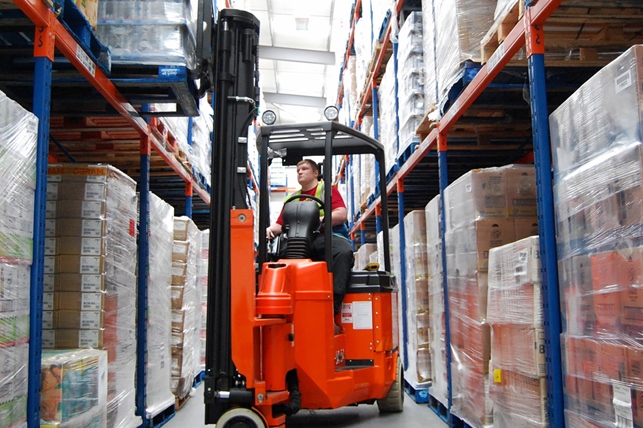
Maximize storage space with articulated or swing mast forklifts. The innovative design allows these lift trucks to do the work of a standard reach truck in aisles up to 40 inches smaller. These specialty forklifts are ideal for any application, both indoors or outdoors, where space to maneuver is limited.

Articulated & swing mast forklifts can help you get the most out of your warehouse storage space, but there are other ways to optimize your warehouse design to ensure optimal efficiency. Analyze your warehouse layout to help you optimize pick processes, reduces manpower costs, and increase profits.

Swing mast forklift

Low mast forklift

With a wide range of mast models available, how do you make the right choice? Before choosing a mast it’s best to take height restrictions into consideration:

How do you calculate the load capacity of a forklift?

How high do you need to lift? Locate and measure your highest shelf to understand lift requirements and then add another 150-200 mm to your measurement. The extra space allows a truck operator additional clearance to lift above the rack and avoid dragging the product as it’s loaded or unloaded.

How to read forklift load capacity chart?

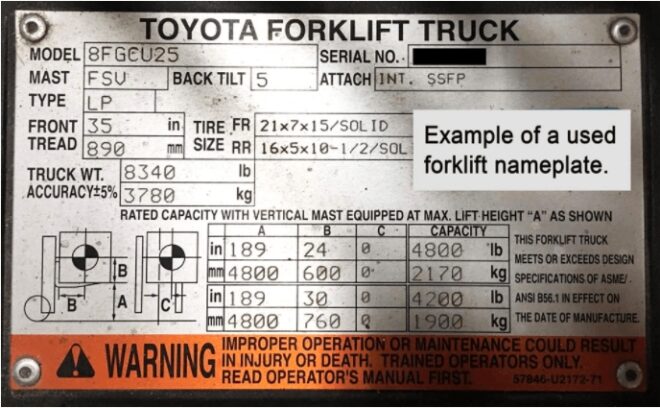
Each load plate is going to differ a little depending on the forklift.
Basic Information: Brand, Model, Serial Number, Forklift Type
Parts & Components Information: Mast Type, Front Tire Tread, Tire Sizes, Tire Type
Weight & Load Information: Truck Weight, Battery Weight, Attachments Included In Weight Calculation, Back Tilt, Forward Tilt, Load capacity, Maximum Lift height, Load center distances, Down rating of lift capacity (if the mast is fitted), Down rating for attachments (as specified on the capacity plate)

How low must your lowered mast be?

Some applications call for entering and exiting doorways. Perform a walk-through of your building and measure doorway heights to learn your lowered height requirement. If your application also requires operation on lorries, you need to take the lorry measurements into consideration too.

If you load product onto lorries, do you double-stack?

When working in a confined space the feature called free lift should be considered. The free lift function enables the forks to be lifted to a certain height with the mast at collapsed height.

Short mast forklift

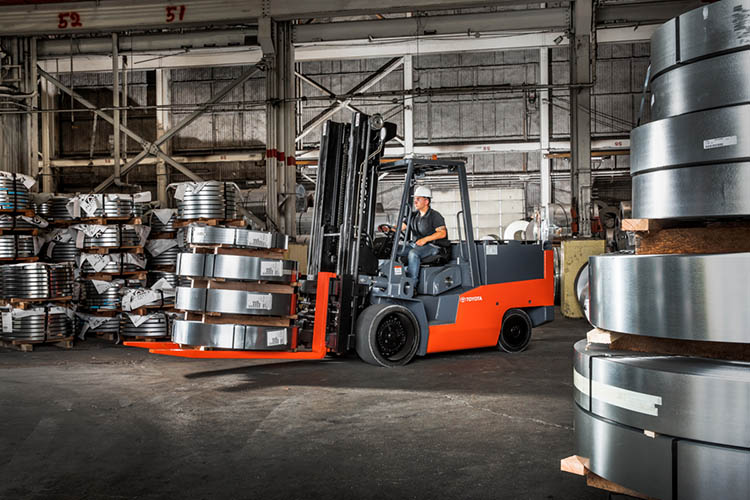
Short mast forklift or warehouse forklift: Some of the most popular warehouse forklift models include the Hyster 36-38T, Komatsu 20 BX50 Hyster, and the Toyota 3-Wheel Electric Forklift. Most industrial forklifts can lift 5,000 lbs of weight, but some heavy-duty models are capable of elevating up to 25,000 lbs.

Straight mast forklift types

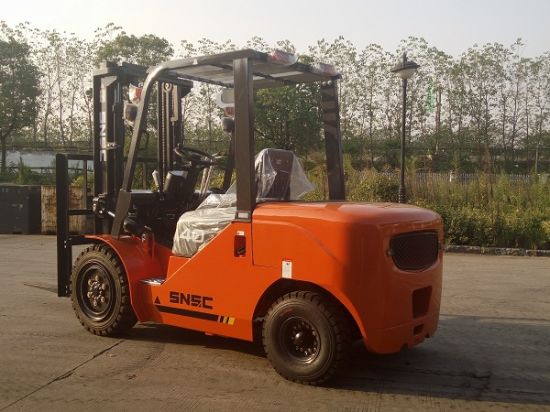
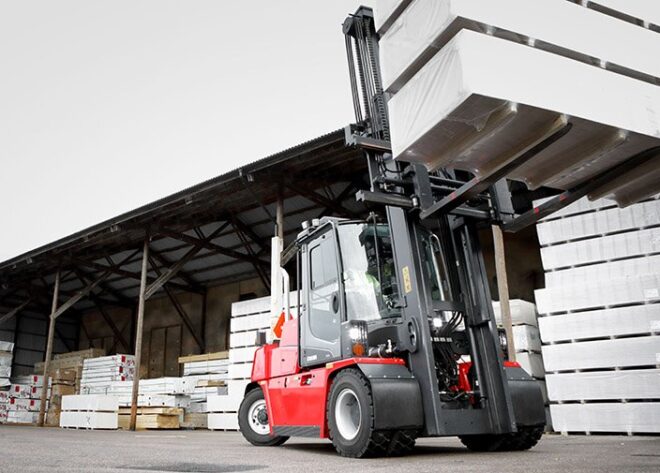
Straight Mast Forklifts are ideal for lifting, carrying and placing palletized materials and bulk items on any type of terrain. One of the many ways to keep productivity high in your operation is having the right truck suited to your specific application and environment. The type of mast for your truck can already make a difference. Here are all models you can choose from:

Standard forklift

Single Stage – A single-stage mast has only one channel, and therefore a limited lifting height. Single-stage masts have zero free lift and are best for outdoor applications or environments where overhead clearance is not an issue.

2 stage mast forklift

2-Stage – A two-stage mast, also known as a duplex, has two sections. The outer stage does not move and gives the option for a free lift. The inner mast section raises up to elevate the carriage and forks. A two-stage mast offers great visibility and is ideal for moving loads in trailers.

3 stage mast forklift

3-Stage – A three-stage mast, or triplex, is the most versatile forklift mast and also the most popular. The outer rails allow for free lift, and the two inner sections can lift loads higher than a two-stage. This mast type is a good choice for general warehouse applications.

4 stage mast forklift

4-Stage – A quad or four-stage mast is designed for very high stacking. Quad masts allow for a shorter collapsed height when compared to a three-stage with equivalent MFH (maximum fork height).

Straight Mast Forklift

Container mast forklift

What does container spec mean? Container spec refers to a truck’s ability to operate in standard shipping containers. What it typically means is that the mast for the truck is, when lowered, beneath the height of the overhead guard and that the truck operates a full-free-lift mast, meaning a load can be picked up when in the container without the height-restriction of the container roof being an issue. Typically, container spec trucks have a triplex, 4,300mm mast fitted.

The most read

Rough Terrain Forklift

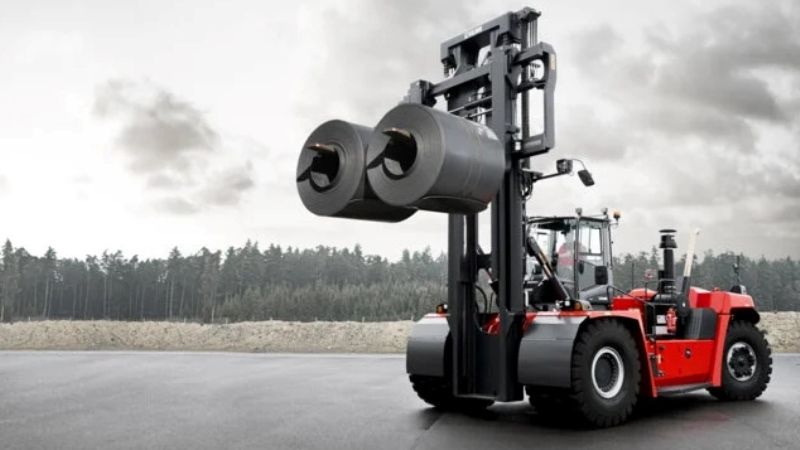
Rough Terrain Forklifts are among the largest of the forklift family. This equipment was designed to be driven over uneven and rocky surfaces, while still transporting a heavy load. Due to size, tires, and weight capacity, these forklifts are primarily used outdoors.
More on this story

Forklift rules and regulations

FORKLIFT SAFETY: forklift loader rules, guidelines and regulations, forklift rules and regulations, fork truck safety, forklift training license.

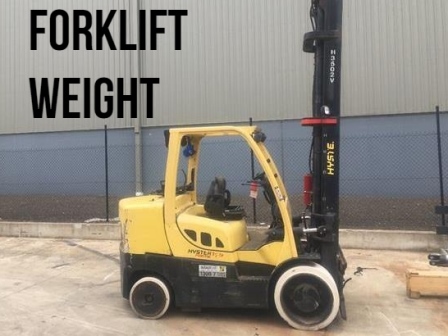
Forklift Weight

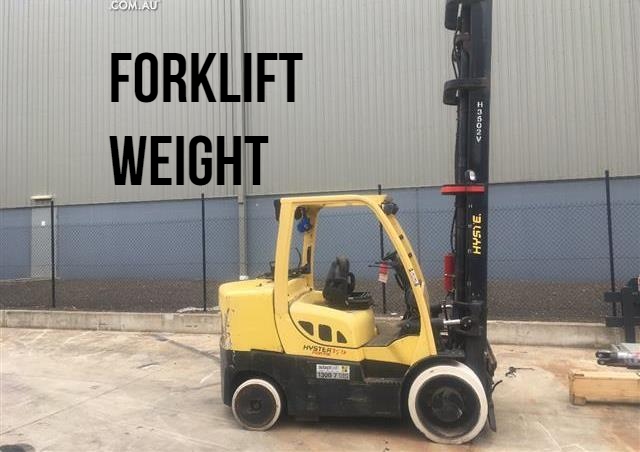
Forklift Weight: How much does a forklift weigh? It’s important to know the weight of your forklift when transporting it, driving it on trailers, moving it in an elevator, or using it in multi-story buildings. You don’t want your forklift to drop through the floor, causing thousands of dollars of damage and injuring workers!

forklift weight

The average weight of a forklift

Forklift weight capacity, Size, and Position: Forklift Weight

The load weight, weight distribution, size, shape, and position are key factors affecting the stability of the forklift.

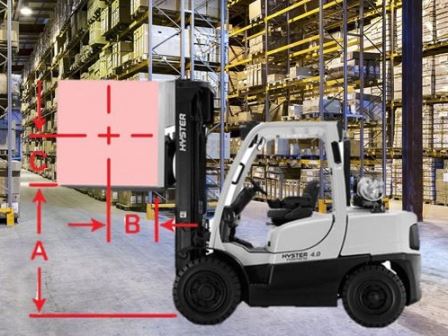
Forklifts are designed to carry a capacity load at a standard load center, commonly 24 inches.

This means that the forklift’s capacity was determined as if the load were a cube whose weight is evenly distributed (i.e., whose center of gravity is exactly in the center of the cube) and which is resting on a standard pallet having dimensions of 48 inches by 48 inches.

With such a load, the horizontal distance from the center of the load to the vertical part of the forks would be 24 inches.

Of course, most loads are not perfectly shaped cubes having their center of gravity exactly in the middle of the cube. To the extent that the load differs from this theoretical load — such as if it is irregularly shaped, has unbalanced weight distribution, or is not centered on the forks — the capacity may be reduced.

Forklift Weight

Forklift weight calculation

The service weight of a forklift is different than its lift capacity. Service weight refers to the actual weight of the forklift, including its battery and any attachments it has.

The best place to find the service weight of a forklift is on the forklift’s data tag. Alternatively, you can search forklift manufacturer websites for product specification pages, but the truck’s data tag is typically preferred over this option.

In addition, an industry rule of thumb is that the service weight of the forklift will generally be 1.5 to 2 times the lifting capacity of the forklift.

For example, if your forklift can lift 5,000 pounds, generally the weight of the forklift will be somewhere between 7,500 and 10,000 pounds. But remember, this is simply a rough standard, and manufacturer information or the forklift’s data tag should always be emphasized.

Forklift Weight

Forklift load capacity

Field Calculation of Safe Load Capacity

Assume a situation where a forklift truck that has a 5,000-pound capacity at a 24-inch load center needs to handle a load whose center is 28 inches from the front face of the forks in the horizontal direction. The first thing to recognize is that the actual load center distance of 28 inches exceeds the standard load center distance of 24 inches on which the 5000-pound capacity is based, so the safe load capacity is actually less than 5000 pounds.

Forklift load center

Shifting Center of Gravity: Forklift load center

All objects have a specific center of gravity. Gravity is a force that always pulls objects toward the earth’s core. Center of gravity means the point on an object at which all of the object’s weight is concentrated and all of the parts balance each other.

For symmetrical loads, the center of gravity is in the middle of the load in terms of the load’s length, width and height. Since the capacity of the forklift is based on the assumption of a cube having the center of gravity in the middle, the shape and position of the actual load are key factors when determining whether a load can be carried safely.

When a load is placed on a forklift, the key concept is the combined center of gravity of the forklift and the load.

For example, a typical unloaded forklift weighing 4000 pounds may have its center of gravity about 10 inches (25.4 cm) above and two feet (0.6 m) behind the front axle, about halfway up the truck body.

Forklift Weight

Forklift counterweight

The heavy counterweight located toward the rear of the forklift places the center of gravity toward the rear, which keeps the forklift from tipping forward. In the meantime, a 4,000-pound load consisting of a cube with even weight distribution has a CG in its center.

When the load is placed on the forklift, the combined center of gravity of the forklift and the load will move forward, but the forklift will not tip over so long as the weight of the load is centered and does not exceed the capacity stated on the data plate.

But if the load is too heavy, or if it is placed at the end of the forks so that the load center distance is increased, the excessive load moment will cause the forklift to tip forward. Remember, when the forklift engages a load, the combined center of gravity of both the load and the truck system shift forward from the center of gravity of the unloaded forklift.

Forklift Weight

How much does a forklift weigh?

How much does the average forklift weigh?

How much does the average forklift weigh?

The average automobile weighs approximately 3,000 lbs and the average forklift weighs close to 9,000 lbs. Also, forklifts are heavier in the rear to counter the weight of items being carried in the forks.

What information is on a forklift data plate?

Forklifts are equipped with a nameplate, also called the data plate or forklift capacity plate. The data plate includes vital information about the forklift, such as its fuel type, weight, and forklift load capacity.

What does the nameplate on a forklift tell you?

The nameplate provides important information for the forklift operator, including the fuel type, forklift weight, and capacity. Operators should read the nameplate to know the forklift’s capabilities and limitations.

how much does a 5000 lb capacity forklift weight?

if your forklift can lift 5,000 pounds, generally the weight of the forklift will be somewhere between 7,500 and 10,000 pounds.

The most read

More on this story

How heavy is a forklift?

While the average automobile weighs around 4,000 pounds, the average forklift weighs around 10,000 pounds.

Forklift Safety Procedures

Forklifts can be dangerous and account for 25% of on-the-job injuries.

Forklift Capacity Calculator

The lift truck’s lifting capacity factor is important in selecting your equipment.

Forklift Lifting Capacity

What useful load can forklifts transport? What requirements are necessary for a forklift?

Forklift Truck Batteries

Forklift Truck Batteries: Currently, within the industry can find different types of batteries for forklifts, which are differentiated by their uses and applications.

Its main function is based on storing enough energy to start the forklift engine. Its secondary function is to store the remaining energy for later use in equipment for extended periods.

In the same sense, forklifts that are used with different uses also require care, especially with regard to the maintenance of forklift batteries.

Do you know the different types of batteries for forklifts truck?
What are the main characteristics of forklift truck batteries?

Forklift Truck Batteries

Lift truck battery

The most common forklift battery is one that contains lead-acid and includes a lead plate (negative electrode), an electrolyte solution of sulfuric acid and another lead peroxide plate (positive electrode). Every time you operate a forklift or other motorized vehicle, inspect it to verify that it is working properly.

It is worth mentioning that the best way to preserve the batteries, whatever they may be, is through a daily control of their condition and a good use of them, but to do this, make a good maintenance of forklift batteries, you need to incorporate a vital information series otherwise you can not do it efficiently.

  • First of all, keep in mind that a battery and a battery are electrochemical devices that have the capacity to store energy in a completely chemical way.
  • Once the battery is fully or partially charged, this chemical energy is transformed into electrical energy that is subsequently transmitted via a circuit to a motor that transforms it once again, this time into mechanical energy that enables the movement of the vehicle.
Forklift Truck Batteries

Forklift battery types

The vast majority of modern batteries are manufactured following a similar pattern, in this case, a series of internal cells that mark the voltage that the battery will have, plus cells plus voltage. The batteries provide power and counterbalance to the forklifts. Batteries can weigh up to 1,000k.

Voltage: It is worth adding that the voltage of each of the cells is two volts. But in spite of this common characteristic, in the modern market, several types of batteries can be found.

Rechargeable batteries: The second variant within the types of forklift batteries most widespread in the world are rechargeable batteries or accumulators that comes in different sizes and at different voltages.

The internal composition of the battery: A difference that is important to take into account among all rechargeable variants when carrying out the maintenance of forklift batteries is to know exactly what the internal composition of the battery is.

The primary batteries: they use their stored chemical energy once in a single discharge and then they are discarded.

The secondary batteries: on the contrary, they can be brought to their initial state (charged) after the discharge, bypassing an alternating current AC through them in the reverse direction to the discharge and are usually called “rechargeable batteries” “

Nowadays the vast majority of them internally is composed of acid lead because they are economically more viable than other combinations such as lithium-polymer, nickel-cadmium, nickel-zinc, zinc-air, sodium-sulfur, lithium metal hydride, lithium-ion (used cell phones and similar devices), etc.

Industrial forklift batteries

Forklift batteries are generally lead-acid or nickel-iron. These are recharged by connecting the forklift to a fixed station or with a charger “on board” inside the forklift.

Because batteries contain corrosive chemicals that can cause burns to the eyes and skin, use personal protective equipment to prevent contact and splash, and such equipment should include:

  • Rubber gloves
  • Safety glasses and protective masks
  • An apron
  • Boots with a steel toe for protection against crushing risks

Once all this information is assimilated, what must be done, to begin with, the maintenance of forklift batteries proper is a visual check of the state of the battery in question, emphasizing the following points or possible inconveniences:

  • check connections and charger status
  • check the battery status looking for the existence of some type of leak
  • check the internal acid level of the battery
  • check the electrolyte density, emphasizing analysis of the cells
  • search for dirt particles in the battery
Forklift Truck Batteries

Forklift battery maintenance

The continuous maintenance of the batteries is essential for the forklift to work safely at all times and be ready to carry out its work.

  • Industrial batteries, like all pieces of industrial equipment, require proper maintenance to prolong their useful life.
  • Battery life always extends when the proper maintenance regimes are observed.
  • On the other hand, in bad conditions, industrial batteries used improperly cannot realize their full potential for the duration of the warranty period.
  • This is what should and should not be done in battery care for users of motive power batteries.

An efficient way to check if the battery works properly is to make a small voltage discharge. If the verification of all these issues is successful, it means that the battery is in good condition. However, to maximize the maintenance of forklift batteries, these recommendations should be taken into account:

  • keep batteries between 15 and 25 degrees centigrade
  • keep the batteries fixed
  • avoid partial recharges or that the battery is completely discharged
  • do not use them too much

That is why the maintenance of forklift batteries is so important to give more life to it.

Forklift Truck Batteries

Forklift battery charger

During the recharging of the batteries, potentially flammable gases such as oxygen and hydrogen can be produced. Choose and carefully maintain the location of the battery recharging station to avoid injury.

  • Choose a ventilated room to avoid the accumulation of gases
  • Label the area with signs and stripes on the floor that delimit the area of ​​the battery recharging station
  • Install eyewash stations and emergency showers near the recharge area in the event of splashes and exposures to acid and other corrosive materials.
  • Place a spill kit that includes acid neutralization materials near the location.
  • Provide visible instructions in addition to equipment for combat and/or suppression of fires.

Forklift battery repair

Obtain training in inspection, maintenance, and battery recharging procedures. Checkpoints during battery inspection should include:

  • Correct levels of fluid
  • Verify that the cables are intact, insulated and connected
  • The contact terminals must be clean and show no signs of crystallization or corrosion
  • Check that there are no cracks in the housing

Other useful general maintenance and safety tips for batteries include:

  • Before recharging the batteries, make sure that the forklift is off and with the emergency brake activated
  • Make sure the charger is in the OFF position before connecting it or disconnecting it from the battery
  • Add the acid slowly to the water, never add water to acid solutions
  • Keep the battery vent caps firmly in place so that the emitted gas is vented outside the forklift
  • Avoid flames, electric arcs, and sparks near the forklift’s battery
  • Never smoke near a battery recharge station
  • To avoid electric shocks and burns, remove all metal jewelry and keep metal objects away from the battery, including funnels and containers

Forklift safety

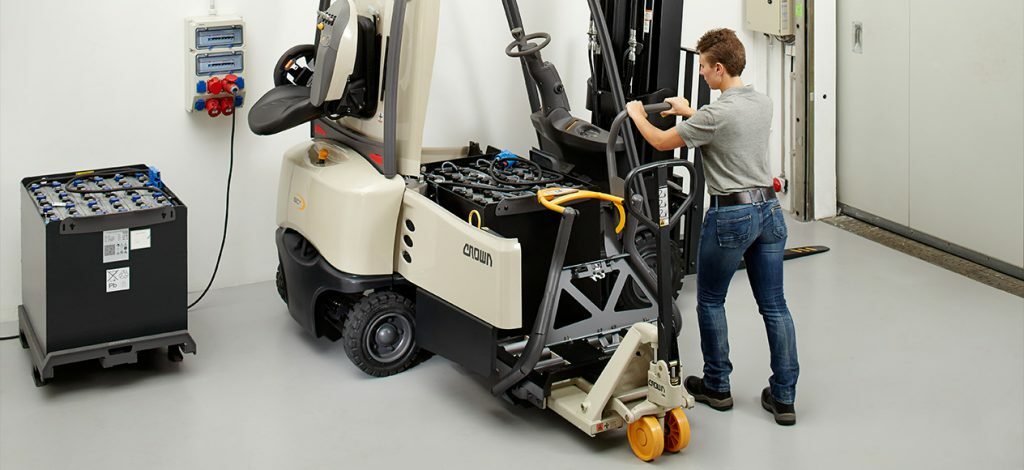
The batteries provide power and counterbalance to the forklifts. Batteries can weigh up to 2,000 pounds so apply best practices and precautions to avoid crush accidents when moving, changing and handling batteries and remember:

  • Move the battery only if you have a properly equipped cart and forklift with the necessary capacity
  • Securely attach the battery to the transfer equipment and the destination forklift

The recharging of forklift batteries is not a difficult procedure; however, it must be done with great care.

Compliance with workplace safety practices to properly recharge and maintain forklift batteries can prolong the life of the battery and ensure there is always enough charge to complete the work task.

Electric forklift battery

Is it necessary to use electric forklifts and battery recharging operations?

The operation of recharging electric forklift batteries is widely used in the industry but exposes buildings, equipment, stored materials and personnel to losses, including the continuity of operation of the company. Battery recharging operations are particularly common in warehouses where the fuel load is generally high.

The presence of battery recharging operations in proximity with combustible products can generate fire with a high velocity of propagation; therefore, it is advisable to have a robust fire prevention program and control measures that include:

… the relocation outside of buildings of this type of battery recharging operations or the protection with automatic sprinklers both in storage areas and operations with battery recharging.

Forklift Truck Batteries

Forklift battery charging station

What is a forklift battery charger?

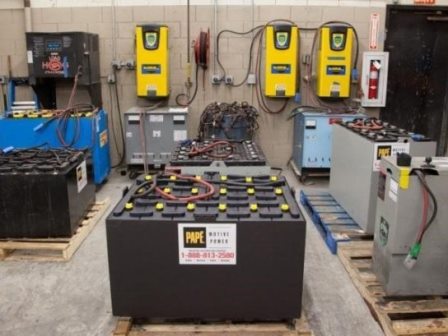
The industrial charger is responsible for charging the forklift battery as quickly as possible without shortening the battery’s lifespan due to overheating and overcharging. Before the advent of the current generation of forklift battery chargers, the operator was responsible for setting the desired voltage and amperage for charging the battery, thus opening the door for human error and damage.

Today’s industrial charger contains a complex network of cards and sensors that effectively remove the human from the equation. Today, chargers have preset parameters that protect the battery from overcharging and damage.

These preset parameters will actually stop charging and display error codes if there is a problem with the battery instead of pumping the battery full of power until it either boils over or in a worst-case scenario, catches fire.

There are myriad choices as for industrial chargers from small portable chargers that plug into any wall socket, to large wall mounted units that require large amperage capacities with dedicated wiring.

Current chargers allow the user to custom-tune a specific charge cycle. This customization allows you to control everything from the amount of voltage, amperage, charging time, and even the fill rate over a given time span. These controls allow you greater flexibility in charging, as well as longer battery life and performance.

Used forklift batteries

Used forklift batteries are a fraction of the cost of new, and will keep your forklift running.

Used forklift batteries are extremely heavy-duty and can be recharged a number of times. By following these basic tips, you will extend the useful life of your forklift battery significantly, saving you money and reducing forklift downtime.

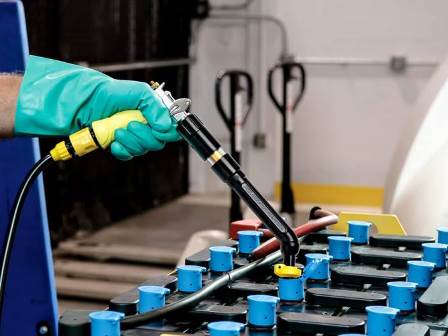
  • Replacing the water in the battery will help keep the interior from corroding, and distilled or deionized water is preferred.
  • The fluid level should typically be about ¼’’ below the vent wall neck after the battery is charged, and fluid should not be added before charging the used battery.
  • When using a forklift battery, do not discharge more than 80%.
  • An average life cycle that helps ensure a longer-lasting forklift battery is around a 50% discharge.
  • The reconditioned, used battery should also be equalized every 5 to ten charge cycles, and this is basically a controlled overcharging that adjusts the voltage difference between the cells.
  • It also helps get rid of the sulfate particles that build upon the plates.

If your used forklift’s battery ever overspills, make sure to wash it immediately with water and baking soda to stop corrosion from forming on top of or underneath the battery.

If this isn’t done quickly the battery can be completely ruined. It is a good idea to wash the outside of the battery twice a year because acid vapors escape during recharge. These vapors cause residue to build up around the vent cap area, which will eventually corrode and damage the outside of the battery.

How long do forklift batteries last?

How long do forklift batteries last?

5 years. Most new batteries start with 1500 cycles prior to the end of its usable battery life. A battery charged once each working day (300 per year) will last 5 years (1500 cycles). Opportunity charging (mentioned below) can reduce the life by over half. “Remember, the battery is the fuel tank of the forklift.

How much does a forklift battery cost?

Used forklift batteries usually cost around $1,500 to $3,500. You can buy used industrial batteries through a local material handling or battery dealer.

What kind of battery does a forklift use?

Lead-acid forklift batteries have two main functions. They provide a power source and act as a counterweight to a lift truck. A typical lead-acid battery is made up of a battery case, battery cells, and battery cables that come together to house a liquid electrolyte mixture of sulfuric acid and water.

When should you put water in a forklift battery?

You should add water to the forklift battery after its charge. Typically, batteries need watering 1x / weekly.

How much do forklift batteries weigh?

The weight of these heavy batteries can crush hands and feet if care is not taken when charging and handling them. Adequate and proper handling of equipment should be provided. The average lift truck battery weighs over 2000 pounds.

The most read

Reconditioned Forklift Battery

Sulfation is crystallization that forms a hard shell surrounding the lead plates within the battery cell, this shell prevents efficient charging and discharging of the battery.

More on this story

Forklift Battery Charger

Your forklift truck will run on its own battery if it’s an electric vehicle. The battery is a vital piece of equipment and must be cared for and kept charged in order for your truck to work properly.

How heavy is a forklift?

Compare a forklift to a car and you’ll see that forklifts are unique vehicles with special challenges.

While the average automobile weighs around 3,000 pounds, the average forklift weighs around 9,000 pounds.

Also, forklifts are heavier in the rear to counter the weight of items being carried in the forks.

And, while cars have brakes on all four wheels, most forklifts only have stopping power in their front drive wheels.

Those factors combine to make forklifts harder to stop, so they should be driven slowly.

How heavy is a forklift?

More on this story

Forklift Safety Procedures

Forklifts are extremely useful workplace vehicles, as long as they are used safely and appropriately by operators who are appropriately trained and competent to use them. Learn about the rules for driving forklifts.

How much does a forklift weigh?

It’s important to know the weight of your forklift when transporting it, driving it on trailers, moving it in an elevator, or using it in multi-story buildings.

Side Loader Forklift

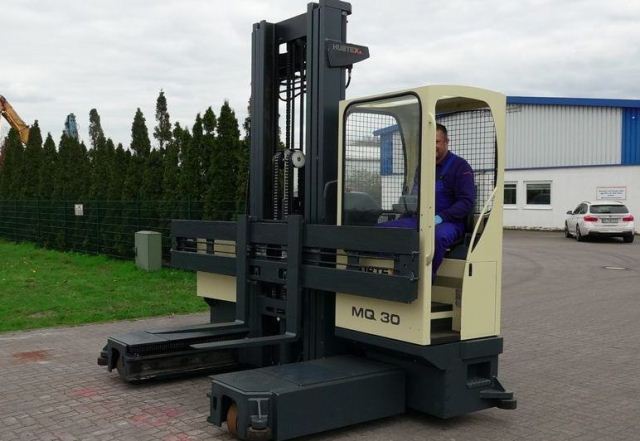
Side load forklift or Side Loader Forklift: There are various types of forklift trucks today, from the three-wheel counterbalanced lift truck, the teletruck, powered pallet lift trucks, pump trucks, reach trucks, and, of course, side loaders.

A side loader forklift truck pretty much does what it says on the tin. Side loader forklifts are powerful industrial trucks that lift loads from the side, so they are well suited to carry wide or long loads. Narrow aisles which may be a problem for regular forklift trucks can be easily navigated through in a side loader.

Side Loader Forklift

Side loader forklift for sale

Buying the right-side loader forklift can be time-consuming and uncertain. How can you avoid buying equipment that won’t meet your needs within a year or overpaying for capacity or features that you may never use?

Whether you want to buy a new or used side loader forklift, key considerations will help you choose the right forklift for your application, now and in the future.

You can also take a shortcut by contacting one of the side loader forklift experts who can help you find the best forklift for your application and budget.

Side loading forklift truck

Side loader forklift trucks may be considered safer than conventional forklift trucks because they pick loads up from the side, meaning that the driver of the forklift truck has a full view of what is in front of and behind them, whereas a regular forklift truck may sometimes have reduced visibility at the from due to large loads.

Side Loader Forklift

Forklift safety procedures

Side Loader Forklift: Safety is a priority where forklift trucks are concerned. Forklifts are often a huge help in the workplace, reducing the need for manual labor as they carry bulky and heavy loads – sometimes loads that can cause the forklift to tip over! Moreover, the load on the forklift (whether it be on the side or otherwise) can seriously reduce the driver’s visibility and this can cause accidents in the workplace.

So, it is imperative that anyone wishing to operate a forklift undergo training so that they can safely operate the vehicle. Many accidents in the workplace can be caused by those who are not properly qualified to operate such a dangerous machine; bumping into employees on the ground or moving the vehicle too fast so that it topples over. Accidents may also occur when forklifts are left unattended without first shutting off the power, setting the brakes and lowering the forks.

Side Loader Forklift

Narrow aisle side loader forklift

Side loader Forklifts are forklifts fitted with the lifting forks perpendicular to the drive direction of the forklift. By configuring the forks perpendicular to the drive direction this allows the forklift to operate in close spaced isles. Sideloader forklifts normally are capable of extending the forks with a scissor-like action to place the load on to the storage space.

Small side loader forklift

Side Loader Forklift: The lifting mechanisms are provided as hydraulic, pneumatic, electric or mechanically operated. Side-loader forklifts can be either man-up or man-down configurations. The man-up version has the advantage of locating the operator close to the load. One of the main advantages of a side-loader forklift is that storage area requirements are reduced because forklifts can travel, load, and unload within much narrower aisles. This is facilitated by the forklift’s ability to extend and retract the lifting forks perpendicular to the forward and reverse driveline of the forklift.

Side loader forklifts are available in diesel, gas, or electric power.

Warehouse forklift

It’s often said the key to an effective shipping or warehousing operation relies on knowing your options and applying the right solution for your application.

When it comes to standard pallet operations utilizing counterbalance forklift trucks on tarmac yards, the options are straightforward – diesel, LPG, or electric power, mast heights and types, and a few added extras to boost safety, management information, attachments, and such.

Inside the modern logistics warehouse, there are often other considerations – stacking, picking, loading bays, aisle widths, and, consequently, more exotic flavors of equipment available to choose from. Long load handling, however, presents some unique challenges.

Lumber, plastics, and steel structures are rarely produced in pallet-sized chunks. Moving long loads inside or out, storing them in racking, stacking them in blocks, carrying them over rough terrain, or simply getting them off a flatbed and into production areas can be difficult issues to solve.

Side Loader Forklift

Industrial side loader forklifts

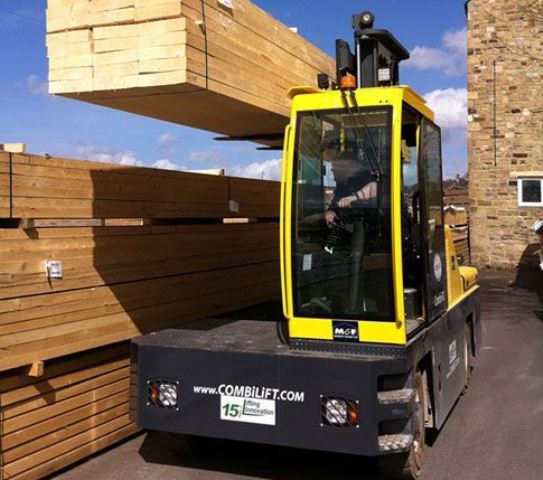
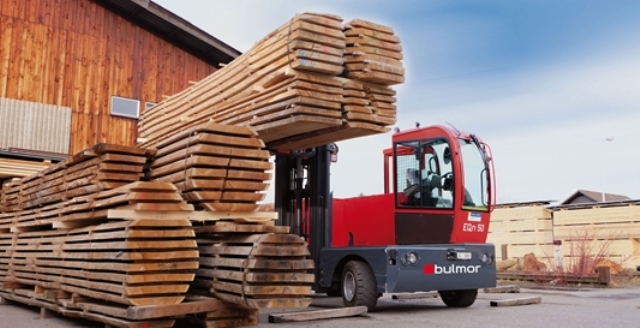
Step forward the Side loader forklift; a mainstay of lumber yards, steelworks, pipe producers, and hundreds of other industries around the globe. The name derives from the design, where the load is carried to the side of the truck on a deck or bed which can be tailored (specified) to suit the loads being handled. The forks of the side loader extend outwards from the center of the deck, like that of a warehouse reach truck, allowing a long load to be lifted at its middle and most stable point, then rested on the deck of the truck as it is driven.

As the load is being securely carried, in effect, sideways, it means the truck can travel through standard doorways, down narrower aisles, and across uneven ground. Moving the load is also far safer for the operator, who might otherwise have to raise a wide load, if using a forklift, to negotiate neighboring obstacles, and risking tipping the truck.

Side loader forklifts have quietly gone about their business for the past 50 years. They’ve dominated European markets, where the combination of practicality, safety, and durability have made them a must-have in lumber merchants where space is at a premium or steelworks where loads can reach up to 100,000 lbs in weight.

Those types of industries have taken to the side loader with gusto, often finding a practical solution where previously there was none. Perhaps somewhat ironically, the spread of side loaders to a wider audience has recently been driven by the success of another type of equipment – the multi-directional machine.

Side Loader Forklift

Combilift Sideloader

These side loader forklift traveling trucks have their origins in the portable truck or trailer mounted piggyback forklift and provide some of the benefits of a side loader. However, in many cases, the trucks are wider, less suitable for long runs or uneven ground, have no in-built deck leveling. Such leveling keeps loads securely horizontal both fronts to back and side to side.

Sideways movement adds lateral stress to both the mast and chassis. Masts have a bespoke profile to provide greater strength, whilst the standard chassis is built to withstand major loads in all directions.

Moving in and out of standard warehouse doorways means side loaders are now used as an in-out truck. Electric side loaders provide engine-like performance and the reduction in noise and exhaust emissions means operator comfort and co-workers’ environments are drastically improved.

The popularity of the side loader is undoubtedly on the rise. Whilst it will always remain a niche product in comparison to pallet handlers, it is also true to say that there are certain businesses that have come to rely on the side loaders ability to store products in cantilever racking or block stack steel or even operate efficiently and quietly in confined built-up areas.
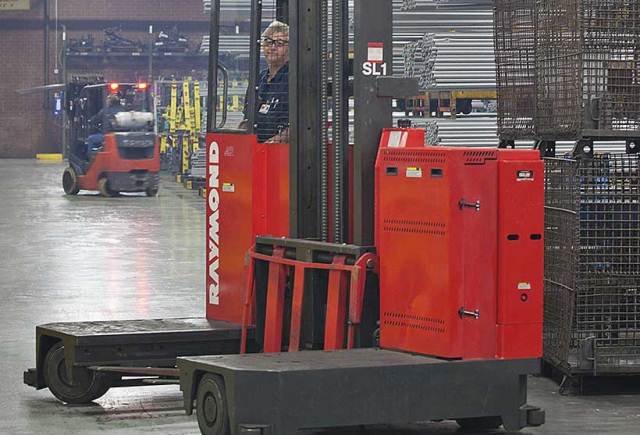
Side loades forklift places a great deal of importance in the longevity and reliability of its products. This too has helped side loaders become an important tool for not just lumber yards and steel mills, but for businesses of all types. Today, energy companies, fabricators, building materials merchants, garbage handlers, insulation, crane and plastic tube manufacturers, amongst a host of others, are some of the latest companies that are experiencing the art of working sideways.

Side Loader Forklift

Side loader forklift manufacturers

Sideloader Suppliers:

To be eligible for Top lift truck suppliers ranking, companies must manufacture and sell lift trucks in at least one of the Industrial Truck Association’s seven truck classes: electric motor rider; electric motor hand trucks; internal combustion engine; pneumatic tire; electric and internal combustion engine tow tractors; and rough terrain lift trucks.

Rankings are based on worldwide revenue from powered industrial trucks during each company’s most recent fiscal year.

  • Raymond Sideloader
  • Toyota side loader
  • Crown side loader forklift
  • Hyster forklift side loader
  • Yale forklift side loader
  • Clark forklift side loader

Where are forklifts used?

A subtype of the warehouse forklift, side loaders are usually found in steel service centers and manufacturing facilities with heavy and bulky items. The operator stands in a sideways compartment and the side loader unloads objects on its side.

Due to its sideways operation, side load forklifts can easily drive up alongside racks and load and unload without having to turn. This makes them suitable for navigating narrow aisles and handling long loads like timber and pipes.
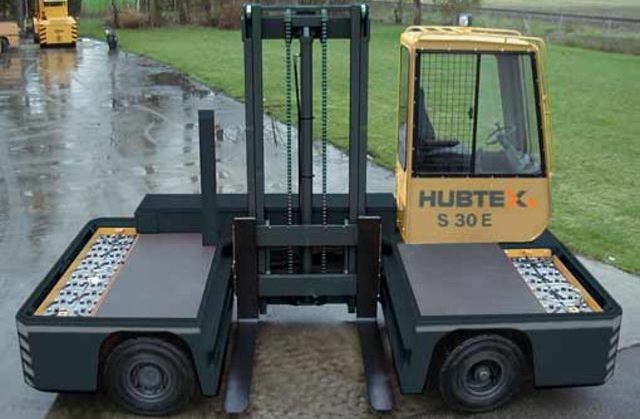
What is a side loader forklift?

What is a side loader forklift?

A side loader does exactly what its title suggests. It loads and unloads from the side of the machine. Instead of the forks being located in front of the equipment like on a standard forklift, a side loader forks are located on its side.

What is a Combilift forklift?

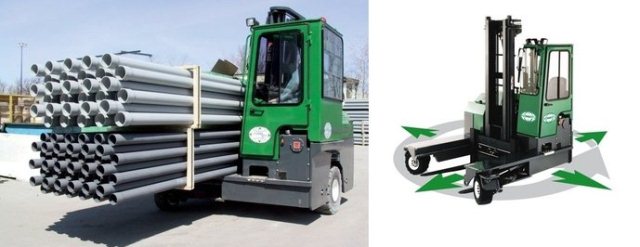
The Combilift Forklifts are the world’s first IC engine-powered all-wheel-drive multi-directional forklifts. Combilift Forklifts use patented, leading-edge 4-way steering technology enabling them to travel sideways with long loads.

What is a side loader forklift?

A narrow-aisle forklift made for lifting very heavy and long items is called a side loader lift truck. They work best for load handling in steel service centers and for manufacturing where long, bulky items are a normal product.

What is the purpose of a side loader forklift?

If you’re in need of a forklift truck that is ideally suited to easily handle wide or long and heavy loads a side loader forklift is purpose-built for these types of tasks.
As their name suggests, side loaders operate by lifting loads from the side. Where regular counterbalance forklifts may become unstable, the side loader fork truck specializes in easily handling long loads such as wood and piping. They are designed to work in narrow aisles and since the load is carried on the side, the driver has a clear view of whats in front and behind them.
There are a variety of different powered fork trucks such as diesel, LPG and even propane fuelled side loader forklifts.

How does a side loader forklift work?

Sideloader fork lifts come in three different variations. The first type of side loader has a large open bay with a mast and fork carriage built to travel perpendicular to the truck as it moves. The forks are extended out to the side of the fork truck allowing it to lift up a load and then retract the load over the large open bay allowing the fork truck to set the load down onto the bay.

More on this story

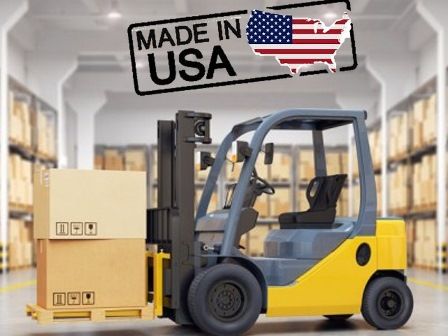
Forklift Manufacturers in USA

Because there are so many forklifts on the market, one of the best ways to start narrowing down your options is to consider the top forklift manufacturers and suppliers.

Forklift Brands

Forklift brands: ranking of manufacturers, world production, makes, and models.

Swing Mast Forklift

Swing Mast Forklift: Maximize storage space with articulated or swing mast forklifts. The innovative design allows these lift trucks to do the work of a standard reach truck in aisles up to 40 inches smaller. These specialty forklifts are ideal for any application, both indoors or outdoors, where space to maneuver is limited.

Articulated & swing mast forklifts can help you get the most out of your warehouse storage space, but there are other ways to optimize your warehouse design to ensure optimal efficiency.

Swing Mast Forklift

Narrow aisle forklift

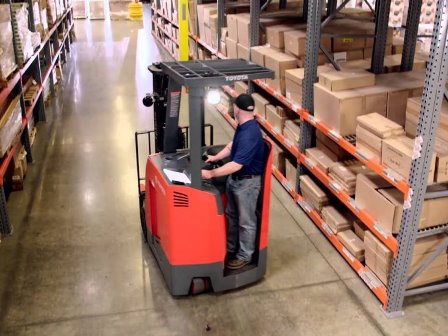
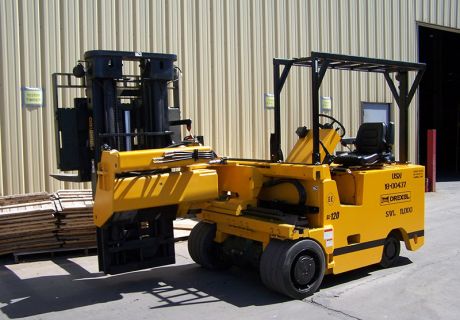
This unit is specially designed for a very narrow aisles operation. Because it will turn sharply to the right (90 degrees) and can use it for your material handling without turning the whole forklift to the rack shelf/mesh direction.

You can simply drive this machine to the aisle (even in the narrow aisle as narrow as 6’/2 meters) and start working with its 90 degrees turn to the right easily. You can also use it for loading and unloading trucks if required. You can drive this machine outside also…but only of good days (no rain or snow ).

Narrow aisle forklift

Very narrow aisle forklift

If your warehouse has building support columns in the aisles, the Narrow Aisle Forklift is much more maneuverable than a turret truck, and additional pallet positions are regained.

New operators will find that it’s easier to learn to operate an articulated forklift than it is to learn to operate more complicated turret forklifts.

This is because narrow forklift requires fewer controls. The Very Narrow Aisle Forklift has the same number of hydraulic controls as most conventional forklifts, and in similar locations as conventional forklifts.

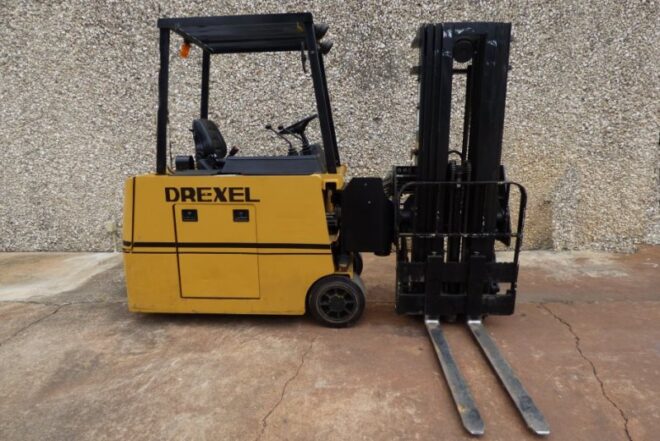
In order to limit the amount of sway in the mast at higher lift heights, turret, Drexel and swing reach trucks typically require much flatter floor tolerances than conventional concrete floors, according to the Design and Construction of Concrete Floors.

These floors are much more expensive as a result. In addition, to flatter floors, most systems require the use of expensive embedded guidance systems and guide rails.

Because the front end of the Flexi pivots, the load remains stable even on rough floors. This eliminates the need for flat floors and the added expense of guidance systems and rails.

Swing Mast Forklift

Articulated forklift truck

Your investment in an articulated forklift will normally be about 50% of the cost of a turret truck. But your savings don’t stop there.

A turret truck “system” often requires very expensive flat floors, wire guidance systems, and/or rails on the floor. This adds substantially to the cost of the basic truck. An articulated forklift truck needs none of this. The cost of the articulated forklift is the cost of the system.

Using an articulated forklift very narrow aisle forklift will typically yield 85% to 90% of the number of pallet positions when compared to turret and swing reach trucks in the same amount of space. But the intersecting aisle required by a turret truck is about twice that of an articulated forklift, so some pallet positions are regained as a result.

Swing Mast Forklift

Swing Mast Forklift

Why Choose Articulating Forklifts Instead of Reach Trucks?

Very narrow aisle forklifts will typically store 15% to 20% more pallet positions than a reach truck can store in the same amount of space. This will significantly lower your cost per pallet position.

Is it easy to learn to drive an articulated forklift?

It’s much easier for a conventional truck operator to learn to operate an articulated forklift than it is to learn to operate a reach truck because the overall truck design and hydraulic levers are the same as conventional forklifts.

Is it expensive to maintain an articulate forklift?

An articulated forklift cost about 20% less to maintain than reach trucks. Most people will agree that maintenance expense is directly proportional to the number of moving parts. An articulated forklift has much fewer moving parts than a reach truck, and the parts are located where they are easier to access on an articulated forklift when service is required. The reach mechanism requires a lot of maintenance.

Is it easy to handle an articulated forklift?

An articulated forklift operator can see the load being handled better than a reach truck operator can see his load. This is because the articulated forklift operator will pick and place loads at a 90° angle to the machine. Visibility from the side is unobstructed when compared to a reach truck operator trying to see through the mast and reach mechanism. In fact, reach truck operators can often be seen leaning outside of the operator’s compartment to get a better view of the forks or the load being handled.

The most read

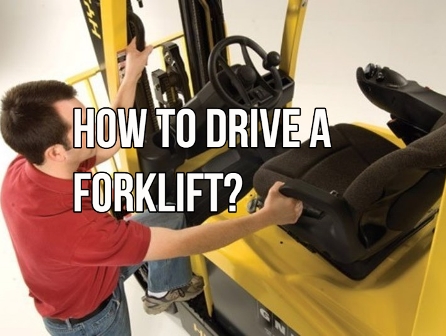
How to drive a Forklift?

Forklift safety is of the utmost importance, and driving a forklift improperly presents various risks to both yourself and others, as well as your surroundings and the things you’re lifting.

More on this story

How to operate a stand-up forklift?

Two main ways of operating a forklift exist. Operating while sitting down, and operating while standing up.