Category Archives: excavating equipment

Amphibious Excavator

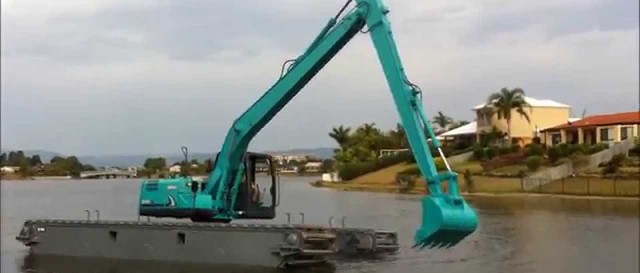
Amphibious Excavator – swamp excavator: Amphibious transporters have been specially designed to work in swamp areas and river deltas. Transporters consist of an undercarriage and an upper structure with a cabin, engine, and platform.

The machine can be custom-made to suit your needs. The structure is also inter-changeable. Transporters are multi-functional and can be used for a wide range of purposes. This includes:

  • Passenger transport
  • Equipment transport e.g. drilling platforms
  • Dumper for ground transport
  • Possible to convert to the amphibious excavator

The undercarriage of transporters is the same as that of amphibious excavators. The transporter has a lot of traction and is able to extract itself from riverbeds, while pontoons have sufficient buoyancy and low ground compression.

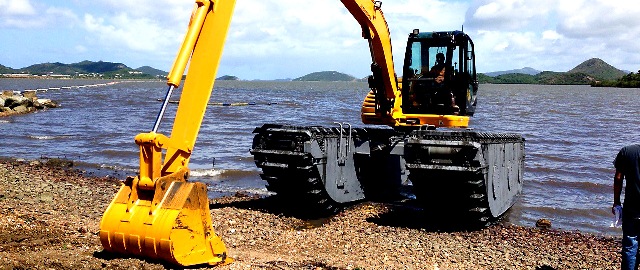
Amphibious Excavator – swamp excavator

Floating excavator

Amphibious excavators are easy to transport. The advantage of excavators with an adjustable undercarriage is that they can be transported in one go. Pontoons can be extended and retracted.

Watering machines weighing more than 15 tonnes are no longer adjustable. This choice was made to reinforce the platforms and pontoons used on heavier machines. After all, they do not need to be retracted.

Despite the fixed undercarriage, transport is more efficient than with adjustable undercarriages. Higher-class adjustable excavators exceed transport dimensions. This means a special permit must be requested, which unnecessarily delays transport and makes it expensive. Amphibious excavators can be assembled and dismantled within one and a half hours.

Machines of 20 tonnes or more are almost always used on large projects. This almost entirely eliminates the advantages of adjustable undercarriages.

Amphibious transporter: The upper structure can be transported separately from the undercarriage. Assembly and disassembly can be realized within an hour. The machine also complies with transport norms when it comes to height, width and length.

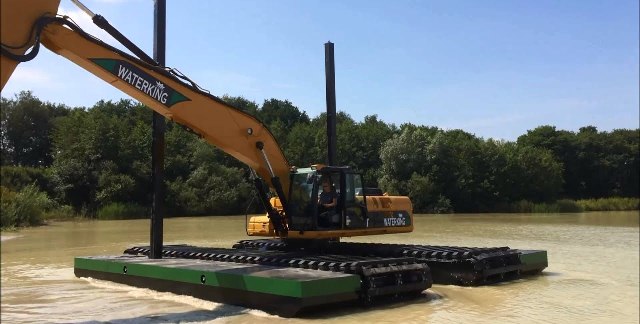
Amphibious Excavator – swamp excavator

Amphibious trackhoe

Industrial applications of amphibious excavators

  • Land clearing and remediation work at mining areas, plantations, and swampy land areas.
  • Deepening and widening of canals and riverways.
  • Building bunds, flood prevention, and land reclamation.
  • Building Walls for Fish and Shrimp Ponds as well as Mining wastewater treatment ponds.
  • Clearing of riverways and water reservoirs.
  • Digging trenches for oil and gas piping installation in water-bogged and swampy environments.
  • Transporting and clearing obstacles at the landslide and earthquake area.
  • Building water irrigation bunds at paddy fields and plantations.
  • Wetland construction.
Amphibious Excavator – swamp excavator

Swamp buggy excavator

Some industrial uses of Amphibious Excavator

Dredging often is focused on maintaining or increasing the depth of navigation channels, anchorages, or berthing areas to ensure the safe passage of boats and ships. Vessels require a certain amount of water in order to float and not touch the bottom.

This water depth continues to increase over time as larger and larger ships are deployed. Since massive ships carry the bulk of the goods imported into the country, dredging plays a vital role in the nation’s economy.

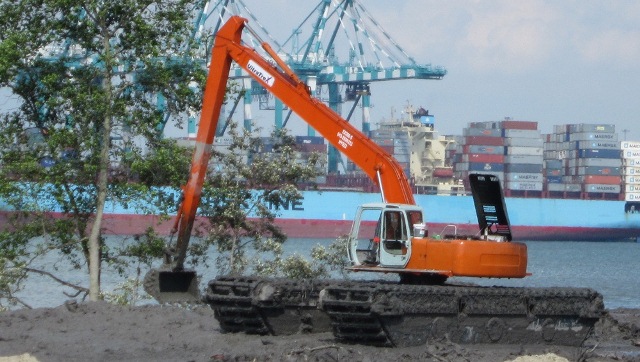
Amphibious Excavator – swamp excavator

Dredging process

Waterways come in different forms and some are just impossible for conventional excavators to work on. Amphibious excavators are specifically designed to take on such harsh environments up to 2-meter water depth.

Amphibious excavators can be equipped with a hydraulic dredging pump that can pump silt from the waterway floor over a long discharge distance of up to 500 meters.

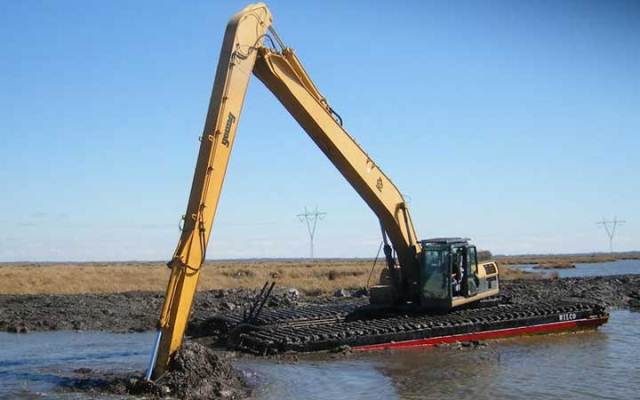
Amphibious Excavator

Deep excavations and tunneling in soft ground

Amphibious excavators are best suited to work in the interiors where soft grounds are often encountered. The excavators are equipped with floats that prevent them from being bogged down in the peat soils. Lumber clearing within soft grounds can be achieved with amphibious excavators.

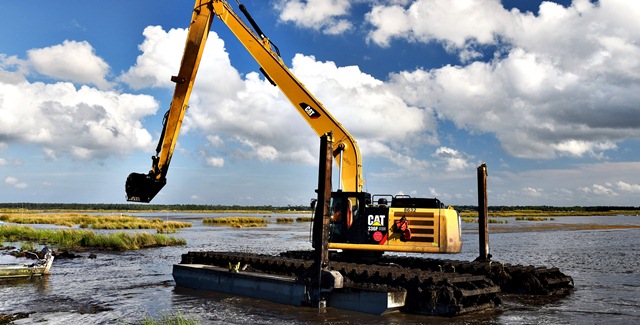
Amphibious Excavator

Shoreline construction

With increasing weather changes and often unpredictable floods, amphibious excavators are often used to build up the shorelines for flood prevention. Levees along the riverways can be easily built using pontoon excavators.

Riverbed deepening

River deltas often require constant de-silting and deepening. Marsh buggies are suitably designed to carry out such river-deepening work. Rivers mouths require scheduled deepening as if they are neglected, flooding happens.

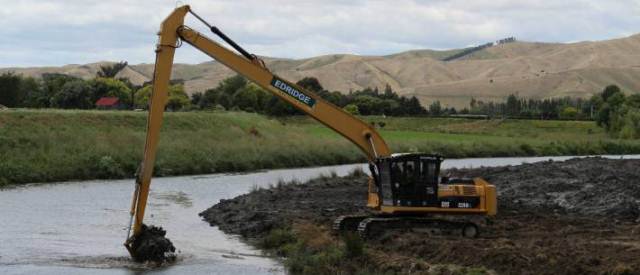
Amphibious Excavator

Landscaping services

Increasingly, swamp excavators are employed for landscaping areas that are near riverways and shorelines. Amphibious excavators have to be used because conventional excavators can easily slip and sink into the soft ground and get immobilized.

Highway construction

Highways do traverse different types of ground conditions. In construction, and where there is a waterlogged and swampy land area, the amphibious excavator can be easily deployed to work on the soft ground. It is also used to dig up tree stumps that if left underground.

Oil exploration

As mankind’s dependency on fossil oil increases, finding more black gold requires the search in remote areas that often required special machines. Amphibious excavators have found use in the transporting of men and equipment into these areas. The benefit of pontoon fixed excavators is that they are very mobile.

Pontoon excavator

Ponton excavator or amphibious excavator is a type of excavator that can perform dredging while afloat in shallow water. An amphibious excavator is better adapted for removing silty clay, clearing silted trenches, swampland operation, and shallow water operation than traditional barge-mounted dredgers.

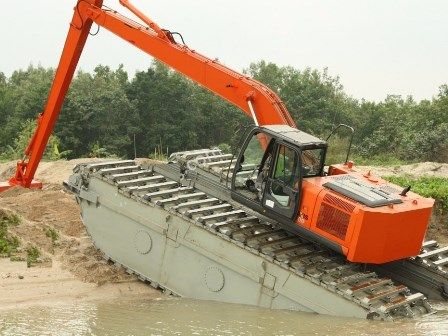
The amphibious excavator can walk or work in water because the chassis crawler floats on sealed pontoons. It may swing or even roll over when excavating with no support underneath. It moves using a dual-body boat from a buoyancy tank.

A reducer drives the crawler chain, allowing free and smooth movement. Its upper structure is a modified excavator that allows 360° full rotation and hydraulic operation.

Amphibious undercarriage

The machines have been developed to operate in poor load-bearing areas. The undercarriage is designed and built to have maximum buoyancy and low ground pressure. The low ground pressure ensures that the surface will have limited damage.

Other than that the amphibious excavator can be built with a new or used upper structure of choice. It is also possible to purchase only the undercarriage (this consists of two pontoons and a mounting frame).

All machines are durable, safe, and have proven reliability. The amphibious excavators are efficient and they have strong construction. The undercarriage is made of Cor-Ten steel and the bottom plates and wears strips are made of Hardox. Critical parts of the machine are protected to make sure they can’t get damaged by the use of the machine.

The upper structure is placed at the center of the machine. This has the advantage that the machine has a working range of 360 degrees and that the machine can be customized and equipped with extra options such as an extra fuel tank. Equipped with heavy-duty travel motors the undercarriage has a high tractive force.

Amphibious excavators can be used on land as well as on water. This means it is possible to easily cross swamps, moats, lakes, and other waterways.

Pontoon mounted excavator

The amphibious excavators can be equipped with additional pontoons. The pontoons provide extra stability and buoyancy for the amphibious excavator. By adding pontoons to the machine it is possible to work in water with a depth between 4-6 meters.

The additional pontoons are built to fit the model of the undercarriage of choice. The pontoons are extra long, high, and wide for extra buoyancy.

The spud poles measure 20 x 20 – 30 x 30 cm and because of their strong robust appearance, the spud poles make sure that the machine is stable and can use more force while working. The spud poles are designed to go through the pontoon instead of being mounted on the back. This makes the entire structure of the machine and the pontoons stronger.

The pontoons are built with integrated steps to have easy access to the cabin. The steps and deck of the additional pontoons are covered with an anti-skid surface. The coupling system is easy to use and due to several locks

What is a hydraulic excavator?

what is the difference between an excavator and an amphibious excavator?

Excavators are heavyweight construction equipment whose house is outfitted with a cab, a boom, a dipper, and a bucket. The house is a rotating platform that rests upon an undercarriage with a track system.

An operator controls the apparatus from the cab. A boom is connected to the house and has a stick attached to the end known as a dipper, providing adequate digging force to pull the bucket through the earth. Buckets come in a host of sizes and shapes to perform a variety of functions.

Many other attachments are available to be used with the excavator employed in various applications, such as cutting, crushing, or boring, for example.

Hydraulic dredging equipment

Amphibious excavators are a type of excavator designed to be used for dredging in shallow water. They are better equipped with their pontoon undercarriages for operation in swamp/wetlands operations that traditional barge-mounted dredgers are ill-equipped to handle. Barge-mounted dredgers are better suited for deeper fresh waterways.

Amphibious excavators are engineered to have the most stable undercarriages constructed from the most reliable, state-of-the-art components available. Each undercarriage is fabricated to the specifications of the attached equipment to supply the lowest ground pressure, the best maneuverability, and the highest degree of buoyancy possible.

Amphibious Excavator

What is dredging?

Dredging is the removal of sediments and debris from the bottom of lakes, rivers, harbors, and other water bodies. It is a routine necessity in waterways around the world because sedimentation—the natural process of sand and silt washing downstream—gradually fills channels and harbors.

What are the benefits of dredging?

The advantages of dredging are: Widening and Deepening: Dredging can be a critical process for the commercial shipping industry. Removing sediment can maintain the appropriate width and depth for enabling the safe, unobstructed passage of cargo vessels carrying oil, raw materials, and other essential commodities.

How is dredging harmful?

Sediment can smother seagrasses, which are the key food source of dugongs and sea turtles, and damage corals. Some activists want dredging to be banned completely, blaming it for releasing toxic chemicals, increasing water turbidity, and littering harmful metals throughout the food chain.

Why dredging is needed at the port?

In the shipping industry, dredging is generally carried out to increase the channel or port depth for ensuring proper bottom clearance, to improve navigation, and sometimes also for reclamation purposes (to reclaim material and use it later on land or in port development).

The most read

More on this story

Swamp Buggy Excavator

Amphibious Excavators are hard to find, if you are a contractor, you may be wondering why you should consider buying a swamp buggy excavator.
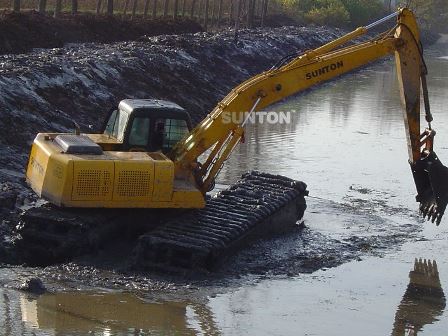
Floating Excavator

A floating excavator also called a swamp buggy, or amphibious excavator is an excavator equipped with a sealed floating pontoon.
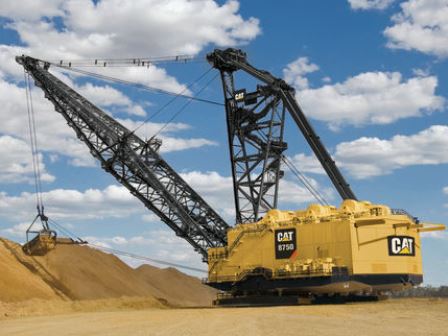
What is a Dragline in Mining?

Draglines are an expensive and essential part of open-cut coal mining.
Excavating Contractors

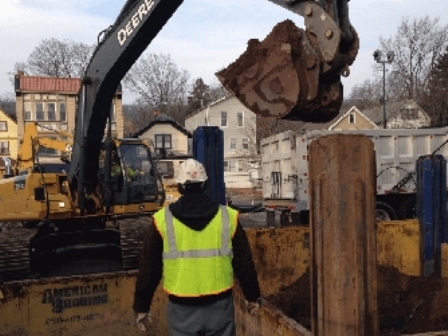
Well before a building or any structure is erected, excavating contractor is hard at work. But what is the role of an excavating contractor, exactly?
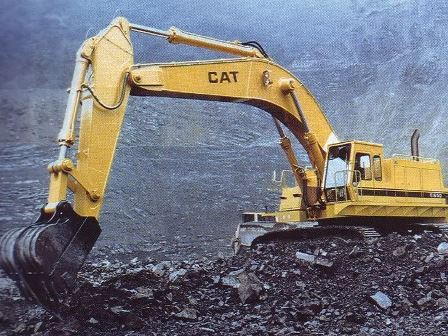
Hydraulic Excavator – how it works?

Essential in the mining sector, over time they incorporated hydraulics, automation, electronics, information technology, etc. Developed for engineering and heavy-duty.

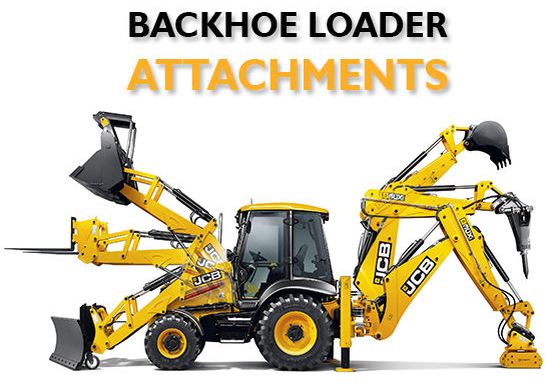
Backhoe Loader Attachments

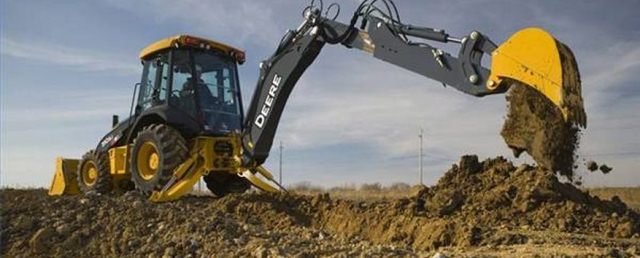
The backhoe is the main tool of the backhoe loader. It’s used to dig up hard, compact material, usually earth, or to lift heavy loads, such as a sewer box. It can lift this material and drop it in a pile to the side of the hole. Basically, the backhoe is a big, extremely powerful version of your arm or finger. It has three segments:

  • The boom
  • The stick
  • The bucket

Backhoe loaders are fantastic general-purpose tools, and nothing increases their utility like backhoe attachments and accessories.

For one thing, they have a reputation for being among the best designed and engineered in the industry, which is a real boon to construction, industry, and agriculture entities who want superior equipment but also to keep a lid on costs.

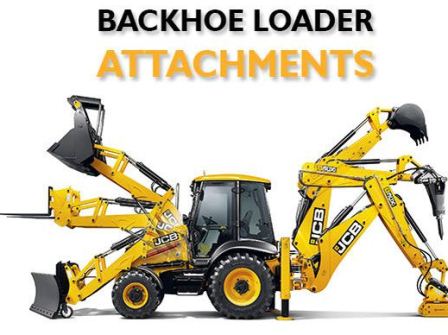
  • Backhoe compaction wheel
  • Hydraulic hammer for backhoe
  • Backhoe bucket forks
  • Backhoe bucket log splitter
  • Hydraulic thumb for backhoe
  • Backhoe bucket cutting edge
  • Backhoe grapple bucket
Backhoe Bucket Attachments

Backhoe attachments

If you were to buy a separate piece of backhoe for each task, you’d be in debt. Fortunately, a good backhoe is incredibly versatile, with dozens of accessories available to handle virtually any project need.

One of the most popular is an attachment that costs only a fraction of the price of a mini excavator.

A backhoe attachment turns your equipment into a mini excavator capable of a variety of tasks, depending on the capabilities of both your loader and the attachment you choose.

Dig basements, drainage ditches, footings, pipe trenches, and more, using nothing but your track loader and a backhoe attachment. You can even add more oomph to your rig with a hydraulically powered attachment, further increasing your digging capabilities.

Backhoe compaction wheel

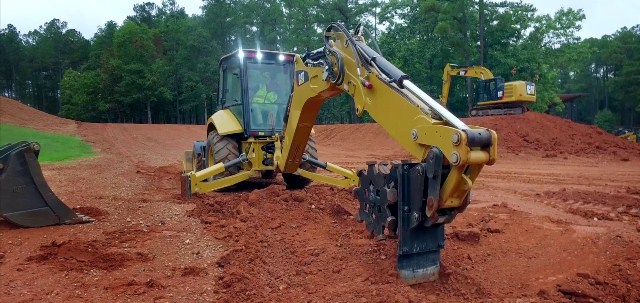
One of the useful backhoe bucket accessories: Compaction while backfilling trenches; compaction wheels are designed to compact the soil when backfilling trenches. They come in a variety of widths and feature tapered roller bearings.

A tampered-foot design with static pad rollers provides smooth operation and a high degree of compaction. The open rim allows the wheel to penetrate the trench fill and compact the soil from the bottom up. The compaction wheels are available for all Cat backhoe loaders, as well as all Cat compact excavators.

Backhoe Bucket Attachments

Hydraulic hammer for backhoe

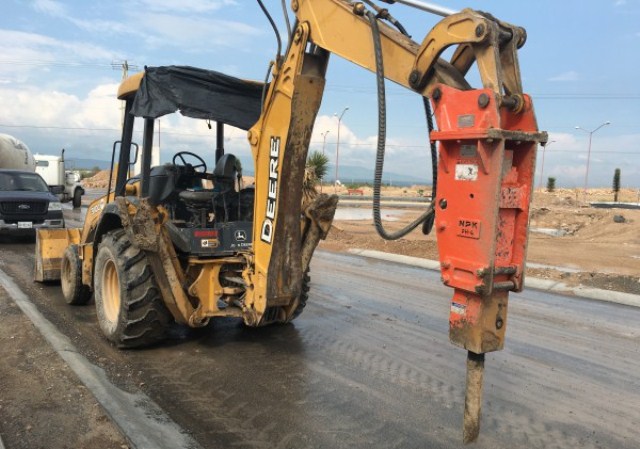
Construction Equipment’s hydraulic hammers have only two moving parts and isolate every blow from the operator and carrier.

The hammers are pre-assembled and made for backhoes, excavators, compact tractor loaders, and skid steers. The blows are isolated in the cushion chamber, and recoil energy is recycled and used for the next blow.

The long-stoke piston facilitates energy transfer and recoil reduction. Hydraulic hammers come with a gas recharge kit and a three-year warranty.

Backhoe Bucket Attachments

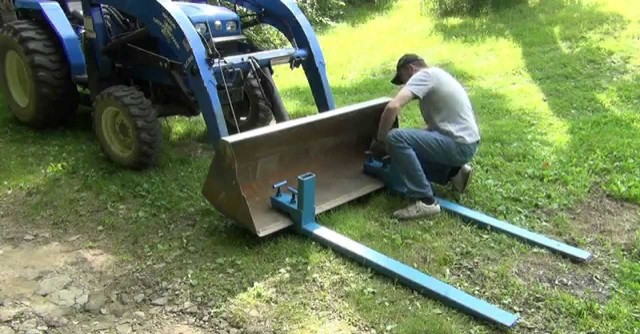
Backhoe bucket forks

Bucket forks allow bucket-mounted loaders to quickly provide the lifting capabilities of a forklift or pallet forks without the need to switch machines or attachments.

All forks are made of a premium steel blend and subjected to a full heat-treatment process. This extends the life of the fork by reducing damage from impact and stress, especially in cooler climates.

Features:

  • Attaches in seconds without tools
  • Adjustable fork spacing for different load sizes
  • Extra mounting brackets available for additional machines
  • Made from a high strength boron-carbon steel
  • Fully heat-treated to better absorb impact
  • Kit includes forks, shaft bar, and mounting hooks
  • Custom modifications available upon request
Backhoe Bucket Attachments

Backhoe bucket log splitter

A log splitting attachment tool adapted for use in combination with a material moving machine having a boom and dipper stick for lifting and moving as well as splitting logs which tool can alternatively be secured directly to a dipper stick and hydraulic bucket cylinder or to a quick connect mechanism secured thereto.

What is the ‘psi’ of the wood splitter?

The answer may surprise you: The SideTool Wood Splitter is not a hydraulic attachment –it is mechanical. It relies on the existing hydraulics of the excavator.

A more accurate gauge to estimate the force and efficiency is not “psi” but rather gallons/minute of hydraulic flow or “GPM” of the machine (excavator or backhoe).

The larger your excavator, the higher the GPM (in most cases), and hence – the greater efficiency and force in splitting wood.

Backhoe Bucket Attachments

Hydraulic thumb for backhoe

The easiest and fastest way to get more capability from your excavator is to install a Hydraulic Thumb. With a Hydraulic Thumb, your excavator goes from digging to complete material handling.

A Hydraulic Thumb makes it easier to pick, hold and move awkward material such as rocks, concrete, branches, and debris that does not fit into the bucket.

hydraulic thumbs are specifically designed to match your bucket tip radius and tooth spacing – accommodating your exact picking and sorting needs for almost any job. Available in hydraulic or stiff link models, pin mounted or under stick mounted.

Backhoe Bucket Attachments

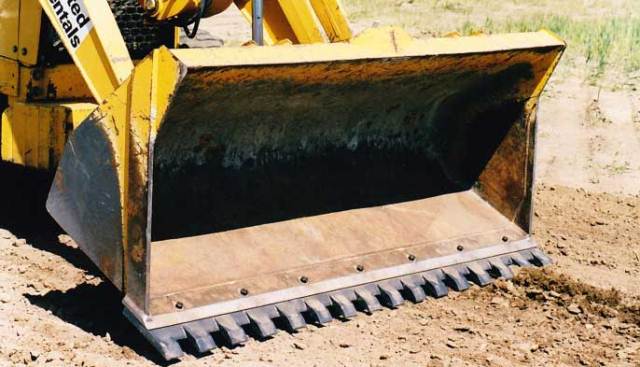
Backhoe bucket cutting edge

Excavator buckets can fail due to corrosion or due to heavy usage that literally wears away the steel or breaks the welds. Weld-on edges make installation of bolt-on cutting edges easy. Weld-on cutting edges come with pre-punched bolt holes for easy installation.
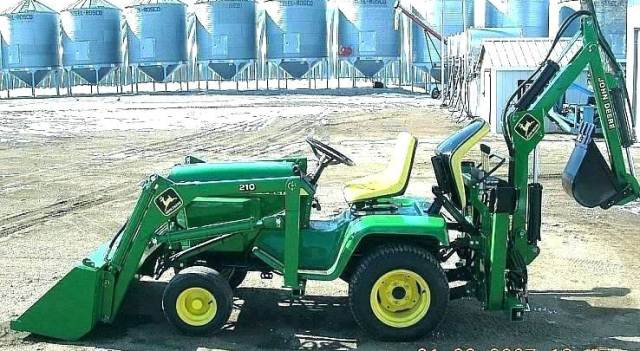
Bolt-on edges are reversible for prolonged use and are very easy to install, edges are available as a bolt-on or weld-on style. Bolt-on edge systems let you quickly change edges on the fly and also extend the life of the bucket base edge and corners. Bolt-on edges can be reversed for extended wear life.

Edges for excavators and backhoes are designed specifically for the demands of heavy equipment use and abuse. They are available in various lengths and thicknesses.

Backhoe Bucket Attachments

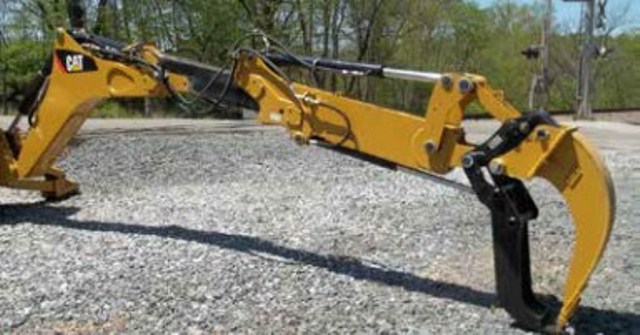
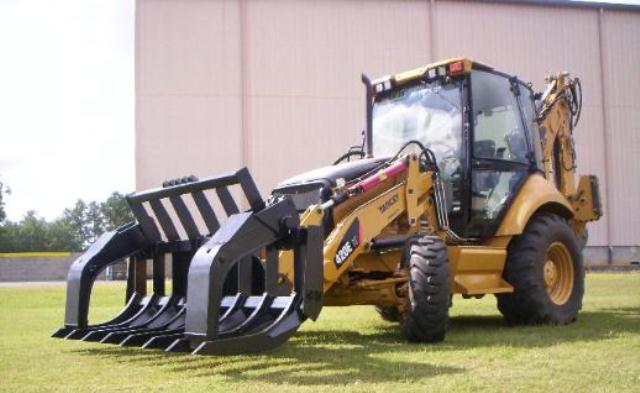
Backhoe grapple bucket

The industrial-grade grapple rake is designed for extreme duty applications. Featuring completely enclosed grapple assemblies, heavy-duty welded end cylinders. Aggressive design with long curved teeth for getting under and lifting debris.

Protected supply hoses with nylon kevlar wrap, heavy-duty construction for years of abuse.

Also available with a shear bar attached to the teeth for use in storm debris clean up. All of the products are made from high-grade alloy steel, making them very durable. This style grapple rake is available for most any type of industrial equipment front end loaders, loader backhoes, Etc.

Backhoe Bucket Attachments

Aftermarket backhoe attachments

Whether you’re looking to dig, drill, or lift heavy loads, choosing the right work tool comes down to knowing which one will get the most benefits for the different tasks you’ve scheduled.

Several things to consider are the type of job site, the size of the attachment, the toughest ground conditions you are operating in, and the make of your backhoe. You should check with your supplier which accessories you will get after-sales.

Backhoe bucket attachment manufacturers:

  • Case backhoe attachments
  • John Deere backhoe attachments
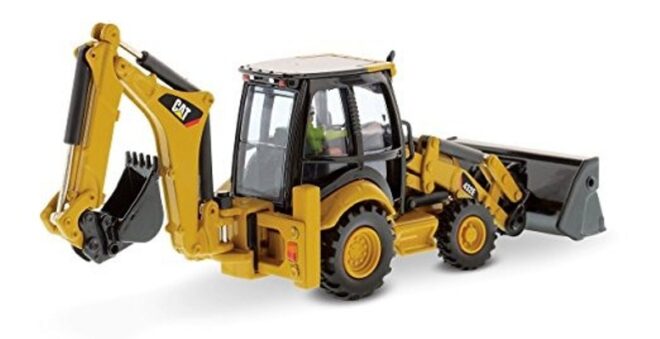
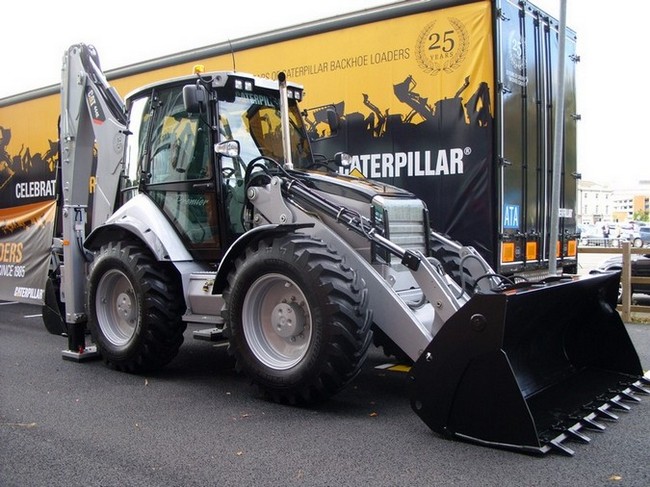
  • CAT backhoe attachments
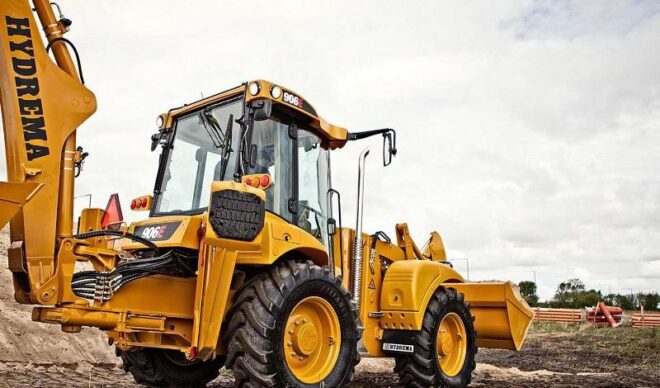
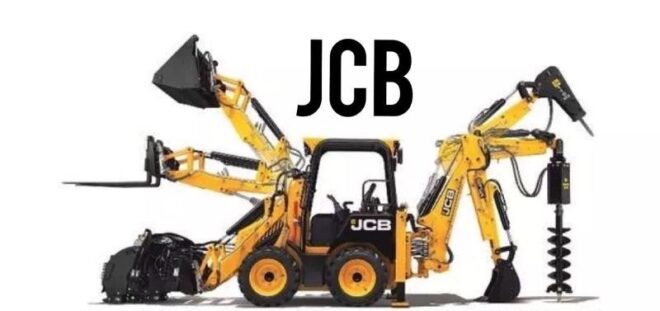
  • JCB backhoe attachments
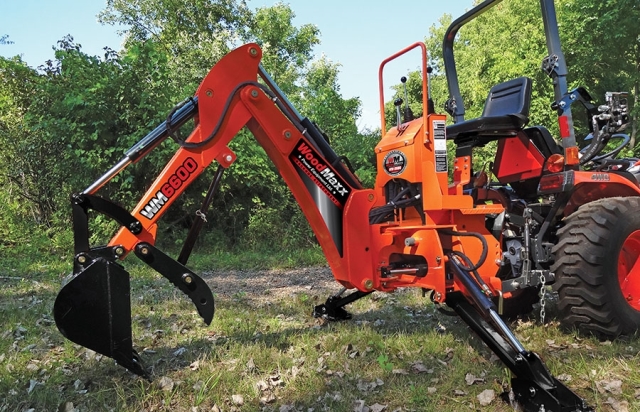
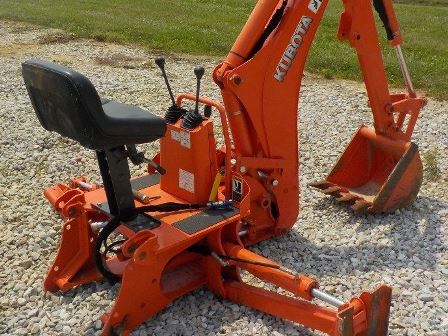
  • Kubota backhoe attachments

Bucket attachment for backhoe

Enhance the performance of Backhoes with buckets designed specifically to meet needs in the construction market. Backhoe Front Buckets match specific job requirements for capacity and functionality.

General-purpose buckets for backhoe loaders are the all-around choice for loading, carrying, dumping, and performing general clean-up work; including side dump buckets that can tip forward or to the left side and provide the versatility required in tight work areas and congested environments.

what is the best attachments for a backhoe?

Starting off, you should look at your project scope and understand what functionality you want the backhoe and its attachment to have. With over 30 types of attachments, knowing which type is best for your backhoe hire job is crucial to making your project both time and cost-efficient.

How deep will a backhoe dig?

One of the most significant variables in backhoe performance is to dig depth. This is simply a rating of how deep the backhoe arm can dig. Typically, dig depth is somewhere between 12 and 16 feet (3 to 5 m). Many backhoes have an extendible stick that lets them increase this dig depth a few feet when needed.

How much does it cost to rent a backhoe for a day?

Renting a backhoe for do-it-yourself use typically costs $100-$200 for half-day or full-day rental of a small or mini-backhoe; larger models typically rent for $200-$350 or more a day or $500-$1,500 or more for a week.

How much is a used backhoe worth?

A 10-year-old John Deere in average condition with 2,000 to 3,000 hours of use might sell for $25,000 to $35,000.

Do I need a license to rent a backhoe?

While backhoe operators don’t need certification, they need to obtain a commercial driver’s license (CDL) in order to drive their backhoes from site to site. Each state has its own requirement for granting licensure.

What is the hourly rate for a backhoe operator?

The average hourly rate for Heavy Equipment operators ranges from $25 to $34 with an average hourly pay of $30. The total hourly cash compensation, which includes a base and short-term incentives, can vary anywhere from $26 to $36 with the average total hourly cash compensation of $32.

The most read

Backhoe Loader Specifications

A backhoe is a type of excavating equipment, or digger, consisting of a digging bucket on the end of a two-part articulated arm

Garden Tractor Backhoe

The loaders and backhoes illustrated here are the perfect tools for the care and maintenance of your property and landscaping.

More on this story

General purpose Bucket attachment for backhoe

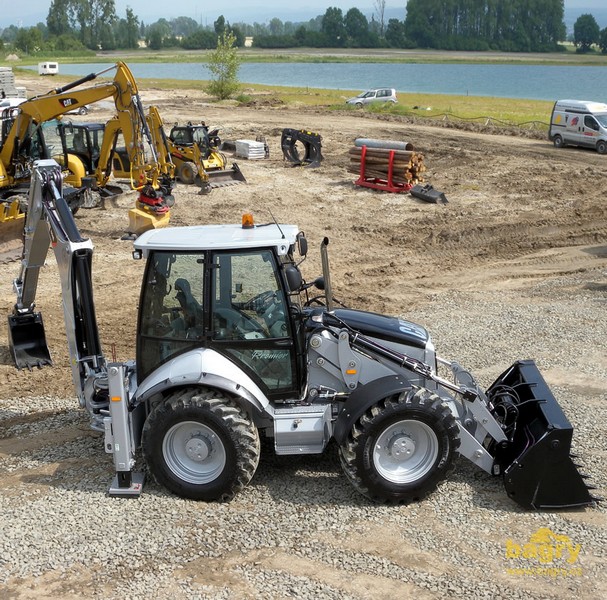
This machine consists of four main parts: the cab, the tractor, the backhoe, and the front loader or general-purpose bucket.

Aftermarket Backhoe Attachments

Aftermarket parts for backhoe loaders are also referred to as non-original equipment manufacturer parts, generic parts, or competitive replacement parts.

What is a backhoe?

What is a backhoe? In cranes and machinery, we analyze some of the characteristics that define the best backhoe loaders in the current construction industry. This machine has been the superstar of construction equipment and the material handling industry for a long time. Have you ever thought about what makes the backhoe so popular? It’s your versatility!

What is a backhoe?

What is the difference between a backhoe and an excavator?

Backhoes are much smaller than excavators and are a standard tractor that supports an arm consisting of two segments, the dipper, and the boom. The boom further supports the dipper, which holds the bucket. Knowing the differences between an excavator and a backhoe will let you choose the right equipment for your project.

Function of backhoe

In a time when equipment manufacturers design machines to perform as many jobs as possible or try to follow the Swiss-army-knife approach, backhoes with their versatility are winning hearts.

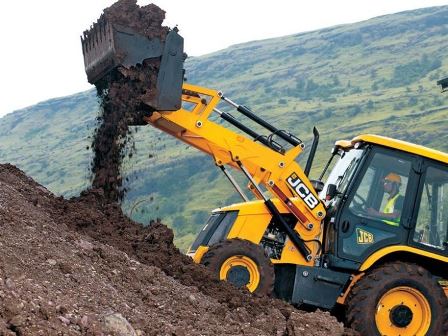
The machine is both a dedicated excavation unit, as well as a front-loading tool. Whether on construction sites, road works, or places where earthmoving is required, backhoes can be seen everywhere.

Most backhoes have quick-connect mounting systems and auxiliary hydraulic circuits for simplified connection assembly, which increases the use of the machine in the workplace.

Backhoe crane attachment

Let’s look at what it takes to be the best backhoe in the world.

Powerful mechanics: a powerful diesel engine in the heart and an incredible hydraulic system define the best of backhoes.

The diesel engine generates power while the hydraulics amplifies it. The power of the diesel engine and the capacity of the hydraulic systems differ from one variant to another.

Savings in fuel consumption: In addition, for a backhoe loader as the best in its class, the main requirement is fuel efficiency. Here, it deserves a mention; offers the best fuel efficiency in its class.

Low maintenance cost: when you identify the best backhoe, it is also important to consider the cost of maintenance. The lower the cost, the better it is and this is very possible with the modern machines of the segment.

With better technology and design improvements, modern machines are very capable of reducing the overall cost of maintenance. Therefore, you can have peace of mind while this excellent machine does its job.

With improvements in technology and design, they have been able to reduce lubricant filling requirements with extended service intervals, which reduces overall maintenance costs.

All this plus a guarantee of limited duration, so that one can enjoy the tranquility.

What is a backhoe good for?

Backhoe machine

Productivity and performance: it is another criterion to judge the productivity of the machine. Here, it must be taken into account that it comes with more range, a robust and reputable gear pump, and have the maximum depth of excavation and discharge height of the loader.

Intelligence matters: apart from strong mechanics, the intelligence of the machine must also be considered. Therefore, if a backhoe comes with remote monitoring functions that allow you to obtain a daily work report, fuel level warning, and maintenance warning via SMS, then there is nothing like that.

Backhoe driving

Effortless operations with the joystick: since fast and effortless operations are the need of the hour, this function also becomes very important. Usually, a joystick is used to maneuver this complex system to make heavy work seem much easier and effortless than it really is. A joystick allows precise and smooth power control.

Highly connected: not only must the equipment be excellent, but it must also communicate effectively. If any backhoe meets this requirement, then it must be considered the best in its class. Today, highly advanced backhoe loaders come with a radio with a two-way speaker system that facilitates communication with the operator and, through it, with people in the place. It becomes effective and useful in congested sites and large sites without a mobile network.

Very convenient and comfortable: last, but not least, comfort also matters. Backhoes should be such that they are easy to use and operate. It is believed that the most important part of the machine is the person who operates it. That is why you must do a lot of work, that your experience is the most comfortable. Design and ergonomic seats that make all controls smooth and easy to reach, advanced mechanical control levers, 21st-century style with luxurious interiors, personal storage space, and an easy-access toolbox.

Backhoe models

Comparison of models: When comparing the backhoe loaders manufacturers and the various models available, you will find two main types, the centrally mounted backhoe loaders, and the side-scroller backhoe loaders. While both offer comparable levels of overall performance, differences can be found in the degrees of maneuverability and stability they provide.

Backhoe Loader

Backhoes of the central assembly

Often this type of loader is known as a center pivot backhoe, it has the backhoe mounted in the center of its rear frame. Its gull legs rotate downwards and provide stabilization. In addition, this design provides a wider posture and more ground clearance, making it ideal for sloping terrain and heavy loads.

What is a backhoe? Side-scroller backhoes

This type of backhoe is mounted on rack rails and outriggers that allow the operator to change the work or materials from one side of the loader to the other, greatly saving the time it would take to reposition the platform. Ideal for narrow aisles or work situations where the machine is located near buildings or other immobile objects, the side-scrolling backhoes achieve the perfect balance between precision and productivity.

Backhoe brands

Here is the list of the best brands of backhoes.

  • Caterpillar
  • Volvo
  • JCB
  • Komatsu
  • Liebherr
  • CASE
  • John Deere
  • Terex
  • Hitachi
  • Hyundai

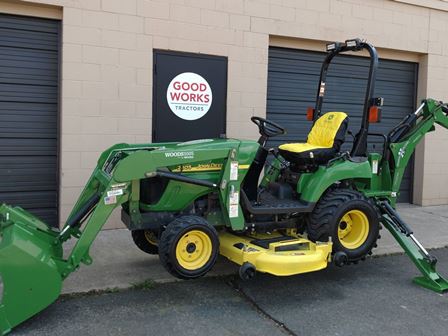
Tractor with loader and backhoe

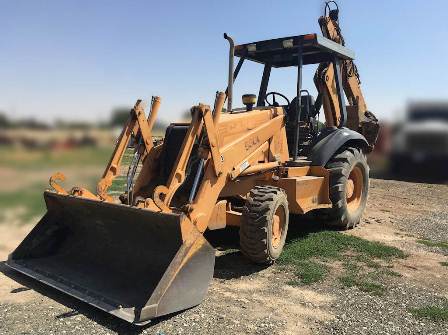
Backhoe loaders have a very unique appearance, they have components sticking out every which way. It’s obvious what a dump truck does just by looking at it; but what are the different appendages of a backhoe used for?

A backhoe loader is an interesting invention because it is actually three pieces of construction equipment combined into one unit. A backhoe loader is:

  • A tractor backhoe
  • A loader
  • A backhoe

Each piece of equipment is suited to a particular sort of work. On a typical construction site, the backhoe operator usually uses all three components to get the job done.

This content is not compatible with this device.

Tractor backhoe

The core structure of a backhoe loader is the tractor. Just like the tractors that farmers use in their fields, the backhoe tractor is designed to move easily over all kinds of rough terrain.

It has a powerful, turbocharged diesel engine, large, rugged tires, and a cab with basic steering controls (a steering wheel, brakes, etc.). Backhoe cabs are either completely enclosed or have an open canopy structure to give the operator protection.

The Loader

The loader is attached in the front and the backhoe is attached in the back. These two components serve very different functions.

The loader can do several different things. In many applications, you use it like a big, powerful dustpan or coffee scoop. You usually don’t dig with it; you mostly use it to pick up and carry large amounts of loose material. It’s also used to smooth things over like a butter knife, or to push dirt like a plow; the operator controls the loader while driving the tractor.

The Backhoe

The backhoe is the main tool of the backhoe loader. It’s used to dig up hard, compact material, usually earth, or to lift heavy loads, such as a sewer box. It can lift this material and drop it in a pile to the side of the hole.

Basically, the backhoe is a big, extremely powerful version of your arm or finger.

Backhoe or excavator

Do you need a license to operate a backhoe?

Applicants are typically expected to have a license to operate a motor vehicle, and some require that students have a high school diploma. A driver’s license will be required to assist in the transport of backhoes and other large equipment between work sites.

What does an excavator do?

Excavator shovel is a self-propelled machine, on tires or tracks, with a structure capable of rotating at least 360º (in one direction and in another, and uninterrupted) that excavates land, or load, lift, rotate and unload materials by the action of the spoon. The cab sits on top of the chassis or body. They are a natural progression of steam shovels and are often referred to as electric shovels.

Why is it called a backhoe?

The term backhoe is used to describe a piece of excavating equipment that consists of a digging bucket fixed to the end of an articulated arm. However, the location of the bucket is not why they are referred to as backhoes. The name is derived from the motion of the digging bucket.

What function does the backhoe perform?

A backhoe is a machine that is used to perform excavations on land, it performs its job by burying a spoon or shovel with which it removes soil or materials deposited in the ground, then drags them and deposits them inside.

How much does a backhoe cost?

CAT Backhoe Loader Average Costs. There are four basic models of CAT backhoe loaders. They begin in price at about $85,000 and range upwards of $150,000. The smallest model, the CAT 416E with 74 horsepower and 14.3 feet of dig depth capability, starts at $84,660.

The most read

Backhoe Loader Specifications

A backhoe is a type of excavating equipment, or digger, consisting of a digging bucket on the end of a two-part articulated arm.

More on this story

Backhoe Bucket Attachment

The backhoe is the main tool of the backhoe loader. It’s used to dig up hard, compact material, usually earth, or to lift heavy loads, such as a sewer box.

CAT 416 Backhoe Specs

CAT backhoes – CAT 416 Backhoe Specs: ingenious, productive, original, durable

For excavation, trenching, filling and material handling capacity, the Caterpillar line of backhoe loaders is certainly strong in those aspects.

CAT backhoe

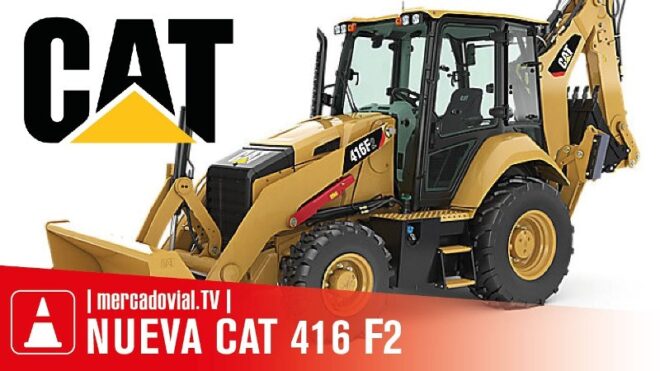
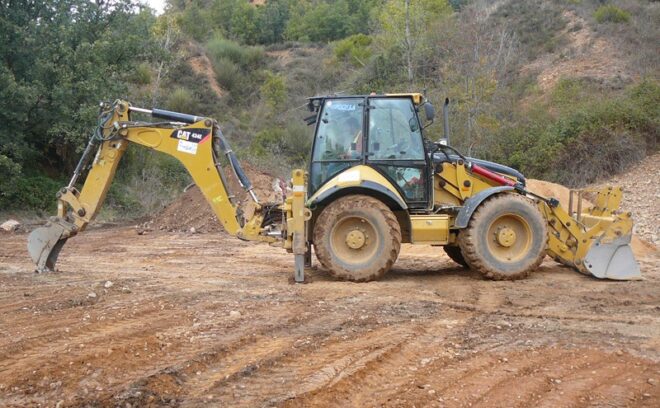
To illustrate this, the series of Cat F2 backhoes are very ingenious and spacious. The five models of the line join the other Cat backhoe loaders available, the 416E and the 450F of 127 hp, with an excavation depth of 17 feet.

With two engine offers and a range of power levels, the F2 Cat features a powerful hydraulic system and lifting performance.

You can also add a hydromechanical tool with auxiliary lines of combined function or a hydraulic thumb to increase the functionality of the machine.

CAT 416 Backhoe Specs

Caterpillar backhoe models

Each model of the F2 series (415F2, 415F2 IL, 414F2, 416F2, 420F2 and 430F2) has a completely redesigned cab that offers better visibility, better cooling, larger seating area, and ample storage space.

In addition, the seal against the elements and an improved safety keyboard immobilizer have been improved on board.

Operators receive both the space to move and a clear field of vision while they work. The coupler of the double-locking backhoe in the F2 is another key benefit.

With this advanced machine, the operator does not need to leave the cab to install a locking bar or pins when connecting the buckets to the hydraulic coupler.

In addition, the secondary locking system is automatically activated when a tool is attached.

The secure grip of the coupler in each working tool helps reduce the costs of ownership and operation.

Retro Caterpillar

  • The hydraulic load sensing system in the Cat backhoe line maintains maximum power and precision operation in its Standard and Economy modes.
  • The improved hydraulic system provides more power faster, along with a faster hydraulic output, even at low engine speeds.
  • The line runs at the right speed for the given application.
  • The variable flow system deftly adapts the pressure and flow of the pump to the demands of each job, unlike the fixed displacement pump systems in some backhoes that pump oil constantly, wasting large amounts of fuel.
CAT 416 Backhoe Specs

Caterpillar products

Will backhoes still be popular?

Many contractors have started using more specialized machines such as mini excavators and skid steer loaders for jobs that used to belong to backhoes.

Although it is still a general-purpose tool, the important question seems to be:

Will backhoes continue to play an important role in most construction projects?

Construction contractors firmly believe that they will. “There are two things that a backhoe really has in its favor”,

  • “First, the ability to drive to the workplace eliminates the need for a truck or trailer to transport it, which makes it perfect for owner-operators who provide services in the local community.”
  • “Second, the versatility that backhoe offers is still hard to match.”

“You can achieve almost everything required by most work sites. An excavator can dig a trench a little faster than a backhoe, but the loader bucket will dig in the basement much faster and load the trucks in the process.

As they are also compact, they can lead to small worksites that can be difficult for other vehicles.

Then, the forks of the backhoe can handle palletized loads in a few minutes. “

Heavy machinery caterpillar

  • Cat equipment sets the standard for our industry.
  • The Cat product line of more than 300 machines reflects an increased focus on customer success.
  • is the leader in helping its clients, to satisfy their needs with durable and reliable equipment.
  • Caterpillar has the best distribution and product support system in any capital goods industry.

Expansion in developing markets

Caterpillar built its first Russian facility in the town of Tosno, located near St. Petersburg, Russia. It was completed in 16 months, occupied in November 1999, and began fabricating machine components in 2000. It had the first electrical substation built in the Leningrad Oblast since the Communist government was dissolved on December 26, 1991. The facility was built under harsh winter conditions, where the temperature was below −13 °F (−25 °C). The facility construction was managed by the Lemminkäinen Group located in Helsinki, Finland.

The $125M Caterpillar Suzhou, People’s Republic of China facility, manufactures medium wheel loaders and motor graders, primarily for the Asian market. The first machine was scheduled for production in March 2009. URS Ausino, in San Francisco, California, manages facility construction.

Caterpillar has manufactured in Brazil since 1960. In 2010 the company announced plans to further expand production of a backhoe and small wheel loaders with a new factory.

What is a backhoe?

If you were to ask a large group of people what they could tell you about backhoe loaders, a lot of them wou­lddon’t know what you were talking about. We’ve all seen backhoe loaders, commonly called backhoes.

They are used for a number of different jobs and are often the only piece of heavy equipment at a construction site. We pass them on the side of the road all the time. But even somebody who has passed by dozens of backhoes may not know that much about them.

What exactly do they do?
Why are they used for so many different sorts of construction projects?
How can they dig such big holes in such a short amount of time?
How strong are they?

Each piece of equipment is suited to a particular sort of work. On a typical construction site, the backhoe operator usually uses all three components to get the job done.

Backhoe parts

The Tractor

The core structure of a backhoe loader is the tractor. Just like the tractors that farmers use in their fields, the backhoe tractor is designed to move easily over all kinds of rough terrain.

It has a powerful, turbocharged diesel engine, large, rugged tires and a cab with basic steering controls (a steering wheel, brakes, etc.). Backhoe cabs are either completely enclosed or have an open canopy structure to give the operator protection.

The Loader

The loader is attached in the front and the backhoe is attached in the back. These two components serve very different functions. The loader can do several different things. In many applications, you use it like a big, powerful dustpan or coffee scoop.

You usually don’t dig with it; you mostly use it to pick up and carry large amounts of loose material. It’s also used to smooth things over like a butter knife, or to push dirt like a plow. The operator controls the loader while driving the tractor.

The Backhoe

The backhoe is the main tool of the backhoe loader. It’s used to dig up hard, compact material, usually earth, or to lift heavy loads, such as a sewer box. It can lift this material and drop it in a pile to the side of the hole.

Basically, the backhoe is a big, extremely powerful version of your arm or finger. It has three segments:

  • The boom
  • The stick
  • The bucket

The backhoe segments are connected by three joints, comparable to your wrist, elbow, and shoulder. The backhoe moves in pretty much the same way as your arm. In a Caterpillar® backhoe, the boom is bent upward to make it easier to dig with obstacles in the way. This design also provides extra space for the bucket when the operator curls it in with a full load.

The backhoe can dig all sorts of holes but is especially suited for digging ditches. To use the backhoe, the operator has to park the tractor and turn the seat around.

Backhoe attachment

What do the tractor, loader, and backhoe have to do with each other? The tractor component is for moving the other two components from place to place, and the operator also maneuvers it when using the loader.

The loader and backhoe components are a natural combination for all sorts of jobs. When you dig up a lot of dirt to make a ditch or any other sort of hole, you generally need a loader to either move the dirt out of the area or to fill the dirt back in once you’ve got the pipes, power lines, etc. in position.

The most common application for a backhoe loader is this basic job: digging a trench with the backhoe and then back-filling it with the loader.

What makes Caterpillar?

What makes Caterpillar?

Caterpillar is the world’s leading manufacturer of construction and mining equipment, diesel and natural gas engines, industrial gas turbines, and diesel-electric locomotives.

Where does Caterpillar manufacture its products?

While most Caterpillar machines are manufactured in the Midwest in the USA, some of the company’s other leading manufacturing plants are located in Russia, China, and Brazil. Caterpillar moved its headquarters closer from Chicago to Deerfield, Illinois, a few miles north of the city.

What is considered heavy machinery?

Heavy equipment refers to heavy-duty vehicles, specially designed for executing construction tasks, most frequently ones involving earthwork operations. They are also known as heavy machines, heavy trucks, construction equipment, engineering equipment, heavy vehicles, or heavy hydraulics.

Why is construction equipment yellow?

The primary reason is yellow is considered to be cautious. Usually yellow and the red color represents the alertness and dangerous. since the equipment used in construction sites are heavy and dangerous so they use this color for equipment. Many accidents in constructions took place due to these heavy moving vehicles.

Used Wheel Loaders for sale

The most read

Backhoe Loader Specifications

A backhoe is a type of excavating equipment, or digger, consisting of a digging bucket on the end of a two-part articulated arm.

More on this story

Backhoe Bucket Attachment

The backhoe is the main tool of the backhoe loader. It’s used to dig up hard, compact material, usually earth, or to lift heavy loads, such as a sewer box.

Garden Tractor Backhoe

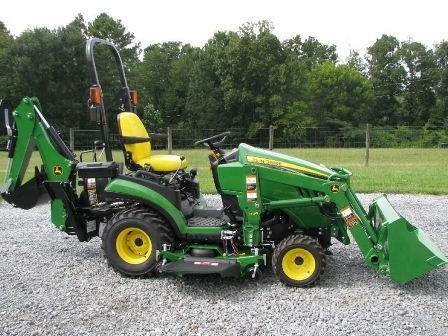
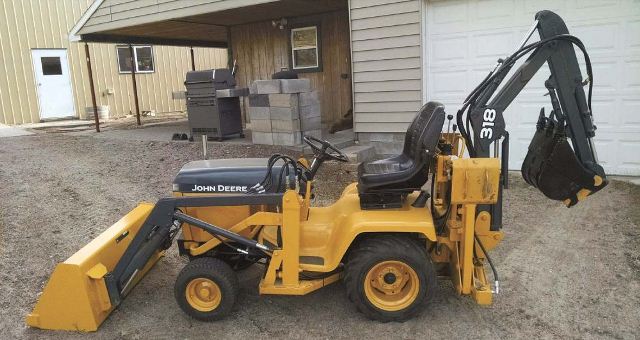
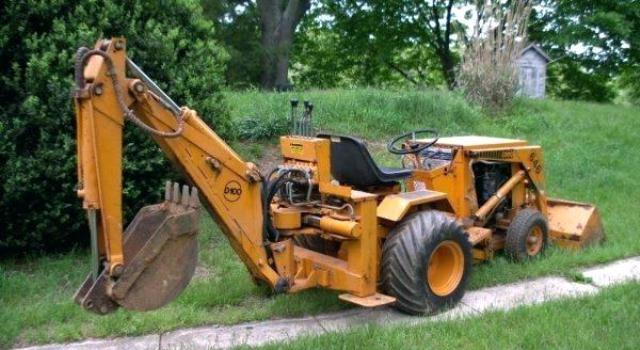
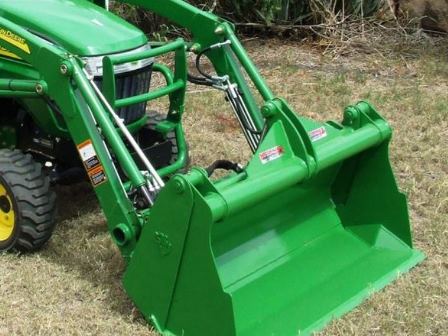
Lawn tractor backhoe – Garden Tractor Backhoe: The loaders and backhoes illustrated here are the perfect tools for the care and maintenance of your property and landscaping. Light and powerful, they are great for those hard to get at locations where a larger machine won’t fit and are able to travel over the lawn and landscaped areas with minimum ground compaction and surface damage.

Lawn tractor backhoe

Garden tractor front end loader

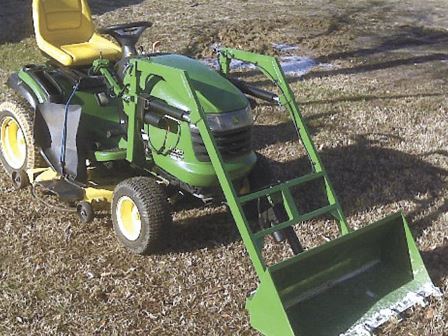
My favorite implement for a garden tractor is the front end loader. To those not familiar with garden tractors, a front end loader may seem more like a toy rather than a tool. The truth is garden tractors are fantastic platforms for small front end loaders.

This combination makes for a very capable, compact and inexpensive machine to help you manage your property chores. With a properly set up front end loader, your garden tractor can dig, lift, and carry materials up to 800 pounds in weight and up to 6 feet high. This makes it the perfect tool for the rural property owner, orchard business, equine and livestock farms.

Use a fleet of Garden Tractor Loaders to manage horse manure, compost, dirt, snow, mulch, and more. Their small size makes it so I can navigate small gated areas and aisles in between outbuildings and other obstacles. The lightweight of my machines (Under 2,000 pounds) allows me to drive my loader tractor anywhere on the property without fear of damaging lawns or pathways.

lawn tractor backhoe

Garden tractor front end loader kits

Front End Loader: Buy or Build

There were many manufacturers in the United States that made front end loaders for Garden Tractors from the 1950s through the 1990s. Some popular manufacturers were Johnson, Kwik Way, Danco, Ark among others.

You can still occasionally find these loaders on internet classifieds such as Craigslist and Facebook Marketplace.

The two most likely scenarios you will find are Loaders already attached to tractors, or loaders for a different garden tractor than you own. The options in these cases are to fabricate a custom way to attach the loader to your tractor. This process is not difficult but will require creativity and some fabrication skills.

garden tractor backhoe

Farm equipment repair

All garden tractors are capable of handling a front-end loader. All true garden tractors have engines, front axles, transmissions, and frames that are capable of withstanding the workload from a front-end loader. However, there are some characteristics that make some tractors better than others.

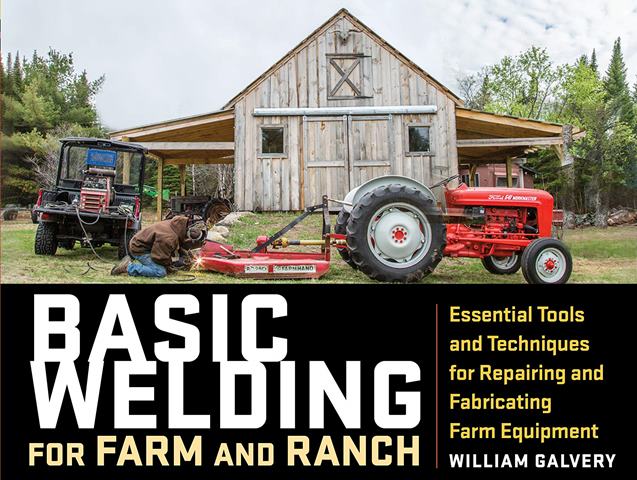
Farmers, ranchers, and homesteaders who know how to weld can repair and even fabricate some equipment on their own, saving both time and money.

Basic Welding for Farm and Ranch introduces this crucial skill and covers the most popular techniques used by the home hobbyist and DIY devotee, with chapters and detailed illustrations dedicated to oxyacetylene welding (or gas welding), stick welding, MIG, and arc welding, as well as brazing and soldering.

Repair and maintenance of farm machinery

Basic Welding for Farm and Ranch: Essential Tools and Techniques for Repairing and Fabricating Farm Equipment

Basic Farm and Ranch Welding Book

Farm equipment repair

Garden tractor attachments

Wheel Spindle

All garden tractors will have at least a ¾” spindle with a wheel supported by 2 ball bearings. This is adequate for a front end loader, but if you want to utilize the full power of your loader you will want to upgrade to a stronger 1” wheel spindle with tapered bearings. You can make your own by using a trailer spindle, hub and bearings.

Garden tractor frame

While all of the frames of garden tractors are strong enough to hold a front end loader, some designs are easier to work with than others.

John Deere and Cub Cadet both provide a lot of flat, square surface area that you can weld and drill into to create many mounting positions and options for you. Tractors such as Wheel Horse use angle iron frames and are close together. This can make it more difficult to mount components to.

The Ford LGT and Bolens tractors have tube frames, which can make it slightly more challenging to find mounting locations for the front end loader subframe.

Garden tractor transmission

First, let’s classify garden tractor transmissions into 3 interface types.

  • Foot Controlled Hydrostatic
  • Hand Controlled Hydrostatic
  • Mechanical Gear

Foot-controlled hydrostatic transmissions can be found on Bolens Large Frame and Ford LGT tractors. These allow you to have both of your hands available to manipulate the loader control valve and the steering wheel while driving. This is particularly useful when doing a lot of back and forth driving like when turning manure piles or moving piles of material from one location to another.

Hydrostatic transmission

Hand controlled hydrostatic transmissions can be found in most garden tractors. This is useful so if you are using the loader and steering, you can slow down and stop your tractor without using your hands.

Other tractors do not have return to neutral pedals. To stop these tractors you have to use one of your hands to return to neutral.

Mechanical gear transmissions are found in Wheel Horse, John Deere, Simplicity, Allis Chalmers, Cub Cadets, Sears, and many others.

In order to change directions with these transmissions, you must depress a clutch with your foot and then manually shift to a gear. When you release the clutch your tractor will move. With these transmissions, you can shift the transmission, and then use both your hands to operate the loader and drive while your foot works the clutch.

Operator Station

I would recommend using a “Full Size” garden tractor from the 1970s or later. With these machines, you can mount the Front End Loader and have plenty of room to climb on and off the machine, and be able to sit comfortably even with large work boots and big coats on. The larger “Super Garden Tractors” provide even more space for the operator.

To get the most out of your garden tractor front end loader you will need to consider the following:

  • Wheel Ballast
  • Rear Counter Ballast
  • Hydraulic Relief
  • Tire Tread
  • Steering Technique
  • Loader Technique
garden tractor backhoe

Tractor ballast

Tractor wheel ballast

Garden tractors are powerful machines. After you have mounted a front end loader you have a powerful and versatile tool at your disposal. In order to utilize the most power, you need to increase your tractor’s traction. The best way to do this is to add weight directly to the rear tires. You can do this by adding external wheel weights, filling the tires with a liquid ballast, or both.

External wheel weights have been available in Cast Iron, as well as Concrete filled plastic wheel weights. They come in 50# and 75# versions. You can also fabricate a special mount to use Olympic gym free weights.

Liquid ballast for tractor tires

Liquid ballast can be added to the inside of your tires using a small electric pump, 5 Gallon Bucket and a special valve stem tool that connects a water hose to your valve stem. Common liquids to act as ballast are: water, calcium chloride, RV antifreeze, and specialty fluids such as rim guard.

Water is the easiest and most readily available liquid. However, it freezes in cold climates.

Calcium chloride tractor tire ballast

Calcium Chloride is the densest liquid ballast and therefore can add the most weight. A drawback to using this is if air contacts the inside of the wheel through a leak in the tire, rust will form and over time will destroy your wheel.

RV Antifreeze is what I prefer to use. It adds the same weight as water, will not freeze, and will not damage your wheels. Specialty Fluids such as Rim Guard are available through tractor dealers. These fluids don’t freeze and are dense enough to add significant weight to your wheel. The drawback to using this is the cost and availability.

Rear ballast weight for tractor

To get the most lift out of your front end loader, you need to balance the weight of the tractor. You should put additional weight behind your rear axle and it should be equal to at least half of your load in the front end loader.

However, the more weight the better while remaining below your rear axle capacity. You can also extend the weight further from the axle to apply a mechanical advantage to the weight. This weight will help reduce the load on the front end of your tractor and make steering and maneuvering more manageable with a loaded bucket. I personally have 330 pounds on the rear of my primary tractor loader.

Hydraulic Relief Valve

The control valve on your front end loader has an adjustable pressure relief. This relief will dictate the maximum amount of weight you can lift with your front end loader. You should adjust your relief so you are never able to lift more than your tractor can handle. With that said, a properly equipped garden tractor can handle a substantial amount of weight in the front bucket. The maximum weight depends on many factors including any upgrades you make to your tractor. My machines are set up so I can comfortably load 500 pounds of material and still drive around.

Tractor tire tread patterns

Your garden tractor loader can drive into piles of material, dig into the ground, push out small stumps and much more. Tire tread and wheel slippage come into play when performing these tasks. Agricultural lug tires are a common choice for front end loaders but may not always be the best choice. Ag tires can provide great traction in many conditions but in some conditions, they can dig your tractor into a hole very quickly and get you stuck. Less aggressive tires with a wide tread like turf tires or multi-terrain tires can provide lots of traction however when the wheels spin they won’t dig you deep into a hole.

Steering Techniques

Regardless of your tractor has power or mechanical steering, you should always try to turn while you’re in motion and let the front tire tread aid in steering. For tractors with power steering, it will help prevent damage to your tie rods, and for mechanical steering, it may be the only way you can steer the tractor. Some tire treads such as tri-rib tires in the front can also help with steering.

Loader operating techniques

Remember to use your garden tractor loader with caution. Most garden tractors do not come equipped with rollover protection structures so good sense and an acute awareness of your surroundings are important. When transporting material in your bucket, carry the loader bucket low to the ground and avoid uneven terrain and drive slowly.

When getting material from a pile, it is best to approach the pile and lift your loader up and scrape down loose material, then bring your bucket back down to take a scoop.

When back-dragging an area, only curl your bucket forward enough to let your cutting edge contact the ground so most of the hydraulic ram is still inside the cylinder. This prevents bending and damaging the hydraulic rams.

Compact tractor attachments

Compact Tractors make easy work of big tasks, but did you know there are more than 600 implements and attachments available to make your tractor even more helpful around the house? The available and versatility of attachments make your Compact Tractor the ideal workhorse, but it can be tough to know how to prioritize amidst the choices available.

Here are the top 10 implements we recommend every property owner consider for their Compact Tractor:

  • Loader.
  • Rotary Cutter.
  • Grooming/Belly Mower.
  • Rear Blade.
  • Box Blade.
  • Post Hole Digger.
  • Land Plane.
  • Snowblower.
  • Broadcast Spreader.

How much does it cost to build garden backhoe?

how much does it cost to build one of these backhoes?

figure around $1800 complete for steel and all hydraulics, a little less if you can use your tractor’s onboard hydraulic system to power the unit. buying local steel should cost you close to $350 and the remaining cost would be in hydraulics and for having parts shipped in.

how much hydraulic flow (GPM) and PSI is required to run this backhoe?

The Micro backhoe can be run with as little as 3 Gallons Per Minute hydraulic flow and with as low as 750 – 1000 PSI in easy soils. for simultaneous cylinder movements like on the larger hoes using joystick valves, I suggest 4 to 6 Gallons Per Minute . for more difficult digging environments you can increase system pressure from 1000 to 1500 PSI at the relief valve(s).

do I need any special tools to build the Micro backhoe?

not really, I was able to build my prototype backhoe (above) with what I consider basic tools. for cutting steel, a Makita 10″ chop saw with a composite metal cutting blade and a Sawzall. drilling was done with a small benchtop drill press and bi-metal hole saws, a welder is a Lincoln SP-100T, 100 amp wire feed mig using .035″ flux core wire, running on a dedicated 20 amp household circuit. I would suggest having a bench grinder, disk grinder, assorted clamps, bench vise, etc. just the basic stuff for garage steel fabrication projects.

how many breaks out force does this backhoe have?

this depends on the bore diameter of your hydraulic cylinders and what you are running for system pressure, with the 2″ bore cylinders we spec running at 1000 PSI, you should be able to get 3000 lbs or better break out force, however to put this into “real world” digging terms you must take into consideration the weight of your tractor as a whole.

how long does it take to build one of these backhoes?

this would depend on your steel fabrication skills, however, an average mechanically inclined person with basic tools should be able to construct one of these backhoes in 4 to 6 weeks of spare time evenings and weekends. I’ve noticed that when you have one of these projects on the bench, you seem to suddenly find the more spare time than you thought you had! I have had some customers take less than a month to build the hoe, and some quite a bit more. my original Micro backhoe took me 5 months of spare time, but that was designing, searching for suppliers, working out conflicts, building, testing, etc, etc.

will this backhoe fit my tractor? how does it attach to my tractor?

the Micro backhoe can be mounted on any tractor (or other vehicles) capable of carrying an extra 350 lbs. our plans provide an example of a solid mount subframe cage that attaches to the rear of your tractor at 6 points, two upper mounts, two lower mounts and two arms that go under the rear axle and attach to forward points on the tractor frame. the backhoe then attaches to this subframe at 4 points with quick pins, two uppers and two lower.

The most read

Lawn Mower Front end Loader Kit

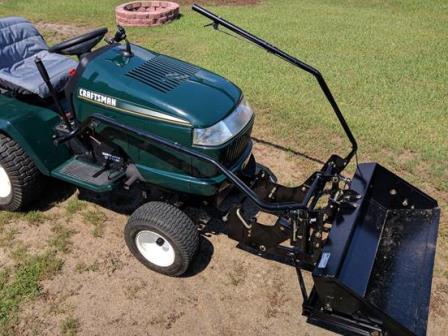
Whether you call it a bucket, a scoop, or a front loader, the solution for handling materials with a lawnmower is through a kit, which you must install in your equipment.

Front end Loader for Sale

Buying a front loader can be a big investment, so if you don’t need a front loader repeatedly for different types of jobs, renting may be the best way to go.

More on this story

Electric front end loader for garden tractor

Whether you call it a bucket, a scoop, or a front loader, the solution for handling materials with a lawnmower is through a kit, which you must install in your equipment.

Riding Lawn Mower with Backhoe Attachment

Whether you work in the construction or landscaping business or own a home with acreage, purchasing versatile equipment will increase productivity.

Garden Tractor Loader Kits for Sale

For those unfamiliar with garden tractors, a front loader doesn’t seem like a useful tool. The truth is that garden tractors can be fitted with a front loader kit.

Backhoe Loader Specifications

The engineers of each of the manufacturers of backhoes design their vehicles to minimize operator fatigue and allow greater productivity. View and compare Backhoe loader specifications from top manufacturers. Compare size, weight and detailed specifications of Backhoes loader.

The spacious and comfortable cabins are the norm in the backhoe excavator market and the ergonomically designed controls are designed to be easily accessible to an operator.

Backhoe operator

Manufacturers have experienced strong sales of their various models of construction equipment, including a line of backhoes.

An emphasis on operator’s ease of use

Its engineers have also worked to optimize the comfort and ease of a backhoe operator. “We always try to keep a low bonnet line and clean site lines for work attachments for the best possible visibility.”

“Camera options are becoming more popular, whether they are used to do reverse work, to help detect the hazard, or forward-facing to help the fork work with pallets.”

Backhoe Cab

The ergonomics inside the cab is designed to ensure that the operator of the backhoe has everything he needs within arm’s reach, and can perform all tasks with minimal effort.

The auto-controls of excavators in the machines have grown in popularity throughout the years since they reduce the stress in the operator. “Other developments are the inclusion of forwarding, neutral and reverse switches on the charger lever to make the charging cycle faster and easier.”

“The steering column is adjustable for both reach and rake to ensure the operator can achieve their perfect driving position for maximum comfort while at work.”

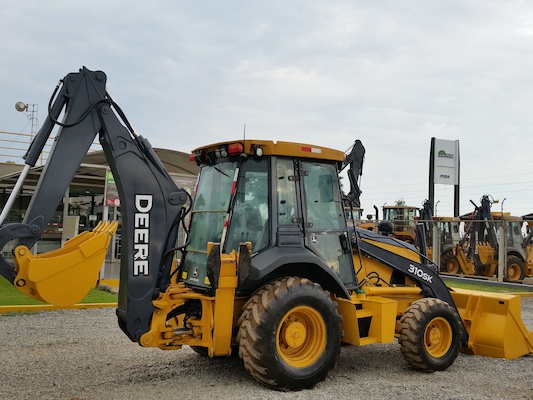
Deere Backhoe loader specifications

In recent years, backhoes, like other large and small excavators, have evolved to the point where the controls on their excavator joystick are soft, easy to use and provide an excellent feeling to the hydraulic system.

“Starting with our 310SL HL” from John Deere”. We introduced the control handle of the loader with the palm on top so that additional features could be handled with a single control while maintaining the operators’ line in front of them.

It has a 4-in-1 bucket with a thumb roller control, which means it has an easy-to-operate front loader cover until it opens or closes. ” It also proudly points out John Deere’s momentary four-wheel drive control, which allows the operator to use a button to effortlessly push the backhoe in and out of a four-wheel drive or mechanical front-wheel drive in control. of the front wheel.

In addition, the 410SL HL is equipped with a clutch disconnect that can pause the transmission momentarily, a useful feature in truck loading or storage applications or in storage.

Backhoe design

“We’ve always tried to get a deep understanding of what customers need and what their various applications are.”

“We take that information and use it to develop new ways to provide our backhoe customers with greater versatility, productivity and, above all, reliability. We realize that time is critical for our construction clients at a job site, regardless of the project. “

CASE Backhoe loader specifications

To update their machines and handle a wide variety of applications and special uses, backhoes are always changing their machines to improve their productivity.

Special machines for special uses

“Recently, we have introduced several improvements to our line of N-series backhoes, improvements to the cab and powertrain, as well as electrical and hydraulic systems, which make these already versatile machines even more robust and productive”, He explained in a recent press release.

Several features that were previously additional have become standard on Case machines, such as their fuel savings package. It includes ECO mode switches for the loader and backhoe functions, allowing for greater fuel savings, optimal power, and increased performance.

Backhoe models

The N series backhoe loaders now have a completely new hydraulic system for optimum precision and smoothness, giving the operator more control in applications where accuracy is critical.

Backhoes can be configured in many ways to adapt to specialized applications.

Options such as sirens / public address systems, high visibility paint, strobe lights, LED light bars, remote spotlights, and advanced lighting packages improve visibility and efficiency in most situations. He also says that many railway contractors use specially equipped backhoes in their operations.

Access to work areas is a major challenge in the industry and it is critical to have a tool carrier that serves as a platform for numerous applications.

Backhoe in construction

In addition, they are used to help place, move and change railroad tracks. “In rail applications, backhoes are often equipped with a bucket to move ballast, dirt and other materials, and a set of long forks to move packages of railroad ties and other supplies.”

“Some backhoes can be equipped with universal couplers that allow the machine to handle accessories from other original equipment manufacturers.”

Construction machines

The new extendable option of Case in the N series of backhoes allows them to move further away from the base of the machine, allowing more work to be done without moving the vehicle.

In addition, it improves access at sites where the base of the backhoe can not get too close to the tracks.

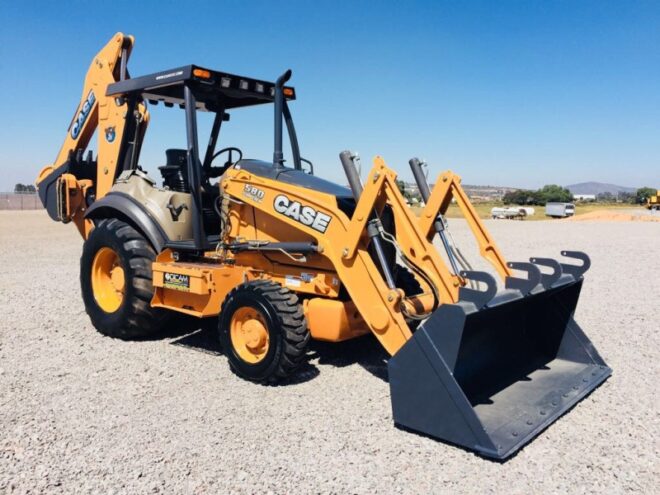
The Case 580 Super N, for example, achieves more than 3 feet of additional range with the function. Contractors and operators always want to see more scope from their backhoes or bulldozers, whatever the use, but that often causes other problems.

The engineers of each manufacturer have been busy over the years in the search for solutions to these problems, which has greatly improved the capacity of the backhoe.

“The challenge of improving the reach is that it could reach a compromise for stability.”

“To improve the stability of the machine, would require a mass increase, either a larger excavator or the addition of counterweights, could result in a machine that exceeds 10 tons.”

Backhoe loader attachments

Hydraulic breakers, thumb kits, compaction wheels, and quick couplers are among the attachments designed to extend the uses of your backhoe. Here are some recent product releases geared toward backhoes for breaking, grabbing, backfilling and quickly changing attachments:

Extendahoe backhoe thumb

Thumb kit made for Extendahoe

They are available for backhoes with or without a quick coupler. Customers can choose between manual or hydraulic versions. They are made of T1 and AR400 steel has a new main long pin for mounting and see-through plating between the tines. They come with the jump hoses needed for the stick’s hydraulic fittings. They are designed to clear the boom and stick at all points and mesh with the teeth on a stock Cat 24-inch bucket.

Backhoe breaker

Converting recoil to reusable energy

Epiroc designed its RX hydraulic breakers to convert recoil energy to reusable energy to deliver more power with the same amount of hydraulic input. The breakers’ box guiding system also minimizes recoil forces to put less strain on the carrier, operator and breaker. They are compatible not only with backhoes but with skid steers and excavators and can be used for demolition, landscaping, building renovation, road construction, rock excavation, and quarrying.

Backhoe compaction wheel

Compaction while backfilling trenches

Compaction Wheels are designed to compact the soil when backfilling trenches. They come in a variety of widths and feature tapered roller bearings. A tampered-foot design with static pad rollers provides smooth operation and a high degree of compaction. The open rim allows the wheel to penetrate the trench fill and compact the soil from the bottom up. The compaction wheels are available for all backhoe loaders.

Backhoe bucket

Quickly switch buckets

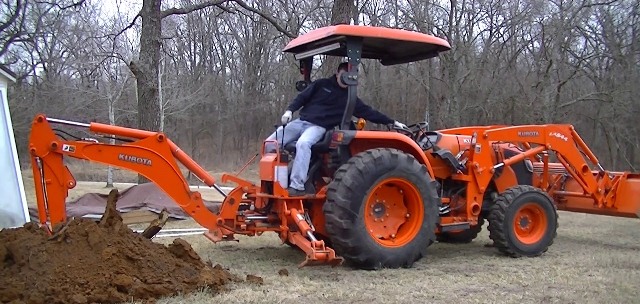
Kubota’s Quick Coupler is designed for fast bucket changes for the company’s tractor-loader-backhoe. The coupler is also compatible with select Kubota compact excavator buckets, tilt buckets, grading buckets, trenching buckets, grading blades, cemetery buckets, frost rippers and excavating rakes.

Backhoe hammer

Low recoil, few moving parts

Case Construction Equipment’s hydraulic hammers have only two moving parts and isolate every blow from the operator and carrier. The hammers are pre-assembled and made for Case backhoes, excavators, compact tractor loaders and skid steers.

The blows are isolated in the cushion chamber, and recoil energy is recycled and used for the next blow. The long-stoke piston facilitates energy transfer and recoil reduction. Case hydraulic hammers come with a gas recharge kit and a three-year warranty.

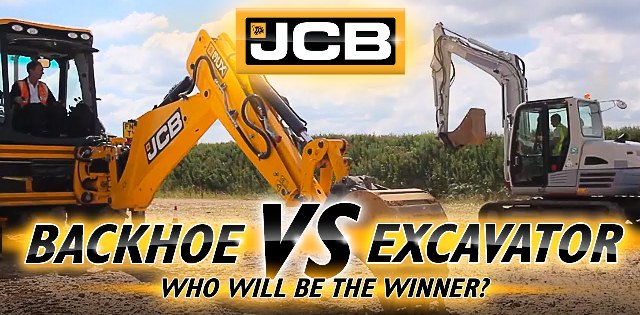
Backhoe vs Excavator

Which Machine Is Best for Your Project?

Though it’s sometimes difficult to tell a backhoe and an excavator apart, they differ in three main ways: size, versatility, and rotation. These factors make each machine suited for different jobs, so it’s important to choose the right one for your project.

Backhoe Sizes

The main difference between the two machines is size — excavators are larger and heavier, while backhoes are slightly smaller. The excavator is typically a better fit for demolition projects, mining, driving piles, drilling shafts for rock blasting, and overall large-scale industrial projects. The backhoe, as the smaller and more adaptable of the two, is better for farming, snow removal, loading jobs, and medium-scale construction and excavation projects.

Multi purpose machine

The backhoe and excavator are also very different in terms of versatility. Though both machines offer a number of attachment options, the backhoe has a much greater selection and is therefore capable of a wider variety of tasks. Backhoes can also be driven on roads, which makes them the better choice for projects with spread out worksites.

Difference between backhoe and excavator controls

Finally, backhoes and excavators have different rotation ranges which make them very different machines from an operator’s standpoint. An excavator operator can rotate the entire machine’s chassis and arm together in a complete circle, while a backhoe’s arm only pivots across a range of about 200 degrees.

Backhoe bucket attachments

Several factors can help excavator operators improve their productivity during everyday construction tasks, but the single biggest contributing factor typically circles back to choosing the proper excavator bucket for the application.

There can be a tendency for some excavator operators to gravitate toward using a standard bucket in all applications. However, this approach may negatively impact the operator’s productivity. For example, using a standard bucket rather than a trenching bucket in trenching or deep digging applications may result in decreased efficiency.

Prior to selecting a bucket, it is important for operators to consider the application the bucket will be used in, the density of the heaviest material, the accessories that can be used and the coupling systems for easy attachment changes. Operators should also check that the bucket chosen does not exceed the machine’s operating capacity.

Backhoe bucket Sizes

Choose a bucket type with soil conditions in mind

There are two primary bucket types for contractors to choose from heavy-duty buckets and severe-duty buckets.

Heavy-duty buckets are the most common excavator bucket type because they work well in a variety of soil conditions, such as clay, gravel, sand, silt, and shale. The buckets are manufactured with high-quality, abrasion-resistant material, durable side cutters for extra strength and protection and bottom wear pads.

Severe-duty buckets are best suited for excavator operators who are handling abrasive materials in heavy or severe digging and truck-loading applications.

The buckets are manufactured with abrasion-resistant material for added protection and strength when digging in loose rock or pit and quarry operations. The buckets’ side cutters, shell bottoms, side wear plates, and weld-on wear shrouds all consist of abrasion-resistant material. In addition, reinforced gussets help strengthen the machine-fitting joints on the buckets to promote uptime.

How much is a used backhoe?

How much is a used backhoe?

The price of used backhoe loaders is also influenced by the age and condition of the machine, the brand, and the hours of use. A five-year-old Case 580m with less than 1,000 hours, 14 feet or more of dig depth and 60 to 90 horsepower might run $60,000 to $70,000.

How much does a new farm tractor cost?

New Tractor Average Costs: A bare-bones compact tractor might sell for less than $10,000, while the largest and most powerful farming models could go for as much as several hundred thousand dollars. Most tractors fall somewhere in between. Mid-size tractors with 30 to 75 hp usually cost anywhere from $25,000 to $50,000.

What is the difference between backhoe and excavator?

The backhoes are much smaller than the excavators and are a standard tractor that supports an arm that consists of two segments, the bucket and the boom. The boom supports even more the bucket, which holds the bucket. Knowing the differences between an excavator and a backhoe will allow you to choose the right equipment for your project.

What is a backhoe excavator?

A backhoe (also called rear actor or back actor) is a type of excavating equipment, or digger, consisting of a digging bucket on the end of a two-part articulated arm.

What is the purpose of a backhoe?

Backhoe loaders are very common and can be used for a wide variety of tasks: construction, small demolitions, light transportation of building materials, powering building equipment, digging holes/excavation, landscaping, breaking asphalt, and paving roads.

How many hours will a backhoe last?

Construction Equipment’s 2005 Lifecycle Study found, for example, that 20 percent of engines in 14- to 15-foot backhoe-loaders required major repair or replacement before 6,000 hours. The lower end of the typical range for engine life in 30- to 40-ton articulated dump trucks was 9,000 hours.

Which is the best backhoe loader?

Our list of the best backhoe loaders:
-JCB 1CXT backhoe loader.
-Caterpillar 434E backhoe loader.
-JCB 3CX 70th Anniversary backhoe loader.
-New Holland LB90B backhoe loader.
-JCB 4CN backhoe loader.

The most read

Excavator Bucket Sizes

Excavators and backhoes are designed for rapid earth moving and are not designed for lifting operations as their principal function.

More on this story

Backhoe Bucket Sizes

Buckets for backhoe loaders match the machine to the job. Whether quarry, construction site, or landscaping job, they focus the full power and performance of the machine on the task at hand.